
- 8017 Labana Ct, Canton Township, MI 48187
- +1 (734) 418 2537
- info@a2zbillings.com

A patient mentions a neck skin tag that keeps catching on a necklace. The provider removes it in the same visit. Two codes now decide whether that claim gets paid: the diagnosis code and the procedure code. Get either one wrong, and the payer sends the claim back. This guide walks through the skin tag ICD-10 code, the site-specific alternatives coders reach for less often, and the CPT codes billers pair with them.
Clinically, a skin tag is an acrochordon: a small, soft, usually pedunculated growth made of loose collagen fibers and skin. Pathologists also call it a fibroepithelial polyp or, less commonly, a soft fibroma. All three terms describe the same benign growth, and coders will see each of them in provider notes depending on which specialty documented the visit. Skin tags form most often in areas where skin rubs against skin or clothing: the neck, armpits, groin, eyelids, and under the breasts. They are not warts, moles, or cysts, and mixing them up on a claim is one of the more common causes of denial.
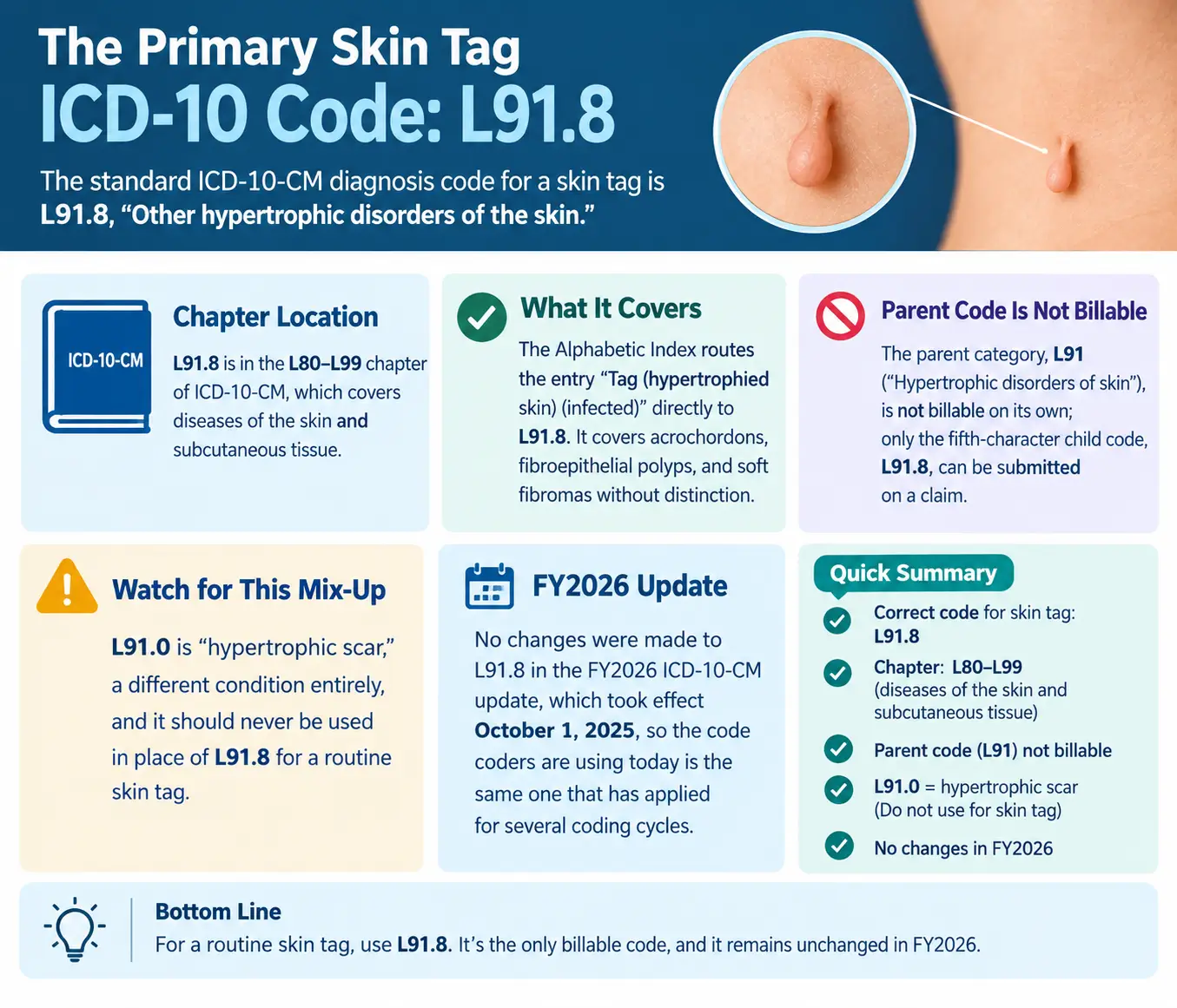
The standard ICD-10-CM diagnosis code for a skin tag is L91.8, “Other hypertrophic disorders of the skin.” It sits in the L80-L99 chapter of ICD-10-CM, which covers diseases of the skin and subcutaneous tissue. The ICD-10-CM Alphabetic Index routes the entry “Tag (hypertrophied skin) (infected)” directly to this code, and it covers acrochordons, fibroepithelial polyps, and soft fibromas without distinction. The parent category, L91 (“Hypertrophic disorders of skin”), is not billable on its own; only the fifth-character child code, L91.8, can be submitted on a claim.
One mix-up worth flagging early: L91.0 is “hypertrophic scar,” a different condition entirely, and it should never be used in place of L91.8 for a routine skin tag. No changes were made to L91.8 in the FY2026 ICD-10-CM update, which took effect October 1, 2025, so the code coders are using today is the same one that has applied for several coding cycles.
L91.8 is the default, but it is a general code, and several more specific situations call for something else. Payers increasingly expect the most specific code the documentation supports, not the catch-all.
Code | Description | When it applies |
L91.8 | Other hypertrophic disorders of the skin | Default code for a symptomatic or routine skin tag with no more specific documentation |
K64.4 | Residual hemorrhoidal skin tags | Anal or perianal tags tied to prior hemorrhoidal disease |
D23.9 | Benign neoplasm of skin, unspecified | A pathology report confirms the excised tissue as a fibroepithelial polyp or benign neoplasm |
Z41.1 | Encounter for cosmetic procedure | Removal is elective, with no documented symptoms or functional complaints. |
Q82.8 | Other specified congenital malformations of skin | The tag has been present since birth rather than acquired later |
Eyelid tags cause their own confusion, since they sit close to codes for eyelid disorders (the H02 category). Unless the documentation supports a distinct eyelid condition, L91.8 remains the correct diagnosis code even for a periocular tag, with the CPT code and modifier doing the work of specifying location.
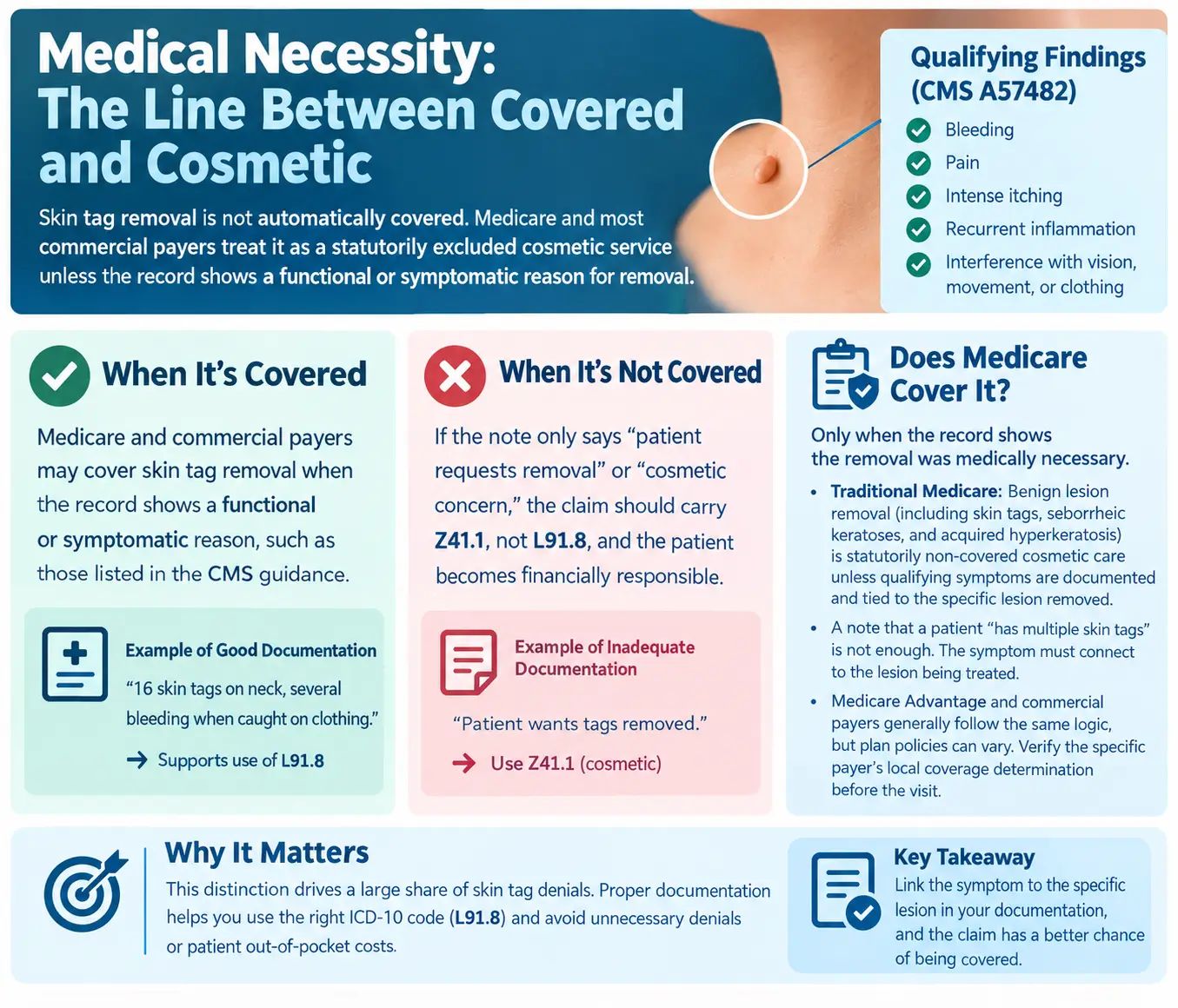
Skin tag removal is not automatically covered. Medicare and most commercial payers treat it as a statutorily excluded cosmetic service unless the record shows a functional or symptomatic reason for removal. A CMS local coverage article on the removal of benign skin lesions (document A57482) lists the qualifying findings: bleeding, pain, intense itching, recurrent inflammation, or interference with vision, movement, or clothing. If the note only says “patient requests removal” or “cosmetic concern,” the claim should carry Z41.1, not L91.8, and the patient becomes financially responsible.
This distinction drives a large share of skin tag denials. A provider who documents “16 skin tags on neck, several bleeding when caught on clothing” gives the coder everything needed to support L91.8. A provider who writes “patient wants tags removed” has documented a self-pay procedure, no matter how the tags look.
Only when the record shows the removal was medically necessary. Traditional Medicare’s coverage policy treats benign lesion removal, including skin tags, seborrheic keratoses, and acquired hyperkeratosis, as statutorily non-covered cosmetic care unless one of the qualifying symptoms above is documented and tied to the specific lesion removed. A blanket statement that a patient “has multiple skin tags” is not enough on its own; the note needs to connect the symptom to the lesion being treated. Medicare Advantage and commercial payers generally follow the same logic, though individual plan policies can vary, so verifying a specific payer’s local coverage determination before the visit is worth the extra step for practices that see this procedure often.
Once medical necessity is established, the removal itself is billed under two integumentary system codes, and they are counted by lesion, not by technique.
Both codes are method-agnostic. Whether the provider uses scissor excision, ligature strangulation, electrosurgery, or a chemical or cryotherapy technique, the same two codes apply. That single detail resolves several of the secondary questions coders ask, including whether cryotherapy of a skin tag gets its own code (it does not).
Because 11201 covers “each additional 10, or part thereof,” a partial group still counts as a full unit. A provider who removes 18 tags bills 11200 plus one unit of 11201 (the 3 tags past the first 15 count as part of the next group of 10). A provider who removes 28 tags bills 11200 plus two units of 11201, since the remaining 13 tags span two partial groups. This “part thereof” language is where new billers most often undercount, reporting one unit of 11201 when two are supported by the documentation.
CPT 17110 is a frequent point of confusion for exactly the wrong reason: its own descriptor excludes skin tags by name. The full code reads: “Destruction (eg, laser surgery, electrosurgery, cryosurgery, chemosurgery, surgical curettement), of benign lesions other than skin tags or cutaneous vascular proliferative lesions; up to 14 lesions.” It is the correct code for destroying warts, molluscum contagiosum, or seborrheic keratoses, not skin tags. If a provider treats warts and skin tags in the same visit, each procedure family needs its own code, generally 17110 for the warts and 11200 (with 11201 as needed) for the tags, and a modifier may be required to show the payer they were distinct services. Reporting a skin tag under 17110 because the practice is more familiar with that code is a documented cause of clinical-coding mismatch denials.
A defensible skin tag removal claim generally includes:
Most skin tag denials trace back to a handful of recurring errors rather than anything exotic: billing L91.8 on a claim the note clearly describes as cosmetic, reporting 11201 without 11200 on the same claim line, undercounting lesions when the total crosses a group-of-10 threshold, or defaulting to 17110 out of habit when the lesion is, in fact, a skin tag. None of these require new knowledge to avoid. They require reading the note for the lesion count and the stated reason for removal before a code gets selected, and matching what’s documented rather than what’s typical for the visit type.
For a biller working through a stack of dermatology or primary care claims, the two questions worth asking on every skin tag encounter are the same every time: how many tags, and why were they removed. The answers determine the ICD-10 code, the CPT units, and, ultimately, whether the claim gets paid on the first pass.