


A bone density study is one of the more predictable radiology claims a practice submits, and also one of the easiest to get wrong. The procedure itself rarely changes. The coding rules around it do. Choosing the correct DEXA scan CPT code, pairing it with a diagnosis Medicare recognizes, and applying the right component modifier is what decides whether a claim pays on the first pass or lands in the denial queue.
The volume behind these claims is not small. The US Preventive Services Task Force reported in its 2025 recommendation, published in JAMA, that the age-adjusted prevalence of osteoporosis is 12.6% among community-dwelling US residents age 50 and older, and 27.1% among women 65 and older. Nearly all of that screening runs on dual-energy X-ray absorptiometry, and every scan needs a code.
This guide covers the four codes billers actually use, the bundling edits that catch newer coders, the modifier questions that come up in split billing, the Medicare coverage rules, and what changed for 2026.
The four DEXA scan CPT codes and what each one covers
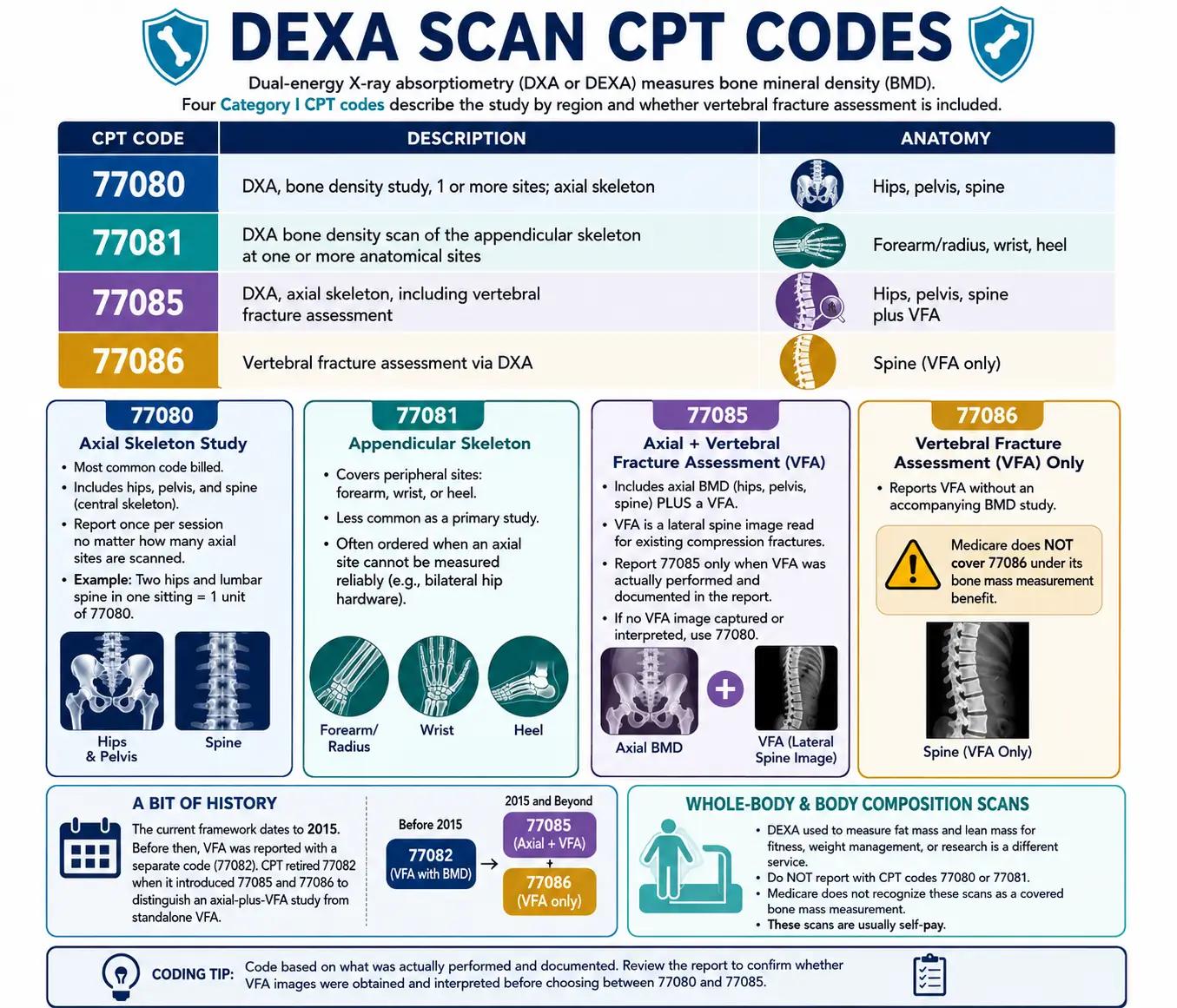
Dual-energy X-ray absorptiometry (DXA, also written DEXA) measures bone mineral density (BMD). Four Category I CPT codes describe the study, separated by the region of the skeleton examined and by whether a vertebral fracture assessment is included.
CPT code | Description | Anatomy |
77080 | DXA, bone density study, 1 or more sites; axial skeleton | Hips, pelvis, spine |
77081 | DXA bone density scan of the appendicular skeleton at one or more anatomical sites | Forearm/radius, wrist, heel |
77085 | DXA, axial skeleton, including vertebral fracture assessment | Hips, pelvis, spine plus VFA |
77086 | Vertebral fracture assessment via DXA | Spine (VFA only) |
77080 is the code most practices bill. It reports an axial study, meaning the central skeleton: hips, pelvis, and spine. Report it once per session no matter how many axial sites the technologist scans. Two hips and the lumbar spine in one sitting is still a single 77080.
77081 covers the appendicular (peripheral) skeleton, so the forearm, wrist, or heel. These scans are less common as a primary study. They tend to be ordered when an axial site cannot be measured reliably, for instance in a patient with bilateral hip hardware.
77085 is the axial study plus a vertebral fracture assessment (VFA) performed in the same session. VFA is a lateral spine image read for existing compression fractures. Report 77085 only when the VFA was actually performed and documented in the report. If the technologist scanned the hip and spine but captured or interpreted no VFA image, the correct code is 77080, not 77085.
77086 reports VFA on its own, without an accompanying BMD study. One point trips people up here: Medicare does not cover 77086 under its bone mass measurement benefit, which CMS states directly in its preventive services material.
The current framework dates to 2015. Before then, VFA was reported with a separate code (77082), which CPT retired when it introduced 77085 and 77086 to distinguish an axial-plus-VFA study from standalone VFA. Coders working from old payer policies or an outdated cheat sheet still occasionally submit the deleted code.
A word on whole-body and body composition scans, since the question comes up often. A DEXA used to measure fat mass and lean mass for fitness, weight management, or research is a different service. It should not be reported with CPT codes 77080 or 77081, and Medicare does not recognize it as a covered bone mass measurement. Those scans are usually self-pay.
Can CPT 77080 and 77081 be billed together?
This is the most common pairing question, and the answer is: rarely, and only with documentation.
77080 (axial) and 77081 (appendicular) describe different anatomy, so they are not automatically mutually exclusive the way the VFA codes are. A claim for both can be legitimate when a patient has an axial study plus a peripheral study performed for a specific clinical reason (hip hardware that blocks a reliable femoral neck reading is the textbook example). Many payers restrict same-day billing of the two and will expect a modifier plus a note explaining why both were medically necessary.
The hard bundling rules apply to the VFA codes. CMS clearly instructs providers not to report CPT 77080 with 77085 or 77086. Likewise, CPT 77085 should not be billed with 77080 or 77086, and CPT 77086 should not be reported with 77080 or 77085. Since CPT 77085 already includes the axial DXA study, submitting CPT 77080 separately would result in duplicate billing for the same service. These edits are enforced through the National Correct Coding Initiative (NCCI).
Getting this wrong does more than underpay the claim. A repeated 77080-plus-77085 submission is a recognizable audit pattern, so the error compounds over time rather than staying contained to a single line.
Professional and technical components: modifiers 26 and TC
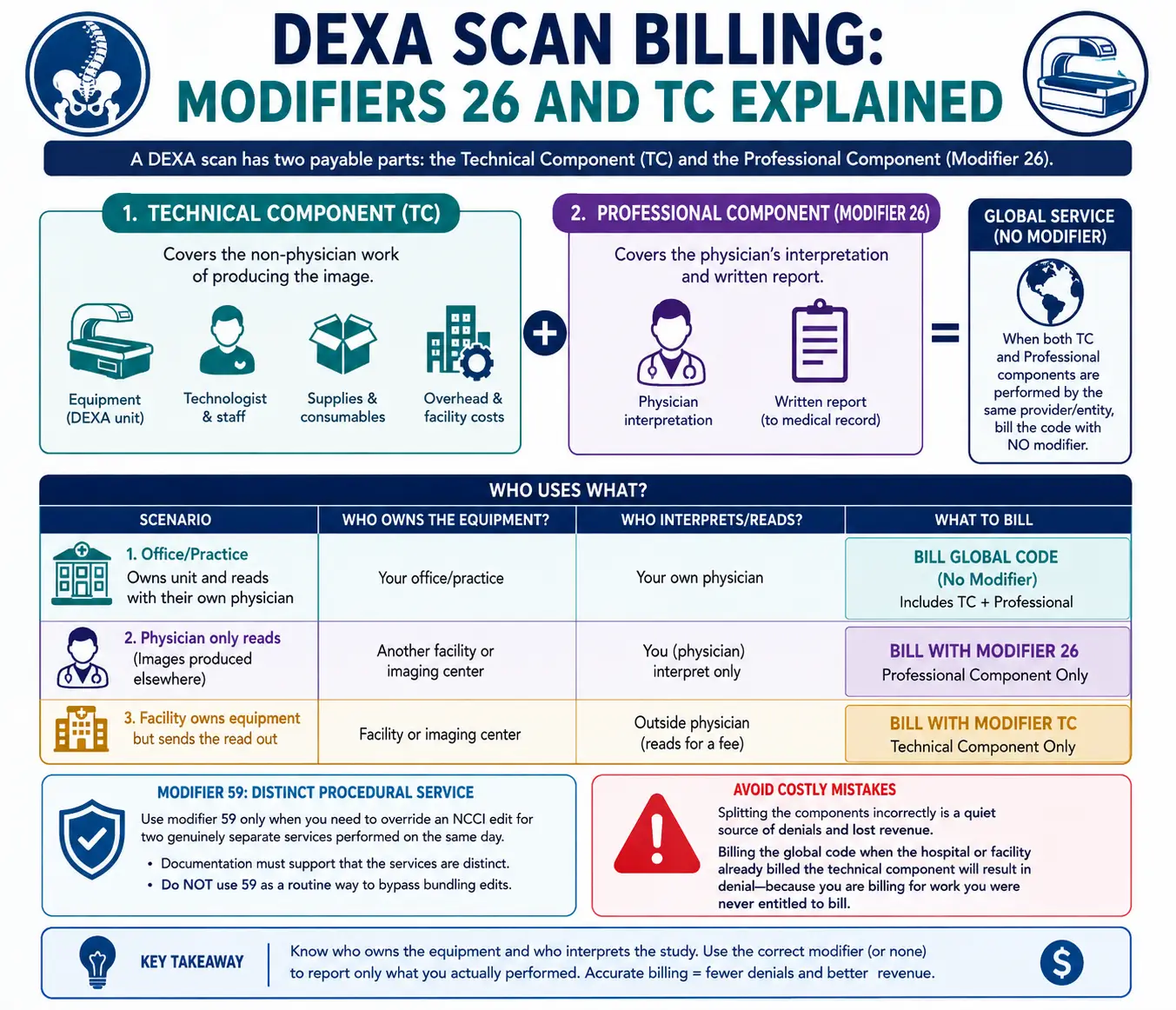
A DEXA scan has two payable parts. The technical component (TC) covers the equipment, the technologist, the supplies, and the overhead of producing the image. The professional component (modifier 26) covers the physician’s interpretation and written report. Billed together with no modifier, the code represents the global service, meaning both parts.
Which modifier applies depends on who owns what:
- An office that owns the DEXA unit and reads the study with its own physician bills the global code (no modifier).
- A physician who only interprets images produced elsewhere bills the code with modifier 26.
- A facility or imaging center that owns the equipment but sends the read out bills the code with modifier TC.
Modifier 59 (distinct procedural service) shows up in DEXA billing when a coder needs to override an NCCI edit for two genuinely separate services performed the same day. Use it only when the documentation supports a distinct service, not as a reflex to push a bundled pair through the edit.
Splitting the components incorrectly is a quiet source of lost revenue. Billing the global code when the hospital already claimed the technical component gets the physician’s claim denied for work they were never entitled to bill.
Medicare coverage and medical necessity under NCD 150.3
Medicare does not pay for a DEXA scan simply because a patient requests one. Coverage runs through National Coverage Determination 150.3, effective January 1, 2007, which defines who qualifies and how often.
On frequency: Medicare covers a bone mass measurement once every 24 months for a qualified beneficiary. It will pay for a scan sooner when doing so is medically necessary, for example to monitor a patient on long-term glucocorticoid therapy or to track response to osteoporosis treatment.
NCD 150.3 recognizes five categories of qualified individuals:
- Women who are estrogen-deficient and at clinical risk for osteoporosis
- Individuals with vertebral abnormalities demonstrated on an X-ray
- Individuals on long-term glucocorticoid (steroid) therapy
- Individuals with primary hyperparathyroidism
- Individuals being monitored to assess response to an FDA-approved osteoporosis drug therapy
For patients who meet the criteria, the bone mass measurement is a preventive benefit. CMS preventive services guidance notes the beneficiary pays nothing when the provider accepts assignment. That zero-cost detail is worth knowing at the front desk, because patients frequently assume a scan carries a copay and question the appointment when they hear “imaging.”
One structural quirk catches even experienced billers. The coverage criteria live in the NCD and the Medicare Benefit Policy Manual, but the actual list of payable ICD-10 codes lives in a separate CMS spreadsheet updated on a quarterly maintenance cycle. An NCD that reads “covered” does not guarantee a specific diagnosis code sits on the current list.
Diagnosis codes that support a DEXA claim
A DEXA claim submitted without a valid, covered ICD-10-CM code is returned as incomplete, a requirement CMS ties to Section 1833(e) of the Social Security Act. The diagnosis, not the procedure code, is what tells the payer whether the scan is a covered screening or a covered monitoring study.
Codes that commonly support a bone density claim:
- Z13.820, encounter for screening for osteoporosis. This is the screening code for an asymptomatic patient who meets a risk criterion, such as an estrogen-deficient postmenopausal woman.
- Z79.52, long-term (current) use of systemic steroids, for the glucocorticoid pathway.
- E21.0, primary hyperparathyroidism.
- E28.310, symptomatic premature menopause (with E28.319 for the asymptomatic form).
- M81.0, age-related osteoporosis without current pathological fracture, plus other codes in the M80 to M82 range for patients already diagnosed.
- The M85.8- subcategory for osteopenia. CMS added these codes after Change Request 9252 initially omitted osteopenia from the covered list.
The screening-versus-monitoring distinction is the piece coders miss most. A first-time screen on a qualifying patient uses Z13.820. A follow-up scan on a patient already being treated for osteoporosis is a monitoring study and takes a diagnosis code that reflects the established condition. Submitting a screening code for a monitoring visit, or the reverse, is a frequent and entirely avoidable denial.
What changed for the DEXA scan CPT code set in 2026
The four procedure codes carry into 2026 unchanged. Payment did move.
CMS set two conversion factors for 2026 in its final Physician Fee Schedule rule: $33.4009 for clinicians who are not qualifying participants in an advanced alternative payment model (a 3.26% increase over 2025), and $33.5675 for APM qualifying participants (a 3.77% increase). The Medicare Economic Index rose 2.7% for the year.
That headline increase does not translate cleanly into higher DEXA payments. CMS also finalized a negative 2.5% efficiency adjustment applied to most services, diagnostic imaging included, which offsets part of the conversion-factor gain. The amount a practice actually collects for 77080 depends on the code’s relative value units, the 2026 conversion factor, and the geographic practice cost indices for its locality, so the number varies by region and by whether the claim is global, professional, or technical. The dependable approach is to pull the current rate from the Medicare Physician Fee Schedule lookup or the local Medicare Administrative Contractor rather than reusing last year’s figure.
Common denials and how to prevent them
Most DEXA denials trace to a short list of errors:
- Diagnosis mismatch. The leading cause. The procedure code is right but the ICD-10 code is not on the current covered list, or a screening code was used for a monitoring visit.
- Frequency. A second axial scan inside the 24-month window without documentation of medical necessity for the early repeat.
- Bundling. 77080 billed alongside 77085, or the retired VFA code carried over from an old policy.
- Component errors. Global billing where the facility already claimed the technical component.
Prevention is unglamorous and reliable: confirm the ordering diagnosis against the current CMS covered-code spreadsheet before the scan, check the date of the patient’s last bone density study against the 24-month rule, and verify who owns the equipment before deciding on a modifier.
Conclusion
The DEXA scan CPT code you bill is set by anatomy and by whether a vertebral fracture assessment was performed: 77080 for the axial skeleton, 77081 for the appendicular skeleton, 77085 for an axial study with VFA, and 77086 for VFA alone, which Medicare does not cover. The VFA codes never combine with 77080. Modifiers 26 and TC split the interpretation from the technical work. Medicare coverage flows through NCD 150.3, which limits scans to five qualifying groups and to once every 24 months absent documented medical necessity, and the diagnosis code (Z13.820 for screening, condition-specific codes for monitoring) determines whether the claim pays. For 2026 the codes are stable but the payment math shifted, so verify the current rate against the fee schedule rather than a prior-year number.