


There is no single metastatic breast cancer ICD-10 code. That surprises a lot of new coders, because most diagnoses map to one clean alphanumeric string. Metastatic breast cancer doesn’t work that way. ICD-10-CM requires at least two codes working together: one for the original tumor in the breast, and at least one more for every place the cancer has spread. Get the pairing wrong, or sequence it backwards, and the claim can be denied or the chart can misrepresent how sick the patient actually is.
This guide walks through the codes coders actually use for breast cancer with metastasis, how the American Cancer Society and CMS guidelines shape sequencing decisions, and the mistakes that turn up most often in chart audits.
How ICD-10-CM splits metastatic breast cancer into two codes
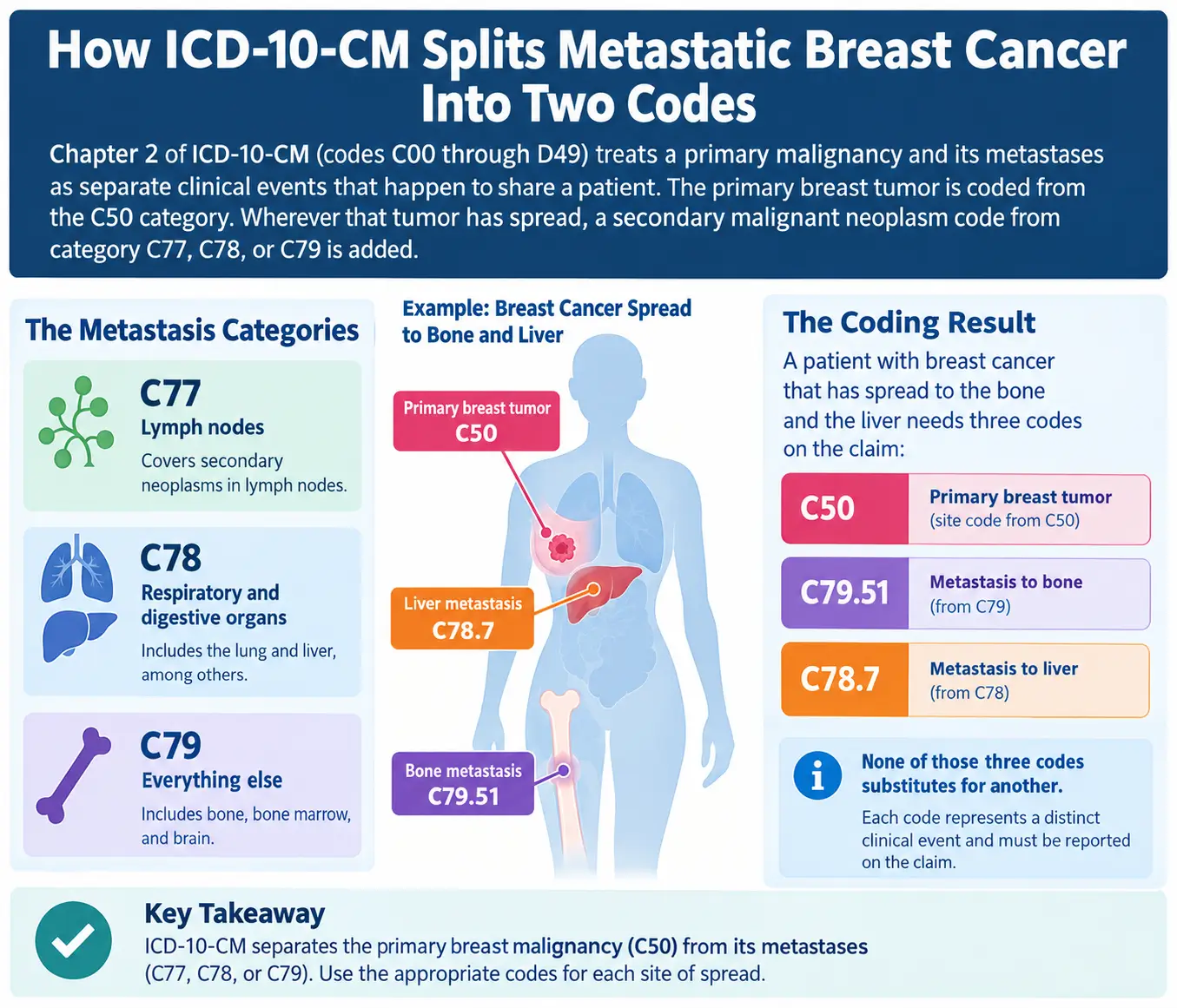
Chapter 2 of ICD-10-CM (codes C00 through D49) treats a primary malignancy and its metastases as separate clinical events that happen to share a patient. The primary breast tumor is coded from the C50 category. Wherever that tumor has spread, a secondary malignant neoplasm code from category C77, C78, or C79 is added.
C77 covers lymph nodes. C78 covers secondary neoplasms of respiratory and digestive organs, including the lung and liver. C79 is the catch-all for everything else, including bone, bone marrow, and brain. A patient with breast cancer that has spread to the bone and the liver needs three codes on the claim: the C50 primary site code, C79.51 for the bone, and C78.7 for the liver. None of those three codes substitutes for another.
Coding the primary tumor: the C50 category
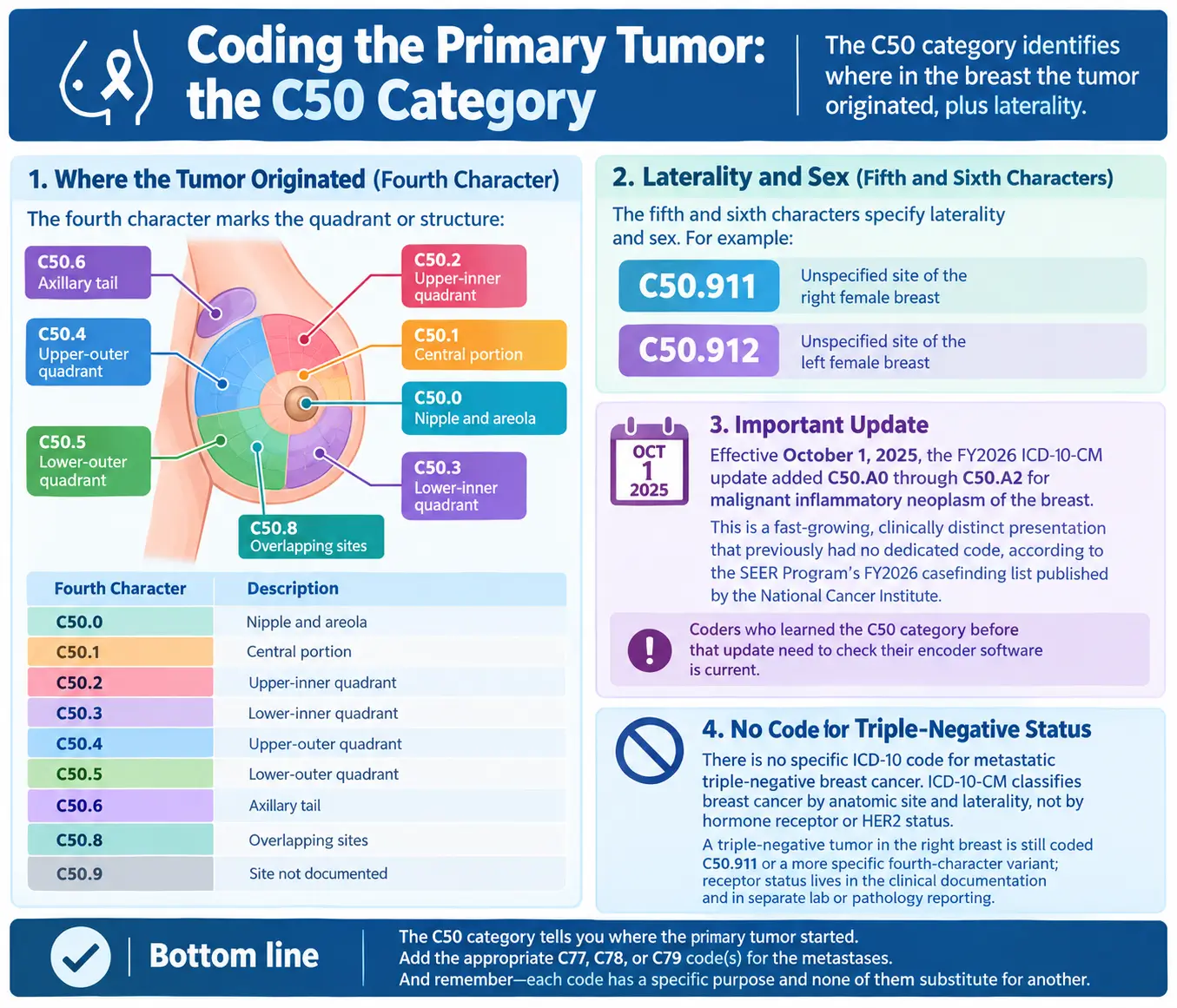
The C50 category identifies where in the breast the tumor originated, plus laterality. The fourth character marks the quadrant or structure: C50.0 is the nipple and areola, C50.1 is the central portion, C50.2 is the upper-inner quadrant, C50.3 is the lower-inner quadrant, C50.4 is the upper-outer quadrant, C50.5 is the lower-outer quadrant, C50.6 is the axillary tail, C50.8 covers overlapping sites, and C50.9 is used when the site isn’t documented. A fifth and sixth character then specify laterality and sex, for example C50.911 for an unspecified site of the right female breast or C50.912 for the left.
The category isn’t static. Effective October 1, 2025, the FY2026 ICD-10-CM update added C50.A0 through C50.A2 for malignant inflammatory neoplasm of the breast, a fast-growing, clinically distinct presentation that previously had no dedicated code, according to the Surveillance, Epidemiology, and End Results (SEER) Program’s FY2026 casefinding list published by the National Cancer Institute. Coders who learned the C50 category before that update need to check their encoder software is current.
One point worth flagging for anyone searching for a metastatic triple-negative breast cancer ICD-10 code: it doesn’t exist. ICD-10-CM classifies breast cancer by anatomic site and laterality, not by hormone receptor or HER2 status. A triple-negative tumor in the right breast is still coded C50.911 or a more specific fourth-character variant; the receptor status lives in the clinical documentation and, where relevant, in separate lab or pathology reporting, not in a distinct diagnosis code.
Coding the metastatic site: C77, C78, and C79
The table below covers the sites coders encounter most often when a chart documents breast cancer with distant spread.
Metastatic site | ICD-10-CM code | Category |
Bone | C79.51 | C79 |
Bone marrow | C79.52 | C79 |
Brain | C79.31 | C79 |
Liver (and intrahepatic bile duct) | C78.7 | C78 |
Lung, unspecified side | C78.00 | C78 |
Lung, right | C78.01 | C78 |
Lung, left | C78.02 | C78 |
Lymph nodes, axilla/upper limb | C77.3 | C77 |
Lymph nodes, intrathoracic | C77.1 | C77 |
Lymph nodes, multiple regions | C77.8 | C77 |
A few of these deserve context. Bone and bone marrow look similar but are billed separately: C79.51 documents metastasis to the bone itself, while C79.52 applies when the marrow is involved, which usually shows up clinically as unexplained cytopenias or an abnormal complete blood count in a patient with known breast cancer. They are not interchangeable, and a chart that only says “bone marrow involvement” doesn’t support C79.51.
Lung metastasis follows the same laterality logic as the primary breast codes. C78.00 is a valid, billable code, but it should only be used when the operative note, imaging report, or oncology documentation genuinely doesn’t specify which lung is affected. If a CT report says “right lower lobe metastatic lesion,” C78.01 is the correct code, not C78.00.
Sequencing: which code comes first
This is where coders new to oncology tend to struggle, because the rule depends on why the patient is being seen, not on which cancer is more clinically dangerous.
The ICD-10-CM Official Guidelines for Coding and Reporting, Section I.C.2, direct coders to designate the malignancy as principal diagnosis when treatment is aimed at that site. If treatment during the encounter is directed at the metastatic site rather than the primary breast tumor, even though the primary tumor is still present, the secondary neoplasm code is sequenced first. A patient admitted for radiation to a symptomatic bone metastasis, for instance, would have C79.51 listed before the C50 code for the primary breast tumor. If treatment addresses both sites equally, the primary malignancy is sequenced first.
There’s a second wrinkle. When the primary breast tumor has already been surgically removed or otherwise eradicated, and there’s no more treatment directed at the breast itself, coders don’t use a C50 code at all. Instead, Z85.3 (personal history of malignant neoplasm of breast) documents the former primary site, and the active secondary malignancy is coded as usual. A post-mastectomy patient now being treated only for liver metastasis would be coded C78.7 followed by Z85.3, not C50.911 followed by C78.7.
Personal history versus active metastatic disease
Z85.3 and an active C50 code are mutually exclusive on the same encounter. Z85.3 documents that the breast malignancy has been treated, resolved, or eradicated, with no current disease at that site. It should never appear alongside a C50 code describing an active primary tumor, and it should never stand in for an active metastasis code either. A patient with a history of breast cancer who is now found to have bone metastasis is not coded with just C79.51; the chart needs to make clear whether the primary site is truly resolved (supporting Z85.3 plus C79.51) or whether there’s evidence the primary tumor persists (supporting C50.- plus C79.51). Coders who default to Z85.3 out of habit, without checking whether the primary site documentation actually supports it, risk both under-coding disease severity and misrepresenting the patient’s clinical status in the record.
Three mistakes that show up in real charts
Confusing C79.81 with metastatic breast cancer. C79.81 is “secondary malignant neoplasm of breast,” meaning cancer from somewhere else that has spread to the breast, the reverse of what most searches for this topic are looking for. Breast cancer that has spread out of the breast is never coded with C79.81; the primary site still gets a C50 code, and the destination organ gets its own C77-C79 code. This mix-up appears often enough in encoder tools and quick-reference articles that it’s worth double-checking every time.
Defaulting to unspecified laterality. C50.919 (unspecified site, unspecified laterality) is a valid code, but payers and quality programs increasingly flag its overuse. If a pathology report, operative note, or radiology read anywhere in the chart identifies laterality or quadrant, that specificity belongs in the code, not the header-level unspecified option.
Treating stage IV as a code. There is no ICD-10-CM code that means “stage IV” on its own. Clinical stage is expressed through the combination of the primary site code and every documented secondary site code, not through a stand-alone stage indicator. Some cancer registries capture AJCC staging separately using registry-specific fields, but that’s a distinct data system from the ICD-10-CM claim itself.
A worked example
Consider a patient with invasive ductal carcinoma of the right breast, upper-outer quadrant, now undergoing chemotherapy for confirmed metastases to the T12 vertebra and segment VI of the liver, with the primary tumor still present and untreated during this visit. Because treatment this encounter targets both metastatic sites rather than the primary tumor, and the primary tumor remains a documented, untreated malignancy, the code set would typically read: C79.51 (bone), C78.7 (liver), then C50.411 (upper-outer quadrant, right female breast) to capture the still-present primary. If the primary tumor had already been excised with no further treatment directed at it, Z85.3 would replace C50.411 in that sequence.
Metastatic breast cancer coding rewards coders who read past the summary line in a chart and check exactly what’s being treated, what’s been resolved, and what site each secondary code actually points to. The codes themselves aren’t complicated once the C50/C77-C79 split makes sense. The judgment calls around sequencing and history status are where accuracy, and reimbursement, actually get decided.