


Normocytic anemia occurs when a patient has a low red blood cell count or low hemoglobin, but the circulating red blood cells remain normal in size. Medical coders and healthcare providers frequently encounter this condition in daily practice. Accurate documentation directly affects reimbursement, claim processing, and patient tracking. The primary Normocytic Anemia ICD-10 designation falls under the broader category of unspecified anemias. Specific underlying conditions require secondary or alternative codes. This guide covers current diagnostic criteria, common etiologies, and precise coding pathways required for compliance with 2026 reporting standards.
The Standard Normocytic Anemia ICD-10 Code
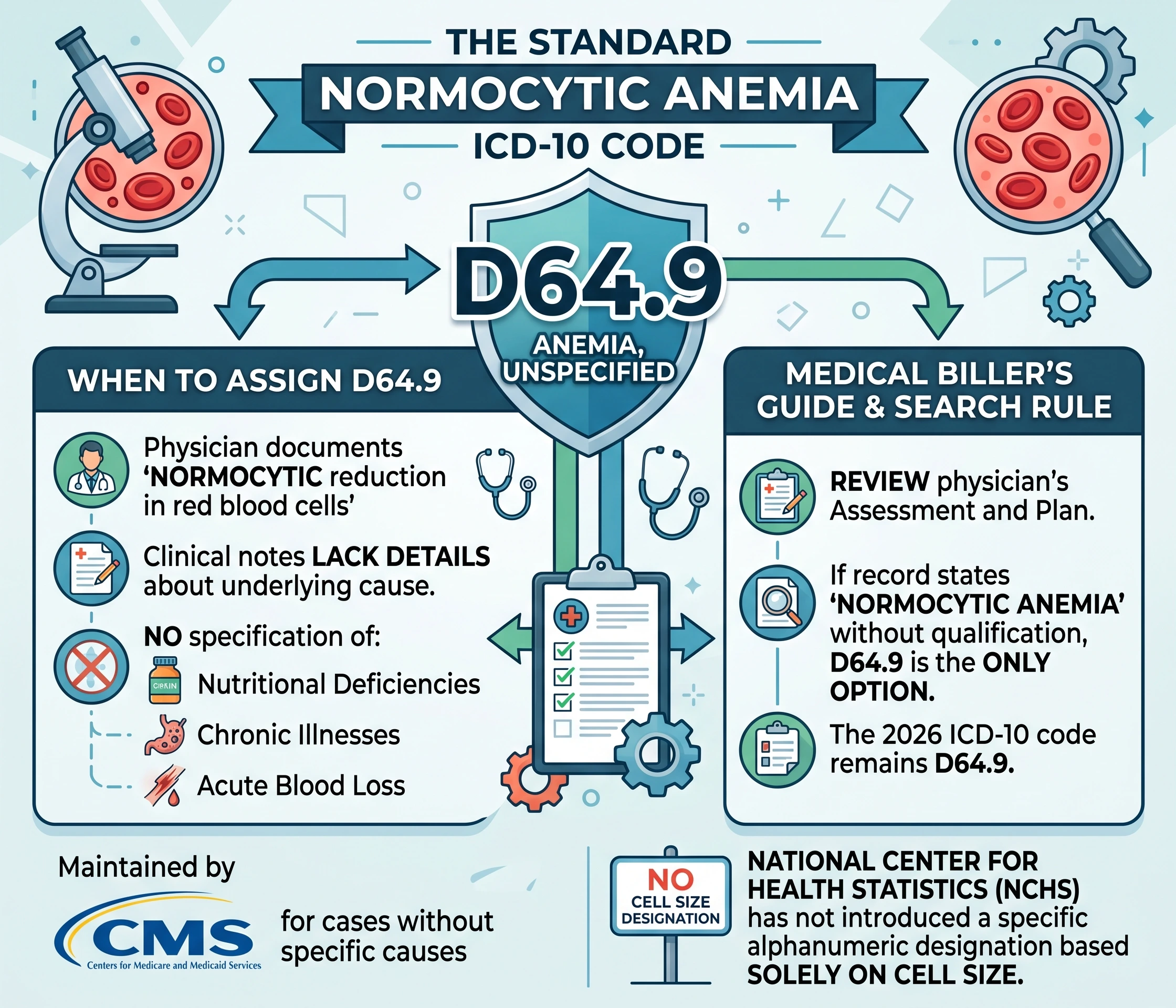
The default ICD-10-CM code for normocytic anemia is D64.9 (Anemia, unspecified). The Centers for Medicare and Medicaid Services (CMS) maintains this code for cases where the physician documents a normocytic reduction in red blood cells without specifying an underlying cause. Coders assign D64.9 when clinical notes lack details about nutritional deficiencies, chronic illnesses, or acute blood loss.
When searching for the exact normocytic anemia ICD 10 code, medical billers must review the physician’s assessment and plan. If the record states “normocytic anemia” with no further qualification, D64.9 is the only option. The 2026 ICD 10 code for normocytic anemia remains D64.9. The National Center for Health Statistics (NCHS) has not introduced a specific alphanumeric designation based solely on cell size.
Coding Specific Variations and Severity Levels
Physicians frequently document the severity and onset of the condition. The ICD-10-CM manual does not always provide separate codes for these descriptive terms. Coders must extract the clinical intent from the provider’s notes.
Mild, Chronic, and Acute Presentations
A diagnosis of mild normocytic anemia ICD 10 maps directly to D64.9. The classification system does not stratify unspecified anemia by hemoglobin thresholds. A patient with a hemoglobin of 11.5 g/dL and a patient with a hemoglobin of 8.5 g/dL receive the same base code if the etiology remains unknown.
Similarly, chronic normocytic anemia ICD 10 defaults to D64.9 unless the provider links the chronicity to a specific disease process. The word “chronic” indicates duration but does not provide a pathological etiology.
Acute presentations require careful chart review. An isolated note of acute normocytic anemia ICD 10 often indicates acute posthemorrhagic anemia. This condition codes to D62 (Acute posthemorrhagic anemia). If the provider documents acute on chronic normocytic anemia ICD 10, coders must verify the distinct causes. The acute phase might result from active gastrointestinal bleeding (D62) while the chronic phase stems from a separate etiology like kidney disease. If no underlying cause is stated for either the acute or chronic phase, coders are restricted to D64.9. Querying the provider is standard practice in these instances.
Normocytic Normochromic Anemia
The term normochromic refers to red blood cells that have a standard concentration of hemoglobin. These cells appear normal in color under a microscope. The normocytic normochromic anemia ICD 10 code is also D64.9. Providers use this specific phrase to explicitly rule out iron deficiency (which typically presents as hypochromic) and macrocytic anemias.
Normocytic Anemia of Chronic Disease
Chronic inflammation alters iron metabolism and suppresses bone marrow production. The normocytic anemia of chronic disease ICD 10 code is D63.8 (Anemia in other chronic diseases classified elsewhere). This is a manifestation code. The ICD-10-CM guidelines mandate coding the underlying condition first.
Common underlying conditions include rheumatoid arthritis, lupus, and chronic infections. If a patient has anemia of chronic inflammation secondary to rheumatoid arthritis (M06.9), the coder sequences M06.9 first, followed by D63.8.
Chronic kidney disease (CKD) follows a specific pathway. Anemia in CKD codes to D63.1 (Anemia in chronic kidney disease). The coder must sequence the exact stage of CKD (N18.-) before assigning D63.1. End-stage renal disease (ESRD) requires the code N18.6, followed by D63.1.
Clinical Definitions and Diagnostic Criteria
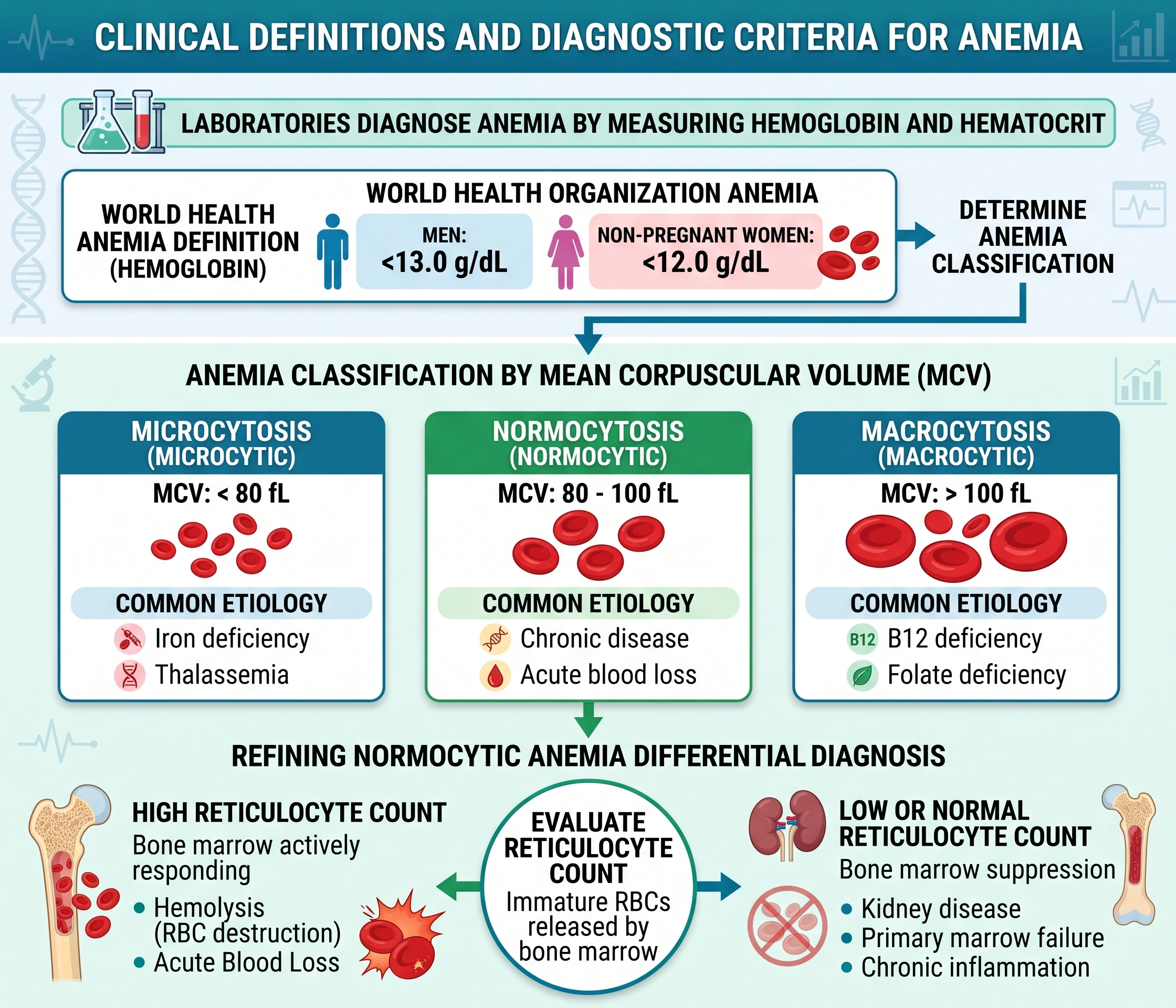
Laboratories diagnose anemia by measuring hemoglobin and hematocrit. The World Health Organization defines anemia as a hemoglobin concentration below 13.0 g/dL for men and below 12.0 g/dL for non-pregnant women. Once a low hemoglobin or low RBC count is established, the mean corpuscular volume (MCV) determines the specific classification.
The MCV measures the average size of red blood cells in femtoliters (fL). A normal MCV falls between 80 fL and 100 fL. Values within this range confirm a normocytic presentation.
Anemia Classification | MCV Value | Common Etiology |
Microcytosis (Microcytic) | Less than 80 fL | Iron deficiency, Thalassemia |
Normocytosis (Normocytic) | 80 fL to 100 fL | Chronic disease, Acute blood loss |
Macrocytosis (Macrocytic) | Greater than 100 fL | B12 deficiency, Folate deficiency |
To refine the normocytic anemia differential diagnosis, physicians evaluate the reticulocyte count. Reticulocytes are immature red blood cells. The bone marrow releases them into the bloodstream before they mature.
A high reticulocyte count indicates the bone marrow is actively responding to red blood cell destruction (hemolysis) or acute blood loss anemia. A low or normal reticulocyte count suggests bone marrow suppression. This points toward kidney disease, primary marrow failure, or chronic inflammation.
Identifying Normocytic Anemia Causes
Determining the exact cause dictates the final ICD-10 code. The most frequent normocytic anemia causes fall into three categories: decreased red blood cell production, increased red blood cell destruction, and sudden fluid volume shifts.
Decreased production primarily stems from chronic illnesses. The kidneys produce erythropoietin. This hormone stimulates red blood cell production in the bone marrow. Damaged kidneys fail to produce sufficient erythropoietin.
Inflammatory conditions also inhibit production. Diseases like Crohn’s disease or rheumatoid arthritis release cytokines such as hepcidin. Hepcidin traps iron in macrophages. This prevents the bone marrow from utilizing the iron to create new red blood cells, even if the patient’s total body iron stores are normal.
Increased destruction involves hemolytic anemias. These conditions are coded under the D55-D59 range. Sickle cell disease, autoimmune hemolytic anemia, and hereditary spherocytosis reduce the standard 120-day lifespan of red blood cells. The bone marrow produces normal-sized cells, but the spleen or vascular system destroys them prematurely.
Acute blood loss causes an immediate drop in total red blood cell volume. The remaining cells are normal in size and color. This condition codes to D62. Internal bleeding from gastrointestinal ulcers, surgical complications, or severe trauma are frequent catalysts for this presentation.
Coding Anemia in Oncology and Chemotherapy
Patients undergoing treatment for malignancies frequently develop normocytic anemia. The coding sequence depends on the primary reason for the medical encounter.
If the admission or encounter is for the management of anemia associated with a malignancy, and the treatment is only for anemia, the coder must assign the code for the malignancy first. This is followed by D63.0 (Anemia in neoplastic disease).
If the anemia results directly from the administration of chemotherapy, immunotherapy, or radiation therapy, the sequencing changes. The coder assigns the anemia code (D64.81 for Anemia due to antineoplastic chemotherapy) first. The neoplasm code is sequenced second, followed by the appropriate adverse effect code (T45.1X5- range) to indicate the drug causing the reaction.
Coding Anemia During Pregnancy
Pregnancy alters blood volume. Plasma volume expands faster than red blood cell mass, leading to dilutional anemia. If a pregnant patient presents with normocytic anemia, the coder cannot use standard Chapter 3 codes (D50-D89) as the primary diagnosis.
Chapter 15 (Pregnancy, Childbirth, and the Puerperium) takes precedence. The coder must use a code from category O99.0- (Anemia complicating pregnancy, childbirth and the puerperium). The specific code depends on the trimester. For example, O99.012 indicates anemia complicating pregnancy, second trimester. The coder assigns D64.9 as a secondary diagnosis to specify the type of anemia.
Documentation Requirements for Medical Billing
General statements of anemia lead to unspecified codes. Payer algorithms frequently flag D64.9 for review. Commercial insurers and Medicare contractors audit charts to ensure the assigned code matches the clinical evidence and justifies medical necessity for treatments like erythropoiesis-stimulating agents (ESAs) or blood transfusions.
Coders require specific terminology in the medical record. The phrase “anemia likely due to CKD stage 3” allows the coder to assign N18.30 and D63.1. The phrase “normocytic anemia, etiology unknown” restricts the coder to D64.9.
Clinical documentation improvement (CDI) specialists recommend that physicians document the suspected etiology even if the laboratory workup remains active. Laboratory results alone cannot dictate a diagnosis code. A coder cannot view a hemoglobin level of 10.5 g/dL and an MCV of 90 fL and independently code normocytic anemia. The physician must explicitly state the diagnosis in the assessment and plan.
Coders must observe “Excludes1” notes in the ICD-10-CM manual. Code D64.9 excludes refractory anemias (D46.-), nutritional anemias (D50-D53), and hemolytic anemias (D55-D59). If a provider documents both normocytic anemia and iron deficiency anemia, the coder must query the provider. Iron deficiency eventually causes microcytosis and falls under D50.9. This conflicts with the unspecified nature of D64.9.
Advanced Laboratory Testing and Coding Implications
When initial tests show a normochromic anemia, physicians often order a peripheral blood smear and an iron panel. The blood smear allows the pathologist to view the actual shape of the cells.
Spherocytes indicate hereditary spherocytosis (D58.0). Schistocytes (fragmented red blood cells) suggest microangiopathic hemolytic anemia, which occurs in conditions like thrombotic thrombocytopenic purpura (M31.11).
An iron panel includes serum iron, total iron-binding capacity (TIBC), and ferritin. In anemia of chronic inflammation, ferritin is typically high or normal, while TIBC is low. In early iron deficiency, before the cells become microcytic, ferritin is low, and TIBC is high. These test results prompt the physician to document a specific etiology, allowing the coder to move away from the unspecified D64.9 code and assign a precise diagnosis code.
Medical Necessity and Treatment Coding
Treatments for normocytic anemia depend on the etiology. Insurers require precise ICD-10 linkage to approve therapies and process payments.
Blood transfusions require documentation of symptomatic anemia. If a patient receives a transfusion, the coder must link the procedure code (such as CPT 36430) to the specific anemia code.
Erythropoiesis-stimulating agents require strict diagnosis coding. Medicare National Coverage Determinations restrict ESA coverage. If the physician prescribes an ESA for anemia of chronic kidney disease, the claim must include N18.- and D63.1. If the claim only lists D64.9, the payer will deny the ESA as not medically necessary.
Intravenous iron therapy is occasionally used if a patient has concurrent iron deficiency. If the patient has mixed anemia (normocytic anemia of chronic disease and early iron deficiency), both conditions must be documented to support the administration of iron products.
Assigning the correct Normocytic Anemia ICD-10 code depends entirely on provider specificity in the medical record. While D64.9 serves as the default for undefined cases, billers must locate underlying causes such as chronic kidney disease (D63.1) or acute hemorrhage (D62) to ensure compliance. Understanding the clinical threshold of an MCV between 80 fL and 100 fL helps auditors verify that the laboratory data matches the documented diagnosis. Complete clinical documentation reduces denied claims, justifies the medical necessity of treatments, and accurately tracks patient pathology across the healthcare system.