

This blog shows how the healthcare professional can use the ICD-10 code B35.1 for Tinea unguium to gain expedited claim approvals. It explains the various elements of effective coding including the preparation of clinical documentation, ICD-10 code guidelines, errors to avoid, and the correct application of coding to specific claims. It summarizes that to increase claim approval, workflow to improve billing, and maintain quality documentation and compliance to ICD guidelines, the healthcare provider should preprocess the documentation to identify claims that may be denied and assess the possible revisions to improve reimbursement.
The accuracy of medical billing and coding impacts how quickly healthcare providers receive their payments and is particularly relevant for billing conditions of Tinea unguium. Tinea unguium, also known as onychomycosis, requires special attention when coding to avoid claim denials or delays in payments. Coding errors can lead to delays in payments, as do claim denials, which can put a strain on a healthcare provider’s office and create a need for more coding personnel to process those claims. The use of a coding error as a rationale for claiming billing denial is a repetitive claim. This is a rationale that, when used, can inhibit the medical office from receiving reimbursement for the services performed. Accurate use of the ICD-10 code B35.1 for Tinea unguium is essential for faster claim approvals, helping providers reduce denials, improve documentation, and streamline reimbursement processes effectively.
Comprehending Tinea Unguium and Its ICD-10 Code
Tinea unguium
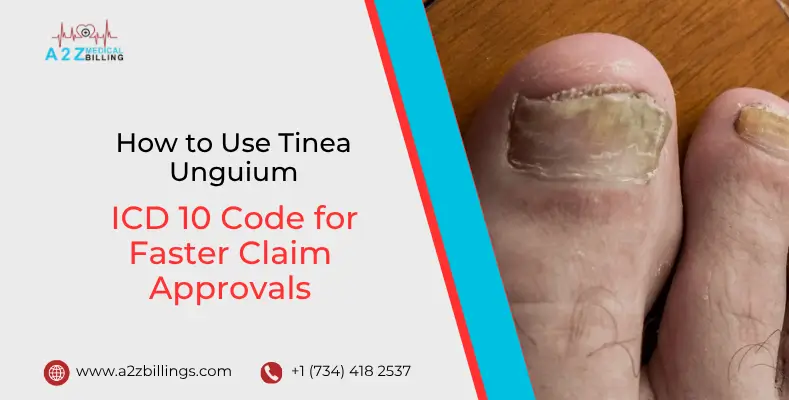
Tinea unguium is a nail fungal infection. It is predominantly caused by dermatophytes, but yeasts and molds can also be the cause. It can lead to nails that are discolored, thick, and brittle. In extreme cases, the nail can completely separate from the nail bed. It can be seen in both the fingernails and toenails, but it is seen more often in the toenails because of the warm, moist environments.
Understanding ICD-10 Code B35.1
B35.1 is the ICD-10-CM code for tinea unguium. It is more specifically categorized under dermatophytosis, which is the infection of the nails, skin, or hair by a fungus. It is a billable code, which is to say, it is specific enough to be used for an insurance claim without having to elaborate any further in the majority of situations. B35.1 also encapsulates the terms dermatophytic onychia and ringworm of the nails, which makes this code an extremely detailed one for the classification of infected nails.
Importance of Accurate ICD-10 Coding in Claim Approvals
Effect on Payments When it comes to ICD-10 coding, insurance companies will use those codes to determine a diagnosis’ medical necessity. Because of this, if a code is inconsistent with the diagnosis, the claim is likely to be denied or sent to review. When a code is specifically used for a diagnosis, it eliminates presumption, thereby justifying a quicker turn around for a claim. This is also especially important for the consolidation of communication between the provider and the payer.
Preventing Claim Denials and Payment Delays
When ICD-10 codes are vague or erroneous, audits, claim denials, and payment delays are all common outcomes. For example, a diagnosis code for a fungal infection that is not B35.1 is more likely to be considered a vague diagnosis and calls into question the accuracy of the diagnosis. Accurate coding from the outset allows health care providers to lessen administrative setbacks and enhance efficiency when pursuing claims.
Clinical Documentation Specifications for B35.1
Essential Documentation Components
Inadequate documentation can result in claim denials, argue coding experts, even when the proper ICD-10 code was used. Clinical notes describing the condition should be recorded by Providers. Documenting visible symptoms, for example, nails that are discolored, thick, and are crumbling, or detached from the nail bed is imperative.
Diagnostic Evidence Support
Documentation is clear and precise about which nails are infected, and the extent of the infection is helpful. Antifungal treatment, when prescribed, should be included in the documentation. This officially reinforces the claim and portrays the condition’s medical necessity.
How to Avoid Coding Errors
Misdiagnosis and Improper Code Application One of the most frequent errors is coding B35.1 without diagnostic corroboration. Claims will be denied for lack of clinical or laboratory evidence documenting a fungal infection. Another problem is that tinea unguium can be confused with other nail diseases. Other nail conditions, such as nail changes related to psoriasis, or traumatic nail dystrophy, are classified with different ICD-10 codes, and should not be billed with B35.1.
Insufficient or Contradictory Documentation
Another common cause of claim denials is insufficient documentation. The clinical notes can be an explanation for the claim being flagged for review if the notes do not align with the corresponding diagnosis code. Healthcare professionals must be aligned with the diagnosis, clinical evidence, and the treatment to minimize the chances of observations that could postpone the approval.
Advice for Fast Claim Approval B35.1
Diagnoses Must Be Verified Prior To Coding
ICD-10 code B35.1 should be assigned only after the diagnosis is confirmed. Insurance companies often request documentation to prove that the condition is fungal in nature. A coding without adequate justification will be a basis for a claim denial. An insurance claim should be built on proven facts.
Provide Comprehensive Supporting Documents
The level of detail in the supporting documents is directly related to the speed of claim resolution. Cases will be accurately documented if there are precise descriptions of the symptoms and the supporting documentation is in line with the diagnosis code. Documentation will need to be complete with descriptions of discolored nails and supporting documents will need to be complete with supporting documents. Descriptions of affected nails, their length and the duration of symptoms, previous treatments. These details go a long way in assuring that the claim is not flagged, queried or rejected.
Implement Supporting Evidence and Additional Coding
Supplementing the claim with diagnostic evidence such as supporting KOH tests or evidence from fungal cultures solidifies the claim’s strength. In certain instances, the addition of some secondary or associated codes can illustrate the patient’s condition more thoroughly and more precisely demonstrate the severity and necessity of the treatment, increasing the probability of primary claim approval without further information requests.
Timeliness of Submission and Audits
Claims that are submitted in a timely manner, and claims that have been reviewed prior to submission, are the most likely to avoid delays. In house audits carried out at regular intervals help to pinpoint documentation that is missing, codes that may lead to denial, and the inconsistencies in documentation. When healthcare providers are proactive, and are able to diagnose issues earlier, there is a visible improvement in the smoothness of claim processing and the speed at which reimbursements are received.
ICD-10 Guidelines and Coding
Following the Coding Standards
ICD-10 guidelines show which diagnosis codes to use and how to apply them. For example, tinea unguium coders must confirm that the patient fits in the dermatophytosis and B35.1 category. Guidelines are meant to encourage specificity and coders are to use the most specific code rather than general or unspecified ones.
Compliance and Accuracy
Compliance with ICD-10 guidelines will ensure no payer requirements are neglected, and the audit risk is low. Consistent coding will ensure the same reliability on all claims. Health care providers will have to improve with standards, their coding, and billing accuracy and efficiency.
Advantages of Correct Coding
Financial and Operational Benefits
There is less work to be done on the resubmission of claims and correction on coding as accurate and correct coding will mean faster payments on the claims and fewer claims will be noted. This will definitely improve the revenues of the health care practice.
Better Data From Patient Care
With coding, the quality of health care data improves, making the tracking of disease and treatment outcomes easier. This information is beneficial for clinical decision making, and for research. Accurate documentation improves continuity of care, as future care providers have accurate and appropriate detailed diagnosis
Conclusion
Using the ICD-10 code B35.1 for Tinea unguium is the most appropriate way of achieving accurate claim inquiries. Everything from accurate diagnosis, and all the way to being compliant with the coding policies is part of making this a reality. Healthcare providers who code accurately achieve improved reimbursement and operational efficiency. They improve their revenue cycle and the outcomes for their patients.
Make An Appintment With A2ZFAQs
The code used to signify Tinea Unguium is B35.1. This is a code that is used to signify nail fungus infections, including Onychomycosis.
The impact of the coding directly coincides with the outcome of the claim. The coding encompasses the medical need and the diagnosis. Poor coding can lead to denials and can cause delays with claims, as well as the auditing process.
Clinical notes should be included with the documentation. The clinical notes should describe any changes to the nails, the areas that were impacted, and the severity of the condition. In order to obtain documentation, a KOH exam or a culture of the infected nails can be useful to confirm a diagnosis.
Common mistakes to look for when coding includes confusing B35.1 with a diagnosis that is different from the one found in the documentation. This is further complicated by inconsistent and incomplete documentation that does not support claims.
In order to increase the claims that are accepted, the healthcare provider is urged to confirm the diagnosis, document in full the details of the claim, and ensure that the claim is complete. Coding for the claims should be done as auditing.