


According to a 2024 report published by the Centers for Medicare and Medicaid Services (CMS), podiatry care registered an 11.2 percent improper payment rate. This error margin resulted in roughly $216.9 million in incorrect payments. Most of these denied claims and delayed payments do not stem from simple coding typos. They happen because practices fail to document specific class findings, miss prior authorizations, or incorrectly apply Medicare modifiers.
Finding the best podiatry medical billing software for faster claims in 2026 requires medical billers and clinic owners to look beyond general practice management tools. Podiatry revenue cycle management software must incorporate automated claim scrubbing, specific Local Coverage Determination (LCD) logic, and specialized templates for diabetic foot care.
Why Standard Medical Billing Fails Podiatry Clinics
Standard electronic health records (EHR) often lack the specialized logic required for podiatry medical billing. Medicare denies more podiatry claims for coverage issues than for coding errors.
Routine foot care is generally excluded from Medicare coverage. To receive payment for procedures like trimming dystrophic nails (HCPCS code G0127) or debridement of nails (CPT codes 11720 and 11721), the provider must prove the care is medically necessary due to a systemic condition. A general practice software might allow a biller to submit these CPT codes without verifying the presence of an underlying risk factor. Specialized podiatry billing software blocks the claim submission until the user attaches the required clinical findings.
Enforcing Medicare Q Modifiers Through Software
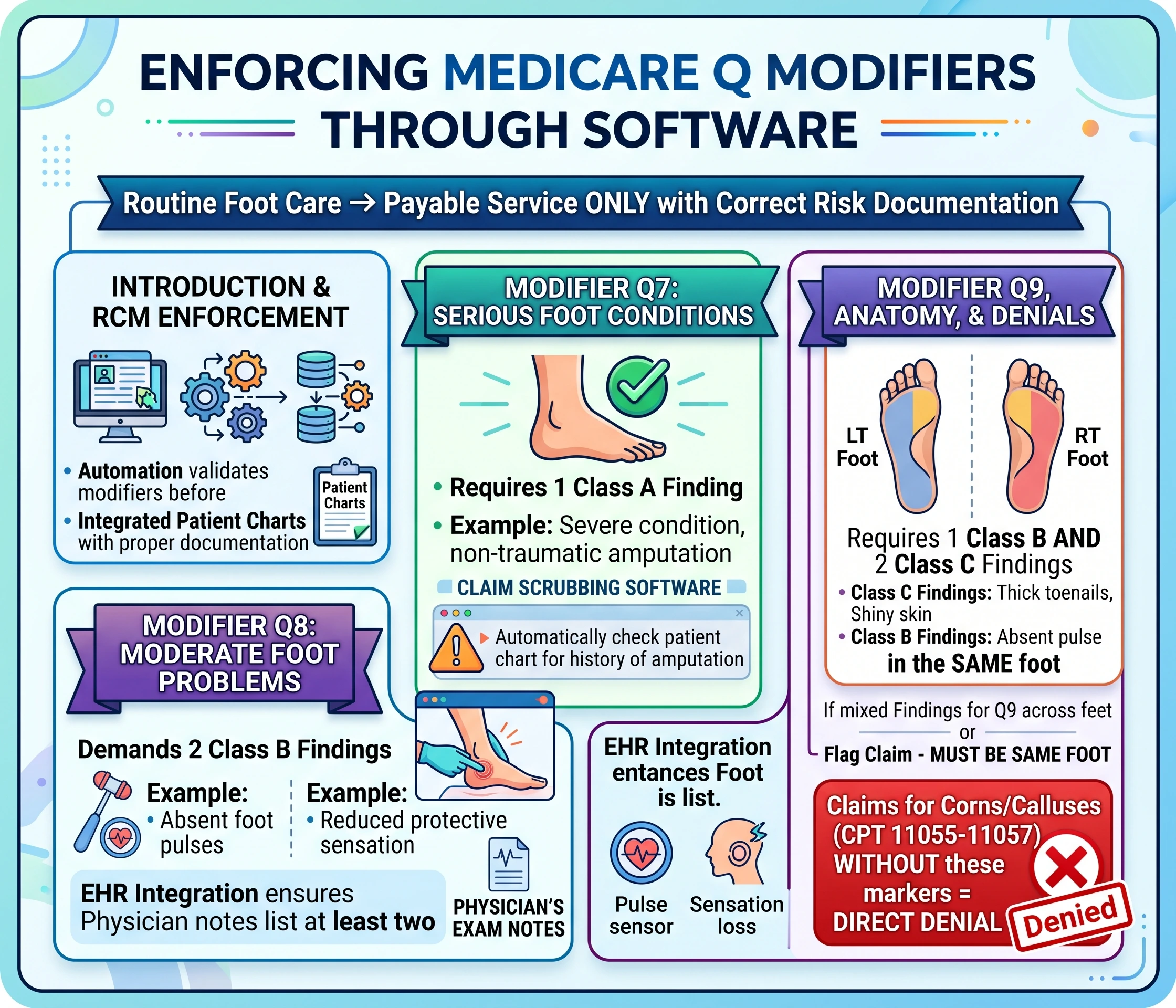
Routine foot care transitions into a payable service only when risk is documented correctly. The use of Q modifiers is the primary mechanism for proving this risk. The best podiatry RCM software automates the validation of these modifiers before the claim reaches the clearinghouse.
Modifier Q7: Serious Foot Conditions
Modifier Q7 requires one Class A finding. This represents a severe condition, such as a non-traumatic amputation of the foot or an integral skeletal portion of the foot. If a provider selects modifier Q7, the medical billing software should automatically check the patient’s chart for a history of amputation.
Modifier Q8: Moderate Foot Problems
Modifier Q8 demands two Class B findings. These are moderate issues requiring medical intervention. Examples include absent foot pulses, reduced protective sensation, or specific skin abnormalities like thinning or dryness. A podiatry EHR integration ensures that the physician’s exam notes specifically list at least two of these symptoms in the same foot before allowing the Q8 modifier on the claim.
Modifier Q9: Mixed Clinical Findings
Modifier Q9 requires a combination of one Class B moderate problem plus two Class C minor issues. Class C findings include reduced hair growth on the foot or leg, thick toenails, or shiny skin. Proper claim scrubbing systems tally these symptoms per foot and flag the claim if the user attempts to mix findings from the left and right foot to meet the criteria.
The Per-Foot Rule and Anatomy Modifiers
Podiatry billing requires exact anatomical mapping. Medicare and commercial payers expect the modifier to reflect findings in the specific foot treated on the date of service. Podiatry medical billing software enforces the use of LT (left foot) and RT (right foot) modifiers alongside specific toe modifiers ranging from TA to T9. A claim for corns and calluses (CPT codes 11055 to 11057) will result in a direct denial if the software permits the biller to submit the claim without these anatomical markers.
Managing Complex Clinical Scenarios
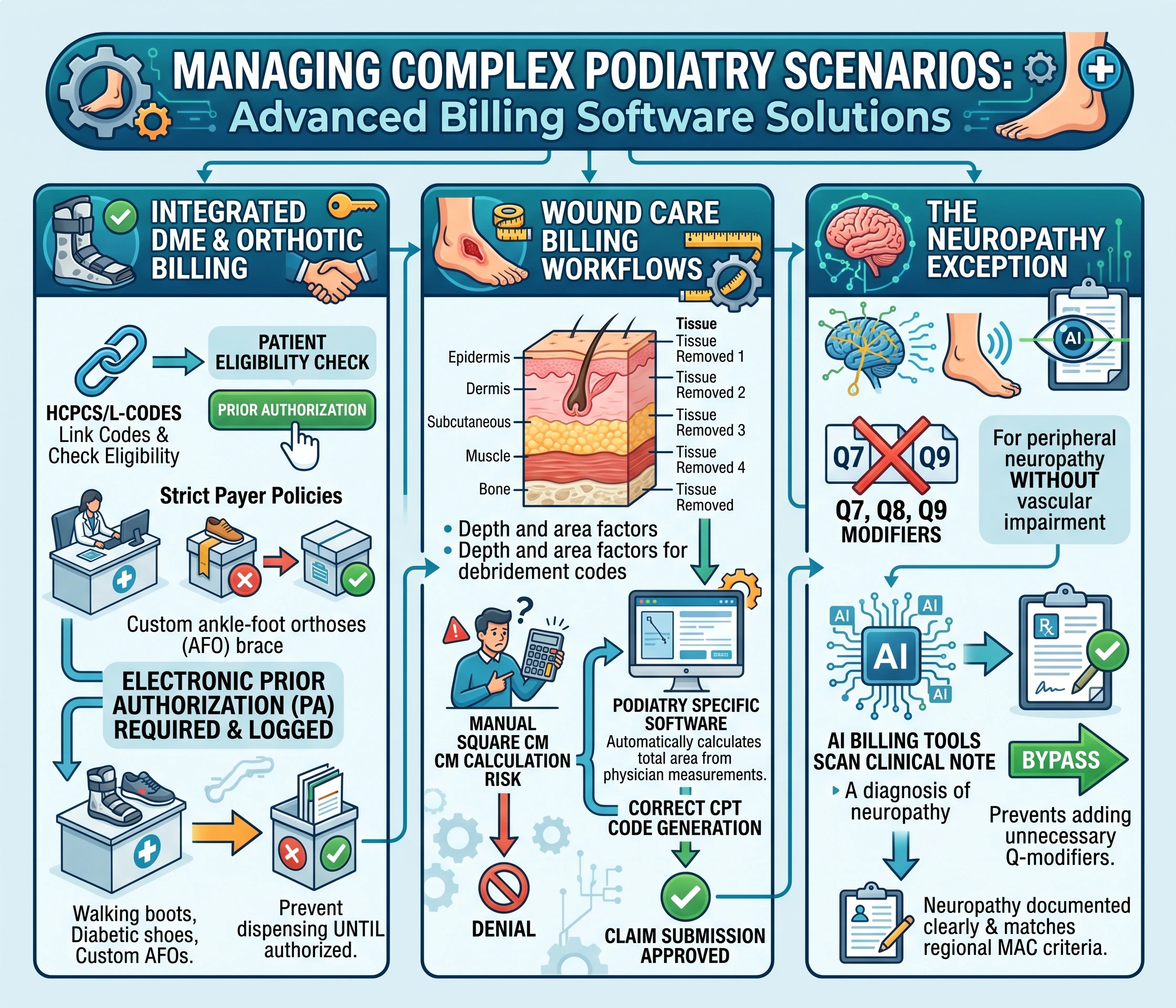
Beyond routine foot care, medical billing for podiatry involves high-cost procedures that trigger frequent audits. Software designed specifically for this specialty targets these high-risk areas.
Integrated DME and Orthotic Billing
Durable medical equipment (DME), including walking boots, diabetic shoes, and custom ankle-foot orthoses (AFOs), requires strict adherence to payer policies. Missing prior authorization is one of the top three denial reasons in podiatry. Effective podiatry billing software links HCPCS codes and specific orthotic L-codes directly to patient eligibility checks. The system prevents the clinic from dispensing the equipment until the prior authorization is electronically secured and logged.
Wound Care Billing Workflows
Wound care billing presents another area of high denial risk. Debridement codes are based on the depth of the tissue removed (epidermis, dermis, subcutaneous tissue, muscle, or bone) and the surface area of the wound. Standard billing systems rely on the coder to manually calculate the square centimeters. Podiatry specific billing software calculates the total surface area automatically based on the physician’s clinical measurements, ensuring the correct CPT code is generated for the claim submission.
The Neuropathy Exception
Medicare offers an exception for patients with peripheral neuropathy without vascular impairment. In these specific cases, providers do not need to use Q7, Q8, or Q9 modifiers. However, the neuropathy must be documented clearly and match the regional Medicare Administrative Contractor (MAC) criteria. Advanced AI billing tools scan the clinical note for neuropathy diagnoses and bypass the Q-modifier requirement, preventing the biller from adding unnecessary modifiers that could trigger a rejection.
Evaluating Top Podiatry Billing Software Platforms
Different clinics require different technical capabilities based on their patient volume and surgical focus. The table below compares two podiatry-focused platforms against the baseline of a standard general EHR.
Software Category | Primary Clinical Focus | Automated Q-Modifier Scrubbing | Cloud-Based Access | Custom Podiatry Templates |
TRAKnet | Podiatry specific EMR and billing | Yes | Yes | Yes |
DocVilla | Multidisciplinary with podiatry modules | Yes | Yes | Yes |
Standard General EHR | Primary care and family medicine | No | Varies | No |
TRAKnet operates as a podiatry-focused Electronic Medical Records (EMR) and practice management solution. It provides clinical documentation tailored specifically to foot and ankle specialists, embedding specific coding logic directly into the daily workflow. DocVilla offers a cloud-based architecture with strong telemedicine integration and podiatry-specific notes, giving practices flexibility if they manage remote consultations alongside in-office procedures.
Measuring Financial Impact with Hard Data
Evaluating podiatry RCM software requires clinics to track specific key performance indicators. The technology must measurably improve the reimbursement workflow.
The industry target for a clean claim rate is 95 percent or higher. This metric tracks the percentage of claims that pass clearinghouse integration checks on the first attempt. High-performing podiatry practices utilizing automated billing tools often achieve a 98 percent clean claim rate. They achieve this by utilizing software that flags bundling violations and missing documentation before the claim leaves the building.
The first-pass acceptance rate measures the percentage of claims paid on the first submission without rejection from the payer. A rate below 90 percent indicates upstream problems in eligibility verification or coding accuracy.
Days in accounts receivable (A/R) track the average time from claim submission to final payment. The industry benchmark sits near 40 days. Practices leveraging the best podiatry revenue cycle management software maintain their A/R under 30 days. Efficient clearinghouse integration accelerates payment processing, ensuring electronic remittance advice (ERA) files automatically post to patient accounts.
Finally, the net collection rate reveals the true financial health of the clinic. A successful podiatry practice collects 95 percent or more of its contractually allowed revenue. Anything under 90 percent means the clinic is losing money to untracked underpayments or writing off claims due to poor denial management.
Selecting the Best Podiatry Medical Billing Software for Faster Claims in 2026
Upgrading to podiatry specific billing software directly addresses the most common administrative failures in foot and ankle clinics. By enforcing Medicare billing rules, validating CPT codes against anatomical modifiers, and tracking DME requirements, these systems stop revenue leaks at the source. Clinics evaluating new systems must prioritize platforms that offer billing logic tailored entirely to podiatry. Software that forces billers to verify the exact class findings for every foot treated will consistently produce higher clean claim rates, shorter A/R days, and faster reimbursements.