


A nail-treatment claim can contain the correct diagnosis and still fail a coverage review. The tinea unguium ICD 10 code is B35.1, but that code alone does not explain which nails were treated, what procedure was performed, or why the service qualified for payment.
For healthcare providers and billing students, fungal nail claims offer a useful lesson: diagnosis accuracy, procedure selection, and medical necessity require separate checks. These 10 mistakes show where those checks belong and how to build them into everyday claim review.
Understanding the tinea unguium ICD 10 code
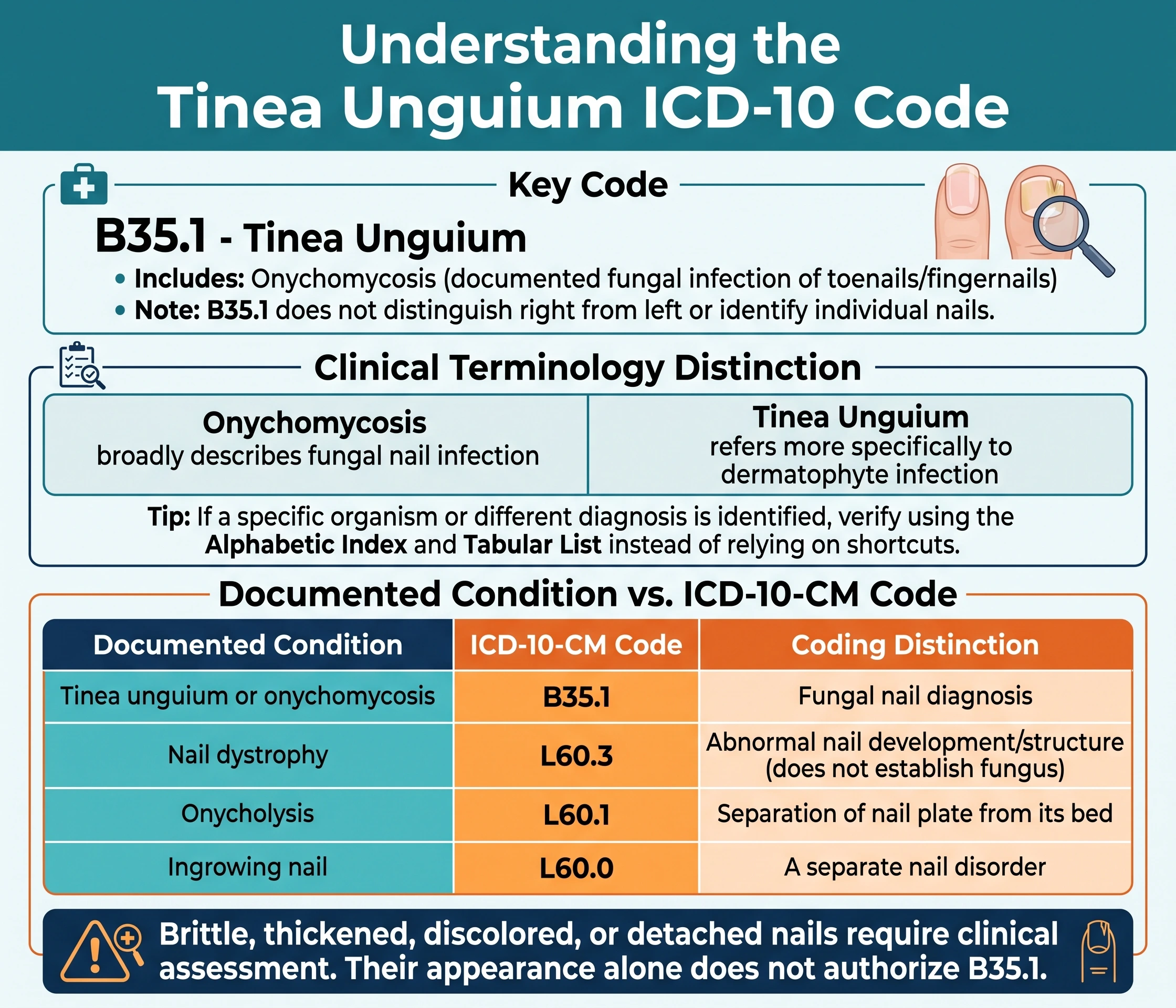
B35.1 identifies tinea unguium. Onychomycosis is included under this code, which is commonly used for documented fungal infection of toenails or fingernails. B35.1 does not distinguish right from left or identify individual nails.
Clinical terminology still deserves attention. Onychomycosis describes fungal nail infection broadly; tinea unguium refers more specifically to dermatophyte infection. Where the clinician identifies a particular organism or a different diagnosis, verify the Alphabetic Index and Tabular List instead of relying on a saved “nail fungus” shortcut.
The following comparisons help prevent symptoms and established diagnoses from being treated as interchangeable:
Documented condition | ICD-10-CM code | Coding distinction |
Tinea unguium or onychomycosis | B35.1 | Fungal nail diagnosis |
Nail dystrophy | L60.3 | Abnormal nail development or structure; does not establish fungus |
Onycholysis | L60.1 | Separation of the nail plate from its bed |
Ingrowing nail | L60.0 | A separate nail disorder |
Brittle, thickened, discolored, or detached nails require clinical assessment. Their appearance alone does not authorize B35.1.
1. Assigning B35.1 from the nail’s appearance
A biller reads “yellow, thickened toenails” and selects onychomycosis without a documented diagnosis. That substitutes a billing assumption for the clinician’s assessment.
The American Academy of Dermatology’s undated Choosing Wisely guidance recommends confirming a fungal infection before initiating oral antifungal therapy. Similar-looking nail disorders make that distinction relevant to both care and documentation.
How to stop it: Look for the clinician’s diagnosis, then review supporting findings and available test results. If the documentation identifies only a nail abnormality, seek clarification from the provider when necessary. Do not interpret a photograph, medication order, or isolated laboratory result as permission to independently establish the diagnosis.
2. Coding suspected infection as confirmed in outpatient care
“Possible onychomycosis” and “onychomycosis” carry different coding implications.
The FY 2027 ICD-10-CM Official Guidelines for Coding and Reporting, issued by CMS and the National Center for Health Statistics and effective October 1, 2026, instruct outpatient coders to report the highest level of diagnostic certainty supported by the encounter instead of coding uncertain diagnoses as confirmed conditions.
How to stop it: Flag terms such as “suspected,” “possible,” and “rule out” during outpatient review. Use documented signs, symptoms, or other established conditions as appropriate.
For example, a hypothetical visit documenting nail dystrophy with fungal testing pending should not automatically produce B35.1. Follow the organization’s clarification and coding workflow if the clinician later establishes a diagnosis.
3. Using the wrong annual code set
The calendar year printed on a blog is not enough to identify the applicable ICD-10-CM release.
CMS specifies that the FY 2027 diagnosis files are applicable to encounters occurring between October 1, 2026, and September 30, 2027. Consequently, a search for the “2026 ICD-10 code for tinea unguium” may return references that do not match an October 2026 encounter.
To avoid this issue, choose the appropriate code set based on the encounter or discharge date. Verify annual updates and any applicable midyear changes before updating billing-system favorites.
Keep the effective date with internal coding references. Although a diagnosis code may remain the same, related coding guidelines or payer policies may still need to be reviewed.
4. Assuming B35.1 guarantees coverage
A diagnosis code identifies a condition. Coverage policies determine whether a particular service meets the payer’s requirements.
Novitas Solutions’ Billing and Coding: Debridement of Mycotic Nails, article A56640, revised September 12, 2019, requires B35.1 plus an applicable listed diagnosis indicating secondary infection, pain, or walking difficulty for the claims addressed by that policy.
How to stop it: Review the policy for the patient’s payer, jurisdiction, procedure, and service date. Record which coverage pathway applies.
Do not add pain or difficulty walking solely to satisfy a claim edit that requires an additional diagnosis. Those conditions must be supported by the medical record. An unmet coverage requirement cannot be repaired by selecting an unsupported code.
5. Writing notes that omit the reason for treatment
“Fungal nails debrided” gives a reviewer little information about the patient’s symptoms or the work performed.
A useful documentation template should prompt the clinician to record:
- Which nails were affected and treated.
- Relevant nail findings.
- Symptoms and functional effects, when present.
- The treatment performed and number of nails debrided.
- Relevant examination findings and treatment plans.
How to stop it: Build prompts around the applicable payer policy without forcing positive findings.
For a hypothetical patient, pain from shoe pressure should be documented only if reported or established during assessment. Avoid inserting walking difficulty into every note. Templates should capture differences between encounters, including improvement and the absence of previously documented symptoms.
6. Confusing nail trimming with debridement
The presence of nail fungus does not determine the procedure code.
CPT 11720 describes nail debridement involving one to five nails; 11721 applies to six or more. Routine trimming and debridement represent different services, so a note that supports only clipping should not be upgraded because B35.1 appears on the claim.
How to stop it: Match the procedure code to the actual documented work and nail count.
Suppose eight nails appear abnormal, but the clinician debrides only four. The treated count supports the one-to-five category, assuming the service otherwise meets its requirements. Count the nails receiving the procedure, not every abnormal nail observed during examination.
7. Adding modifiers automatically
Two modifier-related mistakes require particular attention: routinely appending modifier 25 to every same-day E/M service and using class-finding modifiers without the necessary examination documentation.
The Medicare billing article Routine Foot Care and Debridement of Nails, A57759, explains that a same-day E/M service must be significant and separately identifiable to support modifier 25. Class-finding modifier requirements depend on the coverage circumstances described in the applicable policy.
How to stop it: Review the additional evaluation work and supporting findings before selecting modifiers. Document why a separately billed E/M service qualifies.
A second diagnosis alone does not establish a separately payable visit. Likewise, a systemic condition should not trigger a modifier through an unchecked default.
8. Applying one payer’s frequency limit to every patient
Repeated treatment introduces another claim-review question: whether the interval meets the applicable coverage policy.
Novitas article A56640 specifies that 11720 and 11721 are not reimbursed more often than once every 60 days and describes a potential six-session limit within 12 months, with further details in its related coverage determination.
How to stop it: Maintain payer-specific frequency checks and review prior service dates before billing repeat procedures.
Treat these limits as provisions of that policy, not universal rules for every insurer. Separate scheduling decisions from coverage review, and investigate any exception criteria in the governing policy instead of assuming a recurring appointment will qualify.
9. Reusing the previous claim without reviewing today’s encounter
A copied claim can preserve yesterday’s nail count, symptoms, or procedure after the clinical situation changes.
How to stop it: Use a short reconciliation step before submission: compare today’s assessment, treated nails, procedure, and diagnosis pointers with the claim.
Also check that patient identifiers, coverage information, rendering-provider details, and service date reflect this encounter. These are useful workflow controls even when the clinical coding has already been reviewed.
For returning patients, keep previous information visible as history while requiring review of current findings. Ensure staff do not have to piece together the encounter details from a charge sheet listing only B35.1 and a procedure code.
10. Resubmitting denials without identifying the reason
Repeatedly sending the same claim is a poor correction strategy if the original problem remains unresolved.
How to stop it: Assign the denial to a specific review category: claim data, diagnosis support, procedure selection, coverage, frequency, or missing records. Review the payer’s explanation of benefits or denial notice before deciding on the appropriate next step.
A useful denial log records the stated reason, supporting documentation, responsible staff member, and deadline. Distinguish a corrected claim from an appeal under the payer’s instructions.
If the dispute concerns medical necessity, organize the existing records around the relevant coverage criteria. Never alter the clinical documentation simply to align with an insurer’s list of accepted codes.
Frequently asked questions
What is the ICD-10 code for onychomycosis of toenails?
B35.1 is used for documented onychomycosis. It does not provide separate right-foot and left-foot versions. Record the affected nails and side in the clinical note.
Can B35.1 be used for thick toenails?
Thickness alone does not establish fungal infection. Code the clinician’s documented diagnosis or the appropriate documented finding under applicable coding rules.
Does every B35.1 claim require a positive fungal test?
Do not confuse treatment recommendations with a universal claim requirement. The AAD recommends confirmation before oral antifungal therapy; coding and coverage review also depend on the diagnosis documentation, service, and applicable payer policy.
A final check before submission
Accurate use of the tinea unguium ICD 10 code begins with a supported diagnosis. Before releasing a claim, confirm that the procedure matches the work performed, the note supports any additional diagnoses and modifiers, and the applicable coverage requirements have been checked. If any part is missing, resolve that specific gap before submission.