

The 97140 CPT code reports skilled manual therapy, including joint mobilization, soft tissue techniques, manual lymphatic drainage, and manual traction. It is a timed service covering treatment of one or more regions. Treating additional body areas does not automatically justify additional units. The American Medical Association’s code reference identifies a 15-minute reporting interval.
Accurate billing requires more than recording hands-on treatment. The service must match the code, the documented time must support the units, and any modifier must reflect the circumstances of that encounter.
For providers and billing students, the most useful distinction is between three separate questions: What treatment occurred? How much billable time was provided? Does a payer edit affect separate payment?
What does the 97140 CPT code include?
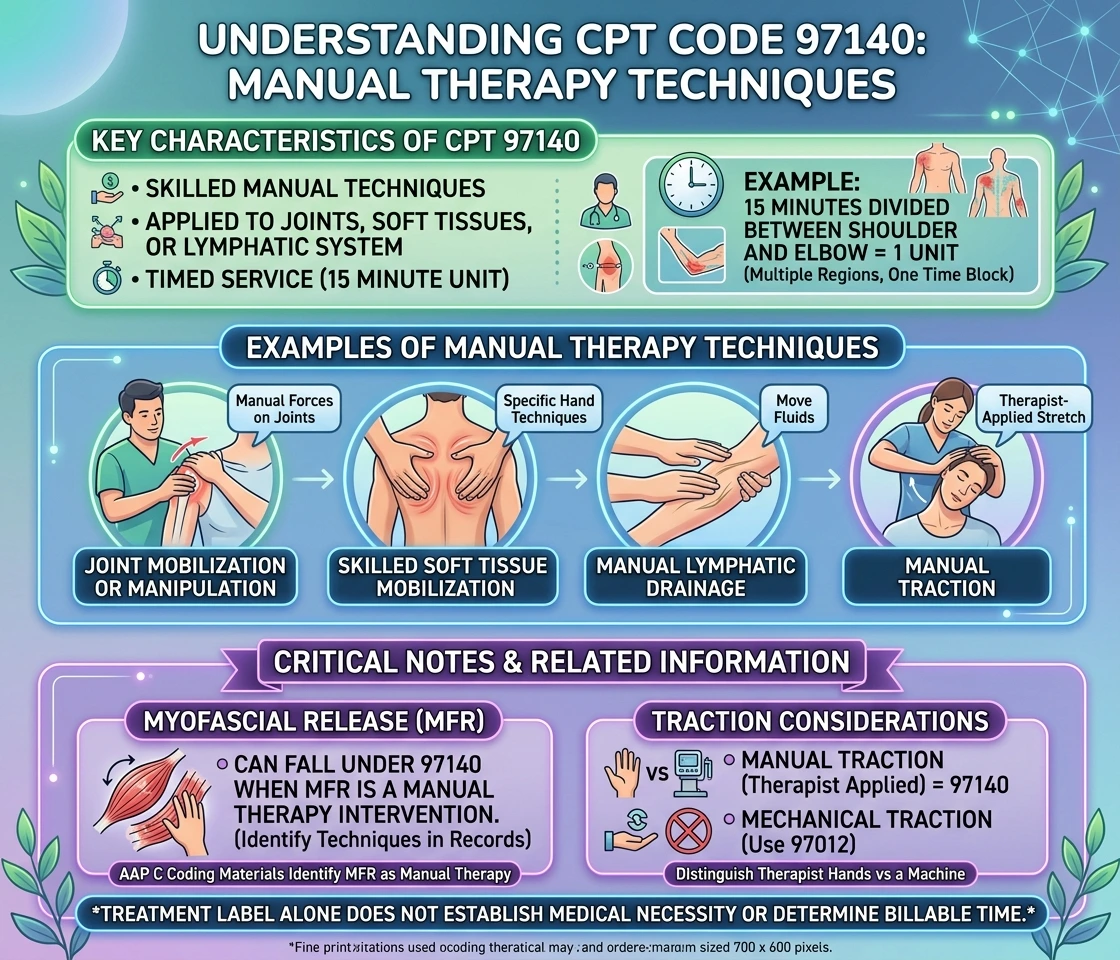
In plain language, the CPT code 97140 description covers manual techniques applied to joints, soft tissues, or the lymphatic system. Examples include:
- Joint mobilization or manipulation.
- Skilled soft tissue mobilization.
- Manual lymphatic drainage.
- Manual traction.
The AMA description includes one or multiple treatment regions within the same timed service. For example, dividing 15 minutes between the shoulder and elbow does not create two units merely because two areas were treated.
Myofascial release can fall under 97140 when the documented intervention constitutes manual therapy. AAPC’s coding education materials identify myofascial release among manual therapy techniques. The treatment label alone, however, does not establish medical necessity or determine the billable time.
Manual traction also belongs within this code family. Mechanical traction uses a different code, 97012, so the record should distinguish therapist-applied traction from treatment delivered through a traction device.
When is manual therapy medically necessary?
Medicare evaluates whether therapy requires professional skills and is reasonable and necessary for the patient’s condition. A diagnosis alone does not explain why repeated manual treatment is needed.
For rehabilitative care, the record should connect the impairment to a functional limitation and the planned intervention. An illustrative shoulder case might identify restricted motion that interferes with dressing, describe the mobility restriction being addressed, and explain how treatment supports the established goals.
Improvement is not an absolute condition of Medicare coverage. Skilled maintenance therapy can qualify when professional care is necessary to maintain function or prevent or slow deterioration. CMS addresses this distinction in its therapy coverage guidance.
Avoid treating visit counts as universal coverage limits. Local Medicare article A56566, revised April 1, 2026, calls for documentation supporting continued manual therapy beyond 12–18 visits. That is a jurisdiction-specific documentation provision, not a nationwide automatic cutoff.
How to calculate CPT 97140 units of service
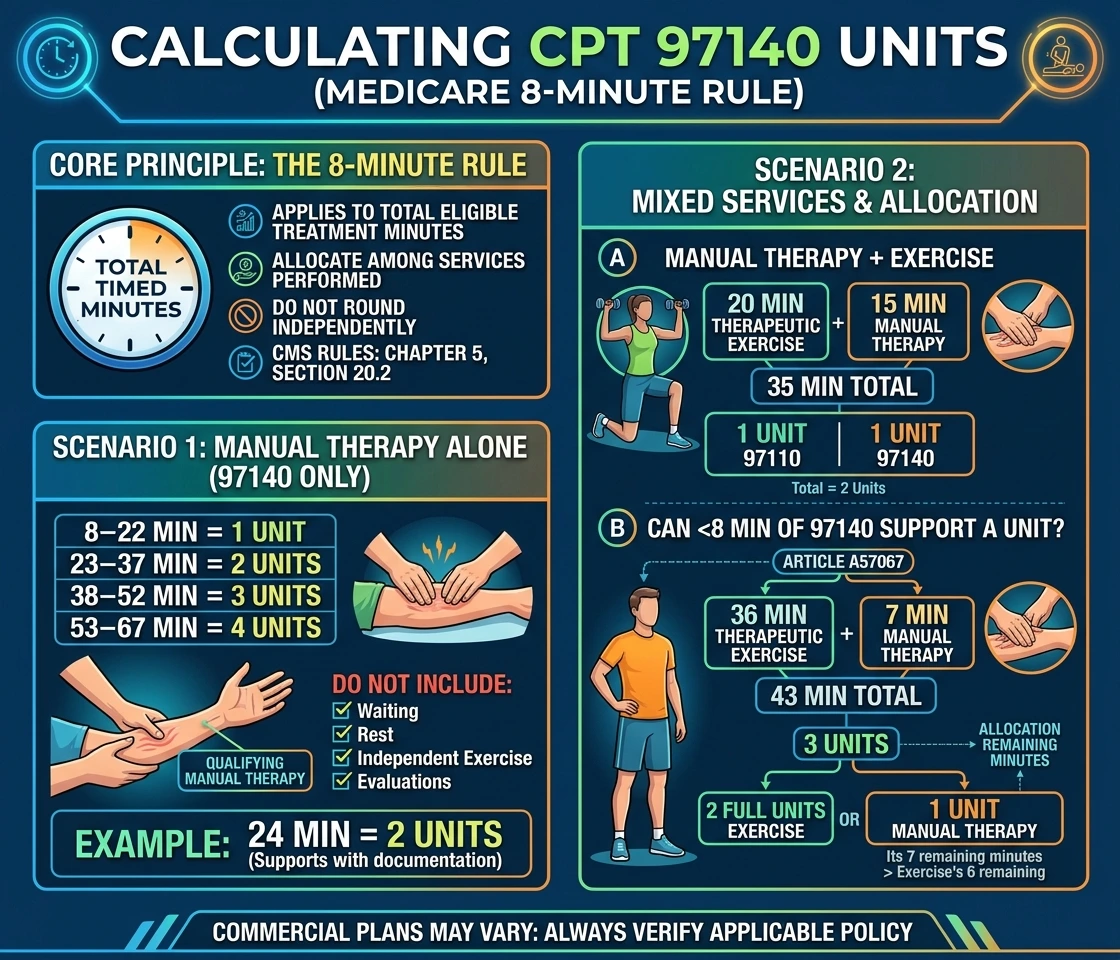
For Medicare outpatient therapy, the 8-minute rule applies to the total eligible timed treatment minutes, followed by allocation among the services performed.
When 97140 is the only timed service, 8–22 minutes support one unit, 23–37 support two, 38–52 support three, and 53–67 support four. Fewer than eight minutes do not support a unit in that single-service situation.
Only qualifying treatment time belongs in the calculation. Waiting, rest periods, and independent exercise do not become manual therapy minutes. Evaluation time and other untimed services must be handled separately. CMS explains these rules in the Medicare Claims Processing Manual, Chapter 5, section 20.2.
Example: Manual therapy alone
A therapist provides 24 minutes of skilled manual therapy, with no other timed treatment that day. Under Medicare’s time ranges, this supports two units of 97140, assuming coverage and documentation requirements are satisfied.
Example: Manual therapy plus exercise
Consider 20 minutes of therapeutic exercise and 15 minutes of manual therapy. The 35-minute total supports two timed units: one of 97110 and one of 97140.
Do not round each service independently and produce more units than the total allows.
Can fewer than eight minutes of 97140 support a unit?
Sometimes, within a mixed-service session.
CMS-hosted article A57067 illustrates 36 minutes of therapeutic exercise and seven minutes of manual therapy. The 43-minute total supports three units. Exercise receives two full units; manual therapy receives the remaining unit because its seven remaining minutes exceed exercise’s six remaining minutes.
Thus, “97140 always requires eight minutes by itself” is an incomplete statement of Medicare’s allocation method. Commercial plans may specify another methodology, so verify the applicable policy.
CPT 97110 vs. 97140 and 97124 vs. 97140
These codes describe different services, even when treatment addresses the same complaint.
Code | Service represented | Coding distinction |
97140 | Manual therapy | Identify the manual technique and treatment region |
97110 | Therapeutic exercise | Identify exercise directed at strength, endurance, range of motion, or flexibility |
97124 | Massage | Identify massage techniques such as stroking, kneading, or percussion |
CMS’s therapy coding guidance distinguishes these services and, in local article A56566, excludes payment for 97124 on the same visit date as 97140. Check the applicable payer policy before billing both; different treatment labels do not establish separate coverage.
Billing 97110 and 97140 together can be appropriate for separately performed, supported services. Record the interventions clearly and avoid counting the same minutes twice. Medicare does not permit a clinician to report overlapping one-on-one therapeutic procedures as though each received separate direct treatment time.
Which 97140 modifiers apply?
A 97140 modifier can identify the therapy discipline, assistant involvement, or a distinct service. Those purposes should not be confused.
GP, GO, CQ, and CO
Medicare uses GP for services under a physical therapy plan and GO for services under an occupational therapy plan.
CQ identifies qualifying physical therapist assistant involvement; CO identifies qualifying occupational therapy assistant involvement. CMS applies specific allocation rules, including its de minimis standard. Services subject to the assistant payment adjustment are paid at 85% of the otherwise applicable Part B amount. Review CMS’s assistant-billing examples when therapists and assistants share treatment.
KX for services above the annual threshold
For calendar year 2026, Medicare’s KX threshold is $2,480 for physical therapy and speech-language pathology combined, with a separate $2,480 threshold for occupational therapy.
KX indicates that applicable requirements are met and the record supports continued medically necessary care. It does not create coverage for an unsupported service or function as a routine modifier on every manual therapy claim.
Modifier 59 with CPT 97140
Do not append modifier 59 merely because two procedures appear on the claim.
CMS’s April 2026 booklet, Proper Use of Modifiers 59, XE, XP, XS & XU, explains that these modifiers identify qualifying distinct services. Different diagnoses alone are insufficient. Use a more specific modifier when appropriate, and apply it to the correct code in the edited pair.
The booklet gives a useful example: 97140 and physical performance testing code 97750 may be separately reported when performed in distinct time blocks, with modifier 59 on 97750. It does not support billing both for overlapping time.
Before using a distinct-service modifier, review the applicable edit, its modifier allowance, and the documentation. Neither modifier 59 nor an X modifier guarantees payment.
Manual therapy with chiropractic manipulation
CMS’s 2026 NCCI Policy Manual, Chapter XI, prohibits separately reporting 97140 for treatment in a spinal region undergoing chiropractic manipulative treatment.
A different region may support separate reporting with 59 or XS when the provider is eligible to report those rehabilitation services under Medicare. Region separation does not override provider eligibility restrictions.
CPT 97140 documentation requirements
Medicare’s Benefit Policy Manual, Chapter 15, section 220.3, requires treatment-day documentation identifying the services, total timed treatment minutes, total treatment time, and the responsible professional’s signature and identification.
Recording minutes for each intervention is useful for reconciling units, but Medicare’s national treatment-note rule does not universally require a separate minute entry for every intervention. Distinct-service billing still needs documentation supporting the distinction claimed.
The broader record, including the evaluation, plan, and progress reports, should explain the skilled treatment and its clinical purpose.
An illustrative note fragment might read:
Right shoulder joint mobilization performed for 15 minutes to address restricted mobility affecting overhead dressing. Technique adjusted to patient tolerance. Shoulder flexion measured 110 degrees before treatment and 120 degrees afterward.
This is a fictional example, not a complete treatment note. Its useful features are specificity: region, intervention, time, functional context, and response. Actual records must describe actual findings.
What determines 97140 reimbursement?
There is no single nationwide 97140 reimbursement rate that applies to every claim. Medicare’s Physician Fee Schedule incorporates geographic adjustments, while the applicable year and payment policy also affect the amount.
To verify a Medicare allowance, use the CMS fee-schedule lookup for 97140 with the relevant year and locality, then review applicable adjustments. For commercial coverage, consult the contracted fee schedule. A billed charge is not evidence of the allowed amount.
Medicare’s multiple procedure payment reduction can reduce the practice-expense component of qualifying therapy services. Consequently, multiplying an unreduced single-unit allowance by the number of units may overstate expected reimbursement. Assistant adjustments can also affect payment.
Check the service, time, and modifier before submission
Use the 97140 CPT code for documented manual therapy that meets coverage requirements. Calculate units under the payer’s timing method, keep overlapping minutes out of separate services, and use modifiers only when their requirements are satisfied. A defensible claim allows a reviewer to trace the reported procedure, units, and modifier back to the treatment record.