ICD-10 Code for Overactive Bladder: Documentation & Billing Guide (Updated 2026)

  • Home
  • Uncategorized
  • ICD-10 Code for Overactive Bladder: Documentation & Billing Guide (Updated 2026)
ICD-10 Code for Overactive Bladder Documentation & Billing Guide (Updated 2026)

Overactive bladder (OAB) affects an estimated 7% to 27% of men and 9% to 43% of women in the United States, with prevalence climbing sharply with age. Despite being one of the most common urological diagnoses, it remains one of the most frequently miscoded conditions in medical billing – resulting in claim denials, audit exposure, and lost revenue for practices.

This guide covers every ICD-10 code you need for accurate OAB documentation and billing, including the latest 2026 ICD-10-CM updates effective October 1, 2025, along with expert-level documentation standards, CPT-to-diagnosis crosswalks, and critical billing errors that trigger payer scrutiny.

What Is Overactive Bladder? Clinical Definition for Coders

Before selecting a diagnosis code, it helps to understand the clinical picture that supports it.

Overactive bladder is defined as a symptom complex – not a single disease – characterized by urinary urgency, with or without urge incontinence, usually accompanied by increased daytime frequency and nocturia, in the absence of urinary tract infection or other detectable pathology.

The key symptom that separates OAB from simple urinary frequency is urgency – the sudden, compelling desire to void that is difficult to defer. A patient who voids 15 times per day without urgency does not meet clinical criteria for N32.81. The correct code in that case would be R35.0 (Frequency of micturition), not OAB.

This clinical distinction is also a billing distinction. Coders and providers must read documentation carefully and not assume OAB when urgency is not explicitly stated.

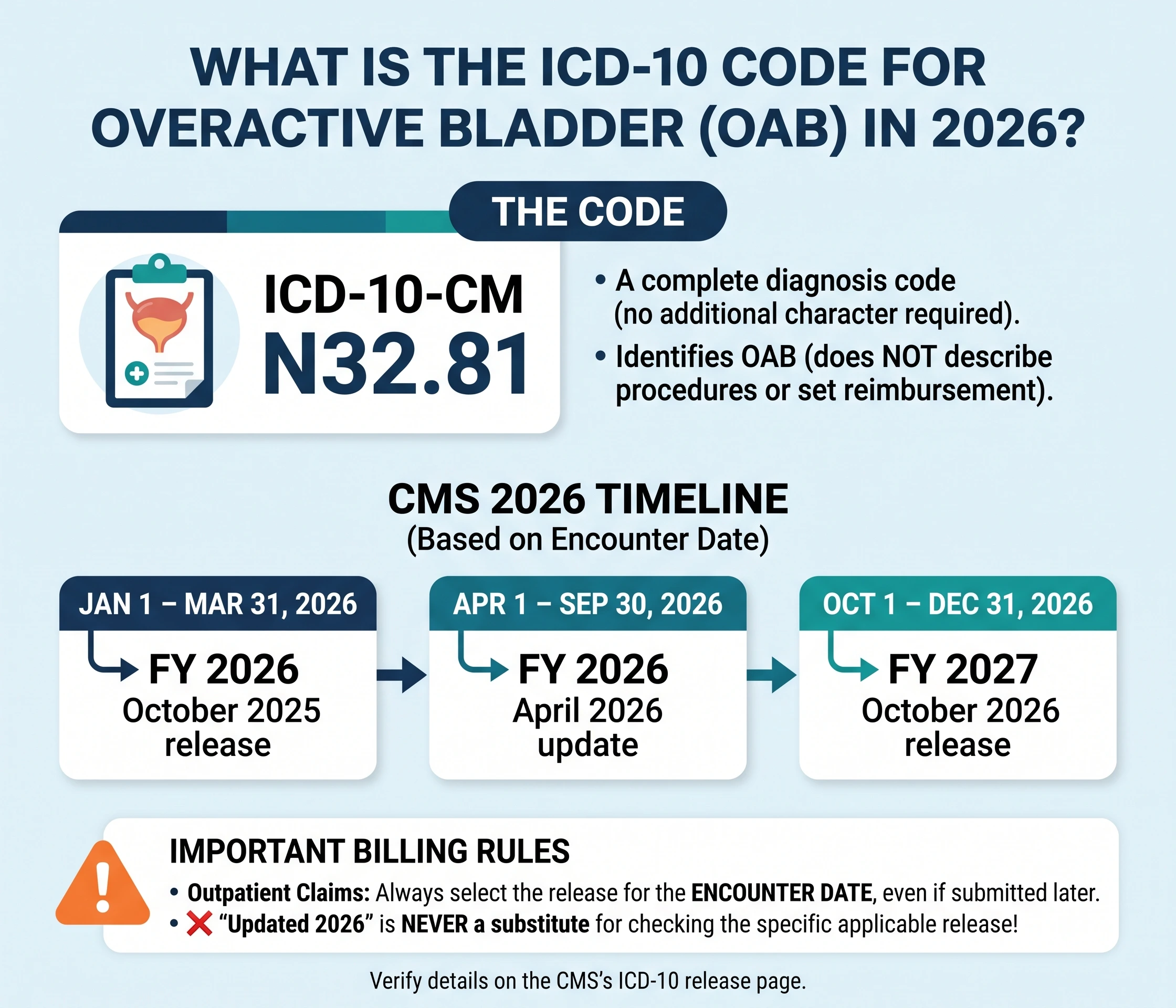
Primary ICD-10 Code for Overactive Bladder: N32.81

N32.81 – Overactive Bladder

The official, billable ICD-10-CM code for overactive bladder is N32.81. This is a final-level (“leaf”) code, meaning you cannot go deeper in specificity – and you should never use the parent code N32.8 for billing purposes.

2026 Status: Valid for HIPAA-covered transactions from October 1, 2025 through September 30, 2026 (MS-DRG v43.0). It falls under Chapter 14 – Diseases of the Genitourinary System, within the N30-N39 subcategory for other disorders of the urinary system.

MS-DRG Groupings for N32.81 (v43.0):

  • DRG 698 – Other kidney and urinary tract diagnoses with MCC
  • DRG 699 – Other kidney and urinary tract diagnoses with CC
  • DRG 700 – Other kidney and urinary tract diagnoses without CC/MCC

The reimbursement weight assigned to the encounter depends on the presence of major complications or comorbidities (MCC) and complications or comorbidities (CC) documented in the record. Thorough documentation of comorbid conditions – hypertension, diabetes, obesity – directly affects DRG assignment and reimbursement.

What Documentation Must Support N32.81?

Before assigning N32.81, the clinical record must explicitly reflect:

  • Urinary urgency – The hallmark symptom. The chart must state this directly, not imply it.
  • Voiding frequency – How many times per day does the patient void? How many episodes at night? Document quantified numbers.
  • Duration of symptoms – How long has the condition been present? Weeks? Months? Duration establishes chronicity and supports medical necessity for ongoing treatment.
  • Exclusion of neurological cause – If the bladder dysfunction stems from multiple sclerosis, Parkinson’s disease, spinal cord injury, or stroke, N32.81 is not appropriate. Use the N31.x series (neuromuscular dysfunction of the bladder) instead.
  • Exclusion of infection – Urinalysis results must confirm that no active urinary tract infection is driving the symptoms. A note such as “Urinalysis negative; post-void residual normal; no neurologic abnormalities identified” satisfies this requirement and demonstrates diagnostic rigor.

ICD-10 Code for Overactive Bladder Unspecified

When the provider has not yet established a confirmed OAB diagnosis – or when clinical documentation lacks enough detail to support N32.81 – the applicable code is:

N32.9 – Disorder of bladder, unspecified

The ICD-10 code for overactive bladder, unspecified, should be used only when documentation genuinely cannot support specificity. It should never be used as a shortcut. Unspecified codes carry lower reimbursement weight, weaken the case mix index (CMI), and flag claims for payer scrutiny.

Best practice: When N32.9 is assigned, query the treating provider to obtain additional clinical detail. If the provider confirms OAB based on their clinical assessment, update the record and resubmit with N32.81.

ICD-10 Code for Overactive Bladder With Incontinence

One of the most common coding gaps in urology billing is failing to distinguish between OAB without incontinence (OAB-dry) and OAB with incontinence (OAB-wet). These are not coded the same way.

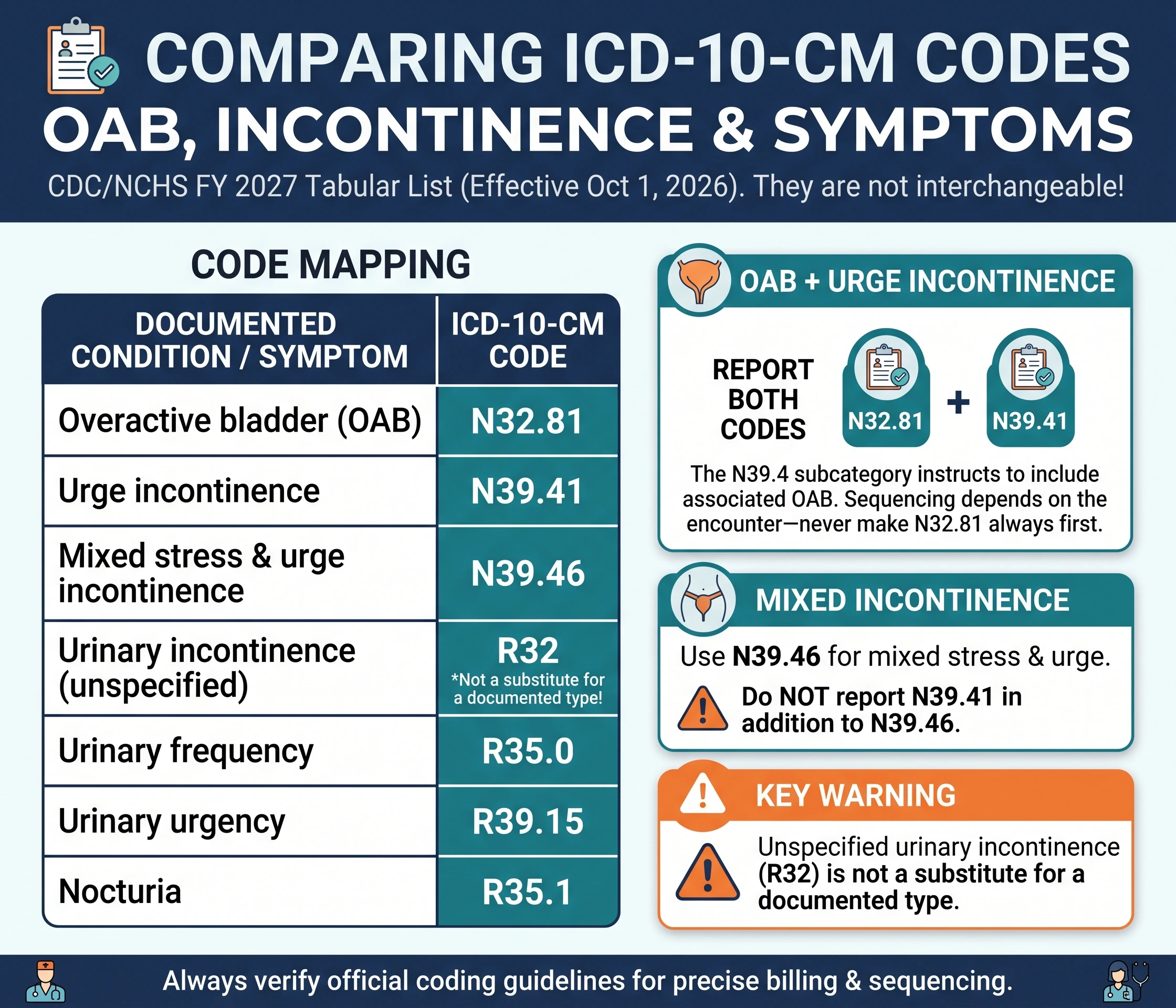
N32.81 covers both presentations on its face. However, when urge incontinence is documented, best practice – and the ICD-10-CM official guidelines – direct coders to additionally assign N39.41. The two codes are not mutually exclusive and work together on the same claim to paint a complete clinical picture.

This distinction matters for reimbursement because certain treatments – intradetrusor Botox (CPT 52287), sacral neuromodulation, and PTNS – may require documentation of incontinence to meet payer medical necessity criteria.

ICD-10 Incontinence Code Comparison Table

Conditions ICD-10 Codes Notes
Urge incontinence N39.41 Use with N32.81 when OAB is also documented
Stress incontinence (female/male) N39.3 Leakage triggered by exertion, cough, or sneeze
Mixed incontinence N39.46 Both stress and urge components were documented
Incontinence without sensory awareness N39.42 Patient is unaware of the leakage episode
Post-void dribbling N39.43 Dribble after voiding is complete
Nocturnal enuresis N39.44 Involuntary loss during sleep
Continuous leakage N39.45 Constant urine leakage
Urinary incontinence, unspecified R32 Use only when type is not documented


Urge Incontinence ICD-10: N39.41 Explained

Urge incontinence ICD-10 code N39.41 identifies the involuntary passage of urine that occurs immediately following a sudden, strong urge to void. Clinically, this results from involuntary contractions of the detrusor muscle – also called detrusor overactivity or detrusor hyperreflexia.

N39.41 is valid for fiscal year 2026 (October 1, 2025 – September 30, 2026) and is grouped within MS-DRGs 695 and 696 (Kidney and Urinary Tract Signs and Symptoms).

Important coding rules for N39.41:

  • N39.41 and N32.81 can and should appear together when both OAB and urge incontinence are documented
  • Do not assign N39.41 alongside R39.15 (urgency of urination) – urgency is already embedded in the OAB definition, making dual coding redundant
  • Do not use N39.46 (mixed incontinence) unless the notes clearly support both urge and stress components simultaneously
  • N39.41 applies to both male and female patients – it carries no gender restriction

Documentation language that supports N39.41: Phrases such as “patient cannot make it to the bathroom in time,” “leaks before reaching the toilet,” or “involuntary urine loss following a sudden urge” all provide the clinical foundation for this code.

Urinary Incontinence ICD-10: Full Code Set

Understanding the complete urinary incontinence ICD-10 landscape prevents both undercoding and overcoding. The ICD-10-CM system provides a specific code for virtually every type of bladder leakage. Using vague codes like R32 when specificity is available triggers claim denials and audit flags.

Key Urinary Incontinence Codes – 2026 Edition

Code Description When to Use
N39.3 Stress incontinence Leakage with cough, sneeze, lifting, exercise
N39.41 Urge incontinence Leakage immediately after or with a strong urge
N39.42 Incontinence without sensory awareness Patient is unaware until the leak occurs
N39.43 Post-void dribbling Dribbling after completing void
N39.44 Nocturnal enuresis Involuntary voiding during sleep
N39.45 Continuous leakage Constant uncontrollable urine loss
N39.46 Mixed incontinence Documented stress AND urge components
N39.490 Other specified incontinence Incontinence type not fitting above
R32 Urinary incontinence, unspecified Only when the type is truly not documented

An important note under the N39.3 code instructs coders to also document an associated overactive bladder if applicable. This means a patient with stress incontinence who also has OAB symptoms should carry both N39.3 and N32.81 on the same claim.

ICD-10 Code for Nocturia: R35.1

Nocturia – waking at night one or more times to urinate – is a distinct, billable symptom in ICD-10-CM and one of the most underreported secondary codes in urology billing.

R35.1 – Nocturia is the specific code for nocturnal urinary frequency. It is separate from R35.0 (Frequency of micturition), which covers daytime frequency only.

When to Code R35.1

  • When nocturia is the primary complaint at the encounter, and no underlying diagnosis has been confirmed
  • As a secondary code alongside N32.81, when the provider documents nocturia as a separately addressed condition during the visit
  • When billing urodynamic studies (CPT 51725–51797) – including R35.1 alongside N32.81 strengthens the clinical rationale for testing

Clinical Note on Nocturia

Nocturia is not always a bladder problem. It can be driven by congestive heart failure, diabetes insipidus, sleep apnea, or medication side effects. When nocturia results from a systemic condition (e.g., E11.21 – Type 2 diabetes mellitus with diabetic nephropathy), code the underlying condition, not just R35.1. The sequencing order should reflect the primary reason for the encounter.

CPT-to-Diagnosis Code Crosswalk for OAB Billing

Accurate ICD-10 coding is the foundation for procedure reimbursement. The following crosswalk reflects 2026 payer and CMS standards:

Procedure CPT Code Required ICD-10 Codes
Office visit (established patient, OAB) 99213–99215 N32.81 ± N39.41, R35.1
Urodynamic testing 51725–51797 N32.81 + symptom codes (R35.0, R35.1, N39.41)
Intradetrusor Botox injection 52287 N32.81 + N39.41 (if OAB-wet)
PTNS (percutaneous tibial nerve stimulation) 64566 N32.81 ± N39.41
Sacral neuromodulation trial 64561 N32.81 ± N39.41
Sacral neuromodulation permanent implant 64581 N32.81 ± N39.41
Telehealth OAB visit 99213–99215 N32.81; use POS 02 or 10, modifier -95

Modifier -25 is required when billing both an E/M service and a procedure on the same date of service. Failing to append modifier -25 when applicable is one of the leading causes of same-day claim denials in urology.

Prior Authorization Requirements for Advanced OAB Therapies

Prior authorization (PA) requirements vary by payer, but the following standards reflect common 2025–2026 commercial and Medicare Advantage policies:

Botox (CPT 52287): 

Most payers require documented failure of at least two anticholinergic medications (each taken for a minimum of 4 weeks), along with a diagnosis of N32.81. PA is required before the procedure. The maximum cumulative dose is 400 units within any three months.

PTNS (CPT 64566): 

Traditional Medicare Fee-For-Service covers PTNS without prior authorization, subject to applicable Local Coverage Determination (LCD) guidelines. Medicare Advantage plans and commercial payers often require PA for more than 12 lifetime sessions and typically mandate that the patient has failed conservative therapy, including at least two anticholinergic agents.

Sacral Neuromodulation (CPT 64561, 64581): 

Phase I (trial period) prior authorization is required by most payers. Permanent implantation requires documented improvement of at least 50% in frequency or incontinence episodes from the trial phase. The patient must have experienced OAB symptoms for more than six months with significant functional limitation.

Documentation Best Practices for Clean OAB Claims

Strong clinical documentation is what separates a clean claim from a denied one. Here is what auditors and payer reviewers look for:

  • Quantify Everything “Patient voids 12 times per day and wakes twice nightly” is far stronger than “patient has urinary frequency.” Numbers support medical necessity, justify diagnostic testing, and prove symptom severity for advanced therapy authorization.
  • State Urgency Explicitly N32.81 requires documented urgency. “Patient reports sudden, strong urge to urinate” or “patient experiences urgency episodes with inability to defer” are both sufficient. Implied urgency does not hold up in an audit.
  • Document Treatment Escalation Before billing for Botox or neuromodulation, the record must show a progression of care: lifestyle modifications (fluid restriction, bladder training), pharmacotherapy (with drug names, doses, and duration), and the reason for escalation (side effects, lack of efficacy, patient preference).
  • Rule Out Competing Diagnoses Document that UTI has been excluded (urinalysis results), neurological causes have been considered, and post-void residual volume is within normal limits. This supports N32.81 over the N31.x neurogenic bladder series and protects against downcoding.
  • Use Validated Outcome Tools Reference the OAB-q (Overactive Bladder Questionnaire) or bladder diary results in your notes. These patient-reported outcome measures substantiate the severity of the condition and strengthen audit defense for high-complexity visits and procedure-based claims.

Common Billing Errors in OAB Coding

These are the most frequent mistakes that lead to claim denials, payment delays, and compliance risk:

Error 1

Continuing to use R39.15 after OAB is confirmed R39.15 (Urgency of urination) is a symptom code. Once OAB is clinically established, transition to N32.81. Using a symptom code for a confirmed diagnosis lacks the diagnostic specificity required for reimbursement and suggests inadequate documentation.

Error 2 

Using R32 when N39.41 is documentable. R32 (Urinary incontinence, unspecified) is appropriate only when the type of incontinence is genuinely unclear. If the provider has documented “urge incontinence,” assign N39.41. Defaulting to R32 downcodes the claim and creates a documentation-to-code mismatch that triggers audits.

Error 3

Assigning N32.81 for neurogenic bladder N32.81 is exclusively for idiopathic OAB — not for bladder dysfunction caused by neurological disease. If MS, Parkinson’s, spinal cord injury, or stroke is the underlying cause, move to the N31.x series. This error misrepresents the patient’s clinical complexity.

Error 4 

Omitting secondary symptom codes. Failing to separately code nocturia (R35.1), frequency (R35.0), or urge incontinence (N39.41) when these are separately addressed in the visit note understates the clinical complexity and may reduce E/M level support.

Error 5 

Missing modifier -25 on same-day E/M and procedure. When a urologist performs a urodynamic study or injects Botox on the same day as a separately identifiable E/M service, modifier -25 must be appended to the E/M code. Without it, the E/M service will be bundled and denied.

Error 6 

Incorrect sequencing of principal diagnosis. The code reflecting the primary reason for the encounter should be listed first. For a follow-up visit to adjust OAB medication, N32.81 is the principal. For a Botox injection procedure visit, the code supporting medical necessity for the procedure takes priority.

Breast Condition Codes That Appear in Multi-Specialty OAB Billing

In multi-specialty practices or integrated women’s health clinics, urology coders frequently encounter breast diagnosis codes on the same patient record. Two of the most commonly queried codes are:

Fibrosclerosis of Breast ICD-10

Fibrosclerosis of the breast ICD-10 codes fall under the N60.3 category. N60.3 as a parent code is non-billable – you must use the laterality-specific child codes for claim submission:

Codes Descriptions
N60.31 Fibrosclerosis of the right breast
N60.32 Fibrosclerosis of the left breast
N60.39 Fibrosclerosis of the unspecified breast

Fibrosclerosis of the breast represents a fibrocystic change marked by the prominence of fibrotic changes in the parenchyma. It is a benign condition but requires histological or imaging confirmation. Laterality must be documented in the provider note – imaging reports and biopsy results are your primary sources. The 2026 edition of N60.3x became effective October 1, 2025.

Critical Note: N60.3x applies when fibrosclerosis is confirmed. Do not use it for a suspected or unconfirmed finding – use an unspecified lump code (N63.x) until pathology or imaging confirms the diagnosis.

Lump in Overlapping Quadrants of Left Breast ICD-10

When a patient presents with a breast mass that spans more than one quadrant, and laterality is documented as the left breast, the correct code is:

N63.22 – Unspecified lump in overlapping quadrants of the left breast

The lump in overlapping quadrants of the left breast, ICD-10 code N63.22, is a 2026-valid, billable code. Related codes in this family include:

Codes Descriptions
N63.21 Unspecified lump in overlapping quadrants of the right breast
N63.10 Unspecified lump in right breast, unspecified quadrant
N63.20 Unspecified lump in left breast, unspecified quadrant
N63.0 Unspecified lump in unspecified breast

These N63.x codes are placeholder codes – they should be updated to a definitive diagnosis once mammography, ultrasound, or biopsy results are available. Continuing to bill N63.22 after a malignant or benign pathological diagnosis has been established is a coding error. Update to the appropriate malignancy code (C50.x) or benign neoplasm/fibrosclerosis code (N60.3x) once confirmed.

Quick Reference: Complete ICD-10 Code Table for OAB and Related Conditions

Condition ICD-10 Code 2026 Valid?
Overactive bladder N32.81 yes
Disorder of bladder, unspecified N32.9 yes
Urge incontinence N39.41 yes
Stress incontinence N39.3 yes
Mixed incontinence N39.46 yes
Urinary incontinence, unspecified R32 yes
Nocturia R35.1 yes
Frequency of micturition (daytime) R35.0 yes
Urgency of urination (symptom only) R39.15 yes
Neuromuscular dysfunction of bladder, unspecified N31.9 yes
Fibrosclerosis of right breast N60.31 yes
Fibrosclerosis of left breast N60.32 yes
Fibrosclerosis of unspecified breast N60.39 yes
Lump, overlapping quadrants, left breast N63.22 yes
Lump, overlapping quadrants, right breast N63.21 yes


Staying Current: Annual ICD-10-CM Update Checklist

ICD-10-CM codes update annually on October 1. The 2026 edition (effective October 1, 2025) confirmed N32.81 and N39.41 without changes, maintaining stability in the OAB coding framework. However, the genitourinary and breast disorder chapters see periodic refinements.

To stay compliant year-round:

  • Subscribe to CMS ICD-10-CM tabular update notifications at cms.gov
  • Cross-reference your practice management system’s code library against the updated CMS General Equivalence Mapping (GEM) files each October
  • Review applicable Local Coverage Determinations (LCDs) from your Medicare Administrative Contractor (MAC) for OAB-related procedures
  • Conduct quarterly internal audits on OAB claim denials to identify documentation gaps early
  • Train coding and clinical staff together – providers who understand the documentation requirements behind billing codes produce cleaner charts and fewer audit risks

Final Thoughts

Accurate ICD-10 coding for overactive bladder is not just an administrative task. It is a clinical compliance responsibility that directly affects patient care quality, practice revenue, and regulatory standing. Understanding the difference between N32.81 and R32, between N39.41 and N39.46, and between R35.1 and R35.0 is what separates a clean claim from a denied one.

Whether you are a urologist, urogynecologist, primary care provider, certified professional coder (CPC), or revenue cycle manager, keeping your documentation precise and your code selection specific is the highest-value investment you can make in your practice’s financial health.

For practices that want a reliable partner to handle the complexity of urology billing from end to end, A2Z Billings offers comprehensive medical billing and coding services designed to reduce claim denials, improve first-pass resolution rates, and keep your revenue cycle running clean. From selecting the right ICD-10 diagnosis codes like N32.81 and N39.41 to managing prior authorization for advanced OAB therapies like Botox and sacral neuromodulation, A2Z Billings brings the coding expertise and compliance rigor that urology and multi-specialty practices need in today’s demanding payer environment. 

Leave A Comment

Your email address will not be published. Required fields are marked *