93000 CPT Code Explained: ECG Procedure, Billing, and Reimbursement

  • Home
  • CPT
  • 93000 CPT Code Explained: ECG Procedure, Billing, and Reimbursement
93000 CPT Code ECG Billing and Reimbursement Guide
Introduction

If you have ever worked in a medical billing office, you already know how quickly a simple mistake on a claim can turn into a denial, a delay, or worse a compliance issue. The 93000 CPT code is one of those codes that looks easy on the surface but hides a surprising number of rules underneath. Get it right, and it processes cleanly. Get it wrong, and you are chasing down remittances for weeks.

This guide walks you through everything that the code actually means, how reimbursement works, which modifiers to use, what CMS expects, and how to pair it with the right diagnosis codes. Whether you are a biller, a coder, a nurse, or a physician trying to understand your own documentation requirements, this is written for you.

What Exactly Is the 93000 CPT Code?

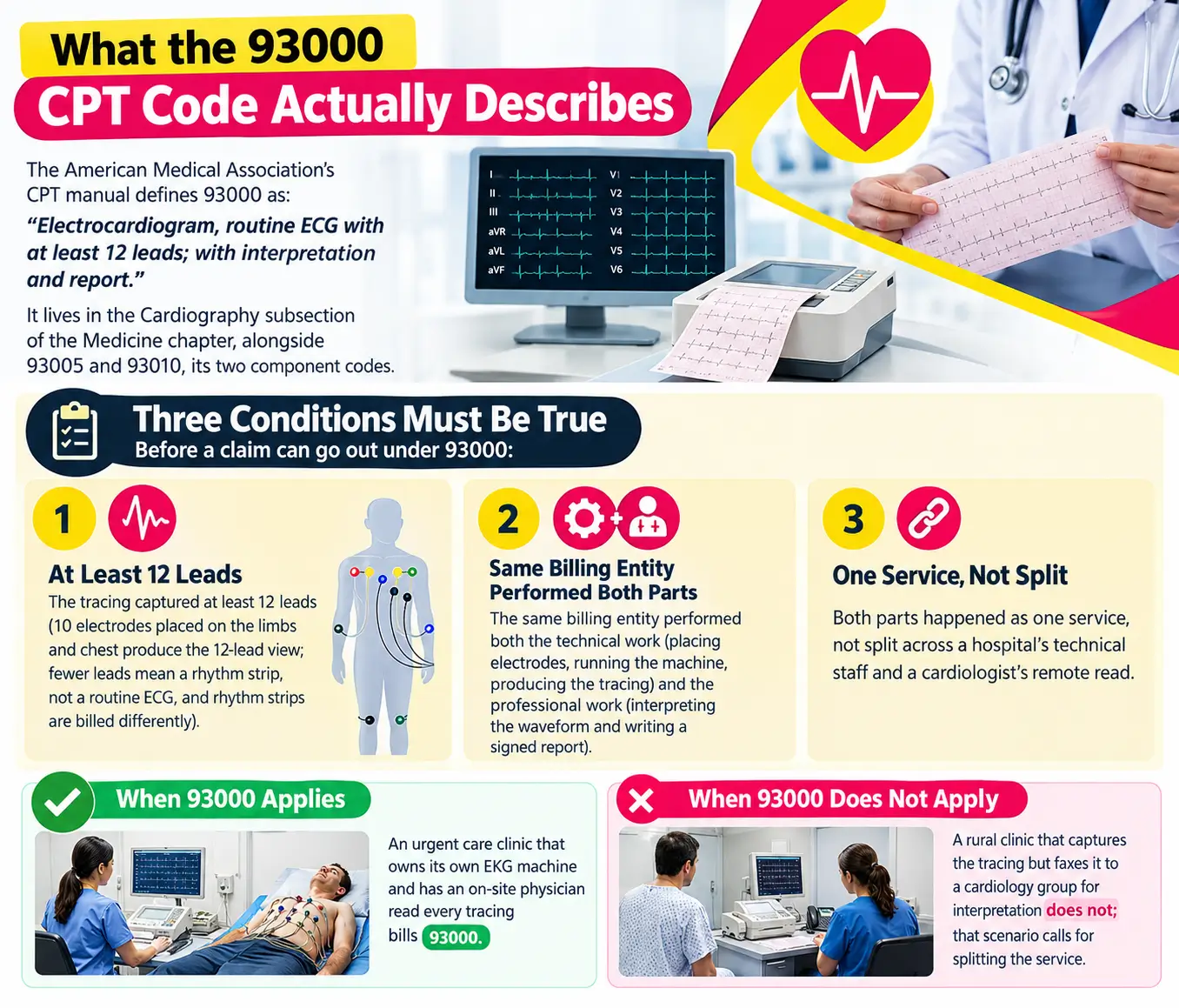
The 93000 CPT code represents a routine 12-lead electrocardiogram but not just any ECG. It specifically covers a complete service where one provider does everything performs the tracing, interprets the results, and produces a written report, all in a single encounter.

An electrocardiogram works by placing electrodes on the skin to detect and record the heart’s electrical signals. Those signals get translated into a visual waveform on paper or a screen. A trained provider then reads that waveform and draws clinical conclusions is the rhythm normal? Is there evidence of ischemia? Is the QT interval prolonged? That entire process, from skin contact to signed report, is what CPT 93000 is designed to capture and reimburse.

It sits within the Cardiovascular Medicine section of the AMA’s CPT manual, under Noninvasive Clinical Cardiac Electrophysiology. And while it is one of the most frequently used codes in outpatient medicine, it is also one of the most frequently miscoded often because providers and billers do not fully understand where 93000 ends and where its sibling codes begin.

93000 CPT Code Description: Breaking It Down Word by Word

The official 93000 CPT code description reads:

“Electrocardiogram, routine ECG with at least 12 leads; with interpretation and report.”

Every part of that sentence carries weight. Let us go through it.

Routine ECG this is not a stress test, a Holter monitor, or a signal-averaged ECG. It is a standard resting electrocardiogram. If the test involves exercise, a treadmill, or prolonged monitoring, you are looking at entirely different codes.

At least 12 leads this is a hard floor. A rhythm strip which might record just one or two leads does not qualify. You need the full 12-lead configuration to bill 93000 legitimately.

With interpretation and report this is where a lot of providers trip up. Interpretation means an actual physician or qualified healthcare professional reviewed the tracing and applied clinical judgment. A computer-generated summary alone does not satisfy this requirement. The provider has to personally engage with the data. And “report” means a written, signed document not a verbal comment during the visit, not a checkbox in the chart, and not just the machine’s automatic printout. The interpretation must be individually and clearly identifiable in the medical record.

Same provider, same encounter this is implied by the global nature of the code. If the tracing is done at one facility and the interpretation is done by a different physician somewhere else, 93000 does not apply. You would use 93005 for the technical component and 93010 for the professional component instead.

Understanding this distinction between 93000, 93005, and 93010 is foundational. Billing 93000 in a split-service scenario is one of the most frequently flagged issues during recovery audits.

93000 CPT Code Reimbursement: What Can You Actually Expect?

The 93000 CPT code reimbursement is modest and that surprises many people when they first see the numbers. Medicare’s national average payment for a global ECG service falls roughly between $17 and $21, depending on the year and the geographic locality adjustment applied to your area.

That figure comes from the Medicare Physician Fee Schedule, which CMS updates annually. Each year, a new conversion factor is applied to the Relative Value Units (RVUs) assigned to the code, and that math produces the final payment. Because the GPCI Geographic Practice Cost Index varies by region, a practice in Manhattan may see a slightly different reimbursement than one in rural Mississippi.

Here is a general breakdown by payer type:

Payer Typical Reimbursement Range
Medicare $17 – $21
Medicaid $8 – $18 (varies significantly by state)
Commercial Insurance $20 – $50+
Self-Pay / Uninsured $50 – $200+ (chargemaster rates)

Commercial payers typically reimburse more than Medicare, but that depends entirely on your negotiated contract rate. Some insurers peg their ECG rates at 110% or 120% of Medicare others negotiate flat fees. If your practice does high ECG volume, even small differences in reimbursement per claim add up quickly across a year.

One important nuance: in a hospital outpatient setting, the facility bills a technical component for running the machine and the reading physician bills a professional component for the interpretation. The facility uses 93005; the physician uses 93010 with modifier -26. Neither bills 93000. Mixing this up is an overpayment scenario that RAC auditors actively pursue.

93000 CPT Code Age Limit: Is There a Restriction?

This is a question that comes up often, and the answer requires a bit of nuance. There is no 93000 CPT code age limit built into the code itself. You can bill it for a two-week-old infant with a suspected arrhythmia or an 85-year-old with new-onset palpitations. The CPT code does not discriminate by age.

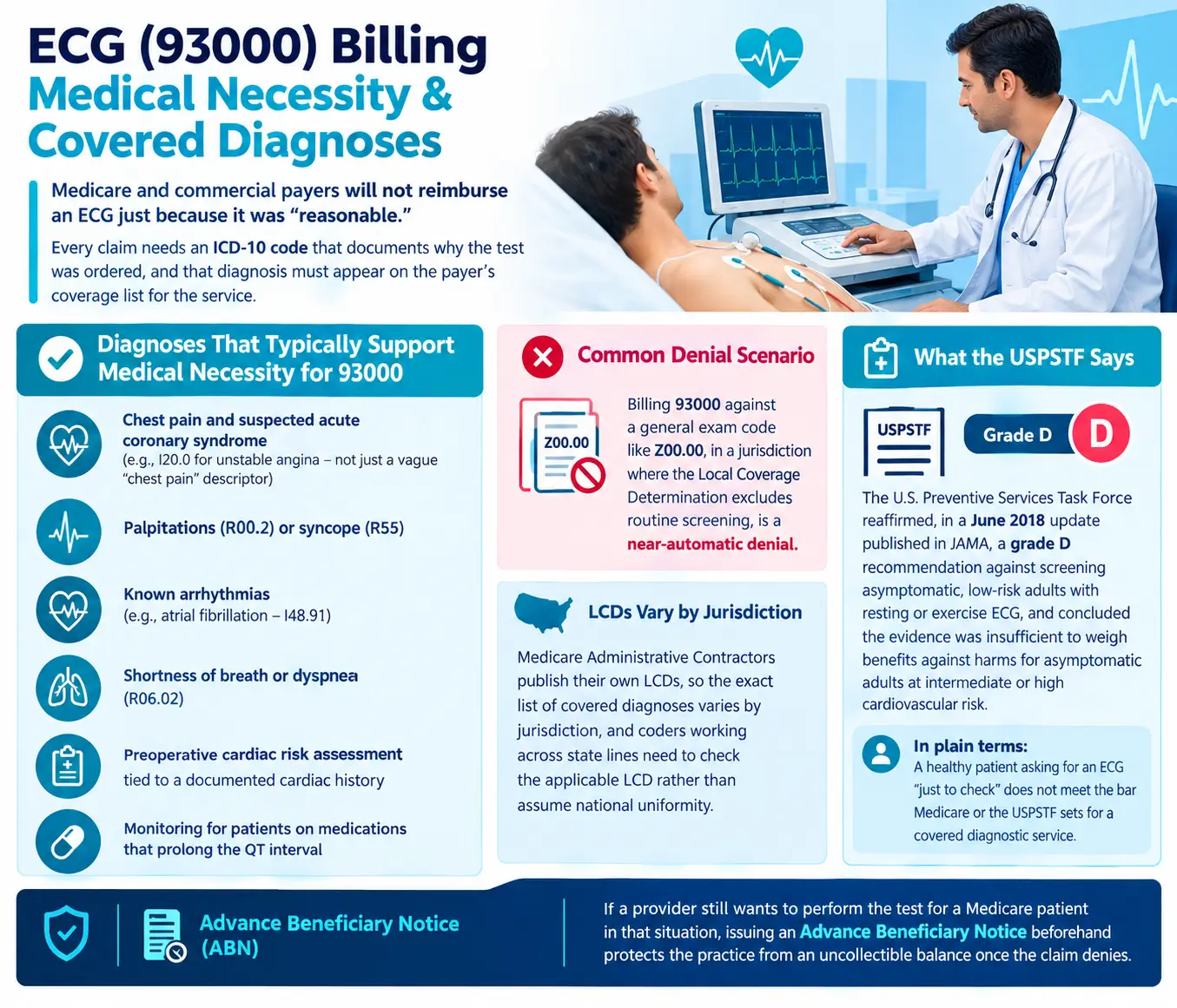
What does matter, though, is medical necessity and that is where age can become indirectly relevant. Some Medicare Advantage plans and commercial payers apply heightened scrutiny to ECGs ordered on young, healthy, asymptomatic patients. This is largely driven by clinical guidelines. The U.S. Preventive Services Task Force has stated that routine ECG screening in low-risk adults without symptoms does not provide a net health benefit, and therefore should not be covered as a preventive service.

That means if you are ordering an ECG on a 28-year-old with no symptoms, no risk factors, and no documented clinical indication simply as a “baseline” you may find yourself with a denied claim, regardless of the patient’s age. The age is not the problem. The missing justification is.

For pediatric patients, particularly those with congenital heart conditions or on medications that affect cardiac conduction, 93000 is entirely appropriate and generally well-supported by payers with proper documentation.

93000 CPT Code Modifier: When to Add One and Which to Choose

Modifiers exist to give payers additional context about how a service was delivered. Knowing the right 93000 CPT code modifier for each scenario is one of the more practical billing skills you can develop.

Here are the modifiers most commonly used with CPT 93000:

Modifier 26 (Professional Component) use this when a physician interprets an ECG tracing that was performed by a separate facility or technical provider. You would append this to 93010, not 93000 but understanding it helps clarify the global vs. split billing logic.

Modifier TC (Technical Component) used by the facility when they perform only the tracing portion of the ECG, without any interpretation. Again, this pairs with 93005 in a split scenario.

Modifier 59 (Distinct Procedural Service) this one comes into play when 93000 is billed alongside other procedures on the same date of service, and there is a legitimate reason it should not be bundled. The ECG must be genuinely separate and distinct not just a routine part of the visit. Documentation must support this clearly.

Modifier 52 (Reduced Services) rarely used for ECGs, but applicable if fewer than 12 leads were recorded due to patient circumstances for example, a skin condition that prevented standard electrode placement. The medical record must clearly explain why the full service could not be completed.

Modifier GZ (Item or Service Expected to Be Denied) this is used when you are performing an ECG for a reason that Medicare is unlikely to cover typically a preventive screen in an asymptomatic, low-risk patient and the patient has not signed an ABN. It signals to the payer that the provider expects the denial and is not attempting to waive Medicare’s rules improperly.

When one provider performs the full global ECG service tracing, interpretation, and report in a single encounter, no modifier is needed. Adding one unnecessarily can actually confuse the claim and create processing issues.

93000 CPT Code CMS Guidelines: What Medicare Actually Requires

The 93000 CPT code CMS guidelines are embedded across several policy documents the Medicare Physician Fee Schedule, the National Coverage Determinations database, and the guidance issued by individual Medicare Administrative Contractors. Together, they paint a clear picture of what CMS expects.

The central requirement is medical necessity. CMS will not reimburse for an ECG simply because a provider thought it was a good idea. There must be a documented clinical reason symptoms, risk factors, a known condition, or a specific monitoring need that reasonably connects the test to the patient’s care.

Beyond that, CMS expects:

  • The ordering provider’s clinical indication to appear somewhere in the medical record, ideally in the visit note or order.
  • A signed, written interpretation from the reading provider that goes beyond the machine’s automated output.
  • That interpretation to be individually identifiable meaning a reader looking at the chart can clearly distinguish the physician’s findings from the computer’s analysis.

One thing that trips up a lot of practices is the question of what constitutes a “written report.” A brief physician note that says “ECG reviewed, normal sinus rhythm, no acute changes” is far stronger than a machine printout with a signature. If the physician found something abnormal, the report should describe it the specific finding, the clinical significance, and any recommended next steps.

93000 CPT Code LCD: How Local Policies Affect Your Claims

While CMS sets the national framework, Medicare Administrative Contractors issue Local Coverage Determinations LCD that define medical necessity criteria for their specific jurisdiction. The 93000 CPT code LCD landscape means the exact coverage rules you follow depend on which MAC processes claims for your region.

The major MACs include Noridian (serving the West and parts of the Midwest), Novitas (covering a large portion of the Eastern United States), CGS (handling Kentucky, Ohio, and Parts of the Southeast), and others. Each MAC may have slightly different thresholds for what counts as a covered indication.

That said, most LCDs for ECG services share a common core of accepted medical necessity criteria:

  • Chest pain, pressure, tightness, or discomfort
  • Palpitations, fluttering, or racing heartbeat
  • Syncope, near-syncope, or unexplained dizziness
  • Shortness of breath with suspected cardiac origin
  • Pre-operative evaluation for patients with cardiac risk factors
  • Monitoring patients on QT-prolonging medications or antiarrhythmics
  • Evaluation after a cardiac event such as a heart attack, ablation, or cardioversion
  • Known diagnosis of arrhythmia, heart failure, or coronary artery disease requiring ongoing monitoring

Checking your specific MAC’s LCD before billing is not optional it is the difference between a clean claim and a prepayment review.

93000 CPT Code ICD-10 and Diagnosis Pairing

Every claim for CPT 93000 needs at least one ICD-10 diagnosis code that justifies the procedure. This is the 93000 CPT code ICD-10 requirement, and it is one of the most common sources of claim denials when it is vague, missing, or mismatched.

The 93000 CPT code diagnosis should reflect what is actually documented in the visit note — not what you think is happening with the patient, but what the provider has written down. Here are the most commonly used ICD-10 pairings:

ICD-10 Code Description
R00.0 Tachycardia, unspecified
R00.1 Bradycardia, unspecified
R00.8 Other abnormalities of heart beat
R07.9 Chest pain, unspecified
R07.89 Other chest pain
R55 Syncope and collapse
I48.0 Paroxysmal atrial fibrillation
I48.11 Longstanding persistent atrial fibrillation
I25.10 Coronary artery disease, unspecified vessel
I50.9 Heart failure, unspecified
Z13.6 Screening for cardiovascular disorders
T36–T65 Poisoning or adverse effect of cardiac-affecting drugs

Code to the highest level of specificity the documentation supports. If the record says “atrial fibrillation,” find out whether it is paroxysmal, persistent, or longstanding each has its own code, and vague unspecified codes draw more scrutiny than specific ones.

Also be cautious with Z13.6 screening codes. Using a screening diagnosis for a symptomatic patient is incorrect, and using it for Medicare patients without verifying coverage for preventive ECGs in your MAC’s LCD can result in denial.

Practical Billing Tips to Avoid Denials

  • Confirm that one provider did the tracing and the interpretation. If not, switch to 93005 and 93010.
  • Make sure the medical record contains a documented clinical reason for the ECG before you bill.
  • Verify that the physician’s written interpretation is in the chart not just the machine printout.
  • Match the ICD-10 code to what the provider actually documented, at the highest specificity available.
  • Check your MAC’s LCD to confirm the indication qualifies as medically necessary under your region’s policy.
  • If the ECG is for a preventive reason not covered by Medicare, issue an ABN before the service is performed.
  • Do not add modifiers unless the service genuinely requires them.
  • Audit a sample of your 93000 claims quarterly to catch documentation gaps before a payer does.

Final Thoughts

The 93000 CPT code is not complicated in theory it is a routine 12-lead ECG billed as a global service by one provider. But in practice, the details matter enormously. The difference between 93000 and its sibling codes, the CMS and LCD documentation expectations, the right ICD-10 pairing, and the careful use of modifiers all come together to determine whether your claim pays cleanly or lands in a denial queue. The providers and billing teams that consistently get this right are not doing anything extraordinary. They simply have clear documentation habits, they know their MAC’s rules, and they treat every ECG claim with the same attention they give to higher-dollar procedures. That discipline, applied consistently, keeps revenue flowing and keeps auditors uninterested. When the documentation is solid and the coding is accurate, the 93000 CPT code is one of the smoothest-processing codes in cardiovascular medicine. The goal is to keep it that way.

Make An Appintment With A2Z

FAQs

Yes, CPT 93000 can be billed on the same day as an evaluation and management (E/M) visit but only if the ECG was performed for a separate and distinct reason from the office visit itself. In that case, you may need to append modifier -59 to indicate it was a distinct service. However, if the ECG was simply part of the routine workup during the visit and the interpretation is already reflected in the visit note, some payers will bundle it. Always check your specific payer's bundling policy before billing both on the same date.

This is one of the most common documentation mistakes. If the physician simply glances at the machine-generated printout and signs it without adding their own clinical commentary, most payers including Medicare will consider the interpretation insufficient. A valid report needs to reflect the physician's independent review, including findings such as rate, rhythm, intervals, and any abnormalities noted. Without that, the claim is at risk of denial or recoupment during an audit. A few sentences of genuine clinical interpretation go a long way toward protecting the claim.

Generally, no not under traditional Medicare. Medicare requires medical necessity for ECG reimbursement, and routine screening of asymptomatic, low-risk patients does not meet that threshold. The U.S. Preventive Services Task Force also advises against routine ECG screening in low-risk adults. If you perform an ECG for purely preventive reasons on a Medicare patient, you should issue an Advance Beneficiary Notice (ABN) beforehand so the patient understands they may be responsible for the cost. Some commercial plans do cover preventive ECGs, so always verify the individual patient's benefit.

CPT 93000 is the global code it covers the complete ECG service, meaning one provider performs the tracing, interprets it, and writes the report. CPT 93010, on the other hand, covers only the interpretation and report, without the technical tracing component. You would use 93010 when a physician reads and reports on an ECG tracing that was performed by a different provider or facility. In that split-service scenario, the facility bills 93005 for the tracing, and the reading physician bills 93010 often with modifier -26 on their professional claim.

There is no universal frequency limit built into CPT 93000 itself, but payers can flag or deny claims when ECGs are billed too frequently for the same patient without clear clinical justification. Medicare and commercial insurers expect each ECG to be supported by its own documented medical necessity. For patients with stable, chronic conditions, billing an ECG at every single visit without new symptoms or clinical changes will likely draw scrutiny. As a general rule, each claim should stand on its own with a specific reason documented in that visit's record that explains why the ECG was ordered that day.

Leave A Comment

Your email address will not be published. Required fields are marked *