


Medical practices do not generate all their revenue directly from insurance carriers. A large and growing segment of healthcare income originates straight from the consumer’s wallet. This financial shift makes understanding exactly what is patient responsibility in medical billing a strict requirement for anyone working in revenue cycle management.
Patient financial responsibility is the specific dollar amount an individual legally owes a clinic or hospital after the health insurance payer processes a medical claim. This debt exists separately from the monthly premiums an individual pays to maintain their active health coverage.
With commercial insurance markets heavily favoring high-deductible health plans, the portion of medical bills paid directly by individuals continues to climb. Medical billers spend hours analyzing insurance contracts, adjusting gross charges, and applying out-of-pocket rules to guarantee practices collect the correct patient payment.
What does patient responsibility mean?

To grasp the patient liability meaning in medical billing, you must look at the legal boundaries established by network contracts. Insurance companies negotiate strict payment caps with in-network doctors.
These payment caps are called allowed amounts.
The allowed amount dictates the maximum revenue a provider can collect for a specific billing code. An individual’s debt to the clinic stems entirely from this negotiated cap, never from the provider’s original sticker price. If an orthopedic surgeon charges $500 for a consultation, but the insurance network contract limits the fee to $210, all out-of-pocket calculations use the $210 figure.
Consumers bear a heavy financial burden under modern insurance models. According to the Kaiser Family Foundation’s 2023 Employer Health Benefits Survey, single-coverage annual deductibles averaged $1,735. Because of these high thresholds, clinics now operate much like retail businesses. They must collect thousands of dollars directly from individuals rather than receiving guaranteed bulk checks from clearinghouses.
Types of patient responsibility in medical billing
Medical billers separate out-of-pocket costs into distinct categories. When individuals ask what is included in patient responsibility, billing departments point to three primary cost-sharing mechanisms along with charges for excluded services. Identifying these types of patient responsibility in medical billing keeps financial ledgers accurate.
Copayments
Patients frequently ask if patient responsibility is the same as a copay. A copay represents just one narrow type of financial obligation. It is a flat, predetermined fee required for a specific type of visit. Health plans set different tiers of copays. A primary care visit might carry a $30 fee. An urgent care visit might cost $75. Front desk staff collect this patient payment in medical billing before the doctor even enters the exam room.
Deductibles
The deductible acts as a yearly financial threshold. An individual must pay 100 percent of their medical bills up to this set limit before the insurance carrier begins funding non-preventive treatments. If a policy sets a $2,500 deductible, the patient absorbs all costs for sick visits, lab work, and surgeries until their out-of-pocket spending reaches that exact number.
Coinsurance
Coinsurance activates only after a person crosses their deductible threshold. This mechanism splits the allowed amount into percentages. A frequent arrangement is the 75/25 split. The insurance carrier pays 75 percent of the negotiated rate. The patient owes the remaining 25 percent.
Non-covered services
Every insurance contract contains a list of exclusions. These are procedures or supplies the payer refuses to cover under any circumstances. Common exclusions include weight loss medications, elective cosmetic surgeries, and specific genetic tests. The patient assumes 100 percent of the financial risk for excluded services. Medical offices typically force patients to sign a financial waiver acknowledging this debt before the physician performs the service.
Network status and patient billing limits
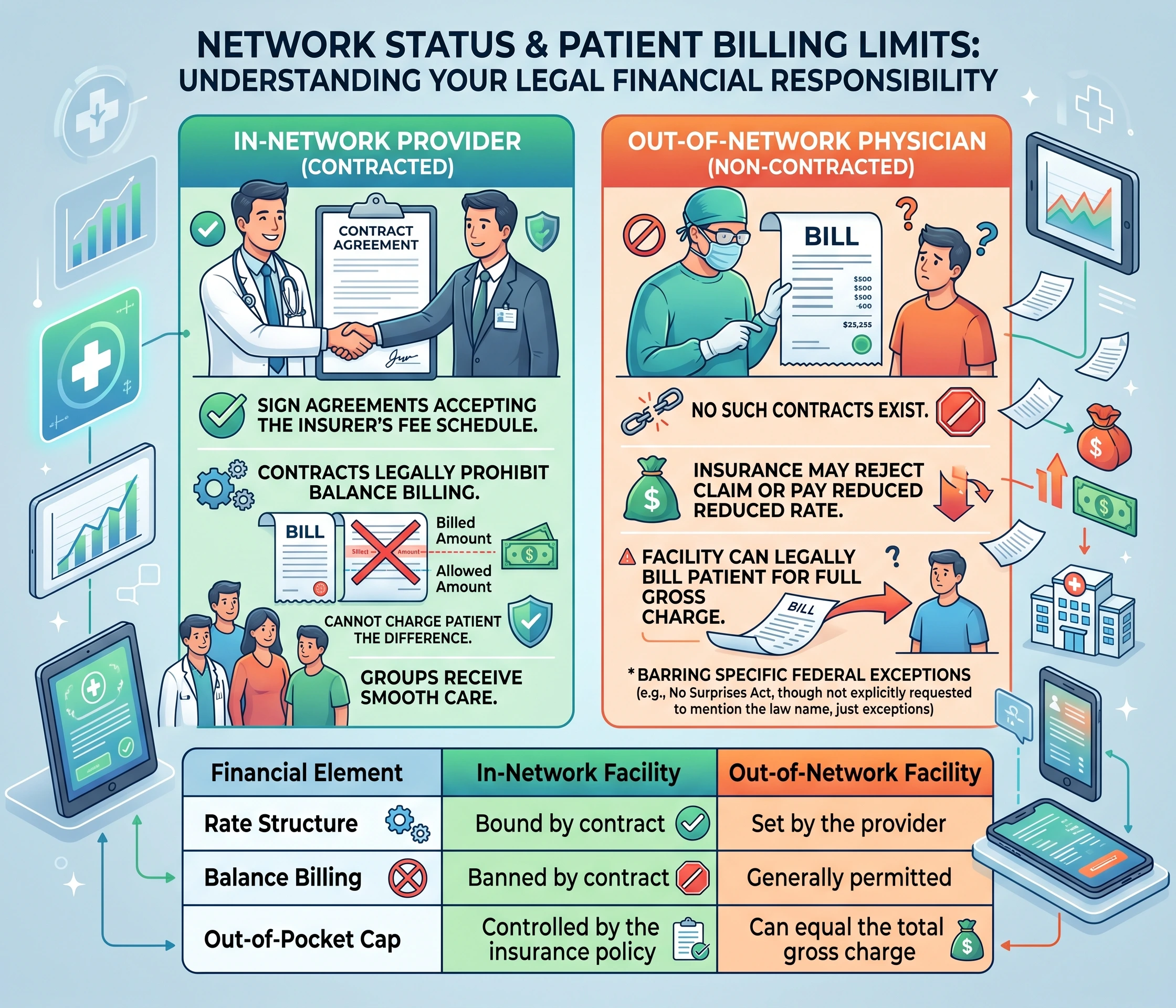
A doctor’s network status directly controls how much money a clinic can legally demand from a consumer. In-network providers sign agreements accepting the insurance company’s fee schedule.
These contracts legally prohibit balance billing. An in-network doctor cannot charge the patient for the difference between the gross billed amount and the carrier’s allowed amount.
Out-of-network physicians have no such contracts. If a person visits an out-of-network surgery center, the insurance company might reject the claim entirely or pay a severely reduced rate. The out-of-network facility can then legally bill the patient for the full gross charge, barring specific federal exceptions.
Financial Element | In-Network Facility | Out-of-Network Facility |
Rate Structure | Bound by contract | Set by the provider |
Balance Billing | Banned by contract | Generally permitted |
Out-of-Pocket Cap | Controlled by the insurance policy | Can equal the total gross charge |
The No Surprises Act
Federal lawmakers changed the rules regarding patient responsibility in healthcare in 2022. Prior to this legislation, individuals frequently received massive, unexpected bills after emergency procedures. A person might visit an in-network emergency room but receive treatment from an out-of-network radiologist. The patient had no ability to choose a network-approved doctor in that moment.
The No Surprises Act made this specific type of out-of-network balance billing illegal.
If a consumer requires emergency intervention, or receives non-emergency care from an out-of-network doctor inside an in-network hospital, the medical biller cannot hold the patient liable for out-of-network rates. The patient responsibility for payment is legally capped at their standard in-network copay or coinsurance rate. The out-of-network doctor must argue with the insurance company over the remaining balance through a federal arbitration system.
How does patient billing work?
The revenue cycle starts at the registration desk and ends only when the accounting ledger shows a zero balance. Receptionists verify active coverage and demand copays. After the clinical visit ends, medical coders read the physician’s notes and assign specific alphanumeric codes to the diagnoses and procedures.
The billing team packages these codes into a formal electronic claim. They transmit this file to the insurance payer. The payer’s software evaluates the codes against the patient’s specific benefit plan.
The insurance company then issues an electronic remittance advice to the medical office. Simultaneously, the payer mails an explanation of benefits to the consumer. This document is not a bill. It is a notification outlining the original charge, the network discount, the carrier’s payment, and the remaining patient obligation in medical billing. Providers must wait for the electronic remittance advice to arrive before they can legally bill the individual for the remaining balance.
How to calculate patient responsibility
Figuring out how to determine patient responsibility requires basic arithmetic and a clear understanding of the explanation of benefits. Medical billing students practice this math daily. Accurately tracking how providers calculate the amount a patient owes prevents federal compliance audits.
Consider a scenario involving a specialist. A dermatologist evaluates a suspicious mole. The clinic’s standard gross charge is $385. The clinic’s contract with the insurance company caps the allowed amount at $210.
The immediate $175 difference is a mandatory contractual write-off. The clinic loses this money.
The calculation for the patient’s debt starts with the $210 allowed amount. The patient’s policy requires a $35 copay for specialists. The front desk collects that $35. This leaves a balance of $175.
The patient has already met their annual deductible. Their policy dictates a 20 percent coinsurance rate. The insurance company pays 80 percent of the $175, which is $140.
The patient owes the remaining 20 percent of the $175. That equals $35.
The final financial breakdown:
- Gross charge: $385
- Contracted allowed amount: $210
- Initial patient copay: $35
- Insurance carrier payment: $140
- Patient coinsurance balance: $35
- Total amount paid by patient: $70 ($35 copay plus $35 coinsurance)
Patient responsibility estimation
Collecting debt after a person leaves a clinic is statistically difficult. Healthcare organizations utilize proactive financial strategies to secure their revenue before the appointment happens.
Modern clinics rely on patient responsibility estimation software. Two days before a scheduled procedure, front desk staff run automated electronic data interchange checks. The software pings the insurance company’s database and instantly returns the individual’s current deductible balance.
Financial counselors review this data to calculate the estimated patient responsibility. If a patient owes a $500 deductible for an upcoming MRI, the counselor calls the patient prior to the visit. Discussing the exact debt in advance gives the consumer time to transfer funds or set up a payment plan. According to a 2022 data report from the Medical Group Management Association, clinics that demand payment prior to service maintain significantly lower bad debt ratios than clinics that wait for post-visit adjudication.
Reconciling accounts and patient statements
Once the insurance payment clears the bank, the software generates a patient statement in medical billing. This paper or digital document serves as the final invoice. A highly detailed statement prevents confusion and reduces angry phone calls to the billing department.
A proper statement lists the exact date of service and provides a plain-English description of the medical procedure. It displays the gross charge, the network discount, the money paid by the carrier, and the final debt owed by the consumer. Including the claim reference number directly on the invoice allows the person to match the clinic’s bill against the paperwork they received from their insurance carrier.
Sometimes, front desk estimates are incorrect. A clerk might collect a $150 deductible payment on Tuesday. On Friday, the electronic remittance advice reveals the patient actually only owed $90. The clinic now holds a $60 credit balance. Medicare regulations and commercial contracts mandate strict timelines for refunding these overpayments. Billing managers audit credit reports weekly and issue refund checks to prevent legal penalties.
Patient responsibility insurance coordination
Many individuals carry more than one active health policy. A common scenario involves a senior citizen who has standard Medicare along with a private Medigap policy. Another example is a child covered simultaneously by both parents’ employer-sponsored plans.
This situation triggers a process called coordination of benefits.
The primary payer processes the claim first. If that primary payer leaves a deductible or coinsurance balance, the medical biller does not invoice the patient. Instead, the biller attaches the primary remittance advice to a new claim and submits it to the secondary payer.
This secondary patient responsibility insurance evaluates the leftover balance. In many cases, the secondary policy funds the exact out-of-pocket costs left behind by the first policy. A biller only finalizes the account balance after all active policies have processed the claim.
Determining what is patient responsibility in medical billing requires strict attention to contracts, active coverage dates, and mathematical formulas. Billers protect clinic revenue by separating network write-offs from actual consumer debt. By running pre-visit estimates and generating transparent invoices, medical facilities successfully collect their revenue while remaining fully compliant with state and federal billing laws.