

NEMT provider credentialing verifies whether a non-emergency medical transportation business, its drivers, and its vehicles meet the requirements of a transportation program. For healthcare practices arranging rides and billing teams processing transportation claims, these approvals deserve attention before the first trip.
The requirements depend on the state, transportation category, and organization paying for or arranging services. The Centers for Medicare & Medicaid Services (CMS), in its September 28, 2023, Medicaid Transportation Coverage Guide, signed by Daniel Tsai, explains the federal framework while recognizing state flexibility in administering transportation programs.
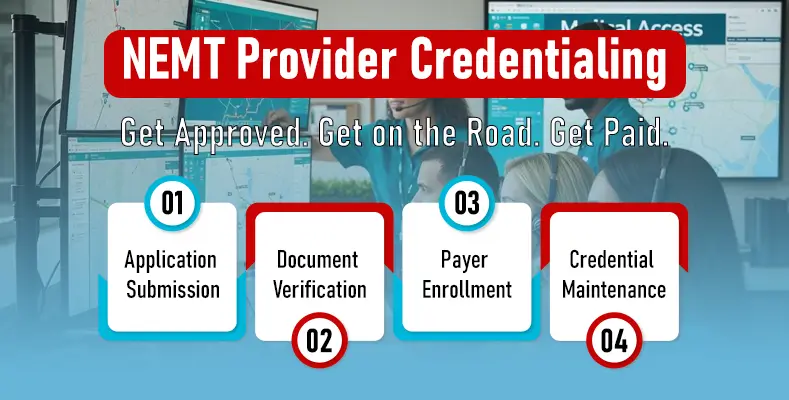
A practical first step is to distinguish four key stages: setting up the business, completing the required Medicaid enrollment, meeting applicable credentialing standards, and securing a contract with a confirmed service start date.
What does NEMT provider credentialing include?
Transportation approval involves several related processes. Keeping them separate helps staff track exactly what remains unfinished.
| Process | Purpose | What to verify |
|---|---|---|
| Credentialing | Reviews qualifications and compliance documentation | Approval of the company, drivers, and vehicles |
| Provider enrollment | Registers the transportation provider with the applicable program | Enrollment status, identifiers, and effective date |
| Contracting | Establishes participation and payment terms | Executed agreement, rates, and covered services |
| Training or certification | Documents completion of specified requirements | Accepted course, certificate, and renewal date |
MTM Health’s Texas provider information, reviewed October 17, 2026, identifies application, credentialing, and contracting as separate recruiting phases. Its network guidance also includes training before the first trip.
Treat “NEMT provider certification” carefully. Ask which issuing organization, course, or state approval the term refers to. A training certificate should never be treated as proof that every enrollment and contracting requirement has been satisfied.
Step 1: Identify the correct enrollment pathway

Identify the program you plan to serve before purchasing vehicles or submitting any applications.
Ask the state Medicaid transportation office or designated administrator:
- Who handles transportation provider enrollment?
- Is separate state enrollment required alongside broker credentialing?
- Which transportation categories are open to applicants?
- Which organization authorizes trips and receives claims?
- Are additional approvals required for each service area?
CMS’s 2023 guide describes multiple delivery arrangements, including brokers and managed care. The state Medicaid agency retains responsibility for compliance even when it delegates program operations.
Write down the answers and save the applicable application instructions. Using another state’s checklist can leave an otherwise organized application incomplete.
Step 2: Assemble consistent business documentation
Build one master record containing your legal business name, tax identification information, ownership details, service address, contact information, and applicable transportation licenses.
Compare those details across every submission. Use the same legal entity information on enrollment records, insurance documents, and contracts, with any trade name identified consistently.
Follow the application’s exact document requirements. New York’s eMedNY non-medical transportation enrollment instructions, updated May 2026, require an IRS assignment letter showing the federal employer identification number and applicant name. A W-9 does not satisfy that particular requirement.
Also confirm which provider identifiers your transportation category requires. Ask whether you need an NPI, a state-assigned identifier, or both, and which identifier belongs on subsequent claims.
Avoid submitting a document merely because it contains similar information. Reviewers need the evidence specified in their instructions.
Step 3: Complete driver qualification checks
Federal Medicaid requirements establish a baseline for NEMT providers and drivers.
CMS’s Assurance of Transportation guidance explains that states must have a mechanism ensuring:
- Providers and individual drivers are not excluded from federal healthcare programs or listed on the HHS Office of Inspector General exclusion list.
- Each driver holds a valid driver’s license.
- Providers have a process for addressing state drug-law violations.
- Providers have a process for disclosing employed drivers’ driving histories, including traffic violations, to Medicaid.
Additional driver qualifications depend on the program. Request its accepted background-screening procedures, driving-record standards, and training requirements.
For example, MTM Health’s Texas provider FAQ addresses motor vehicle records, CPR, defensive driving, and passenger assistance training. Its requirements should be checked directly before enrolling staff in a course.
Maintain a separate file for every driver. Record the document submitted, expiration date, review status, and approval date. Marking a certificate “uploaded” should not automatically mark the driver ready for dispatch.
Step 4: Verify vehicle and service-category requirements
Create a separate record for each vehicle you intend to use. Match registration, insurance evidence, inspection records, and the vehicle identification number.
Confirm with the credentialing reviewer which requirements apply to your intended service category. For wheelchair transportation, request the specific equipment, securement, inspection, and driver-training checklist before committing to a vehicle.
Modivcare’s Transportation Providers/Drivers page, reviewed October 17, 2026, states that the company conducts field visits to check whether vehicles meet contract standards. MTM Health also identifies vehicle inspections among the documentation it monitors.
Keep company approval separate from individual vehicle approval in your records. Before substituting a vehicle, confirm that the replacement has completed the required review.
Step 5: Confirm NEMT insurance requirements in writing
Request the current insurance schedule for your specific state and contract. Do not build your insurance budget around a limit copied from an unrelated provider’s checklist.
Ask your insurance agent to review:
- Required commercial automobile coverage and limits.
- General liability requirements.
- Workers’ compensation coverage or permitted exemption documentation.
- Additional-insured endorsements, if requested.
- Vehicle schedules and cancellation-notice provisions.
MTM Health’s Texas FAQ states that insurance is required and that details are addressed during credentialing. It does not publish a universal coverage limit on that page.
For NEMT insurance compliance, compare the actual policy documents with the contract requirements. Ask the reviewer to identify any missing endorsement or unacceptable wording before the proposed start date.
Track insurance renewals alongside driver and vehicle credentials so staff can see approaching expirations in one place.
Step 6: Submit the application and track deficiencies
Use the current state or broker application, then review every attachment before submission.
A practical application log should record the submission date, confirmation number, reviewer contact, missing items, response deadline, and final decision.
State-specific prerequisites can determine whether an application is accepted. New York’s May 2026 instructions require a support letter from Medical Answering Services for new non-medical transportation applications. They also state that failure to respond to an additional-information request within 45 days results in withdrawal. These are New York requirements, not a national timetable.
To avoid NEMT enrollment delays, assign one person to monitor portal messages and email requests. Check that replacement documents actually resolve the reviewer’s concern instead of resubmitting the same file.
Step 7: Review the provider contract before activation
For providers researching how to get NEMT contracts, submitting an application is only part of the work. Review the agreement’s service expectations and financial terms before accepting trips.
Confirm the rate structure, mileage calculation, cancellation rules, payment submission deadlines, dispute procedures, and conditions for suspension or termination. Ask whether waiting time and travel without a passenger are payable under the proposed agreement.
MTM Health’s Texas FAQ states that rates are determined individually and that it does not reimburse providers for member no-shows. Those terms should not be assumed to apply to every broker.
New York’s enrollment instructions explicitly warn that successful Medicaid enrollment does not guarantee assignments.
Build operating projections from documented rates and realistic scheduling assumptions, rather than an expected number of rides that no agreement promises.
Step 8: Prepare billing before the first trip
NEMT claims submission should connect the authorized service with the transportation actually provided.
Ask the payer for its billing manual and configure your workflow to capture the required trip identifier, passenger information, service date, pickup and destination details, driver, vehicle, mileage, and proof of completion.
Verify the required codes, units, modifiers, and submission method. Do not assume that a broker’s trip portal operates the same way as a healthcare practice’s claims system.
The HHS Office of Inspector General’s 2022 audit of New York City NEMT payments identified problems involving authorization, driver and vehicle compliance, service documentation, and billing for the authorized level of service. Its recommendations directly connect credentialing records with payment support.
As a routine internal check, verify every completed trip against its authorization and supporting documentation before submitting the bill. Investigate differences rather than changing records to make them agree.
Step 9: Maintain approval after onboarding
Create renewal reminders and assign an owner for each credential.
MTM Health’s network guidance, reviewed October 17, 2026, states that its automated system prevents assignments to providers whose credentials are insufficient or no longer current. Modivcare’s compliance training page requires training materials to be completed upon contracting and annually thereafter.
Preserve historical documentation as well as current certificates. A record showing today’s approval may not establish that the same driver or vehicle met requirements on an earlier service date.
NEMT provider credentialing checklist
Before activating service, confirm that your file contains:
- Applicable enrollment approval and effective date.
- Approved driver and vehicle records.
- Accepted insurance documents and endorsements.
- Completed training and required attestations.
- Executed contract and payment schedule.
- Working dispatch and billing access.
- Trip-documentation procedures and renewal tracking.
NEMT provider credentialing requires coordination between enrollment, operations, and billing staff. Keep approval dates, trip authorizations, and service records connected. That gives the billing team evidence to support payment and gives dispatch staff a clear basis for deciding which drivers and vehicles are ready to serve patients.