


Institutional healthcare claims require a specific tracking system to organize services by department and cost center. When processing these claims, billers rely on a standardized numerical system. Asking what is a revenue code in medical billing leads directly to the UB-04 claim form. Hospitals, skilled nursing facilities, and other institutional providers use these four-digit numbers to tell insurance payers exactly where a patient received treatment or which department provided a specific supply. Unlike codes that describe the exact medical procedure performed, revenue codes identify the category of service. They function as the accounting foundation for all facility-based healthcare billing.
What is a revenue code in medical billing?
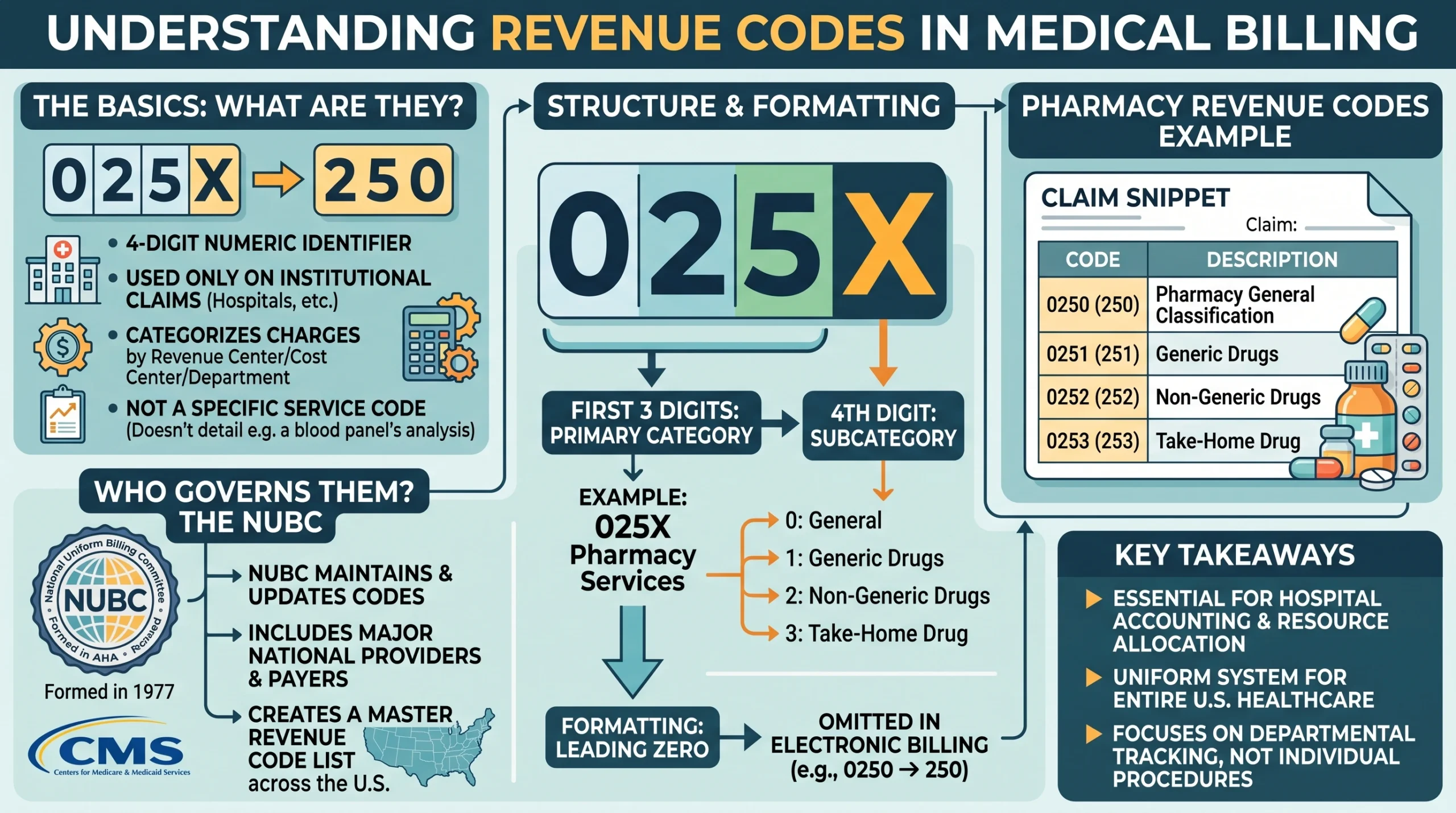
A revenue code is a four-digit numeric identifier used exclusively on institutional claims. The revenue code meaning centers on accounting, resource allocation, and departmental tracking. It identifies the specific hospital revenue center, cost center, or category of service that incurred the charge during a patient’s visit.
The National Uniform Billing Committee (NUBC) maintains and updates these codes. Formed in 1977 by the American Hospital Association (AHA), the NUBC includes representatives from major national health providers and payers, including the Centers for Medicare & Medicaid Services (CMS). They organize a master revenue code list used across the entire United States healthcare system.
If a patient receives a standard blood panel, the revenue code on a claim does not detail the specific chemical analysis. It simply categorizes the charge under the laboratory department. The first three digits identify the primary category, while the fourth digit provides a more specific subcategory. The 025X series represents Pharmacy services. Within that series, 0251 specifies generic drugs, 0252 specifies non-generic drugs, and 0253 indicates a take-home drug.
Many electronic billing systems display these as three-digit numbers. They routinely omit the leading zero, formatting 0250 as simply 250.
Revenue code vs CPT code: Key differences
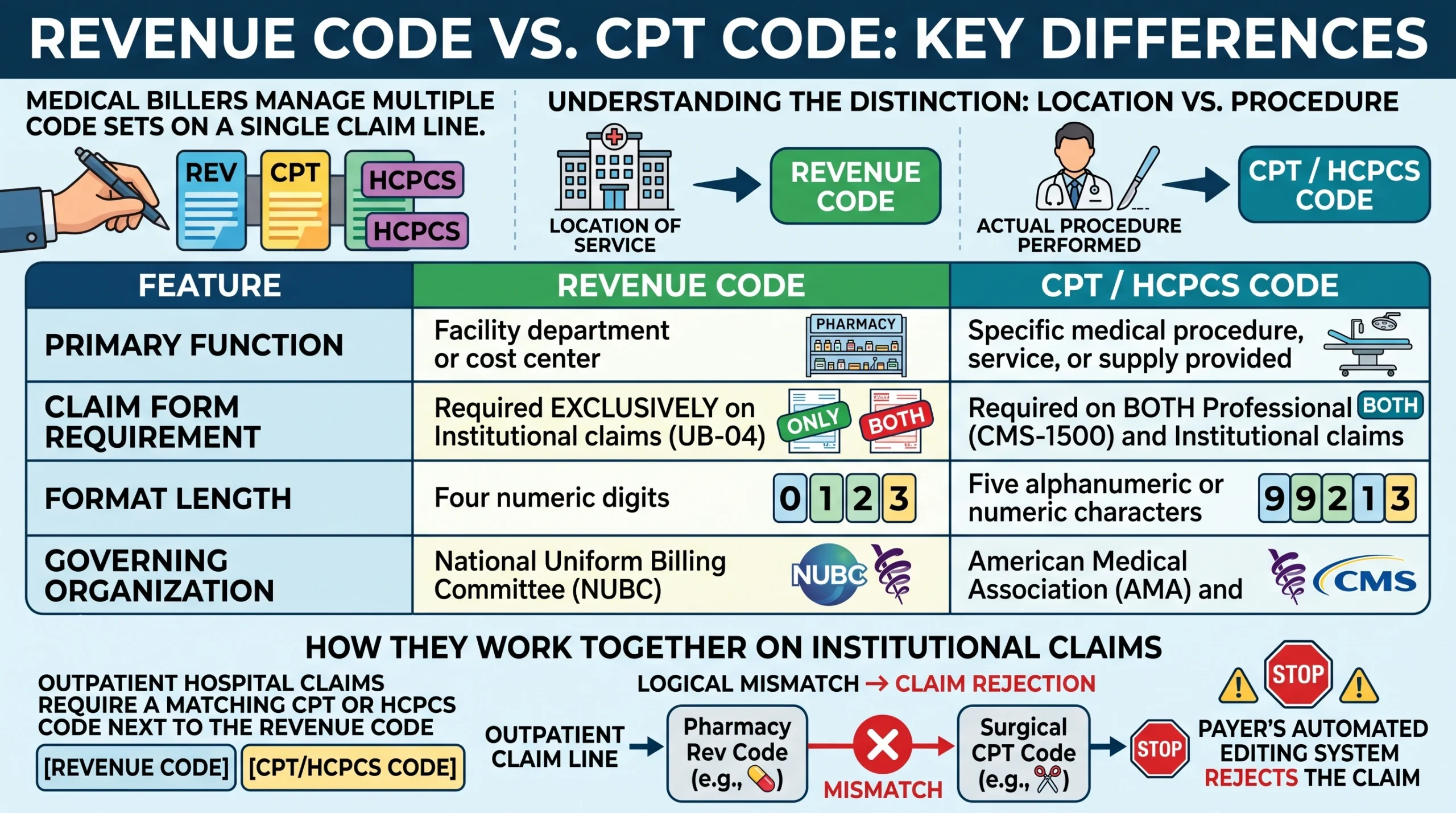
Medical billers manage multiple code sets on a single claim line. The distinction between a revenue code and a Current Procedural Terminology (CPT) code involves differentiating the location of the service from the actual procedure performed.
Feature | Revenue Code | CPT / HCPCS Code |
Primary Function | Identifies the facility department or cost center. | Identifies the specific medical procedure, service, or supply provided. |
Claim Form Requirement | Required exclusively on institutional claims (UB-04). | Required on both professional (CMS-1500) and institutional claims. |
Format Length | Four numeric digits. | Five alphanumeric or numeric characters. |
Governing Organization | National Uniform Billing Committee (NUBC). | American Medical Association (AMA) and CMS. |
These code sets work together on institutional claims. Outpatient hospital claims require a matching CPT or Healthcare Common Procedure Coding System (HCPCS) code next to the revenue code. If a hospital submits an outpatient claim with a pharmacy rev code (0250) but attaches a surgical CPT code to that same line, the payer’s automated editing system will reject the claim due to a logical mismatch.
Claim lines and the UB-04 form locators
Institutional facilities submit paper claims using the UB-04 form, known officially as the CMS-1450. The electronic equivalent is the 837I format. The paper form features 81 separate form locators (FL). Revenue codes strictly populate Form Locator 42.
A typical institutional claim line requires data across several form locators to process correctly. FL 42 holds the revenue code. FL 43 contains the corresponding text description of the revenue center. FL 44 holds the specific HCPCS or CPT code if required. FL 46 lists the service units, representing how many times the service occurred. FL 47 totals the charges for that specific line. A standard claim ends with revenue code 0001 in FL 42. This final entry signals the payer that the total charge for the entire bill follows on that specific line.
CMS revenue codes and standard categorization
CMS adheres to the NUBC definitions for Medicare and Medicaid processing. The complete manual groups hospital revenue codes by numeric blocks. Each 100-number block represents a distinct clinical area or financial category.
Common categories include:
- 011X to 021X: Room and board charges. These differentiate between private rooms, semi-private rooms, intensive care units, and psychiatric wards.
- 025X: Pharmacy items and intravenous medications.
- 027X: Medical and surgical supplies.
- 030X: Laboratory services, including chemistry, immunology, and hematology.
- 032X: Radiology and diagnostic imaging.
- 042X: Physical therapy services.
- 045X: Emergency room services.
- 048X: Cardiology services, including cardiac catheterization.
Coders working in specific facility departments memorize the codes relevant to their daily operations. An emergency department coder consistently uses 0450 (General Emergency Room). A billing specialist in a skilled nursing facility focuses heavily on the 011X or 012X series for daily room and board calculations.
Inpatient revenue codes versus outpatient revenue codes
Hospitals apply these codes differently depending on the patient’s admission status. Billing rules dictate different levels of specificity for inpatient and outpatient encounters.
Inpatient revenue codes often stand alone without an accompanying HCPCS code. Medicare and commercial insurers pay for inpatient stays using the Medicare Severity Diagnosis Related Group (MS-DRG) system. This system bases payment on the patient’s primary diagnosis, secondary diagnoses, and major surgical procedures. It does not pay based on a line-item audit of every single bandage and pill. An inpatient claim might list code 0250 (General Pharmacy) with a single bundled charge representing all medications administered during a five-day admission.
Outpatient revenue codes require exact itemization. Medicare’s Outpatient Prospective Payment System (OPPS) calculates reimbursement based on Ambulatory Payment Classifications (APCs). To assign the correct APC, the payer must know exactly what the outpatient received. The revenue code must align with a specific HCPCS code. A facility cannot simply bill 0320 for an outpatient chest X-ray. The claim line must show 0320 paired directly with a CPT code such as 71045 (Radiologic examination, chest, single view).
A practical scenario: Revenue codes in action
Consider a patient arriving at a hospital emergency room complaining of chest pain. The patient receives an EKG, blood tests, and an evaluation by an emergency physician. The physician determines the patient needs observation and admits them to a cardiac telemetry unit for 24 hours. The resulting institutional claim will contain multiple lines of revenue codes to describe this hospital encounter.
The emergency room visit generates a line with code 0450 (Emergency Room – General). The EKG generates a line with code 0730 (EKG/ECG – General). The blood test generates a line with code 0300 (Laboratory – General). The stay in the telemetry unit generates a charge under 0206 (Intensive Care – Intermediate ICU).
Each of these codes allows the payer to see the progression of care through different cost centers within the facility. The commercial insurer or Medicare contractor processes the data to verify that the services billed align with the hospital departments utilized during the patient’s stay.
The role of the hospital chargemaster
Medical coders rarely type revenue codes manually into a claim form. The hospital’s Charge Description Master (CDM), commonly called the chargemaster, automates this process. The chargemaster is a massive database containing every chargeable item, service, and procedure provided by the facility.
When a nurse documents the administration of an IV antibiotic in the electronic health record, the system triggers a specific charge code. The chargemaster automatically links that internal charge code to the correct NUBC revenue code (0250 for Pharmacy) and the correct HCPCS code before generating the UB-04.
Maintaining the chargemaster requires constant oversight. According to a 2023 report published by the Healthcare Financial Management Association (HFMA), chargemaster misalignment causes a significant percentage of hospital claim denials. If a hospital adds a new surgical implant to its inventory but maps it to a laboratory revenue code in the CDM, every claim containing that implant will fail automated edits.
Cost reporting and Medicare reimbursement
Revenue codes do more than process individual claims. They provide the statistical data that CMS uses to calculate future reimbursement rates. Every Medicare-certified institution must submit an annual Medicare Cost Report.
The cost report maps hospital expenses to specific revenue centers. CMS analyzes the total costs reported under the 030X (Laboratory) or 045X (Emergency Room) series across thousands of hospitals. They compare these reported departmental costs against the amounts paid for specific claims. CMS relies on this aggregated departmental data to adjust the APC weights and MS-DRG payment rates for the following calendar year. Accurate revenue coding directly influences national healthcare reimbursement policy.
Payer-specific revenue code list variations
While the NUBC standardizes the master definitions, individual commercial insurance companies and state Medicaid programs publish proprietary billing manuals. A revenue code combination accepted by Medicare might face rejection from a regional commercial managed care plan.
Certain state Medicaid programs require hospitals to use highly specific fourth-digit subcategories for psychiatric or substance abuse treatments. Medical billers must verify instructions through specific payer portals. The CMS Claims Processing Manual dictates federal claims, outlining exactly which revenue codes are subject to packaging (bundling) and which qualify for separate payment. Coders utilize the Outpatient Code Editor (OCE) logic software to evaluate claims automatically before submission, catching logical errors between diagnoses, procedures, and revenue centers.
Correcting common claim denials
Even with automated systems, medical billing departments regularly process denials related to Form Locator 42. Resolution requires analyzing the payer’s specific denial code and reviewing the medical record.
Common reasons for institutional claim rejections include:
- Billing an unlisted or general code (ending in 0 or 9) when the payer policy explicitly requires a specific subcategory (ending in 1 through 8).
- Omitting a mandatory HCPCS code on an outpatient revenue line.
- Submitting a service under a cost center that contradicts the procedure.
- Failing to include the 0001 total charge line at the end of the claim.
Resolving these denials involves the facility’s health information management department and the clinical staff. The billing department must verify the exact location where the service occurred and update the claim to reflect the correct departmental category.
Managing revenue cycle performance
Accurate institutional billing relies entirely on the precise identification of cost centers. Revenue codes translate the physical layout and departmental structure of a healthcare facility into a standardized numeric format. They provide payers with exact data regarding where a patient was located and which hospital department generated the specific expense.
A claim containing inaccurate department categorization will fail automated payer edits, delaying provider reimbursement. Medical coders, billing specialists, and hospital finance directors must continuously audit their facility’s chargemaster against the latest NUBC guidelines. Ensuring that every procedure, medication, and supply maps accurately to its designated four-digit category prevents delayed payments and maintains facility compliance.