


An esophagogastroduodenoscopy sounds like a mouthful because it is one: the scope travels from the esophagus through the stomach and into the duodenum in a single pass. For medical billers, the real complexity starts once the physician sets the scope down. The CPT code for EGD covers a family of codes, not a single number, and the correct choice depends on exactly what happened during the exam. Picking the wrong one is one of the more common ways gastroenterology claims get denied or underpaid.
This guide walks through the codes billers reach for most often, starting with the diagnostic baseline and the biopsy code, then moving into the wider code family, the modifiers payers expect to see, documentation requirements, and how reimbursement actually gets calculated.
What an EGD procedure actually involves
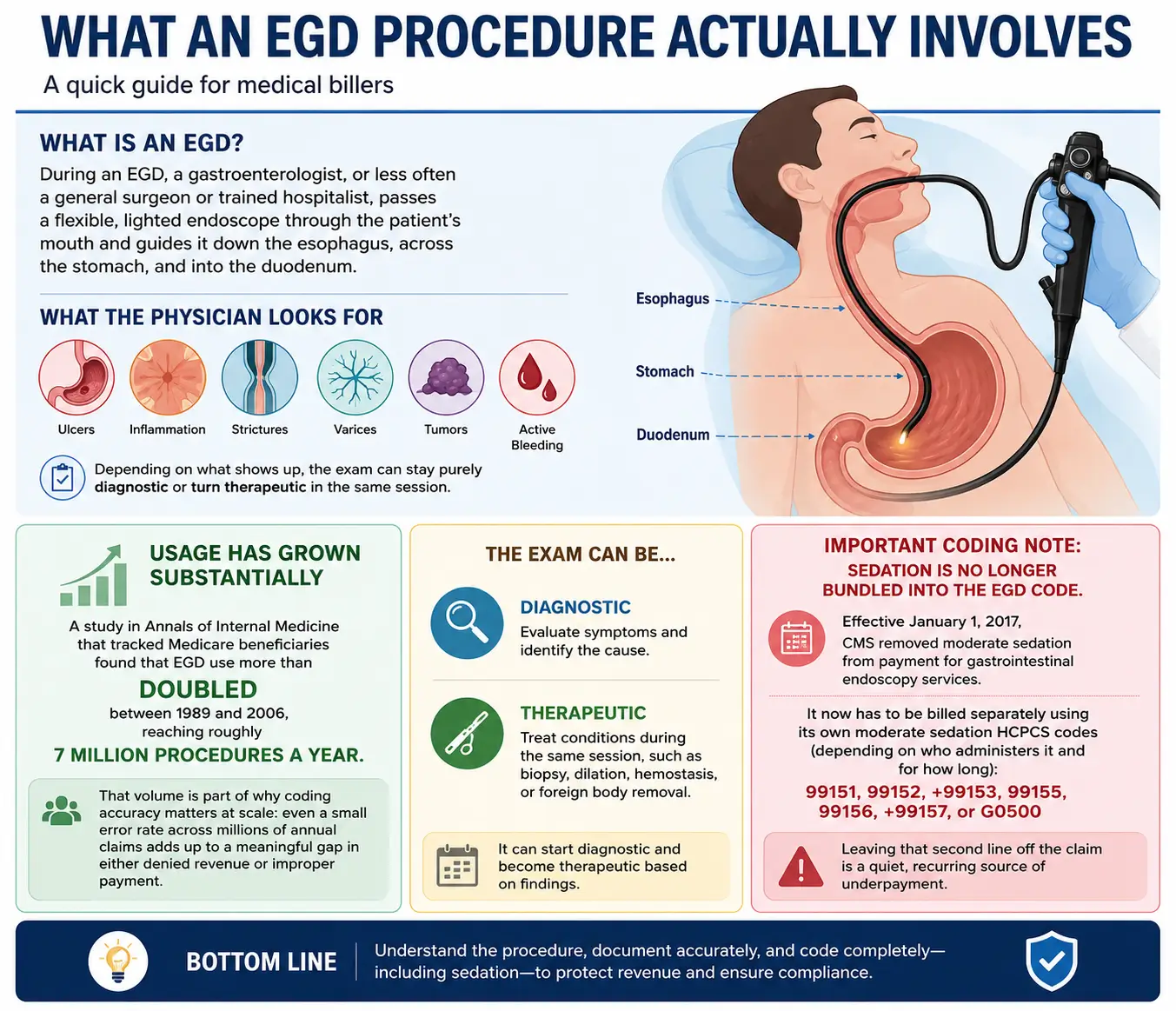
During an EGD, a gastroenterologist, or less often a general surgeon or trained hospitalist, passes a flexible, lighted endoscope through the patient’s mouth and guides it down the esophagus, across the stomach, and into the duodenum. The physician is looking for ulcers, inflammation, strictures, varices, tumors, or active bleeding, and depending on what shows up, the exam can stay purely diagnostic or turn therapeutic in the same session.
Use of the procedure has grown substantially over the past few decades. A study in Annals of Internal Medicine that tracked Medicare beneficiaries found that EGD use more than doubled between 1989 and 2006, reaching roughly 7 million procedures a year. That volume is part of why coding accuracy matters at scale: even a small error rate across millions of annual claims adds up to a meaningful gap in either denied revenue or improper payment.
One detail billers sometimes overlook: sedation is no longer bundled into the EGD code itself. Effective January 1, 2017, CMS removed moderate sedation from payment for gastrointestinal endoscopy services, and it now has to be billed separately using its own moderate sedation HCPCS codes (99151, 99152, +99153, 99155, 99156, +99157, or G0500, depending on who administers it and for how long). Leaving that second line off the claim is a quiet, recurring source of underpayment.
The CPT code for EGD starts with two anchor codes
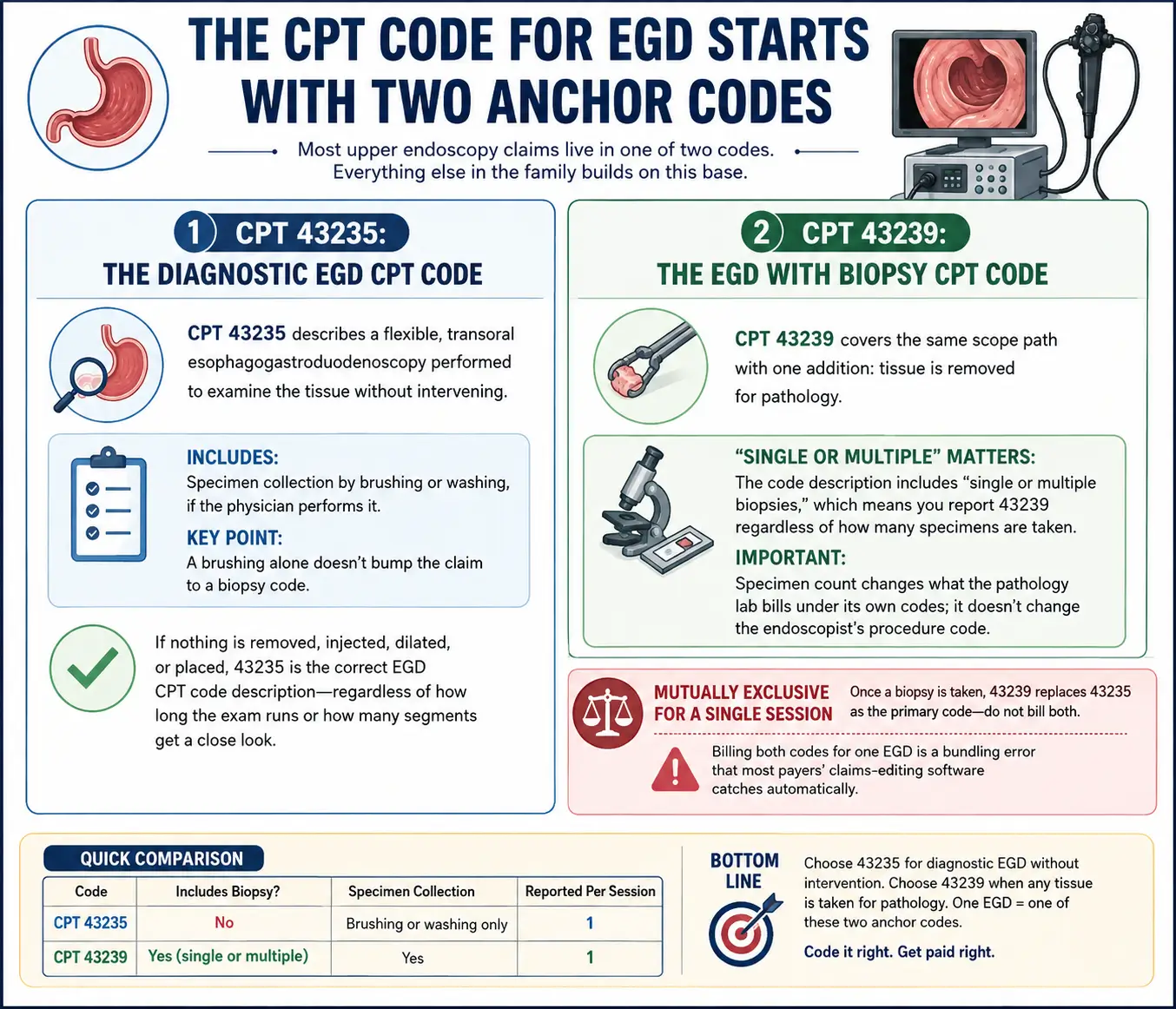
Most upper endoscopy claims live in one of two codes. Everything else in the family builds on this base.
CPT 43235: the diagnostic EGD CPT code
CPT 43235 describes a flexible, transoral esophagogastroduodenoscopy performed to examine the tissue without intervening. Its descriptor already includes specimen collection by brushing or washing, if the physician performs it, so a brushing alone doesn’t bump the claim to a biopsy code. If nothing is removed, injected, dilated, or placed, 43235 is the correct EGD CPT code description, regardless of how long the exam runs or how many segments get a close look.
CPT 43239: the EGD with biopsy CPT code
CPT 43239 covers the same scope path with one addition: tissue is removed for pathology. The phrase “single or multiple” in the code’s own description matters, because it removes any temptation to bill by biopsy count. Take one sample from the antrum, or take six samples spread across the esophagus, stomach, and duodenum in the same session, and the claim still carries one unit of 43239. Specimen count changes what the pathology lab bills under its own codes; it doesn’t change the endoscopist’s procedure code.
The two codes are mutually exclusive for a single session. Once a biopsy is taken, 43239 replaces 43235 as the primary code rather than sitting alongside it. Billing both codes for one EGD is a bundling error that most payers’ claims-editing software catches automatically.
The full range of EGD CPT codes
Diagnostic and biopsy codes cover a lot of ground, but gastroenterologists do more during a scope than look and sample. The table below lists the codes billers run into most often, arranged roughly from simplest to most involved.
CPT code | What it covers |
43235 | Diagnostic EGD, including brushing or washing if performed |
43236 | EGD with directed submucosal injection(s), any substance |
43237 | EGD with endoscopic ultrasound exam limited to the esophagus, stomach, or duodenum |
43238 | EGD with transendoscopic ultrasound-guided fine needle aspiration or biopsy |
43239 | EGD with biopsy, single or multiple |
43241 | EGD with insertion of an intraluminal tube or catheter |
43245 | EGD with dilation of a gastric or duodenal stricture |
43247 | EGD with removal of a foreign body |
43248 | EGD with insertion of a guide wire followed by passage of dilator(s) |
43249 | EGD with transendoscopic balloon dilation of the esophagus, less than 30 mm |
43233 | EGD with balloon dilation of the esophagus, 30 mm or larger |
43250 | EGD with removal of a tumor, polyp, or lesion by hot biopsy forceps |
43251 | EGD with removal of a tumor, polyp, or lesion by snare technique |
43254 | EGD with endoscopic mucosal resection |
43255 | EGD with control of bleeding, by any method |
43266 | EGD with placement of an endoscopic stent |
43270 | EGD with ablation of a tumor, polyp, or lesion |
Two codes on this list get confused often enough to flag directly. CPT 43233 and CPT 43249 both describe balloon dilation of the esophagus, and the only variable separating them is the balloon’s diameter: under 30 mm bills as 43249, and 30 mm or larger bills as 43233. The operative note needs to state the balloon size in millimeters, because without it, a payer has no way to confirm which code applies. Separately, CPT 43270 covers ablation of tissue, not retrieval of a swallowed object; foreign body removal has its own code in 43247. Confusing the two on a claim tied to a swallowed object or food bolus is an easy way to draw a denial.
Diagnostic vs. therapeutic EGD: why the label changes the claim
Coders sort every EGD into one of two buckets before anything else. A diagnostic EGD is a look without an intervention: the physician examines the mucosa, notes findings, and closes out the exam. A therapeutic, or interventional, EGD adds a procedure to that look, whether it’s a biopsy, a polypectomy, dilation, stent placement, or bleeding control.
The distinction affects more than terminology. Therapeutic codes carry more physician work, so they carry more relative value units than the diagnostic baseline, and they demand a longer operative note to support that added value. A biopsy needs a documented site and indication. A polypectomy needs the technique (hot forceps versus snare), the lesion’s size, and its location. A dilation needs the method and, as noted above, the balloon diameter. Skipping these details doesn’t just risk a downcode; it can trigger a records request or a full audit.
Modifiers that actually show up on EGD claims
EGD claims don’t need a modifier on every line, but a handful come up regularly enough to know cold.
- Modifier 59, or the more specific X{EPSU} set, flags a distinct procedural service, most often when an EGD and a colonoscopy are billed for the same patient on the same day. Because the two procedures examine separate anatomical sites, most payers expect one of these modifiers to keep the claims from bundling into a single payment.
- Modifier 22 applies when the procedure demanded substantially more work than the code typically involves, for example an unusually long exam caused by anatomical distortion. It needs a clear explanation in the note, not just the modifier itself.
- Modifier 52 signals a reduced service, such as an EGD that examined only the esophagus and stomach because the duodenum couldn’t be reached.
- Modifier 53 applies when the procedure was started, sedation was administered, and the exam was stopped early because continuing posed a risk to the patient.
- Modifier 33 can apply in preventive contexts, such as Barrett’s esophagus surveillance that meets a payer’s preventive-service criteria.
Modifier 51 deserves its own note. Some billers add it out of habit whenever more than one procedure is reported, but Medicare’s claims processing system already applies its own multiple-endoscopy payment reduction automatically. Appending modifier 51 on a Medicare claim is unnecessary and, according to coding guidance published by the American College of Gastroenterology, can slow a claim down rather than clarify it. Commercial payers vary on this point, so it’s worth confirming the requirement against the specific payer contract rather than applying the modifier by default.
Documentation requirements for a clean EGD claim
Every EGD claim needs to answer the same underlying question: does the note support the code billed? Medicare’s coverage guidance for upper gastrointestinal endoscopy is explicit that the medical record has to be complete and available to the contractor on request, not just summarized after the fact. In practice, that means the operative report should include:
- The clinical indication that justifies the procedure (dysphagia, GERD refractory to treatment, suspected bleeding, anemia workup, and so on)
- A description of the scope’s path and what was, and wasn’t, visualized
- Findings, described by location and appearance
- The specific intervention performed, if any, including instrument and technique
- Specimens collected, with the site documented for each one
- Sedation administered, billed separately under its own HCPCS code
- Any complications
Coders can only bill to the level the documentation supports. A note that says “biopsy taken” without a site, or “polyp removed” without a technique, forces a coder to either query the physician or default to a lower-paying code than the work performed actually justifies.
How EGD reimbursement is actually calculated
Medicare pays for EGD procedures through the Medicare Physician Fee Schedule, which converts each CPT code into a dollar amount using three relative value components (physician work, practice expense, and malpractice risk), a geographic adjustment applied to each component, and an annual conversion factor set by CMS. Because the conversion factor and the geographic indexes both change from year to year, and payment also depends on whether the service is billed in a facility or non-facility setting, the only reliable way to confirm a current rate is to run the code through CMS’s Physician Fee Schedule Look-Up Tool rather than working from a figure that was accurate in a prior year.
What billers can count on staying consistent is the relationship between the codes: therapeutic EGD codes carry more physician work than 43235, so they’re valued higher in every locality, even before the geographic adjustment is applied. Commercial payers typically don’t publish their RVU-based math directly. Contracts more often peg EGD reimbursement to a percentage of the current Medicare rate or to a separately negotiated fee schedule, which is why the same CPT code can pay two different amounts at two insurers operating in the same city.
The CPT code alone doesn’t establish medical necessity for a payer; that job belongs to the ICD-10 code. There’s no single diagnosis code reserved for EGD the way there might be for a screening service. Instead, the diagnosis reported has to reflect the actual clinical indication, such as GERD, dysphagia, gastrointestinal bleeding, iron deficiency anemia, or a suspected mass. Most diagnostic EGDs also carry a 0-day global period, meaning a related office visit shortly afterward is typically billable on its own rather than bundled into the procedure’s payment.
Common EGD billing mistakes
A handful of recurring errors account for most of the denials and downcodes billers see on EGD claims.
- Billing 43235 and 43239 together for one session. Once a biopsy is taken, 43239 replaces 43235; it doesn’t add to it.
- Confusing the 30 mm threshold between 43233 and 43249, or leaving balloon size out of the note entirely.
- Reporting 43270 for foreign body retrieval. That code covers ablation; 43247 is the removal code.
- Leaving sedation off the claim as a separate line, an easy way to leave money on the table under the post-2017 unbundling rule.
- Coding from the physician’s verbal summary instead of the finalized operative note, which can miss a biopsy, injection, or dilation that happened once the scope was already in.
- Skipping the ICD-10 link to medical necessity, particularly on claims where the indication, screening versus diagnostic, affects patient cost-sharing as much as it affects code selection.
Frequently asked questions
What is the CPT code for EGD? The base CPT code for a diagnostic esophagogastroduodenoscopy is 43235. It applies to a visual exam of the esophagus, stomach, and duodenum, including specimen collection by brushing or washing if the physician performs it.
What is the CPT code for EGD with biopsy? CPT 43239 is the EGD with biopsy CPT code. It applies whether one biopsy is taken or several, from one location or several, during the same session.
Does an EGD require a modifier? Not automatically. A standalone diagnostic or therapeutic EGD often needs no modifier at all. Modifiers come into play when another distinct procedure, most often a same-day colonoscopy, a reduced or discontinued exam, or unusually extensive work needs to be flagged for the payer.
What is the CPT code for upper endoscopy with dilation? It depends on the balloon size. Under 30 mm, use 43249. At 30 mm or larger, use 43233. Dilation directed at the stomach or duodenum instead of the esophagus uses 43245.
What supports EGD medical necessity on a claim? An ICD-10 code that reflects the actual clinical indication, such as GERD, dysphagia, GI bleeding, or an anemia workup, tied to what the operative note documents. CPT code selection and medical necessity are evaluated separately, and a clean claim needs both to hold up.
Coding accuracy on an EGD claim has less to do with memorizing every number between 43233 and 43270 and more to do with matching the code to what the documentation actually supports, line by line. The CPT code for EGD lands on 43235 for a straightforward diagnostic look and 43239 the moment biopsy forceps come out, and from there the choice narrows further based on exactly what the operative note describes. Billers who check that alignment before a claim goes out, rather than after a denial comes back, are the ones who keep gastroenterology revenue moving without rework.