

Nine dollars and thirty-four cents. That’s roughly what Medicare pays for CPT code 36415 in 2026, and yet this small line item causes a disproportionate share of billing confusion for a code that pays so little. Part of the reason is that it looks deceptively simple: a needle goes into a vein, a tube fills with blood, and the claim goes out. Whether that claim actually gets paid depends on documentation rules, payer-specific bundling logic, and a modifier question that trips up even experienced billers.
This article breaks down what the 36415 CPT code description actually covers, how CMS prices and pays it, when (and when not) to use a modifier, and where practices lose money on a code most people assume is too small to matter.
What CPT 36415 actually describes
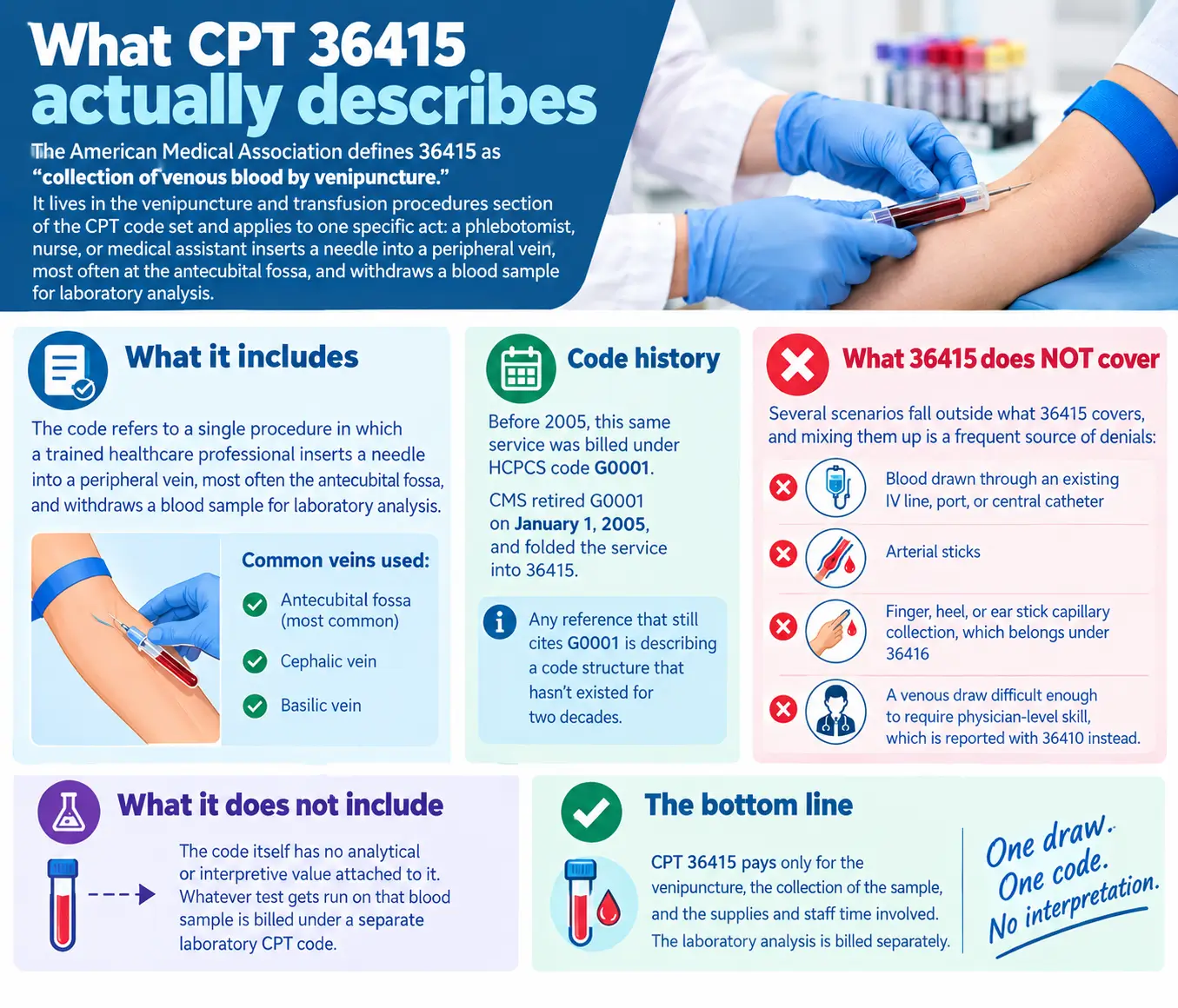
The American Medical Association defines 36415 as collection of venous blood by venipuncture. It lives in the venipuncture and transfusion procedures section of the CPT code set and applies to one specific act: a phlebotomist, nurse, or medical assistant inserts a needle into a peripheral vein, most often at the antecubital fossa, and withdraws a blood sample for laboratory analysis.
Before 2005, this same service was billed under HCPCS code G0001. CMS retired G0001 on January 1, 2005, and folded the service into 36415. Any billing reference that still cites G0001 is describing a code structure that hasn’t existed for two decades.
Several scenarios fall outside what 36415 covers, and mixing them up is a frequent source of denials:
- Blood drawn through an existing IV line, port, or central catheter
- Arterial sticks
- Finger, heel, or ear stick capillary collection, which belongs under 36416
- A venous draw difficult enough to require physician-level skill, which is reported with 36410 instead
The code itself has no analytical or interpretive value attached to it. Whatever test gets run on that blood sample is billed under a separate laboratory CPT code; 36415 exists purely to compensate the labor and supplies involved in obtaining the specimen.
36415 compared with 36416 and 36410
Payers deny claims based on what the chart says was done, not on what the front desk assumed. Mixing up the three venipuncture-adjacent codes is one of the easiest ways to trigger that kind of denial.
CPT code | How the specimen is collected | Requires physician-level skill | Typical scenario |
36415 | Needle into a vein | No | Routine outpatient labs: CBC, CMP, lipid panel, HbA1c |
36416 | Finger, heel, or ear stick | No | Point-of-care glucose testing, some pediatric screens |
36410 | Needle into a vein | Yes | Difficult venous access, often children age 3 and under |
Regardless of which of these applies, Medicare and most commercial payers will pay only a single collection fee per patient encounter. Three failed attempts at the same vein still add up to one billable unit, not three.
Billing guidelines: units, frequency, and documentation
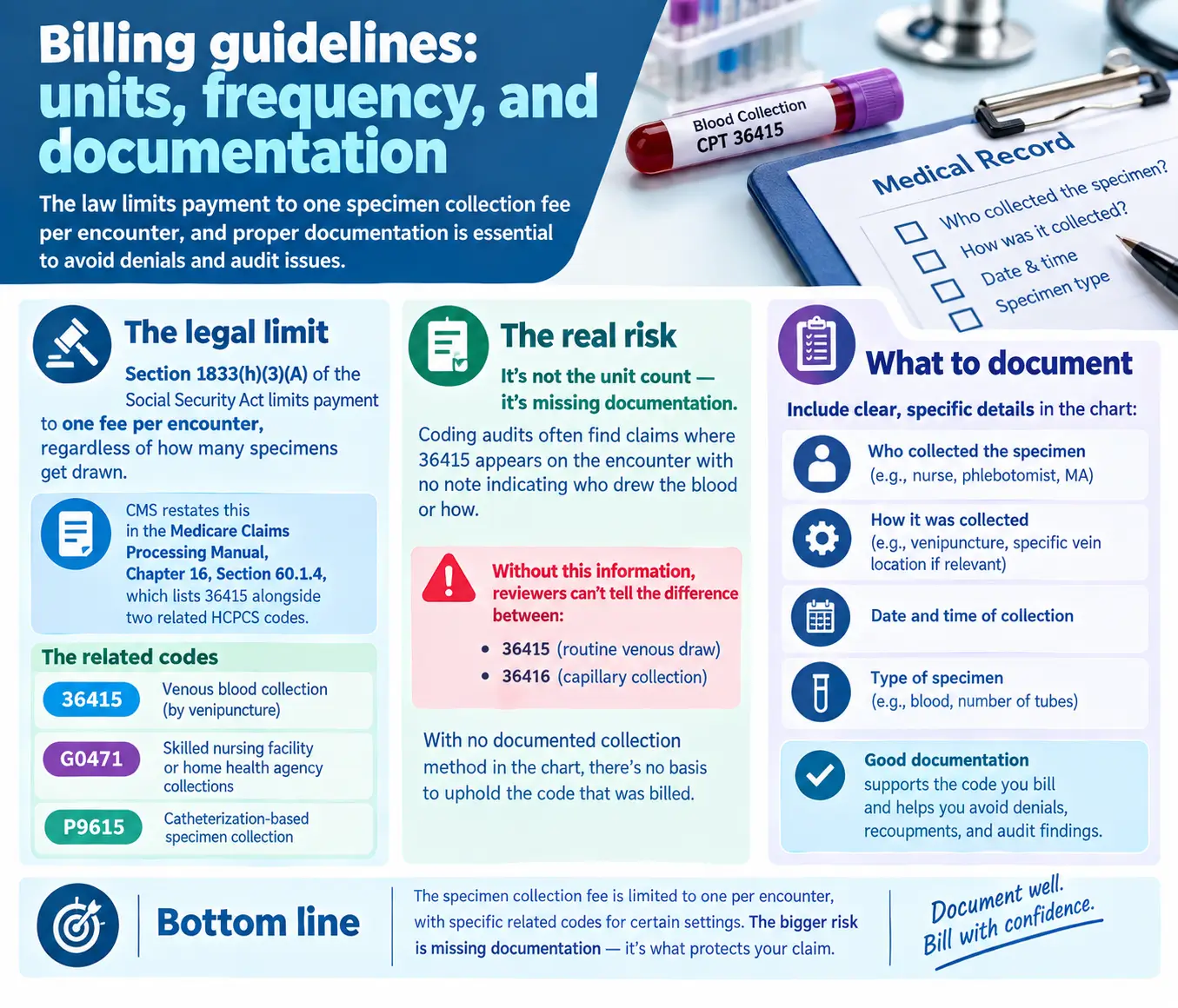
The statutory basis for the specimen collection fee, Section 1833(h)(3)(A) of the Social Security Act, limits payment to one fee per encounter regardless of how many specimens get drawn. CMS restates this operationally in the Medicare Claims Processing Manual, Chapter 16, Section 60.1.4, which lists 36415 alongside two related HCPCS codes: G0471, used for skilled nursing facility or home health agency collections, and P9615, used for catheterization-based specimen collection.
The bigger practical risk isn’t the unit count, though. It’s missing documentation. Coding audits routinely turn up claims where 36415 appears on the encounter with no note indicating who drew the blood or how. Without a documented collection method in the chart, there’s nothing distinguishing a 36415 claim from a 36416 claim after the fact, and a reviewer has no basis to uphold the code that was billed.
Does CPT 36415 need a modifier?
Under the National Correct Coding Initiative, there is no procedure-to-procedure edit linking 36415 to evaluation and management codes in the 99202 to 99215 range. As far as federal bundling logic goes, no modifier is required to bill them on the same claim.
That said, individual payers layer their own bundling rules on top of NCCI, and those rules vary considerably. Some regional commercial plans have written policies that deny 36415 outright whenever the same tax identification number also bills a related blood test or an E/M service on the same date, treating the draw as absorbed into whichever other service was rendered that day. These aren’t NCCI edits; they’re plan-specific medical policies, and they don’t always show up until a claim actually denies.
That gap is exactly where modifier 59 gets misapplied. When a payer representative suggests appending 59 just to force a denied line through, that’s a red flag rather than a fix. Modifier 59 exists to signal a genuinely distinct procedural service, not to override a payer’s internal bundling policy when nothing about the draw was clinically separate from the other billed service. The Office of Inspector General has repeatedly named modifier 59 overuse as an audit priority, and attaching it reflexively to chase a nine-dollar payment creates far more compliance exposure than the payment is worth.
Billing 36415 alongside an office visit
In most cases, yes, and without a modifier on either line, because nothing in NCCI bundles the two together automatically. A claim with 99214 and 36415 on the same date typically processes cleanly as long as the documentation shows a genuine, separately identifiable E/M service plus a documented blood draw.
The lower-level code 99211 is a different story. Some practices bill 99211 when a nurse or medical assistant handles a brief patient contact, and it’s tempting to attach it to a visit that’s really just a lab draw. Medicare guidance has long discouraged that pairing. TrailBlazer Health Enterprises, a Medicare Administrative Contractor whose jurisdiction was later absorbed into other MACs during CMS’s 2013 contractor consolidation, published documentation standards in February 2008 specifying that a visit consisting solely of a blood draw for laboratory testing does not support a 99211 charge, separate from the venipuncture itself. That principle still shapes how billing departments handle the scenario: bill 36415 on its own when the blood draw is the entire encounter, and leave 99211 off the claim.
What “covered diagnosis” actually means for 36415
A lot of billers search for a specific list of diagnosis codes tied directly to venipuncture, expecting something analogous to the covered diagnosis lists used for lab tests. No such list exists, because 36415 doesn’t carry an independent medical necessity requirement of its own.
Medical necessity for the encounter flows from the laboratory test the blood is drawn for, not from the act of drawing it. Local Coverage Determinations set the diagnosis codes that support specific tests, a metabolic panel or a PSA test, for example. The diagnosis reported with the 36415 line should mirror whatever diagnosis justifies that underlying test. Treating the collection code as if it needs its own separate diagnostic justification is a misunderstanding of how the claim actually gets reviewed.
Medicare coverage and the 2026 reimbursement rate
Medicare pays for 36415, but not through the Physician Fee Schedule most other CPT codes fall under. It’s priced on the Clinical Laboratory Fee Schedule instead, which sets one flat national fee rather than a geographically adjusted payment.
That fee rises each year in step with the Consumer Price Index for All Urban Consumers:
Year | General specimen collection fee |
2023 | $8.57 |
2024 | $8.83 |
2025 | $9.09 |
2026 | $9.34 |
CMS published the 2026 figure in Change Request 14345 (Transmittal R13576CP), applying a 1.027 CPI-U adjustment to the prior year’s $9.09 rate. For specimens collected from patients in a skilled nursing facility, or by a lab drawing on behalf of a home health agency, the Protecting Access to Medicare Act of 2014 adds two dollars to that base rate, putting the 2026 figure at $11.34 for those settings.
One detail surprises patients more than billers: clinical laboratory services, including this collection fee, are generally paid at 100% of the Medicare-approved amount, with no Part B deductible or coinsurance applied. Most Part B services carry a 20% patient responsibility after the deductible; routine lab draws are a notable carve-out from that rule.
Where 36415 claims go wrong
A short list of recurring mistakes accounts for most of the denials and lost revenue tied to this code:
- Charging one unit per stick instead of per encounter. Only one collection fee is payable no matter how many attempts the draw took.
- Coding a fingerstick as 36415. Capillary draws belong under 36416; a mismatch between the documented method and the billed code invites a denial or a downcode.
- Leaving the collection method out of the note. If nothing in the chart says how the specimen was obtained, the code can’t be defended if the claim is ever reviewed.
- Reaching for modifier 59 out of habit. Using it to push a claim past a payer’s internal bundling edit, without a real clinical basis for doing so, is precisely the pattern the OIG has flagged as an audit target.
- Billing 36415 separately when it’s already part of a bundled payment. Certain capitated arrangements and global surgical or maternity packages include routine specimen collection, and billing it as a standalone charge in those cases duplicates a service already paid for.
Nearly all of these errors trace back to the same root cause: the claim reflects what someone assumed happened rather than what the medical record actually documents. For a code that reimburses roughly nine dollars, the denial rework it generates is out of proportion to the payment, and almost all of it is avoidable at the point of charting rather than at the point of appeal.