


An electrocardiogram is one of the most frequently ordered diagnostic tests in outpatient medicine, and it’s also one of the most commonly miscoded. The confusion rarely comes from the test itself. It comes from figuring out which entity performed which part of the service, and then matching that to the right CPT code. A cardiology office that runs the tracing and reads it bills differently than a rural clinic that records the tracing and ships it off to a cardiologist thirty miles away. Get that split wrong, and the claim bounces back.
This guide walks through the common EKG CPT codes, the differences between the global and component codes, the modifiers that separate technical work from professional work, and the ICD-10 pairings payers expect to see. It’s written for billers, coders, and clinical staff who need the specifics, not a general overview of what an EKG is.
The three codes that matter most: 93000, 93005, and 93010
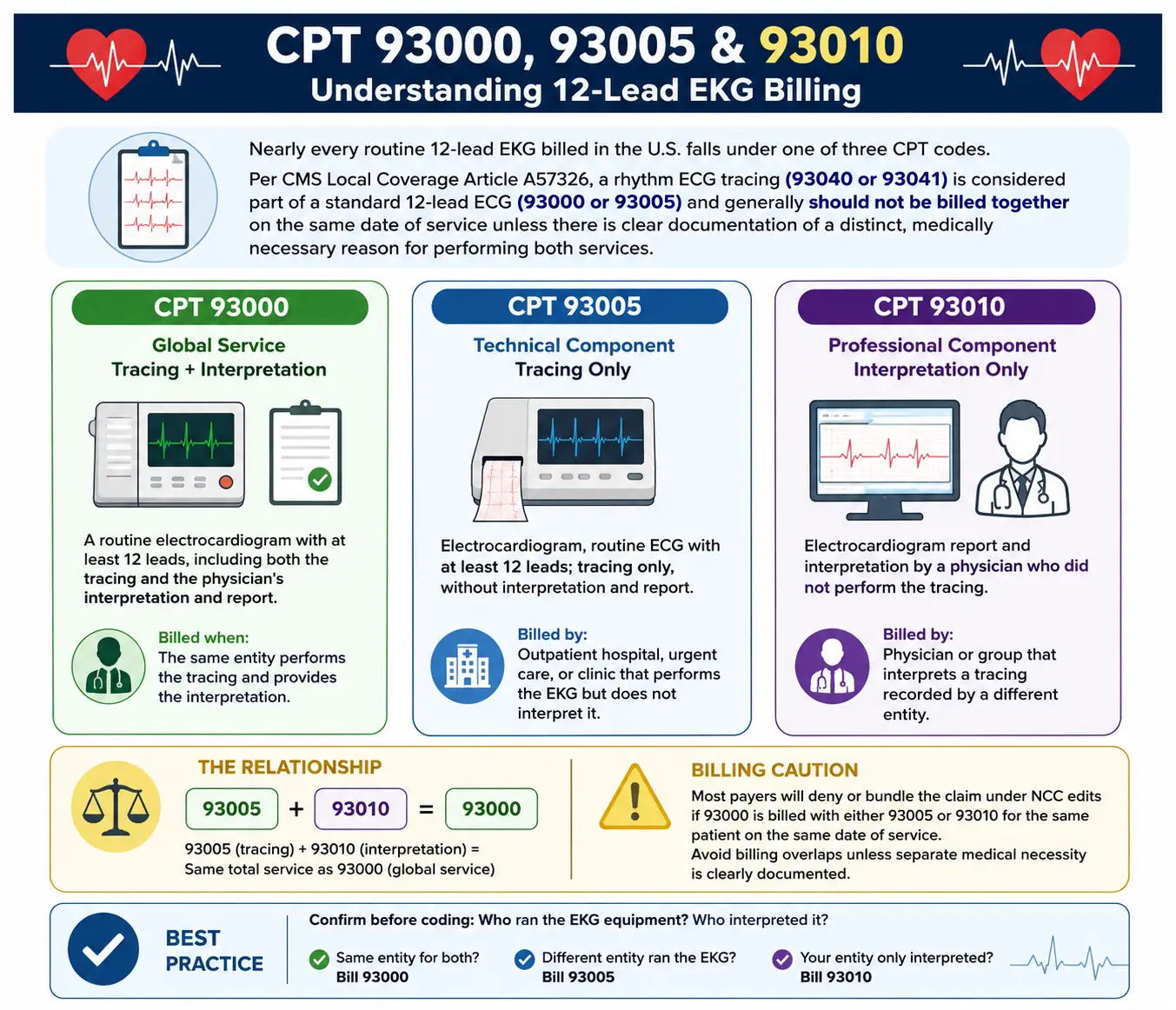
Nearly every routine 12-lead EKG billed in the United States falls under one of three codes.
CPT 93000 describes a routine electrocardiogram with at least 12 leads, including both the tracing and the physician’s interpretation and report. This is the global code. It applies only when a single entity, meaning one practice or provider group, performs the tracing and also produces the signed interpretation. According to the Centers for Medicare & Medicaid Services (CMS) Local Coverage Article A57326, a rhythm ECG tracing reported with CPT codes 93040 or 93041 is considered part of a standard 12-lead ECG reported with 93000 or 93005. As a result, these codes generally should not be billed together on the same date of service unless there is clear documentation supporting a distinct, medically necessary reason for performing both services.
CPT 93005 covers the technical component only: the tracing, without interpretation. This is the code an outpatient hospital department, urgent care clinic, or rural health facility bills when its staff runs the EKG on its own equipment but sends the tracing elsewhere for a physician to read. The CPT descriptor for 93005 is “electrocardiogram, routine ECG with at least 12 leads; tracing only, without interpretation and report.”
CPT 93010 is the mirror image of 93005. It covers the professional component only, meaning a physician interprets a tracing that was recorded by a different entity and produces the signed report. A cardiologist who reads EKGs performed at an affiliated outpatient clinic, for example, bills 93010 rather than 93000, because the cardiologist’s practice did not record the tracing.
The relationship between the three is additive: 93005 plus 93010 equals the same total service represented by 93000. Because of that overlap, most payers will deny a claim, or bundle it under National Correct Coding Initiative edits, if 93000 is billed alongside either component code for the same patient on the same date. The safest approach is to confirm, before assigning a code, which entity physically ran the equipment and which entity produced the interpretation. If it’s the same entity for both, bill 93000. If it’s split, bill the component that matches the actual work performed.
A common scenario worth understanding
A rural health clinic records a 12-lead EKG during a Monday visit because the patient reports chest tightness. No physician at the clinic is credentialed to interpret EKGs that day, so the tracing gets forwarded electronically to a cardiology group across town. The clinic should report CPT code 93005 for the ECG tracing component. The cardiology group, once its physician reviews and signs the interpretation, bills 93010. Neither party should code 93000, because neither one performed the complete service alone. This pattern shows up constantly in telehealth-enabled and critical access hospital settings, and it’s one of the more frequent sources of duplicate billing when staff default to the global code out of habit rather than checking who actually did what.
Rhythm strip codes: 93040, 93041, and 93042
Not every EKG-adjacent service involves a full 12-lead tracing. Sometimes a clinician only needs a quick rhythm strip, typically one to three leads, to check for an arrhythmia or confirm a heart rate during a focused visit.
- CPT 93040: Rhythm ECG, one to three leads, with interpretation and report. This is the global rhythm strip code, used when one provider both records and interprets the strip.
- CPT 93041: Rhythm ECG, one to three leads, tracing only, without interpretation and report. The technical-component equivalent of 93040.
- CPT 93042: Rhythm ECG, one to three leads, interpretation and report only. The professional-component equivalent.
CMS Article A57326 specifically states that a rhythm ECG interpretation and report billed under 93042 is included in a 12-lead ECG interpretation and report billed under 93000 or 93010, meaning the two cannot generally be billed together for the same encounter. If a patient receives both a full 12-lead EKG and a separate rhythm strip on the same day, documentation needs to show they served distinct clinical purposes for both to have a chance of being reimbursed separately, and even then, many payers will still deny the rhythm strip as bundled.
Modifiers: separating technical work from professional work
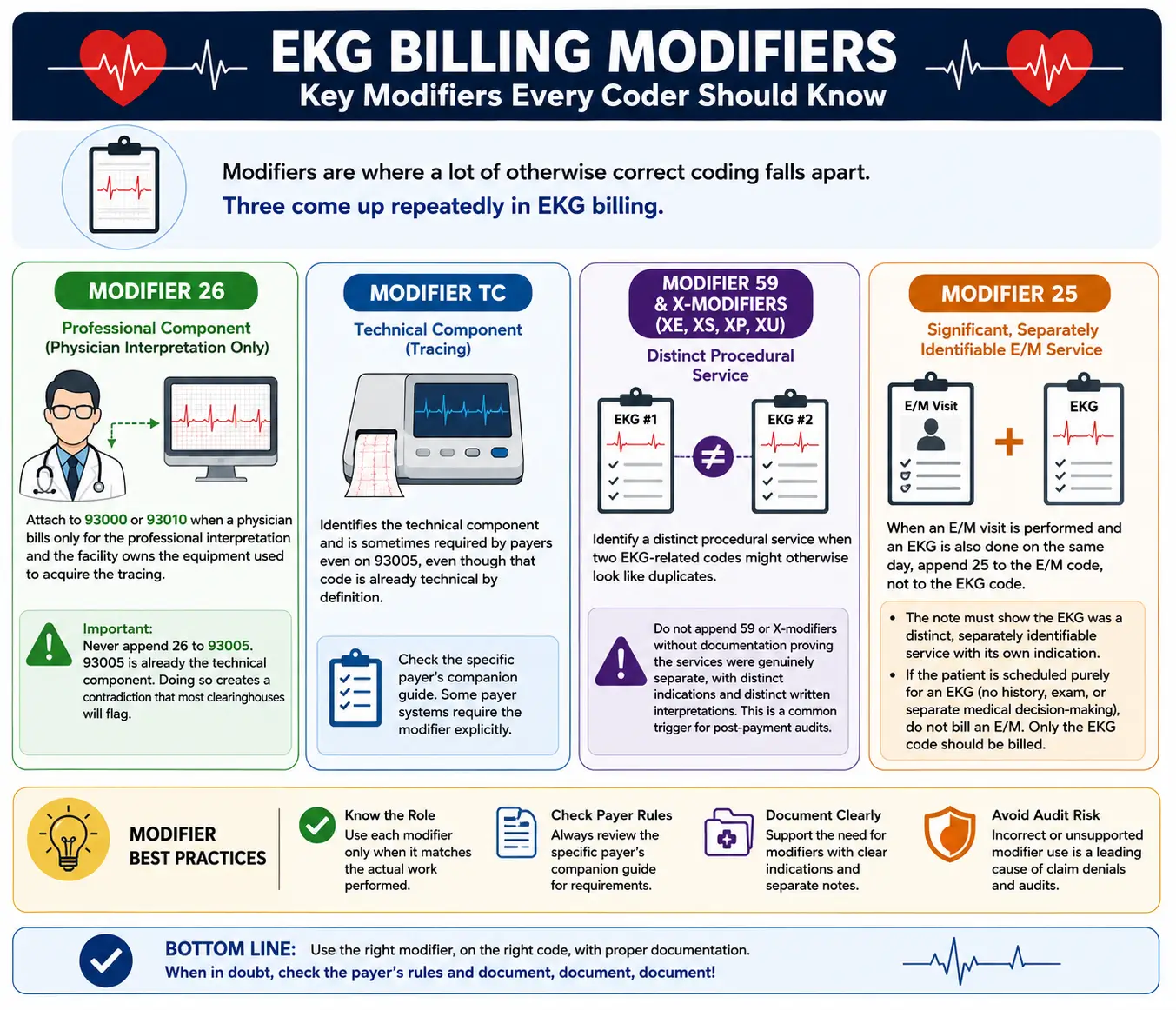
Modifiers are where a lot of otherwise correct coding falls apart. Three come up repeatedly in EKG billing.
Modifier 26 attaches to 93000 or 93010 when a physician bills only for the professional interpretation and the facility retains ownership of the equipment used to acquire the tracing. It should never be appended to 93005, since 93005 already represents the technical component exclusively; stacking modifier 26 on a code that is inherently technical creates a contradiction that most clearinghouses will flag.
Modifier TC identifies the technical component and is occasionally required by payers even on 93005, despite that code already being technical by definition, simply because some payer systems are built to expect the modifier explicitly rather than infer it from the code descriptor. Practices billing frequently to a specific payer should check that payer’s companion guide rather than assume the modifier is optional.
Modifier 59, or the more specific X-modifiers (XE, XS, XP, XU) that CMS increasingly prefers, identify a distinct procedural service when two EKG-related codes might otherwise look like duplicates. Appending modifier 59 without documentation proving the services were genuinely separate, with distinct indications and distinct written interpretations, is one of the more common triggers for a post-payment audit.
Modifier 25 deserves separate mention because it’s frequently misapplied. When a patient comes in for an evaluation and management visit and the physician also performs and bills a same-day EKG, modifier 25 goes on the E/M code, not on the EKG code. The clinical note also has to show the EKG was a distinct, separately identifiable service, meaning it has its own indication documented somewhere beyond simply being part of routine vitals. A patient who is scheduled purely for an EKG, with no history-taking, no exam, and no separate medical decision-making that day, isn’t a candidate for an E/M charge at all. Only the EKG code should be billed.
Reimbursement: what to expect from Medicare
Under the current Medicare Physician Fee Schedule, CPT 93000 carries a relative value unit assignment that translates to a modest national payment, generally in the range of roughly $15 in both facility and non-facility settings once the conversion factor is applied, though the exact dollar figure shifts each year with the fee schedule update and varies locally based on the Geographic Practice Cost Index. Component billing under 93005 and 93010 splits that reimbursement between the two entities rather than duplicating it. CPT 93000 carries no global period, meaning there’s no postoperative day restriction tied to the code, and CMS’s National Correct Coding Initiative edits govern whether it can be billed alongside other same-day services.
Commercial payers typically reimburse somewhere between 100% and 150% of the Medicare rate depending on the specific contract, so a practice’s actual payment for an EKG will vary considerably by payer mix and geography. Because rates are adjusted annually and vary by locality, the only reliable way to confirm a specific dollar amount is to check the current year’s Medicare Physician Fee Schedule lookup tool or the relevant payer fee schedule directly, rather than relying on a fixed figure that will be out of date within a year.
ICD-10 codes that support medical necessity
An EKG CPT code on its own doesn’t justify payment. Payers also require an ICD-10 diagnosis code that establishes why the test was medically necessary. Some of the most frequently paired codes include:
ICD-10 code | Description |
R94.31 | Abnormal electrocardiogram [ECG] [EKG] |
R00.2 | Palpitations |
R07.9 | Chest pain, unspecified |
I10 | Essential (primary) hypertension |
I25.2 | Old myocardial infarction |
Z01.810 | Encounter for pre-procedural cardiovascular examination |
R94.31 is the standard code for a documented abnormal finding when no more specific cardiac diagnosis applies yet. It functions as a placeholder of sorts: appropriate when the tracing shows an irregularity but the ordering physician hasn’t yet established a definitive diagnosis such as atrial fibrillation or a conduction defect. Once a specific diagnosis is confirmed, that diagnosis code should replace R94.31 rather than being billed alongside it indefinitely.
Billing an EKG under a routine screening indication, without symptoms or a qualifying preventive encounter such as Z01.810, is one of the more common reasons for denial. Reviewers look for a documented clinical reason tied to the date of service, not just a note that an EKG was “performed as part of the visit.”
Related codes worth knowing
A handful of adjacent codes come up often enough in EKG-heavy practices that they’re worth flagging even though they cover different services entirely.
G0403, G0404, and G0405 are the HCPCS codes used specifically for the electrocardiogram performed as part of the Medicare Initial Preventive Physical Examination, commonly called the “Welcome to Medicare” visit. These should not be substituted with 93000 series codes when the EKG is furnished in that specific preventive context, since Medicare tracks the initial exam EKG separately from a routine diagnostic one.
93224, 93225, 93226, and 93227 apply to extended external electrocardiographic recording, commonly Holter monitoring, and are structured with the same global-versus-component logic as the 93000 series: one code for the complete service, separate codes for hookup and recording versus the physician’s scanning, analysis, and report.
93241 through 93248 cover external mobile cardiovascular telemetry, a more sophisticated wearable monitoring service than a standard Holter, replacing the code ranges that once fell partly under 93229 in older fee schedules. Practices that bill both standard EKGs and any form of extended monitoring should keep a current CPT reference on hand, since these code sets have been revised more than once in recent years and older billing guides sometimes cite deprecated numbers.
Where billing errors actually happen
Looking across the denial patterns that show up in claims audits, the same few mistakes recur:
- Billing 93000 when the practice only performed the tracing or only performed the interpretation, rather than splitting the claim between 93005 and 93010.
- Attaching modifier 25 to the EKG code instead of the E/M code, or billing modifier 25 without documentation showing the EKG addressed a distinct clinical question from the E/M visit.
- Using modifier 26 on 93005, which is already a technical-only code and doesn’t need or accept a professional-component modifier.
- Pairing the CPT code with a diagnosis that doesn’t establish medical necessity, such as billing a routine EKG with no documented symptom, risk factor, or qualifying preventive encounter.
- Billing both a 12-lead code and a rhythm strip code (93040 through 93042) for the same encounter without documentation showing they served genuinely separate purposes, which runs directly into the bundling rule described in CMS Article A57326.
Most of these errors trace back to the same root cause: staff defaulting to the global code, or a familiar modifier, without first confirming exactly who performed which piece of the service and why. A short checklist step, “who ran the machine, who signed the report, and what diagnosis supports the order,” resolves the majority of denials before the claim ever goes out.
A quick reference for code selection
Situation | Code to bill |
Same provider performs tracing and interpretation | 93000 |
Provider only performs the tracing | 93005 |
Provider only performs the interpretation | 93010 |
Rhythm strip, same provider does both | 93040 |
Rhythm strip, tracing only | 93041 |
Rhythm strip, interpretation only | 93042 |
EKG during Medicare’s Initial Preventive Physical Exam | G0403 |
Getting common EKG CPT codes right comes down to matching the code to the actual division of labor on a given date of service, backing it with a diagnosis that supports medical necessity, and applying modifiers only when the documentation genuinely supports them. The codes themselves aren’t complicated. The errors creep in when billing staff assume rather than verify who did what.