


Breast cancer is the most common cancer diagnosed in U.S. women apart from skin cancers. The American Cancer Society estimates about 321,910 new invasive cases and 60,730 cases of ductal carcinoma in situ in women for 2026, with roughly 2,670 invasive cases in men. Every one of those diagnoses eventually becomes a line on a claim, and the accuracy of that line depends on how well the coder reads the chart. Breast cancer ICD-10 coding rewards precision and punishes shortcuts. A single wrong character can flip a right-side tumor to the left, or turn active disease into resolved history.
This guide walks through the code families a coder actually reaches for, the documentation each one needs, and the mistakes that trigger denials.
How ICD-10-CM builds a breast cancer code
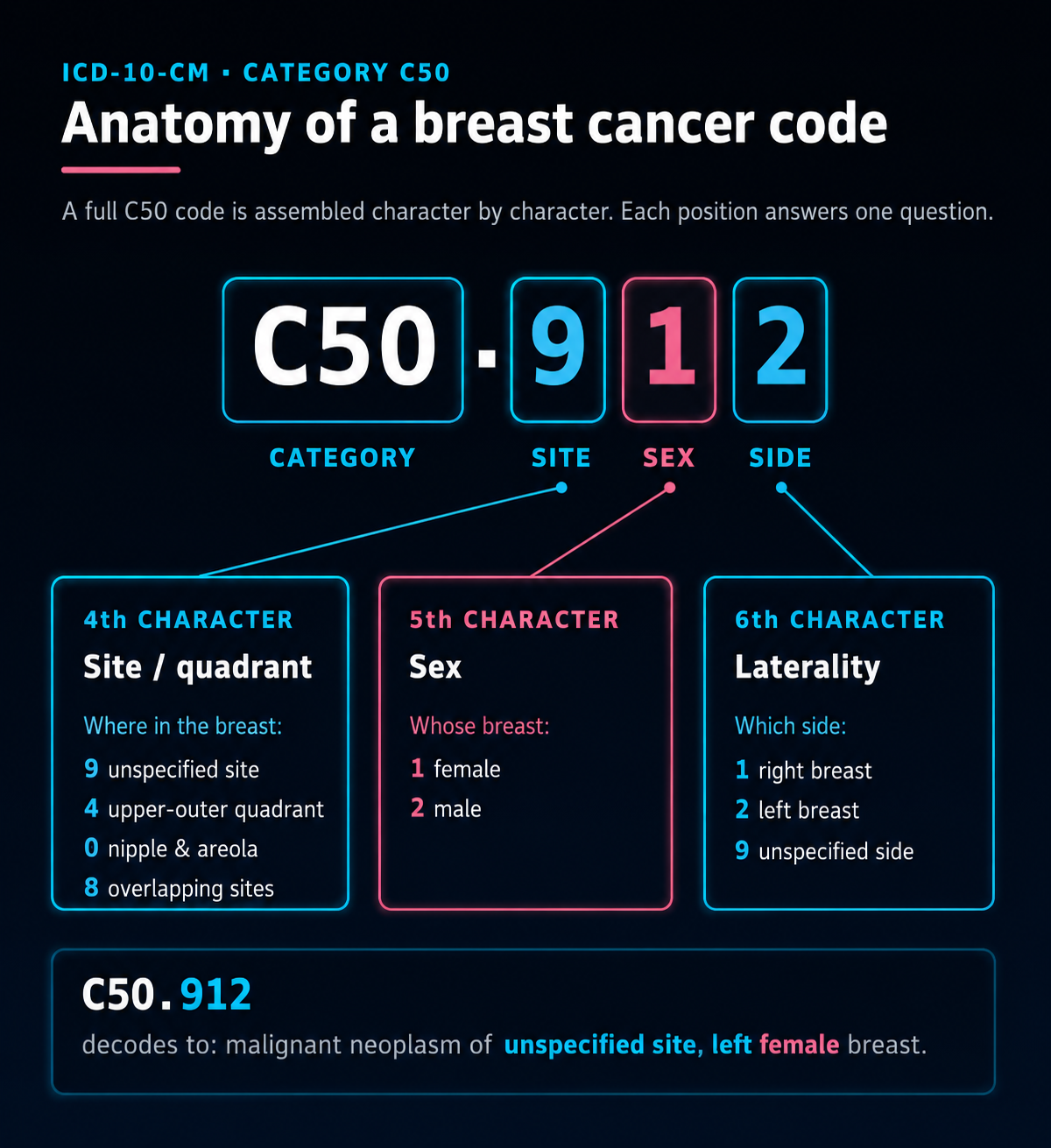
Active breast malignancies live in category C50, malignant neoplasm of breast. What confuses newer coders is that C50 codes are not chosen from a flat list. They are assembled, character by character, from the clinical detail in the record.
A full C50 code carries six characters, and each position answers a specific question:
| Position | What it captures | Example values |
| C50 | The category (malignant neoplasm of breast) | C50 |
| 4th character | Site or quadrant within the breast | 0 = nipple/areola, 4 = upper-outer quadrant, 8 = overlapping, 9 = unspecified site |
| 5th character | Sex | 1 = female, 2 = male |
| 6th character | Laterality | 1 = right, 2 = left, 9 = unspecified |
Read C50.912 with that key in hand and it decodes cleanly: unspecified site (9), female (1), left breast (2). C50.911 is the same tumor on the right. C50.919 is the same tumor when the record never says which side, which is a code payers dislike for a reason discussed below.
The quadrant digit is where documentation quality shows. A pathology report reading “invasive ductal carcinoma, upper-outer quadrant, left breast” supports C50.412. A report that only says “left breast cancer” limits you to C50.912. The clinical facts did not change. The specificity available to the coder did.
Active breast cancer codes (C50)
Assign a C50 code whenever the malignancy is present and being treated. That includes patients mid-chemotherapy, mid-radiation, or awaiting surgery. Ongoing treatment means active disease, and active disease means C50, not a history code.
The unspecified-site codes (C50.911, C50.912, C50.919) remain billable and valid, but they invite trouble when better detail sits in the chart. Payers routinely downcode or deny claims that use an unspecified code when the operative note or pathology report clearly documents a quadrant. The denial is not about clinical error. It is about a coder leaving available specificity on the table.
Two quick rules keep active coding clean. Do not code signs and symptoms (a breast lump, R92 imaging findings) once a definitive malignancy is documented. And do not assign a quadrant code without a source document that names the quadrant, because a guessed site is an audit finding waiting to happen.
Laterality, and why bilateral has no single code
ICD-10-CM insists on laterality for the breast, and getting it wrong is one of the most common triggers for a claim review. Right-side codes end in 1. Left-side codes end in 2.
There is a gap that surprises people. ICD-10-CM has no single code for bilateral breast cancer. When both breasts carry a primary malignancy, you assign two codes, one for each side. A patient with cancer in the upper-outer quadrant of both breasts is coded with both C50.411 (right) and C50.412 (left). The two codes are not mutually exclusive, and reporting only one understates the disease.
Histology does not change the C50 code
This point trips up coders coming from a clinical background. “Invasive ductal carcinoma” and “invasive lobular carcinoma” are histologic descriptions, not codes. ICD-10-CM is histology-agnostic in the C50 family. Invasive ductal carcinoma of the left upper-outer quadrant and invasive lobular carcinoma of the same location share the same code, C50.412, because the code is built from site, sex, and laterality, not from cell type.
Histology still matters clinically, and cancer registries capture it through separate ICD-O-3 morphology codes. For claim submission under ICD-10-CM, though, chasing a “code for invasive ductal carcinoma” is a dead end. There isn’t one. Code the location and laterality, and let the pathology narrative live in the record.
Carcinoma in situ uses D05, not C50
Non-invasive disease breaks away from C50 entirely. Carcinoma in situ of the breast is coded in category D05, and the split matters:
- Ductal carcinoma in situ (DCIS), also called intraductal carcinoma in situ, codes to D05.1- (D05.11 right, D05.12 left, D05.10 unspecified).
- Lobular carcinoma in situ (LCIS) codes to D05.0- (D05.01 right, D05.02 left, D05.00 unspecified).
An Excludes1 note ties these categories together. A coder cannot report a C50 invasive code and a D05 in situ code for the same breast at the same encounter, because ICD-10-CM treats them as conditions that do not coexist in that reporting sense. When a single specimen shows both invasive and in situ components, the invasive C50 code takes precedence and the in situ code is not separately reported for that site. Reading DCIS as “early breast cancer” and coding it to C50 is a frequent and avoidable error.
Receptor status and molecular subtypes
Oncologists talk constantly about triple-negative, HER2-positive, and hormone-receptor-positive disease. ICD-10-CM does not give any of those subtypes its own malignancy code. The cancer is still coded to C50 based on site and laterality, and the biology is carried, where possible, by add-on status codes.
The one receptor status ICD-10-CM does encode is estrogen receptor status:
- Z17.0, estrogen receptor positive status
- Z17.1, estrogen receptor negative status
There is no dedicated ICD-10-CM status code for progesterone receptor status or for HER2 status, and there is no code that says “triple-negative breast cancer” in a single stroke. So triple-negative disease is typically reported as the C50 code plus Z17.1 to capture the ER-negative component, with the rest of the receptor profile living in the clinical documentation. Male breast cancer follows the same C50 logic, using the 5th-character value of 2 (for example, C50.921 for an unspecified site of the right male breast).
Metastatic breast cancer and code sequencing
Metastatic disease is where sequencing rules earn their keep. There is no ICD-10-CM code for “stage IV breast cancer.” Stage is not carried in the diagnosis code at all. Instead, metastatic breast cancer is reported as the primary C50 code together with a secondary neoplasm code for each documented distant site:
- C79.51, secondary malignant neoplasm of bone
- C78.7, secondary malignant neoplasm of liver and intrahepatic bile duct
- C79.31, secondary malignant neoplasm of brain
- C78.00, secondary malignant neoplasm of unspecified lung
- C79.81, secondary malignant neoplasm of breast (used for spread to the breast, including the contralateral breast)
Sequence by the reason for the encounter. When treatment is directed at the primary breast tumor, the C50 code is listed first. When the visit exists to treat a metastasis, for example radiation to a bone lesion, the secondary site code is sequenced first and the C50 code follows. And metastasis is never assumed. It has to be stated by the provider before a secondary code goes on the claim.
The sequencing choice carries money, not just tidiness. Under the CMS-HCC V28 risk model, an active primary breast malignancy (C50.-) maps to HCC 23 with a community, non-dual, aged risk-adjustment factor near 0.186. A documented secondary neoplasm such as C79.81 maps to HCC 18, cancer metastatic to bone and other sites, at a risk-adjustment factor of roughly 2.341. Capturing documented distant spread, rather than the C50 code alone, is what reflects the patient’s true burden in a Medicare Advantage population.
Personal history of breast cancer (Z85.3)
The switch from an active code to a history code is the decision coders get wrong most often.
Use Z85.3, personal history of malignant neoplasm of breast, only when three things are true: the malignancy has been excised or eradicated, no treatment is currently directed at the site, and there is no evidence of existing disease. A patient who finished a mastectomy years ago, has no recurrence, and takes no active cancer treatment is a Z85.3 patient.
The gray area is hormonal therapy. Adjuvant agents like tamoxifen and aromatase inhibitors are often continued for five to ten years after the tumor is gone, and coders disagree about whether that ongoing therapy counts as treatment “directed at the site.” Because the answer affects whether you assign an active C50 code or Z85.3, this is a place to lean on provider documentation and current AHA Coding Clinic guidance rather than a personal rule of thumb. What is not debatable: a patient still receiving chemotherapy or radiation for the breast malignancy is active, and Z85.3 does not apply.
Family history of breast cancer (Z80.3)
Z80.3, family history of malignant neoplasm of breast, documents genetic and familial risk, not disease in the patient. It supports medical necessity for earlier or more frequent screening, for genetic counseling, and for BRCA1 or BRCA2 testing decisions. A strong family history of breast, ovarian, or related cancers is one of the recognized risk factors that drives those referrals. Z80.3 belongs on the record of the at-risk person, and it is easy to confuse with Z85.3. One describes the family. The other describes the patient’s own treated cancer.
Surgical history: mastectomy and lumpectomy
Post-surgical status has its own codes, and they are separate from history-of-cancer codes.
Codes in the Z90.1- series indicate a surgically missing breast: Z90.11 for the right side, Z90.12 for the left side, and Z90.13 when both breasts and nipples are absent. They represent the body’s anatomical state after mastectomy. On their own, they do not indicate that the patient ever had cancer.
This difference often creates a familiar hole in documentation. When a patient had both breasts removed due to breast cancer and is currently disease-free, the most accurate approach is usually to pair two codes: Z85.3 to show a personal history of that malignancy and Z90.13 to reflect the acquired absence of both breasts. Using only the absence code omits the cancer history; using only the history code omits the operative outcome. Lumpectomy does not work the same way, since some breast tissue remains, so it is reflected via history and status notes rather than a code for acquired absence.
Follow-up and surveillance visits (Z08)
Surveillance after completed treatment has a dedicated code: Z08, encounter for follow-up examination after completed treatment for malignant neoplasm. If a patient who has finished therapy and shows no current illness arrives for a standard after-cancer scan or checkup, place Z08 at the start, then include Z85.3 to identify the malignancy being monitored. When that return appointment instead reveals the cancer has come back, the approach shifts completely. A relapse counts as ongoing disease, so coding returns to C50 (or the relevant metastatic location), and the aftercare and past-diagnosis codes no longer take priority..
Accurate breast cancer ICD-10 coding comes down to reading three things in the chart before touching the codebook: is the disease active, in situ, metastatic, or resolved; which breast and which quadrant; and what the current encounter is actually for. Get those three right, and the codes (C50 for active disease, D05 for in situ, C79 for metastasis, Z85.3 for history, Z80.3 for family history) follow with little argument. Get any of them wrong, and the denial or the risk-adjustment miss follows just as reliably.