


Upper endoscopy with tissue sampling is one of the highest-volume procedures in gastroenterology, and CPT code 43239 is the code that carries most of that volume. It also carries a fair share of denials, usually for reasons that have nothing to do with clinical care and everything to do with how the operative note was written or which code was paired with it. This guide walks through the descriptor, payment values, coverage rules, and documentation standards a biller needs to defend the claim.
What CPT code 43239 describes
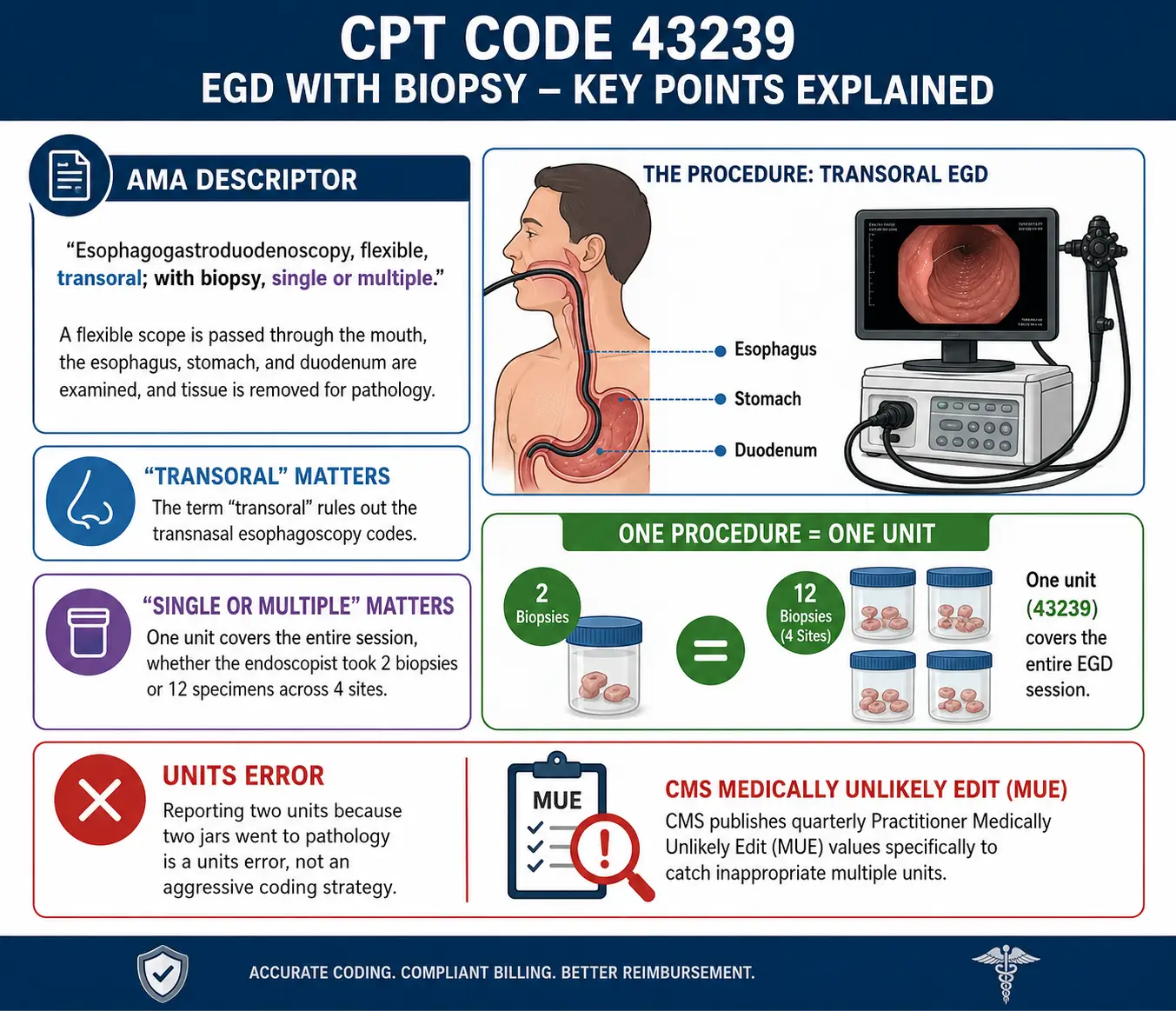
The AMA descriptor reads: “Esophagogastroduodenoscopy, flexible, transoral; with biopsy, single or multiple.” A flexible scope is passed through the mouth, the esophagus, stomach, and duodenum are examined, and tissue is removed for pathology.
Two words in that descriptor do the heavy lifting. “Transoral” rules out the transnasal esophagoscopy codes. “Single or multiple” means one unit covers the entire session, whether the endoscopist took two forceps bites of the gastric antrum or twelve specimens across four sites during a Barrett’s surveillance exam. Reporting two units because two jars went to pathology is a units error, not an aggressive coding strategy, and CMS publishes quarterly practitioner Medically Unlikely Edit values specifically to catch it.
What the code does not include
Brushings and washings are not biopsies. If the endoscopist collected cytology specimens only and took no tissue, the correct code is 43235, which already bundles specimen collection by brushing or washing. Polyp or lesion removal by snare or hot biopsy forceps belongs to 43250 or 43251. Endoscopic mucosal resection is 43254. Control of bleeding, dilation, foreign body removal, and tube placement each have their own codes within the same family.
Is CPT code 43239 a surgery code?
Under the Medicare Physician Fee Schedule, 43239 sits in the surgery section (the 10000 to 69999 range) and carries a status indicator of A, meaning it is active and separately priced. In that administrative sense, yes, 43239 is a surgical code, and surgical billing rules such as the multiple procedure and multiple endoscopy policies apply to it.
Clinically it is a minor procedure performed under moderate sedation or monitored anesthesia care, almost always as a same-day outpatient service. That distinction matters when a payer’s contract applies different cost-sharing or authorization rules to “surgery.”
CPT 43239 global days and 2026 payment values
The global period for 43239 is 000, a zero-day global. There is no postoperative period, so a follow-up visit the next week is separately billable, and an evaluation and management service on the same date can be reported with modifier 25 when it is separately identifiable from the procedure itself.
Values from the CMS 2026 National Physician Fee Schedule Relative Value File, using the non-qualifying APM conversion factor of $33.4009:
Component | Non-facility | Facility |
Work RVU | 2.33 | 2.33 |
Practice expense RVU | 9.94 | 1.10 |
Malpractice RVU | 0.27 | 0.27 |
Total RVU | 12.54 | 3.70 |
National allowable | $418.85 | $123.58 |
The physician claim is only part of the money. When the case is done in a facility, 43239 maps to APC 5301 (Level 1 Upper GI Procedures), which pays the hospital outpatient department $927 nationally in 2026 and a freestanding ASC $498. Those figures come from Addendum B of the OPPS/ASC final rule (CMS-1834-FC) and are separate from the physician payment above.
The gap between the two columns is the single most misread number in EGD billing. When the case is done in a hospital outpatient department or ASC, the physician claim is priced at the facility rate near $124 nationally, because the equipment, scope reprocessing, and staff costs sit on the facility’s claim instead. Practices that model revenue off the non-facility figure will forecast roughly three times what they collect. Clinicians who are qualifying participants in an advanced alternative payment model are paid off a separate 2026 conversion factor of $33.5675, the first year CMS has published two. Two adjustments sit between these national averages and the remittance: geographic practice cost indices, which move the number by locality, and sequestration, the 2 percent across-the-board reduction that applies to all Medicare payments. After sequestration, the facility-setting payment lands closer to $121.
The multiple endoscopy rule, and why 43235 disappears
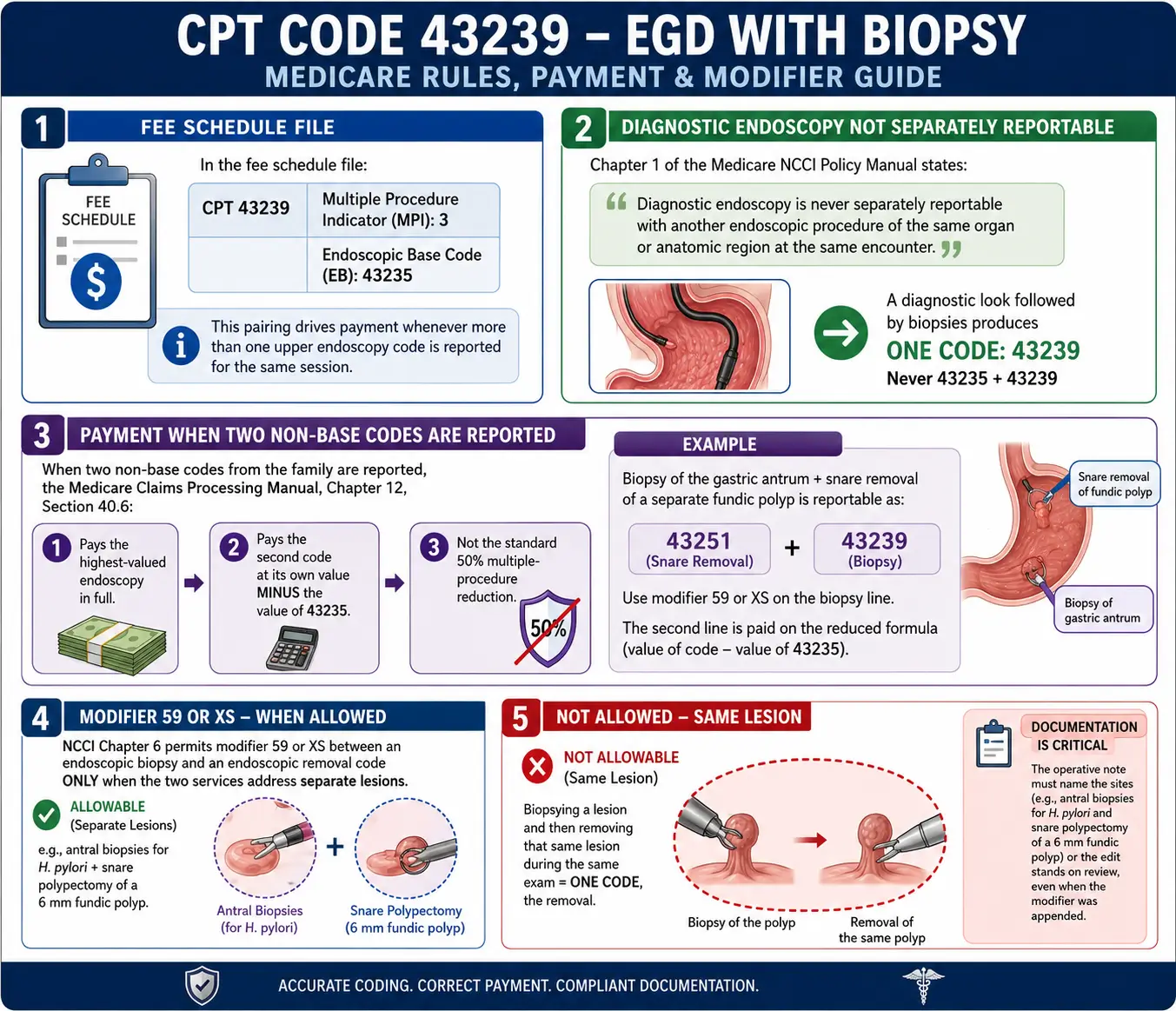
In the fee schedule file, 43239 carries multiple procedure indicator 3 and an endoscopic base code of 43235. That pairing drives payment whenever more than one upper endoscopy code is reported for the same session.
Chapter 1 of the Medicare NCCI Policy Manual states that diagnostic endoscopy is never separately reportable with another endoscopic procedure of the same organ or anatomic region at the same encounter. So a diagnostic look followed by biopsies produces one code, 43239, and never 43235 plus 43239.
When two non-base codes from the family are reported, the Medicare Claims Processing Manual, Chapter 12, Section 40.6 pays the highest-valued endoscopy in full, then pays the second at its own value minus the value of 43235. A biopsy of the gastric antrum plus snare removal of a separate fundic polyp is reportable as 43251 and 43239, with modifier 59 or XS on the biopsy line, but the second line is paid on that reduced formula rather than the standard 50 percent multiple-procedure reduction.
The modifier is not automatic. NCCI Chapter 6 permits modifier 59 or XS between an endoscopic biopsy and an endoscopic removal code only when the two services address separate lesions. Biopsying a lesion and then removing that same lesion during the same exam yields one code, the removal. The operative note must name the sites, for example antral biopsies for H. pylori and snare polypectomy of a 6 mm fundic polyp, or the edit stands on review even when the modifier was appended.
CPT 43239 medical necessity and covered diagnosis
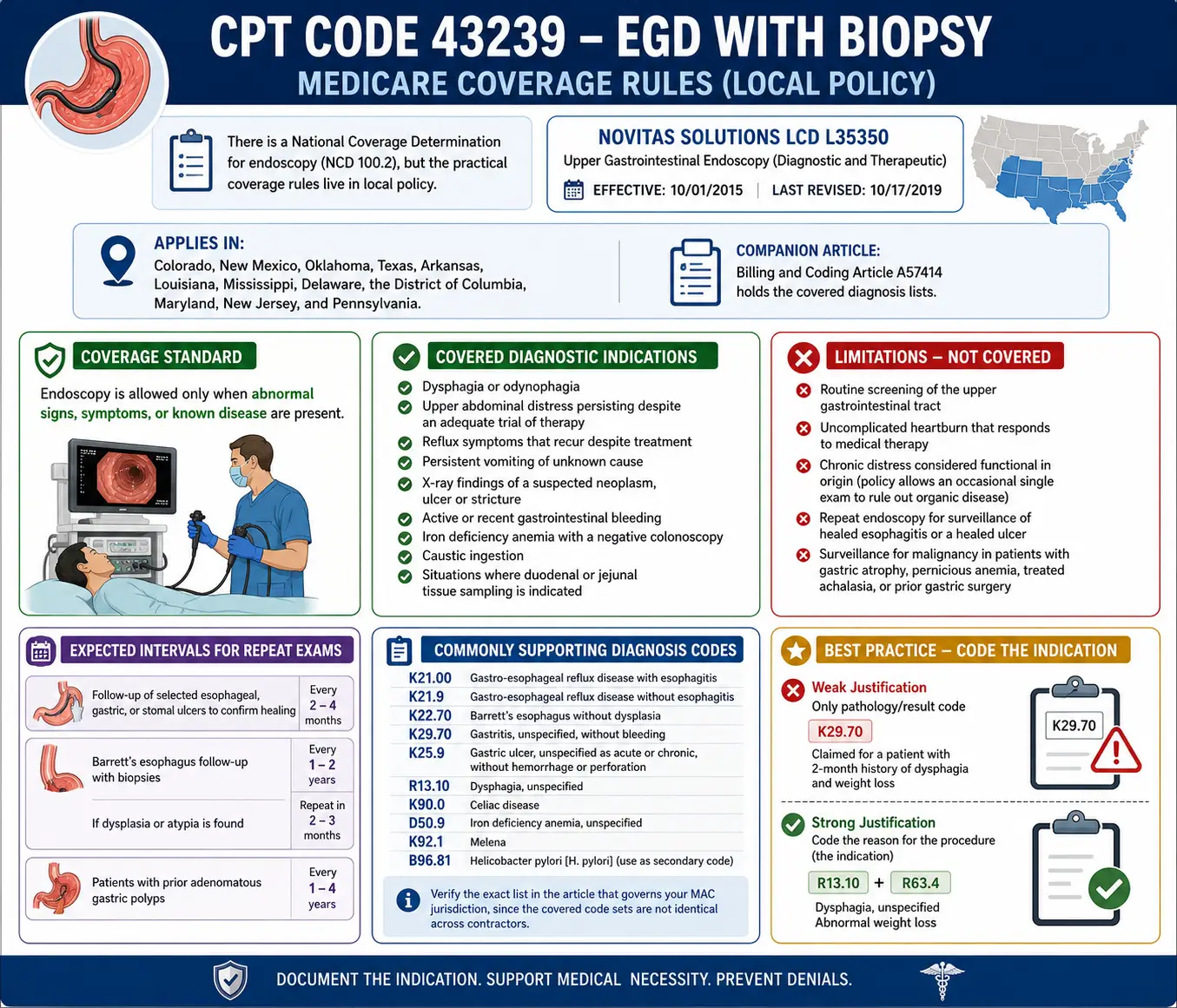
There is a National Coverage Determination for endoscopy (NCD 100.2), but the practical coverage rules live in local policy. Novitas Solutions LCD L35350, Upper Gastrointestinal Endoscopy (Diagnostic and Therapeutic), took effect 10/01/2015 and was last revised 10/17/2019. It applies in Colorado, New Mexico, Oklahoma, Texas, Arkansas, Louisiana, Mississippi, Delaware, the District of Columbia, Maryland, New Jersey, and Pennsylvania, and its companion Billing and Coding Article A57414 holds the covered diagnosis lists.
The opening sentence of the coverage section sets the standard: endoscopy is allowed only when abnormal signs, symptoms, or known disease are present. Covered diagnostic indications include dysphagia or odynophagia, upper abdominal distress persisting despite an adequate trial of therapy, reflux symptoms that recur despite treatment, persistent vomiting of unknown cause, x-ray findings of a suspected neoplasm or ulcer or stricture, active or recent gastrointestinal bleeding, iron deficiency anemia with a negative colonoscopy, caustic ingestion, and situations where duodenal or jejunal tissue sampling is indicated.
The limitations section is where claims die. Novitas lists routine screening of the upper gastrointestinal tract as not covered. So is uncomplicated heartburn that responds to medical therapy, and so is chronic distress considered functional in origin, with the policy allowing an occasional single exam to rule out organic disease. Repeat endoscopy for surveillance of healed esophagitis or a healed ulcer is not covered, nor is surveillance for malignancy in patients with gastric atrophy, pernicious anemia, treated achalasia, or prior gastric surgery.
The policy does set expected intervals for legitimate repeat exams. Follow-up of selected esophageal, gastric, or stomal ulcers to confirm healing is described as reasonable every two to four months until healing is documented. Barrett’s esophagus follow-up is described as every one to two years with biopsies, with a repeat at two to three months when dysplasia or atypia is found. Patients with prior adenomatous gastric polyps fall in the one to four year range. Those numbers give a scheduler and a biller a shared frequency benchmark, and they are the intervals a reviewer will compare against the chart.
Diagnosis codes that commonly support 43239 include K21.00 and K21.9 for reflux with and without esophagitis, K22.70 for Barrett’s esophagus without dysplasia, K29.70 for gastritis without bleeding, K25.9 for gastric ulcer, R13.10 for dysphagia, K90.0 for celiac disease, D50.9 for iron deficiency anemia, K92.1 for melena, and B96.81 as a secondary code for H. pylori. Verify the exact list in the article that governs your MAC jurisdiction, since the covered code sets are not identical across contractors.
One practice habit prevents a large share of medical necessity denials: code the indication that sent the patient to the procedure room, not only the pathology result that came back later. A claim carrying only K29.70 for a case ordered because of a two-month history of dysphagia and weight loss has thrown away its strongest justification.
Does CPT 43239 require authorization, and what about Medicare?
Original Medicare does not require prior authorization for 43239. The hospital outpatient prior authorization program at 42 CFR 419.83 covers eight categories (blepharoplasty, botulinum toxin injection, panniculectomy, rhinoplasty, vein ablation, implanted spinal neurostimulators, cervical fusion with disc removal, and facet joint interventions). Upper endoscopy is not among them. Medicare does cover EGD with biopsy under Part B as a diagnostic service when the indication meets the reasonable and necessary standard of Section 1862(a)(1)(A) of the Social Security Act, and beneficiaries pay the Part B deductible and 20 percent coinsurance. There is no preventive screening benefit for upper endoscopy comparable to the colorectal cancer screening benefit, which is why Section 1862(a)(7), the exclusion for routine physical examinations, appears in the LCD’s reference list.
Medicare Advantage and commercial plans are a different matter, and many require authorization for the facility component, the anesthesia, or both. Timelines tightened this year. Under the CMS Interoperability and Prior Authorization Final Rule (CMS-0057-F), published January 17, 2024, Medicare Advantage organizations, state Medicaid and CHIP programs, and Medicaid and CHIP managed care plans have been required since January 1, 2026, to issue expedited authorization decisions within 72 hours and standard decisions within seven calendar days, down from the previous 14-day standard. Those payers also had to publish aggregated authorization metrics, including approval and denial rates, by March 31, 2026. Practices that track turnaround times now have a published benchmark to hold plans to.
Sedation billing that travels with the code
Since 2017, moderate sedation is no longer bundled into the endoscopy codes. For Medicare patients, the endoscopist providing moderate sedation reports G0500 for the initial 15 minutes of intraservice time, with 99153 for each additional 15 minutes. Many commercial payers do not accept G0500 and expect 99152 instead, so the sedation code often differs by payer for the same procedure. For anesthesia services, the claim is reported with CPT 00731 for upper gastrointestinal endoscopy (when no more specific anesthesia code applies), which carries five base units, or CPT 00732 for ERCP, which is assigned six base units. According to the American College of Gastroenterology’s coding guidance, these codes replaced CPT 00740 and CPT 00810 in 2018.
Documentation that holds up on review
Novitas requires that every page of the record be legible, identify the patient, and carry the signature of the practitioner responsible for the care. Beyond that baseline, an operative note supporting 43239 should record:
- The indication in clinical terms, including duration of symptoms and prior therapy that failed
- Extent of the exam, with the most distal point reached named (second portion of the duodenum, for example)
- Each biopsy site and the instrument used, since site detail is what supports a modifier when a second procedure is reported
- Findings at each site, normal ones included
- Sedation type and intraservice time when the endoscopist provided it
- Specimen disposition and the pathology requisition
Two modifiers deserve a plan before they are needed. Modifier 53 applies when the physician discontinues the procedure after sedation is administered. In a hospital outpatient or ASC setting, the facility uses 73 for a case stopped before anesthesia and 74 for one stopped after. Modifier 52 fits the narrower case where the scope could not be advanced to the duodenum despite a documented attempt, leaving the service reduced rather than abandoned.
Conclusion
CPT code 43239 is a zero-day global surgical code valued at 2.33 work RVUs, paid at roughly $124 nationally in a facility and $419 in the office under the 2026 fee schedule, before locality adjustment and sequestration. It is reported once per session regardless of biopsy count, it absorbs 43235 whenever both would apply, and it pairs with removal codes only when the operative note names separate lesions. Original Medicare covers it without prior authorization when the indication matches an LCD-listed condition, and denies it for routine screening or for symptoms already controlled on therapy. Almost every appealable denial on this code traces back to the same page of the chart, so the fastest revenue fix available to most GI practices is a template that forces the indication, the extent of the exam, and the biopsy sites into the note before it can be signed.