

An estimated 900,000 Americans develop a deep vein thrombosis or pulmonary embolism every year, according to the Centers for Disease Control and Prevention, and millions more live with atrial fibrillation or a mechanical heart valve that requires blood thinning for life. None of those patients are being treated for a new illness when they show up for a medication refill or a routine lab check. They’re carrying a status, and ICD-10-CM has a code built specifically to record it: Z79.01, long-term (current) use of anticoagulants. Chronic anticoagulation ICD-10 coding looks straightforward until a coder has to decide whether Z79.01 belongs first or second on a claim, which common anticoagulants change the coding picture, and when a bleeding complication calls for a completely different code. This guide works through each of those questions, using the FY2026 ICD-10-CM guidelines currently in effect and the documentation patterns that most often trigger denials.
Z79.01 and the basics of chronic anticoagulation ICD-10 coding
Z79.01 sits in Chapter 21 of ICD-10-CM, the chapter reserved for factors influencing health status rather than active disease. Specifically, it falls under category Z79, long-term (current) drug therapy, which groups codes for patients on ongoing medication regimens rather than short courses of treatment. Its parent code, Z79.0, covers anticoagulants and antithrombotics or antiplatelets together, but Z79.0 itself isn’t billable. It serves as a parent category for two subcodes: Z79.01 for long-term use of anticoagulants and Z79.02 for long-term use of antithrombotic/antiplatelet agents, such as clopidogrel. Aspirin gets its own code, Z79.82, filed under a different Z79 subcategory entirely, a distinction that trips up more coders than it should.
The current edition of Z79.01, effective since October 1, 2025 and valid through September 30, 2026 under the FY2026 code set, carries the same official description it has held since ICD-10-CM was first implemented: long-term (current) use of anticoagulants. It’s billable and specific, and it’s exempt from present-on-admission reporting for inpatient claims, so hospitals don’t need to flag whether the anticoagulant use was present at the time of admission. Two Excludes2 notes apply: the code shouldn’t be used for drug abuse or dependence, which falls under F11 through F19, and it shouldn’t cover drug use complicating pregnancy, childbirth, or the postpartum period, which belongs under O99.32. Coders also see it paired routinely with Z51.81, encounter for therapeutic drug level monitoring, whenever a visit centers on INR testing or another drug-level check.
Which patients receive this code
Three clinical situations account for most Z79.01 assignments: atrial fibrillation, venous thromboembolism, and mechanical heart valve replacement. Each affects a substantial patient population.
Atrial fibrillation affects an estimated 3.89% of US adults, according to a 2024 study in JACC: Advances that analyzed more than 259 million patient records through the Epic Cosmos platform. The same study found that roughly 30% of diagnosed AFib patients weren’t receiving any anticoagulant at all, despite guidelines recommending it for most. The CDC’s current data on the condition puts hospitalizations with AFib as the primary diagnosis above 454,000 a year and estimates the condition contributes to about 158,000 deaths annually. A more recent analysis, published in the Journal of the American College of Cardiology and reported on by Patient Care Online in 2026, estimates closer to 10.5 million affected adults, or roughly 5% of the population, a notably higher figure than older estimates that likely reflects better detection rather than a true surge in cases.
Venous thromboembolism runs on a comparable scale. The CDC estimates that as many as 900,000 Americans are affected by a DVT or PE each year, contributing to 60,000 to 100,000 deaths annually. About one in four people who experience a PE have sudden death as their first symptom, which is part of why anticoagulation coding for VTE survivors carries genuine clinical weight and not just administrative value. Mechanical heart valve patients make up a smaller group but need Z79.01 for the life of the valve, since interrupting anticoagulation risks valve thrombosis.
Documentation that supports the code
The chapter-specific coding guidance for category Z79 instructs coders to assign these codes when a patient takes a prescribed drug continuously, either for treatment of a chronic condition or for prophylaxis, and to avoid them for medications used briefly during an acute illness. A short course of antibiotics doesn’t qualify. Neither does a medication taken only as needed. The same guidance excludes drugs used in detoxification or maintenance programs, such as methadone for opioid dependence, since those situations follow an entirely separate coding pathway.
One detail catches newer coders off guard: there’s no official time threshold defining “long term” anywhere in the guidelines themselves. Coding references commonly treat medication taken on a refillable, ongoing basis as long-term use, and many practices apply a rough three-month benchmark internally, but that benchmark comes from coding education rather than CMS. What matters more than the calendar is the intent behind the prescription. A patient started on enoxaparin for ten days after a knee replacement isn’t a Z79.01 candidate. A patient placed on apixaban for life after a second pulmonary embolism is, from the very first refill.
Solid documentation for Z79.01 names the specific drug, states the condition it’s treating or preventing, and confirms the therapy is ongoing rather than time-limited. A vague note reading “patient on blood thinner” invites denials, especially as more payers run automated chart reviews before paying a claim.
Can Z79.01 be a primary diagnosis?
The honest answer has two parts.
First, nothing in the Official Guidelines explicitly bars Z79.01 from the first-listed position the way certain other Z codes are restricted. The guidelines name specific categories, Z00 through Z04 among them, that may only be reported as principal or first-listed diagnosis. Z79 doesn’t appear on that list, and it doesn’t appear on any list of codes forbidden from first-listed use either.
Second, in practice, Z79.01 almost never functions as the reason for an encounter by itself, because it documents a status rather than a condition that requires evaluation that day. Take the scenario coders see most often: a patient comes in solely for INR review and dosage adjustment. Standard coding guidance points to Z51.81, encounter for therapeutic drug level monitoring, as the first-listed code in that situation, with Z79.01 sequenced second to explain why the monitoring is medically necessary in the first place. When a visit instead addresses the underlying disease (an atrial fibrillation follow-up, for instance), the disease code, I48.91 as one example, takes the primary position, and Z79.01 documents the ongoing treatment as a secondary code.
The practical rule most billing teams apply, then: pair Z79.01 as a secondary code with either the condition being managed or the Z51.81 monitoring code, rather than reporting it alone as the reason for the visit.
Coding by medication: warfarin, DOACs, and enoxaparin
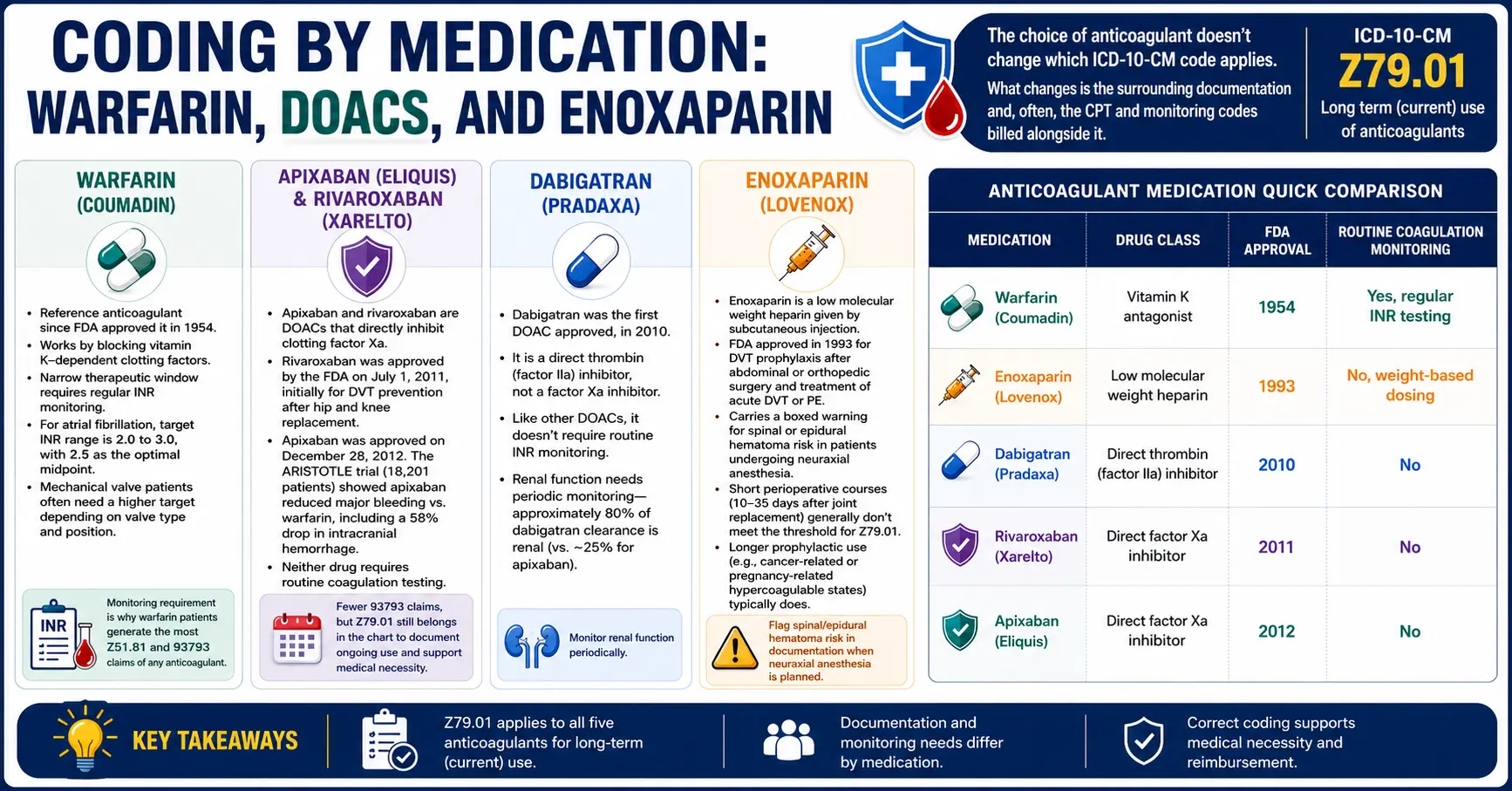
The choice of anticoagulant doesn’t change which ICD-10-CM code applies. Z79.01 covers all five of the medications below. What changes is the surrounding documentation and, often, the CPT and monitoring codes billed alongside it.
Warfarin (Coumadin)
Warfarin has been the reference anticoagulant since the FDA approved it in 1954, making it the oldest oral anticoagulant still in wide use. It works by blocking vitamin K-dependent clotting factors, and its narrow therapeutic window means patients need regular blood draws to check their international normalized ratio, or INR. For atrial fibrillation, the target range recommended across American Heart Association, American College of Cardiology, and American College of Chest Physicians guidance is 2.0 to 3.0, with 2.5 as the optimal midpoint; mechanical valve patients often need a higher target depending on valve type and position. This monitoring requirement is exactly why warfarin patients generate the most Z51.81 and 93793 claims of any anticoagulant group.
Apixaban (Eliquis) and rivaroxaban (Xarelto)
Apixaban and rivaroxaban belong to the direct oral anticoagulant class, known as DOACs, which work by directly inhibiting clotting factor Xa rather than reducing factor production the way warfarin does. Rivaroxaban reached the market first, approved by the FDA on July 1, 2011, initially for DVT prevention after hip and knee replacement surgery. Apixaban followed on December 28, 2012, backed by the ARISTOTLE trial, which enrolled 18,201 patients with nonvalvular atrial fibrillation and found apixaban reduced major bleeding compared with warfarin, including a 58% drop in intracranial hemorrhage. Neither drug requires the routine coagulation testing warfarin does, which changes the billing picture (fewer 93793 claims), though Z79.01 still belongs in the chart to document ongoing use and support medical necessity for related services like pre-procedure bleeding risk assessments.
Dabigatran (Pradaxa)
Dabigatran actually reached the market first among the DOACs, approved in 2010 as a direct thrombin, or factor IIa, inhibitor rather than a factor Xa inhibitor. Like apixaban and rivaroxaban, it doesn’t require routine INR monitoring, though renal function needs periodic checking, since dabigatran clears through the kidneys more heavily than its factor Xa counterparts (roughly 80% of its clearance is renal, compared with about 25% for apixaban).
Enoxaparin (Lovenox)
Enoxaparin stands apart from the oral anticoagulants entirely. It’s a low molecular weight heparin given by subcutaneous injection, and the FDA approved it in 1993 for indications including DVT prophylaxis after abdominal or orthopedic surgery and treatment of acute DVT or PE. It carries a boxed warning for spinal or epidural hematoma risk in patients undergoing neuraxial anesthesia, worth flagging in documentation whenever an anticoagulated patient on Lovenox is scheduled for a procedure involving spinal anesthesia. Short perioperative courses of enoxaparin, the ten-to-thirty-five-day kind prescribed after joint replacement, generally don’t meet the threshold for Z79.01. Longer prophylactic use, such as in certain cancer-related or pregnancy-related hypercoagulable states, typically does.
| Medication | Drug class | FDA approval | Routine coagulation monitoring |
| Warfarin (Coumadin) | Vitamin K antagonist | 1954 | Yes, regular INR testing |
| Enoxaparin (Lovenox) | Low molecular weight heparin | 1993 | No, weight-based dosing |
| Dabigatran (Pradaxa) | Direct thrombin (factor IIa) inhibitor | 2010 | No |
| Rivaroxaban (Xarelto) | Direct factor Xa inhibitor | 2011 | No |
| Apixaban (Eliquis) | Direct factor Xa inhibitor | 2012 | No |
Coding mistakes that trigger denials
Four errors show up repeatedly in claim denials and payer audits tied to anticoagulation coding.
The most common one confuses therapeutic use with an actual bleeding complication. Z79.01 documents that a patient takes an anticoagulant. It says nothing about a bleeding event. If the anticoagulant actually causes bleeding, the correct code is D68.32, hemorrhagic disorder due to extrinsic circulating anticoagulants, and if the bleeding results from taking the drug exactly as prescribed rather than an error in dosing, an adverse effect code from the T45.51- series applies too, sequenced ahead of Z79.01.
A second frequent mix-up involves Z79.01, Z79.02, and Z79.82. Anticoagulants get Z79.01. Antiplatelets and antithrombotics other than aspirin, clopidogrel among them, get Z79.02. Aspirin, despite functioning as an antiplatelet clinically, has its own dedicated code, Z79.82, because ICD-10-CM classifies it separately from the rest of that drug class.
Third, coders sometimes drop the underlying condition entirely. A patient on apixaban for atrial fibrillation needs both the AFib code and Z79.01. Reporting Z79.01 alone, without the condition driving the prescription, leaves the record incomplete and gives payers grounds to question why the medication was prescribed at all.
A fourth pattern involves short perioperative anticoagulation getting coded the same way as chronic therapy. Ten days of enoxaparin after a hip replacement is aftercare, not long-term drug therapy, and coding it with Z79.01 overstates the patient’s ongoing risk profile in a way that can distort quality reporting and risk-adjustment data later on.
CPT and HCPCS codes that pair with Z79.01
Because warfarin needs active monitoring, it generates the most billing activity around Z79.01. CPT 93792 covers patient or caregiver training when someone starts home INR monitoring, including a face-to-face demonstration of the device and documentation that the patient can use it correctly. CPT 93793 covers the ongoing anticoagulant management itself: reviewing a new INR result, adjusting the warfarin dose as needed, and scheduling the next test. If the blood draw happens in-house rather than through a home monitor, the lab test itself is billed separately with CPT 85610, prothrombin time. Most payers won’t reimburse 93793 alongside a separate evaluation and management code on the same date, since the management work is bundled into that visit rather than billed as a distinct service.
For Medicare patients specifically, HCPCS codes G0248 through G0250 apply to home INR monitoring for those with a mechanical heart valve, chronic atrial fibrillation, or venous thromboembolism who meet Medicare’s coverage criteria. G0248 covers the initial training demonstration, G0249 covers the test materials and equipment, and G0250 covers the physician’s review of results. DOACs bypass most of this billing structure since they don’t require routine lab monitoring; they’re typically billed through Medicare Part D using NDC codes rather than the medical claims pathway that warfarin monitoring follows. Z79.01 still belongs on the chart either way, documenting the ongoing therapy that justifies related services, from pre-procedure bleeding risk assessments to the periodic renal function checks that dabigatran in particular calls for.
The sequencing rule worth remembering
Every version of this coding question comes back to the same distinction. Z79.01 documents a status, not a diagnosis requiring active treatment at that visit. Pair it with the condition it supports, whether that’s atrial fibrillation, a history of pulmonary embolism, or a mechanical valve, and let that condition, or the Z51.81 monitoring code, carry the encounter. Keep the drug name, the indication, and the ongoing nature of the therapy in the note, since that’s what turns a vague “patient on blood thinner” into a claim that survives an audit. The medication on the chart will keep changing: warfarin gives way to a DOAC, or a short course of enoxaparin turns into permanent apixaban after a second clot. The coding logic behind Z79.01 doesn’t change with it.