


A biller who has never touched an orthopedic claim can still recognize CPT code 27447 by reputation alone. It is one of the highest-volume procedure codes in the Medicare program, and it is also one of the most frequently denied. Between prior authorization mismatches, bilateral billing confusion, and global period disputes, this single code generates more appeals correspondence than almost any other orthopedic entry in the CPT manual.
This guide walks through what the code actually covers, how Medicare prices it, which modifiers apply in real scenarios, and where claims tend to fall apart.
What CPT code 27447 describes
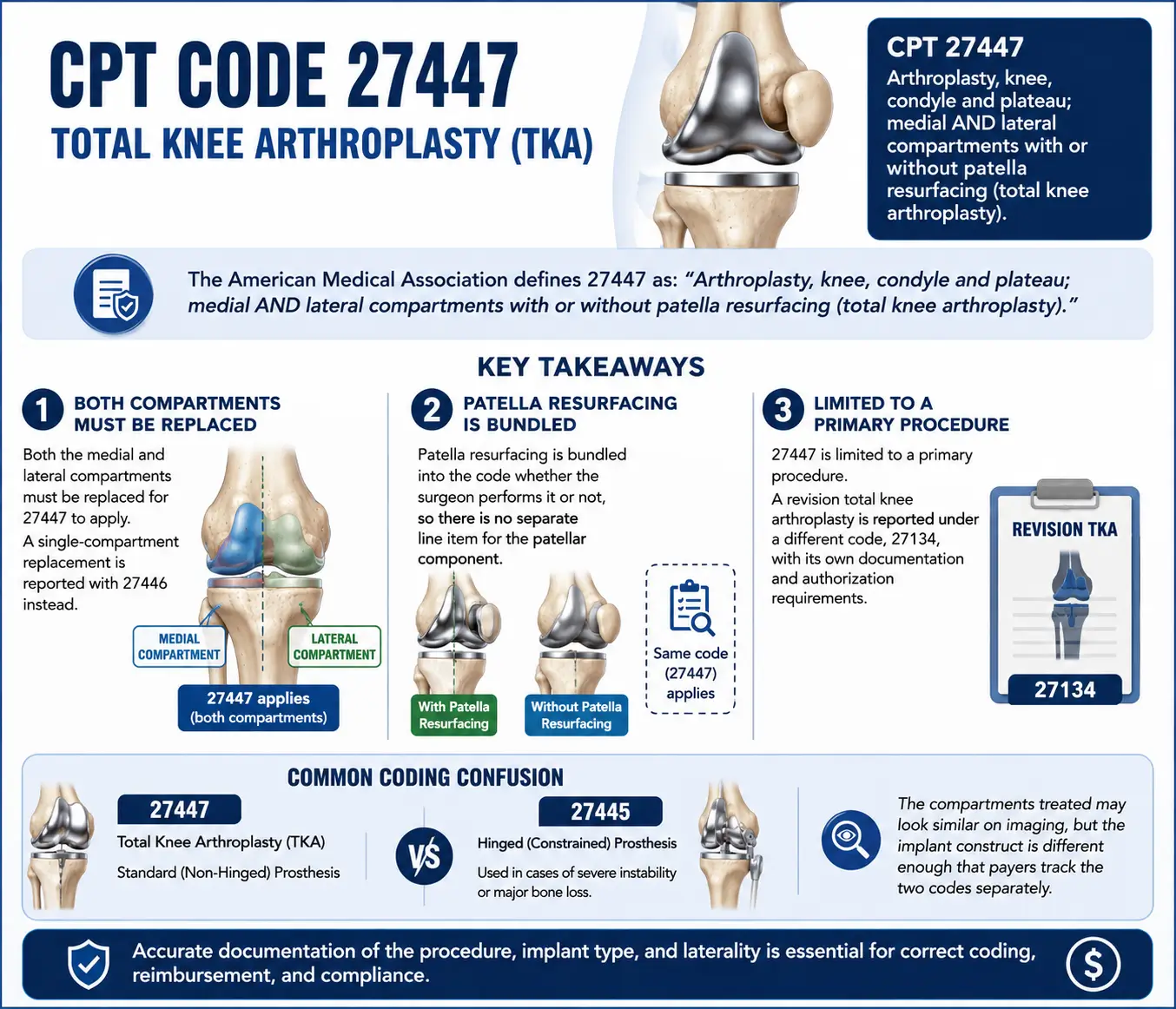
The American Medical Association defines 27447 as: “Arthroplasty, knee, condyle and plateau; medial AND lateral compartments with or without patella resurfacing (total knee arthroplasty).” That single sentence carries more billing weight than its length suggests.
Three things follow directly from the descriptor. First, both the medial and lateral compartments must be replaced for the code to apply; a single-compartment replacement is reported with 27446 instead. Second, patella resurfacing is bundled into the code whether the surgeon performs it or not, so there is no separate line item for the patellar component. Third, the code is limited to a primary procedure. A revision total knee arthroplasty is reported under a different code, 27134, with its own documentation and authorization requirements.
Coders sometimes confuse 27447 with 27445, the code for a hinged (constrained) prosthesis used in cases of severe instability or major bone loss. The compartments treated may look similar on imaging, but the implant construct is different enough that payers track the two separately.
Where 27447 sits in site-of-service history
For years, Medicare treated total knee arthroplasty as an inpatient-only procedure, meaning hospitals could not bill it in an outpatient setting regardless of clinical circumstances. That changed with the 2018 Medicare Outpatient Prospective Payment System final rule, published in the Federal Register on November 13, 2017 (82 Fed. Reg. 52,523). The American Association of Orthopaedic Surgeons had lobbied for the change, and CMS removed 27447 from the Inpatient-Only list effective January 2018, allowing the surgeon to determine the appropriate setting on a case-by-case basis.
CMS went further two years later, adding the procedure to the Ambulatory Surgical Center Covered Procedures List in 2020. That decision opened a third billing pathway. Today, 27447 can legitimately be reported in an inpatient hospital, a hospital outpatient department, or a freestanding ASC, and each setting carries a different facility payment mechanism: the inpatient prospective payment system, the outpatient prospective payment system with its APC rate, or the ASC fee schedule, which typically pays the least of the three.
This flexibility is a double-edged sword for billing departments. Choosing the wrong setting, especially billing an uncomplicated same-day discharge as inpatient, is one of the most common triggers for post-payment recoupment. The two-midnight rule still governs whether an inpatient admission is appropriate, and CMS guidance places the final judgment on the operating surgeon, documented before the procedure, not decided retroactively by billing staff after a short length of stay raises a flag.
Medicare reimbursement figures for CY 2026
Medicare prices the surgeon’s professional work through the Physician Fee Schedule, which assigns relative value units for physician work, practice expense, and malpractice risk. For calendar year 2026, industry analyses of the CMS Medicare Physician Fee Schedule data list the work RVU for 27447 at approximately 19.11, down from 19.60 the prior year. CMS applied a 2.5 percent efficiency adjustment to work RVUs across most non-time-based services in the CY 2026 final rule, and 27447 falls into that category. The total facility RVU sits near 34.71, and the resulting national professional payment lands around $1,159 before geographic adjustment.
That number moves with locality. Every Medicare payment area applies a geographic practice cost index to the work, practice expense, and malpractice components separately, so a surgeon in a high-cost metropolitan area will see a higher final payment than one in a rural locality, even though the RVUs are identical on paper. Billing staff should pull the specific locality’s GPCI values from the CMS Physician Fee Schedule Look-Up Tool rather than rely on the national average when projecting revenue.
Commercial payers price the procedure differently, typically as a multiple of the Medicare rate negotiated by contract. Total allowed charges for a single knee, including both the professional and facility components, commonly range from roughly $11,000 to $30,000 depending on the payer and the site of service, with the facility fee accounting for most of that variation rather than the surgeon’s payment, which stays relatively stable across settings.
The code carries a 90-day global period, meaning the professional payment already includes routine postoperative visits for three months after surgery. A separate evaluation and management claim for a routine follow-up during that window will be denied as included in the global package.
Modifiers that apply to CPT code 27447
Because 27447 describes a single knee, several situations require modifiers to describe what actually happened in the operating room.
LT and RT identify which knee was replaced. Many payers require laterality on every single-knee claim, and the operative note should state the side explicitly rather than leaving it to be inferred from the diagnosis code.
Modifier 50 reports a bilateral procedure performed in the same operative session. Medicare pays bilateral claims at 150 percent of the single-procedure fee schedule amount rather than doubling the payment outright, reflecting shared setup and anesthesia time between the two sides.
Modifier 58 applies to a staged bilateral case, where the second knee is replaced during the 90-day global period of the first. Because the second surgery is planned rather than a complication, modifier 58 signals that the return to the operating room was anticipated and should be paid as a new, separately billable procedure rather than bundled into the first knee’s global package.
Modifier 22 reports substantially greater work than the code typically requires, for example a knee with severe deformity or retained hardware from a prior fracture. Payers generally want a supporting operative narrative describing the added time and complexity, and many route these claims for manual review rather than automatic payment.
Modifier 62 covers true co-surgery, where two surgeons of different specialties or with distinct skill sets are each required to complete separate portions of the same procedure. Each surgeon bills the same code with modifier 62 appended, and Medicare pays each at 62.5 percent of the fee schedule amount, provided both operative notes independently justify why two surgeons were medically necessary.
Modifiers 80, 82, and AS cover assistants at surgery. Modifier 80 applies when another physician assists throughout the case, paid at 16 percent of the fee schedule amount. Modifier 82 is reserved for teaching hospitals, used only when a qualified resident was unavailable to assist. Modifier AS covers a physician assistant, nurse practitioner, or clinical nurse specialist assisting at surgery, and Medicare prices that service at 85 percent of the modifier 80 rate.
Modifiers 78 and 79 distinguish complications from unrelated procedures during the global period. An unplanned return to the operating room for a complication of the knee replacement, such as a hematoma requiring evacuation, uses modifier 78 and is paid for the intraoperative work only, without a new global package. A genuinely unrelated procedure, such as surgery on the opposite, unaffected joint, uses modifier 79 and starts its own global period.
Bundling rules coders need to know
The National Correct Coding Initiative bundles several services into 27447 when performed on the same knee during the same session. A diagnostic arthroscopy used to inspect the joint before the open procedure is not separately payable. Intraoperative fluoroscopy used to confirm component alignment is included as well.
Robotic-assisted and computer-navigated total knee arthroplasty deserve a specific mention, because this is a point of confusion even among experienced coders. There is no separate professional CPT code for robotic assistance in knee replacement. Codes such as 20985 and the Category III codes 0054T and 0055T describe computer-assisted navigation, but none of them generate additional professional reimbursement when reported alongside 27447. The surgeon’s fee is identical whether the case is performed with robotic guidance or with conventional instrumentation. A facility may recoup some of the added technology cost through hospital-level charge capture, but that has no bearing on the physician’s payment.
Medical necessity and supporting diagnosis codes
Payers do not authorize 27447 on the strength of an osteoarthritis diagnosis alone. The documentation trail typically needs to show a trial of conservative management, often a minimum of three months, including physical therapy, NSAIDs or other analgesics, activity modification, and in many cases a corticosteroid or viscosupplementation injection. Weight-bearing radiographs showing advanced joint space narrowing, combined with documentation of the patient’s functional limitations in daily activities, complete the clinical picture.
Common supporting ICD-10 codes include M17.11 and M17.12 for unilateral primary osteoarthritis of the right and left knee, M17.0 for bilateral primary osteoarthritis, the M05 and M06 series for rheumatoid arthritis, and M17.31 or M17.32 for post-traumatic osteoarthritis following an old fracture or ligament injury. The diagnosis code establishes the clinical picture, but it is the documented failure of nonoperative treatment that actually satisfies most payer medical policies.
Common denial triggers and how to prevent them
A handful of patterns account for most 27447 denials seen across orthopedic billing operations.
Site-of-service mismatches occur when a same-day, uncomplicated case is billed as inpatient without documentation supporting the two-midnight expectation. The fix is straightforward: document the anticipated length of stay before surgery, and default to outpatient billing when the clinical picture does not clearly support an inpatient stay.
Authorization specificity is another frequent problem. A prior authorization obtained for 27447 does not cover a later revision procedure billed under 27134, even on the same knee. Each code needs its own authorization tied to the correct laterality and site of service.
Insufficient conservative-treatment documentation causes denials even when the surgery itself was clearly indicated. Submitting the full nonoperative trial, along with weight-bearing imaging, at the time of the original authorization request avoids a preventable back-and-forth with the payer.
Finally, separately billing bundled services, whether a same-session diagnostic scope or a navigation code like 0054T, remains one of the easiest ways to trigger an automatic NCCI edit rejection. Running every claim through an NCCI-aware scrubber before submission catches most of these before they become a denial.
Getting CPT code 27447 right comes down to matching the clinical documentation to the specific rule in play, whether that is a modifier, a global period restriction, or a site-of-service justification. The code itself is simple. The billing environment around it is not.