

Billers who work Aetna claims for behavioral health services run into the same question within their first few months on the job: does Aetna actually follow Medicare’s incident-to rules, or does it run its own version? The short answer is that Aetna has historically modeled its incident-to policy on Medicare’s framework more closely than most commercial payers, but the two are not identical, and the gap between them has widened since 2023. This guide covers what Aetna incident-to billing for mental health requires, where it departs from Medicare, and where practices most often lose money or invite an audit.
What incident-to billing actually means
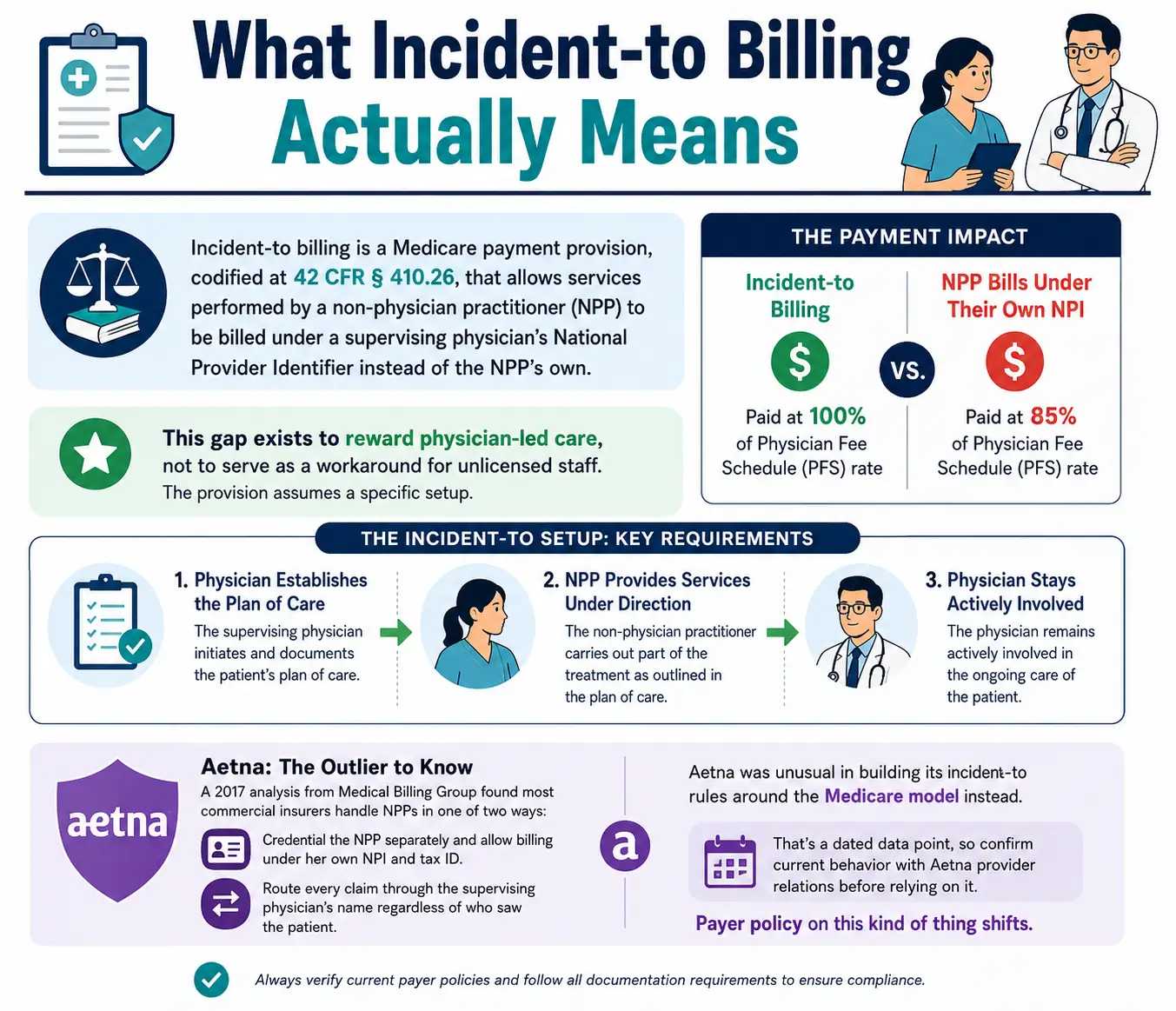
Incident-to billing is a Medicare payment provision, codified at 42 CFR § 410.26, that allows services performed by a non-physician practitioner (NPP) to be billed under a supervising physician’s National Provider Identifier instead of the NPP’s own. The payoff for the extra paperwork is real: Medicare pays incident-to claims at the full Physician Fee Schedule rate, compared with 85% of that rate when the same non-physician practitioner bills directly under her own NPI.
That gap exists to reward physician-led care, not to serve as a workaround for unlicensed staff. The provision assumes a specific setup: a physician establishes the plan of care, an NPP carries out part of the treatment under that physician’s direction, and the physician stays actively involved as the case continues.
Aetna is the outlier worth knowing about here. A 2017 analysis from billing consultancy Medical Billing Group found that most commercial insurers handle non-physician practitioners one of two ways: credential the NPP separately and let the practice bill under her own NPI and tax ID, or route every claim through the supervising physician’s name regardless of who actually saw the patient. Aetna, the analysis noted, was unusual in building its incident-to rules around the Medicare model instead. That’s a dated data point, so confirm current behavior with Aetna provider relations before relying on it. Payer policy on this kind of thing shifts.
Where Aetna’s rules diverge from Medicare
Aetna’s incident-to policy tracks Medicare in structure but layers on its own administrative requirements, and those requirements shifted in 2025.
According to reporting the Texas Medical Association published that year, Aetna had long required an SA modifier on incident-to claims tied to nurse practitioners, and as of April 1, 2025, that requirement split: SA still covers nurse-practitioner services, while a new SB modifier identifies work performed by a certified nurse midwife. The same effective date brought a 15% cut to what Aetna pays for care delivered by advanced practice providers, applied whether the claim goes out as incident-to or under the provider’s own NPI.
The second change is the one practices tend to miss. A claim missing the correct modifier for the credential type is a common source of denials, particularly in groups that recently added an NP or CNM. The rate cut, meanwhile, narrows the financial case for incident-to billing generally, since the entire point of the arrangement was collecting the full physician rate. Practices that built staffing models around pre-2025 reimbursement assumptions should rerun those numbers against the current fee schedule.
Incident-to versus supervisory billing: a distinction billers get wrong constantly
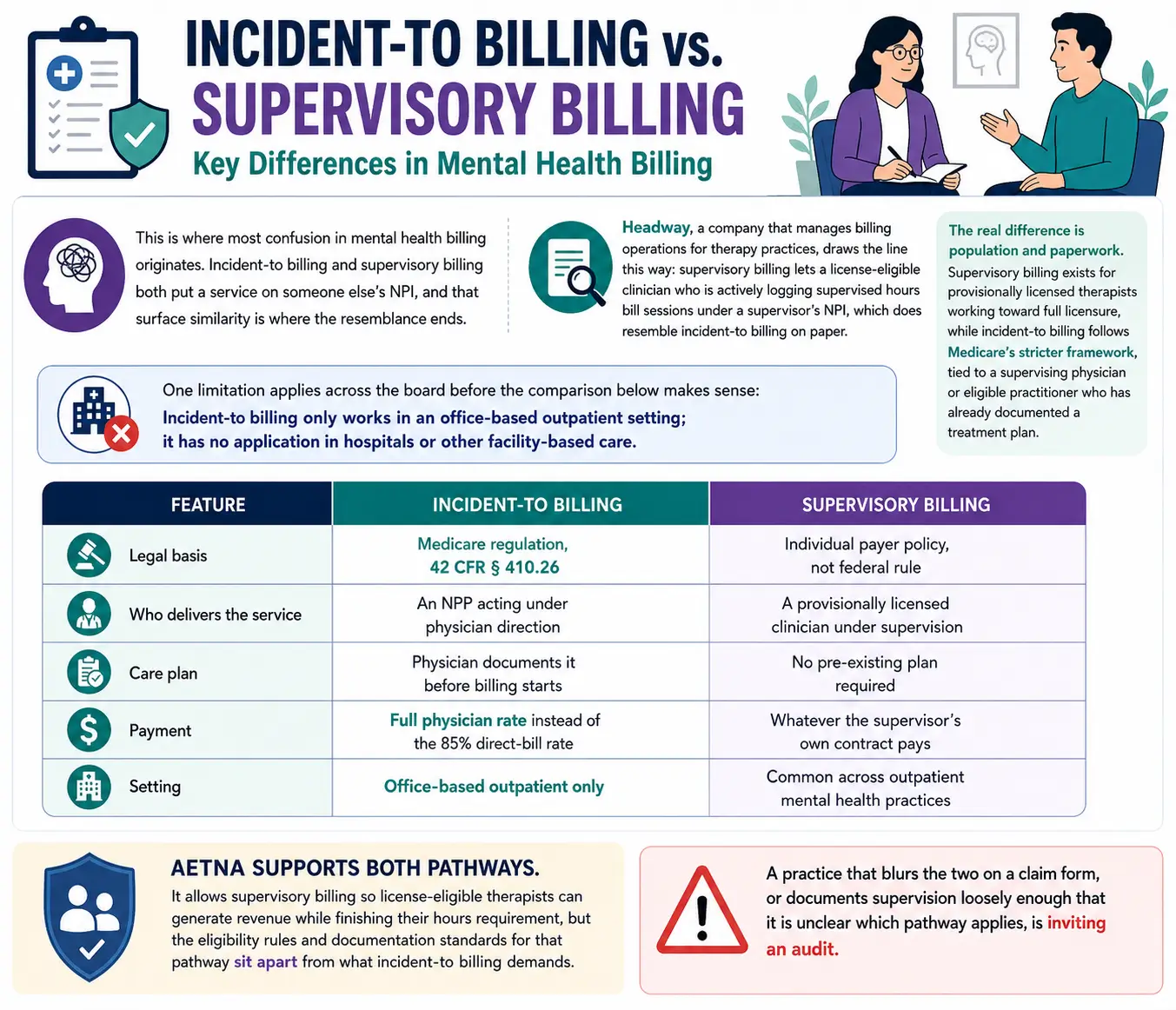
This is where most confusion in mental health billing originates. Incident-to billing and supervisory billing both put a service on someone else’s NPI, and that surface similarity is where the resemblance ends.
Headway, a company that manages billing operations for therapy practices, draws the line this way: supervisory billing lets a license-eligible clinician who is actively logging supervised hours bill sessions under a supervisor’s NPI, which does resemble incident-to billing on paper. The real difference is population and paperwork. Supervisory billing exists for provisionally licensed therapists working toward full licensure, while incident-to billing follows Medicare’s stricter framework, tied to a supervising physician or eligible practitioner who has already documented a treatment plan.
One limitation applies across the board before the comparison below makes sense: incident-to billing only works in an office-based outpatient setting; it has no application in hospitals or other facility-based care.
Feature | Incident-to billing | Supervisory billing |
Legal basis | Medicare regulation, 42 CFR § 410.26 | Individual payer policy, not federal rule |
Who delivers the service | An NPP acting under physician direction | A provisionally licensed clinician under supervision |
Care plan | Physician documents it before billing starts | No pre-existing plan required |
Payment | Full physician rate instead of the 85% direct-bill rate | Whatever the supervisor’s own contract pays |
Setting | Office-based outpatient only | Common across outpatient mental health practices |
Aetna supports both pathways. It allows supervisory billing so license-eligible therapists can generate revenue while finishing their hours requirement, but the eligibility rules and documentation standards for that pathway sit apart from what incident-to billing demands. A practice that blurs the two on a claim form, or documents supervision loosely enough that it is unclear which pathway applies, is inviting an audit.
The 2023 CMS rule change that reshaped behavioral health incident-to billing
The supervision standard changed first
Any current discussion of incident-to billing for mental health has to account for a regulatory shift that took effect at the start of 2023, because it redefined what supervision means for this category of service.
CMS issued its 2023 Physician Fee Schedule final rule on November 1, 2022. Tucked inside was a change to how physicians and other qualified practitioners must supervise behavioral health services billed incident-to.
Meeting the old direct-supervision standard, meaning a physician had to be immediately available inside the office suite, had proven difficult for practices trying to furnish behavioral health services this way, especially against a backdrop of workforce shortages.That’s the specific fix CMS made: physicians and other listed practitioners supervising auxiliary staff on behavioral health cases only need to be generally available now, not standing in the next room. The change also extended supervising authority to physician assistants, nurse practitioners, clinical nurse specialists, nurse midwives, and clinical psychologists. A licensed clinical social worker or counselor delivering therapy billed incident-to no longer needs a physician down the hall. A phone call or telehealth connection now satisfies the requirement.
Direct billing arrived a year later
CMS finalized a separate change implementing Section 4121 of the Consolidated Appropriations Act, 2023, which established Medicare Part B coverage and payment for marriage and family therapists and mental health counselors billing under their own credentials, effective with the 2024 calendar year. Before that, an MFT delivering therapy inside a physician’s practice essentially had to be billed incident-to or not billed to Medicare at all. Direct enrollment gives these practitioners a real alternative now. Incident-to only makes sense when the supervision and care-plan requirements are genuinely being met, not as a default because no other option exists.
Commercial payers do not automatically inherit CMS’s regulatory changes. A shift in Medicare policy signals direction, but practices should not assume Aetna adopted the same general-supervision standard for its own incident-to claims without confirming it through the current provider manual or a direct call to provider relations.
Documentation Aetna expects on an incident-to claim
Aetna’s documentation expectations track the Medicare framework closely enough that billers coming from Medicare Part B work will recognize the pattern:
- A documented treatment plan first. The supervising physician has to have personally evaluated the patient and established the care plan before incident-to billing begins. A claim for a patient the supervising provider has never met will not hold up under audit.
- Continuing involvement, not a one-time hand-off. The chart needs to show the supervising provider staying engaged in the case over time, not signing off once at intake and stepping away.
- NPI accuracy and session timing. Group practices lose clean claims over two Aetna-specific details more than any others:a rendering NPI that doesn’t line up with whichever provider Aetna has actually credentialed for that patient, and clinical notes that skip the session’s start and end time, or total minutes, in favor of a vague reference to “the session.” The NPI problem is the more serious of the two: billing a supervisor’s NPI for work an unlicensed intern actually performed, with no incident-to documentation behind it, is fraud, not a clerical slip.
- Modifier accuracy. SA for nurse practitioner services, SB for certified nurse midwife services, matched to the correct claim lines.
Aetna’s telehealth and EAP modifiers
Aetna’s telehealth modifier is 95. Employee Assistance Program sessions bill under a separate EAP modifier, typically HJ, rather than standard mental health billing, and those visits are capped at a set number of sessions requiring authorization. Confirming the visit limit before treatment starts avoids a denial after the fact, and it is worth checking that the card presented is medical coverage and not an Aetna dental plan, which will not cover mental health services at all despite sharing a similar-looking ID card.
Employer-sponsored plans and carve-outs complicate the picture
Large employers that self-fund their health coverage sometimes use Aetna purely as a third-party administrator, in some cases routed through a subsidiary like Meritain Health, and in that arrangement, whatever the employer’s plan document specifies governs the claim, even where it conflicts with Aetna’s published policy. A mental health carve-out compounds this: the medical plan may permit incident-to or supervisory billing while a separate behavioral health vendor administering the mental health benefit does not, and the claim submission process itself can vary from one plan to the next.
Verify benefits and billing rules at the plan level before assuming a patient’s Aetna card guarantees Aetna’s standard incident-to policy applies. A benefits verification call that references the specific group number on the card catches most of these mismatches before a claim goes out.
Common errors that trigger denials or audits
Recurring problems worth building into an internal QA checklist:
- Billing incident-to without a documented initial visit and care plan from the supervising provider.
- Missing prior authorization on plans that require it beyond a set number of sessions.
- Diagnosis codes that fall outside a plan’s approved list, particularly claims that lean on adjustment or stress-related Z codes without a primary mental health diagnosis attached.
- A credential and modifier that don’t match, such as an NP’s service billed without the SA modifier.
- Treating “Aetna’s policy” as fixed when the plan in front of you is actually a self-funded, employer-defined arrangement.
Mental health parity adds another layer of scrutiny
Pennsylvania’s insurance department, under the Shapiro administration, fined Aetna over conduct spanning January 1, 2021, through December 31, 2022. Regulators cited incomplete claims files for autism spectrum disorder services, slow claim decisions, denials traced to breakdowns in internal communication, and violations of mental health parity requirements, then gave Aetna a year to reprocess the affected claims with interest, fix the internal process that produced them, and explain denial reasons and cost-sharing more clearly to members.
That enforcement action is a reminder that payer-side errors happen too. A denied incident-to claim is not automatically a documentation failure on the provider’s end. When a properly documented incident-to claim gets denied without a clear reason, an appeal that references the Mental Health Parity and Addiction Equity Act is a reasonable next step rather than an overreach.
A checklist for billing Aetna incident-to claims in mental health practices
Before submitting a claim under Aetna’s incident-to policy, confirm:
- The supervising physician or eligible NPP personally performed the initial evaluation and documented a treatment plan.
- The supervising provider’s ongoing involvement is visible in the chart, not just a signature at intake.
- The rendering NPI reflects the actual credentialing arrangement Aetna has on file.
- SA or SB modifiers are applied correctly based on the auxiliary provider’s credential.
- The specific plan, including any employer carve-out or third-party administrator, has been verified rather than assumed from the ID card.
- Session notes include timing detail sufficient to support the billed code.
- EAP and telehealth services carry the correct modifier (HJ or 95) rather than a generic code.
Incident-to billing rewards precision, and Aetna mental health claims are not the place to guess. The payer borrows Medicare’s structure closely enough that Part B experience transfers directly, but the April 2025 rate cut, the SA/SB modifier split, and the plan-level variation created by employer carve-outs mean the policy has to be checked against current documentation rather than memory. Billers who verify the specific plan, keep the supervising provider’s involvement visible in the chart, and apply the right modifier every time will see fewer denials on Aetna incident-to claims for mental health than practices treating the policy as fixed and uniform across every plan.