

You send in a clean claim. Right code, right patient, right provider. Two weeks later the remit lands and one line has been cut with a message like "number of units is not supported" or "exceeds maximum allowed."
The service was real. The documentation was fine. The only problem was a number in the units box that ran into an edit nobody warned you about.
This can hit any specialty that bills units: therapy, infusion, injections, labs, radiology and more. And UnitedHealthcare unit denials keep landing on claims that should have paid in full. At A2Z Billings, we fix these denials for a living, so this guide covers what the edit is, why it keeps catching good claims, and what to do about it.
Stay with it to the end. You'll know how to get paid on the claims already denied and how to stop the next batch before it leaves your office.
What Those Denial Messages Actually Mean
Both messages say the same thing in different words. The number of units on your claim line is higher than what UnitedHealthcare will pay for that code on one date of service.
It has nothing to do with medical necessity. Nobody read your chart and decided the patient didn't need the service. A system compared your number to a table, saw that yours was bigger, and cut the line.
That matters because it changes how you fight it. A medical necessity denial needs a clinical argument. A units denial needs one of two things: proof that you miscounted and can correct it, or proof that the extra units were performed, documented and allowed under the code's rules.
The Policy Behind the Denial
UnitedHealthcare runs a Maximum Frequency Per Day policy, called MFD for short. It sets the highest number of units that can be paid for one CPT or HCPCS code, for one member, from the same provider, on a single date of service.
Two details catch practices off guard.
The limit counts the whole day, not the line. It applies whether you bill six units on one line or split them into three lines of two. Same total, same denial.
The limits start with CMS. Most begin with the CMS Medically Unlikely Edits, called MUEs, and UHC adds its own claims data where CMS has no value. Every MUE carries an adjudication indicator. Codes with indicator 2 are treated as a hard ceiling, because going over would be contrary to statute or regulation. For those, CMS rules allow no modifier override, so adding a 59 will not rescue the line.
Codes with other indicators leave room. UHC says it will consider extra payment when the units are accurate and reported with an appropriate modifier such as 59, 76, 91, XE, XS or XU, and the medical record backs up the count.
UnitedHealthcare Community Plan (Medicaid) follows CMS MUE values first and then applies MFD, with state-specific exceptions layered on top. If you bill a Medicaid plan, check your state's rules too.
Why It Feels Like It's Getting Worse
The pattern is familiar. A code pays cleanly for months, then starts denying with no change in how your providers work. Four things in UHC's own policy explain it.
The tables keep moving.
UHC's MFD policies say values are evaluated and updated quarterly to reflect new, changed and deleted codes. If your billing system still runs on last quarter's numbers, you're billing against a rulebook that no longer exists.
New codes start loose, then tighten.
When a code has no CMS MUE value or claims history, UHC sets its MFD at 100 so claims can process. Once real data arrives, the value gets reset to match how the code is actually billed. Practices that got used to billing high on a new code hit a wall when the number drops.
Nobody reads the claim.
The edit is automatic. Six units against a cap of four gets cut the moment the claim is adjudicated, so a small counting slip becomes a denial with no chance to explain.
Old shortcuts stop working.
Splitting units across lines, or using the units field for minutes or mileage, may have slipped through in the past. UHC's own policy admits some billing practices use that field for something other than how many times a service was performed. When the edit hits every claim the same way, those workarounds fail.
Stack those four together and you get more denials on the same clinical work. That's why the fix isn't working harder on appeals. It's counting right on the front end and tracking the tables as they change.
The Seven Mistakes Behind Most Unit Denials
Here are the patterns that cause the most trouble.
- Billing minutes as units.
Timed codes count in 15-minute blocks. Entering 45 units for a 45-minute visit is a classic slip, and it trips the edit instantly.
- Skipping the drug unit conversion.
HCPCS drug codes describe a set dose per unit, like 1 mg or 10 mg. Bill the number of vials or the raw milligram total without converting and the count is way off. Drugs missing from the MFD list are not exempt, either. They fall under UHC's Maximum Dosage and Frequency medical policy.
- Splitting units across lines or claims.
The system adds them back together. Splitting only muddies your own reconciliation.
- Misusing LT and RT.
For codes whose descriptor already says bilateral, UHC pays up to the MFD value with or without those modifiers. Adding them to double the units, or using them where laterality doesn't apply, is inappropriate and can trigger a denial.
- Ignoring the code descriptor.
Some codes read "per lesion," "per session" or "per date of service." Stacking units on a code written for once a day invites a denial every time.
- Forgetting the modifier when the units are real.
If the extra units were performed and documented, and the code allows an exception, leaving off the right modifier means leaving money on the table.
- Sticking with the wrong code. If you keep hitting a ceiling on the same code, ask whether that code fits the service at all.
What One Denied Line Costs You
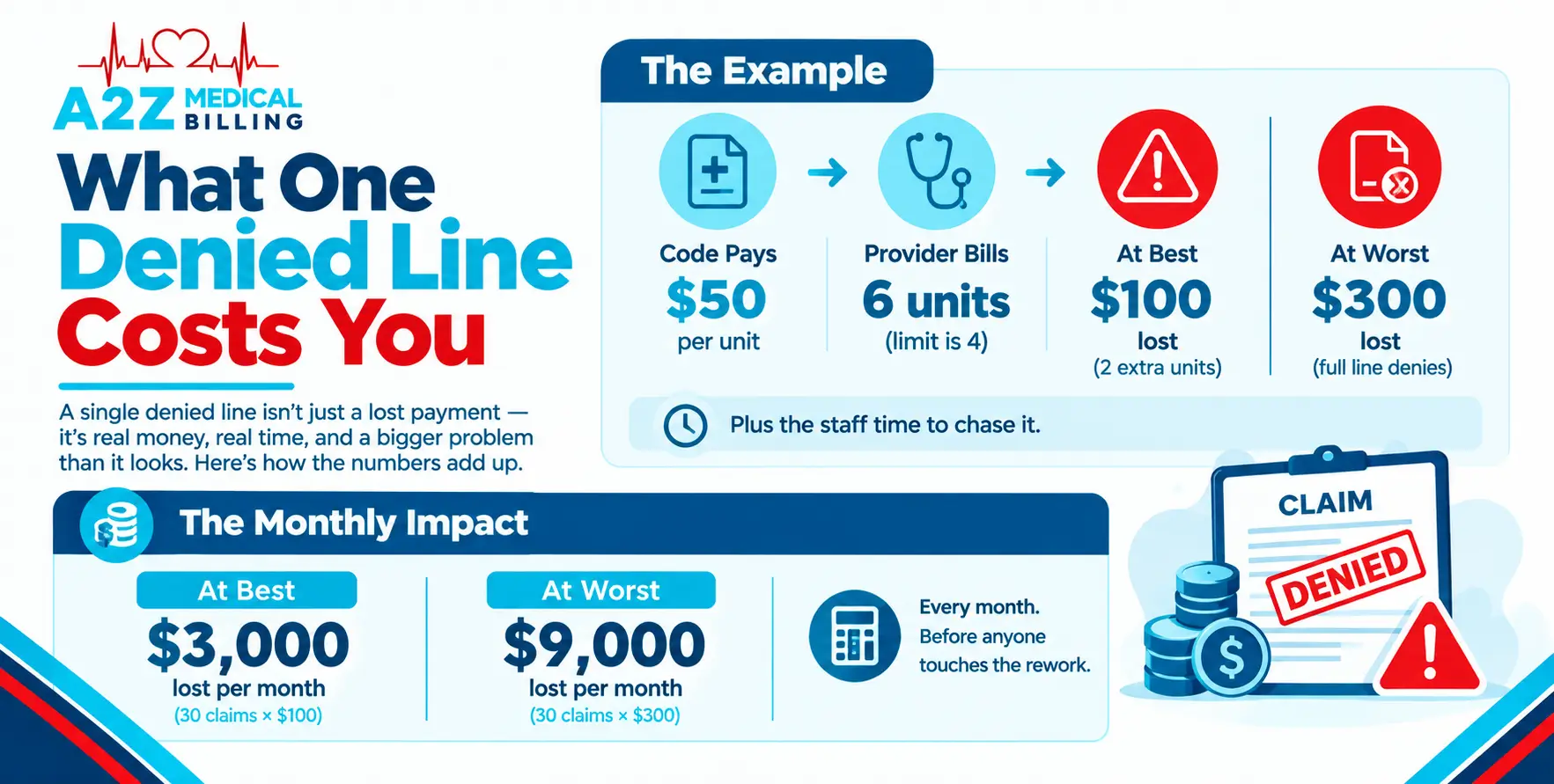
Run the math on a simple example. A code pays $50 a unit. Your provider performs and bills 6 units against a limit of 4. At best you lose the 2 extra units, which is $100. At worst the whole line denies and you lose $300, plus the staff time to chase it.
Now multiply. Thirty claims a month like that means $3,000 lost at best and $9,000 at worst. Every month. Before anyone touches the rework. Those figures are an example, but the math holds for any code and any rate.
How to Fix a Unit Denial, Step by Step
1. Read the remit.
Find the adjustment reason code and the remark code. Reason code 151, for example, means the payer decided the information submitted does not support that number or frequency of services. It often shows up on units and frequency denials.
2. Find the limit.
Pull the MFD list attached to UnitedHealthcare's Maximum Frequency Per Day policy on the UHC provider site, then check the CMS MUE table for the same code. Note the adjudication indicator.
3. Recount the units.
Compare the claim with the code descriptor, the chart note and the service actually delivered.
4. Choose your path.
- You counted wrong: send a corrected claim with the right number. Don't appeal your own errors.
- The units were right and the code allows an exception: add the fitting modifier (59, 76, 91, XE, XS or XU, whichever matches what happened) and send it with the documentation ready.
- The units were right but the code is indicator 2: the limit is firm. Check whether a different code fits better. If it doesn't, appeal only when your contract or state rules give you a real basis.
A note on documentation. If a provider really performed the extra units, the chart has to say so in plain numbers: how many, how long, which site or structure. Phrases like "multiple lesions" or "extended session" won't hold up. Clear notes are the difference between a units appeal that wins and one that gets denied a second time.
5. Watch the deadline. Corrected claim and appeal windows differ by plan and contract. Look yours up today, not on the last day.
6. Log everything. Write down the code, provider, reason and outcome. After a month, the pattern will be obvious.
Stop the Next Denial Before It Starts
Fixing a denial gets you paid once. Fixing the cause gets you paid every time.
- Load MFD and MUE limits into your claim scrubber and refresh them every quarter to match UHC's update cycle.
- Build a one-page unit conversion sheet for your 20 most-billed timed and drug codes.
- Train charge-entry staff that units mean units of the code, never minutes, mileage or vials.
- Run a monthly denial report by code. Any code with repeat unit denials gets its limit checked that week.
- Have providers document the exact number of units performed. Vague notes are why many winnable appeals die.
Get Your Unit Denials Fixed and Stopped
Unit denials aren't random. They come from a policy that updates every quarter, an edit that runs without a human reading the claim, and billing habits that don't match the table. Once you see that, they're fixable.
Fixing them takes someone who tracks the limits, counts units correctly and knows when a denial is worth fighting. That's the job.
A2Z Billings brings 150+ years of collective experience in medical billing and denial recovery. Send us your last 90 days of UnitedHealthcare denials and we'll sort every claim into one of three groups: correct and resubmit, appeal with documentation, or change how it gets billed going forward. You'll know exactly what money is recoverable and what stops the leak.
Reach out today and stop losing money on units you've already earned.
Frequently Asked Questions
1. What does "number of units is not supported" mean on a UnitedHealthcare denial?
It means the units on the claim line are higher than what UHC will pay for that code on one date of service. It's an automated coding edit, not a medical necessity review.
2. Can modifier 59 fix a units denial?
Sometimes. UHC will consider extra payment when accurate units are reported with an appropriate modifier such as 59, 76, 91, XE, XS or XU. For codes CMS marks with indicator 2, no modifier override is allowed, so a 59 won't help there.
3. Should I send a corrected claim or file an appeal?
If you miscounted, send a corrected claim. If the units were right and you have the records plus a valid modifier route, resubmit or appeal with both. Appealing your own counting error only burns time.
4. How does UHC set the maximum units for a code?
The starting point is the CMS MUE value. Where CMS has none, UHC uses its own claims data, and brand-new codes begin at 100 until real data comes in. UHC reviews the values quarterly.
5. Does the limit apply per line or per day?
Per day. It covers the total units of the same code from the same provider for the same member on one date of service, whether you bill them on one line or several.
6. Do these limits apply to drugs?
Yes. Drug codes carry unit limits too. A drug that isn't on the MFD list is not exempt, because UHC's Maximum Dosage and Frequency medical policy covers it. Convert the dose to HCPCS units before you bill.
7. Do UnitedHealthcare Medicaid plans follow the same rules?
Mostly. UHC Community Plan follows CMS MUE values first and then applies MFD, with state-specific exceptions in some states. Check the policy for your state before you appeal.
8. How often should I update my claim scrubber for unit limits?
At least every quarter. UHC reviews MFD values on a quarterly cycle, so a scrubber running on old tables will pass claims that the payer then denies. Set a reminder for the first week of each quarter and recheck the codes you bill most.