

Ask anyone who bills drugs without a dedicated HCPCS code, and they'll tell you the same story. You submit under an NOC code, you wait, and half the time what comes back isn't a payment. It's a denial notice. Dig into why, and it almost always traces back to one small thing: the National Drug Code number either wasn't on the claim, or it was there but wrong.
This one detail sits behind a huge share of BCBS NOC code denials, and most practices don't realize how much money it's quietly holding up.
A2Z Billings sees this constantly in oncology offices, infusion suites, rheumatology practices, and wound care clinics. Different specialties, same denial, same root cause. Once you see what BCBS is actually checking, fixing it isn't complicated. Let's get into it.
What's an NOC Code, and Why Does BCBS Scrutinize It So Closely?
NOC stands for Not Otherwise Classified. Codes like J3490, J3590, J7999, J9999, C9399, and J8499 exist because new drugs, compounded medications, and some specialty treatments don't always have their own billing code yet. The industry hasn't caught up, so these placeholder codes fill the gap.
But a placeholder code is exactly that. Vague. A specific J-code tells the payer precisely what drug went into the patient. An NOC code tells them almost nothing on its own. So BCBS built a rule around that gap: no supporting proof, no payment. And the proof they want first is the NDC.
The NDC Number Isn't Optional, Even If It Feels Like Paperwork
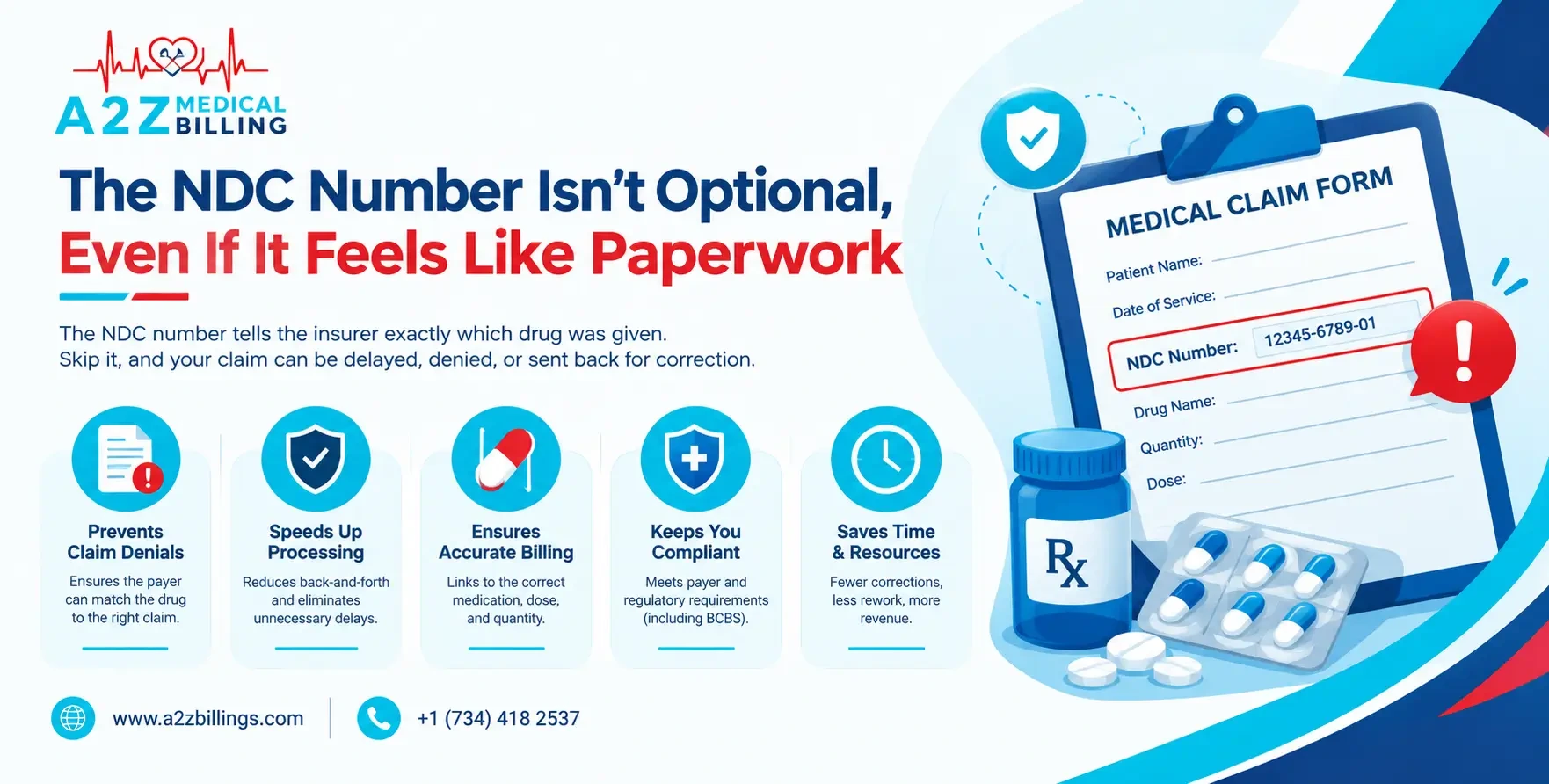
Every drug product on the market carries an 11-digit National Drug Code assigned by the FDA. It's the detail that turns "some unnamed medication" into something a claims examiner can actually look up and verify.
Here's where a lot of claims go sideways, though. The NDC printed right on the vial or package often isn't in the format claims actually need. Manufacturers print it as 4-4-2, sometimes 5-3-2, sometimes 5-4-1. None of those match what BCBS wants, which is 5-4-2, eleven digits total. Converting it usually means slipping a zero into the right segment. Put that zero in the wrong spot and the number looks fine to a human eye but means nothing to the payer's system. It won't match anything in their drug database, and the claim bounces.
On paper claims, the NDC goes in the shaded strip of box 24, right after the N4 qualifier, no dashes, no spaces. Right beside it you also need the unit of measure, whether that's UN, ML, GR, or F2, plus the actual quantity given. Electronic claims carry the same data through the LIN and CTP segments of the 837. Skip any piece of that and the claim isn't just weak. It gets kicked back.
The Real Reasons BCBS Denies These Claims
Pull a denial report and you'll notice it's rarely something exotic. It's usually one of five things, over and over.
The NDC field is just empty.
This is the big one. The NOC code goes out alone, no drug identifier attached, and the payer has no way to know what was billed. Automatic denial.
The format is off.
The number's there, but that leading zero landed in the wrong segment, or a stray character snuck in. Looks correct at a glance. Doesn't match anything on the payer's end.
The NDC and the HCPCS code don't agree.
Every NDC crosswalks to a specific code and strength. Bill a code that doesn't line up with the NDC attached to it, and BCBS catches the mismatch fast.
Units billed don't reconcile.
This one catches infusion and oncology practices more than most. The HCPCS code might bill in one increment while the NDC's package size is measured completely differently. If the math doesn't work out cleanly, the claim gets flagged or denied outright.
The NDC is outdated.
Manufacturers retire and reissue NDCs more often than billing systems get updated. A number that worked fine last quarter might not exist in the current database anymore.
What This Actually Costs You, Beyond the Denial Itself
Here's the part that stings. By the time a denial hits your desk, the drug's already been purchased and given to the patient. That cost already left your account. A denial doesn't save you money; it just sits between you and reimbursement you're already owed.
Then there's the staff time. Someone has to catch it, dig up the original invoice, hunt down the correct NDC, rebuild the claim, resubmit before the filing deadline closes. Do that across every infusion given in a month and it adds up to real hours- hours that a clean claim wouldn't have needed in the first place. Practices that get the NDC right on the first pass just get paid sooner, with a lot less back-and-forth.
Fixing a Denial That's Already Landed
If you're staring at a denial right now, here's the order that gets it resolved without wasted motion.
- First, pull the original purchase invoice. It'll have the exact NDC, lot number, and package size for that specific dose.
- Second, check that the NDC actually corresponds to the HCPCS code billed, not a different strength or a different form of the same drug.
- Third, rebuild the claim with the NDC converted correctly to 11 digits, and confirm the unit of measure and quantity match what was actually administered.
- Fourth, attach the invoice, and chart notes too if the payer's asking for them.
- Finally, get it back out the door before the appeal window closes. BCBS deadlines vary by plan, so know your timeline before you start.
Stopping It Before It Starts
Fixing denials after they happen works, but it's the expensive way to handle this. Catching the problem before the claim leaves is a lot cheaper.
Build the NDC check into charge entry itself, so it's verified when the data's first entered rather than after a denial comes back weeks later. Keep an updated NDC reference list for the drugs your practice bills regularly, and revise it when a new lot or package size shows up. Run the units-to-NDC math before submission on every infusion or injectable claim, since that's where most mismatches hide. And add one final scrub step that flags any NOC line missing its NDC before it ever gets sent.
None of that requires new software. It just requires one consistent checkpoint that catches these five failure points before BCBS ever sees the claim.
Bottom Line
BCBS isn't being difficult for the sake of it. It's confirming the drug billed matches the drug given, at the dose given, and the NDC is how it checks that. Get the number right, formatted correctly, matched to the right code, and these denials mostly disappear. The money you're already owed starts showing up on time instead of sitting in appeals.
Frequently Asked Questions
What is an NOC code in medical billing?
It's a generic, catch-all HCPCS code used when a drug or biologic doesn't have its own specific billing code yet. J3490, J3590, and J9999 are the ones you'll see most.
Why does BCBS deny claims billed under NOC codes?
Because the code by itself doesn't say which drug was given. BCBS needs the NDC number and supporting documentation to confirm the drug, dose, and price before it'll release payment.
What format does the NDC need to be in for a claim?
Eleven digits, arranged 5-4-2. If the package shows a different format, like 4-4-2 or 5-3-2, you'll need to add a leading zero to the right segment to convert it.
Where does the NDC go on a CMS-1500 form?
In the shaded part of box 24, right after the N4 qualifier, with no spaces or dashes, plus the unit of measure and quantity beside it.
What should I attach when appealing a denial like this?
The drug purchase invoice with the NDC and lot number visible, and chart notes confirming the drug, dose, and route if the payer wants them.
Is this a BCBS-only requirement, or do other payers do it too?
Most major payers require NDCs for NOC-coded drugs, Medicare and Medicaid included. BCBS just tends to enforce it strictly and deny outright rather than pend the claim.
How do I stop these denials without overhauling my whole process?
Add one checkpoint to your existing charge entry workflow that confirms the NDC is present, correctly formatted, and matched to the right code. That alone catches most of these before they go out.
What's the actual difference between the NDC on the vial and the one on the claim?
The vial often shows a shorter format depending on the manufacturer. The claim needs the full 11-digit version, which usually means adding a zero to the correct segment before you submit.
Ready to Stop Losing Revenue to NDC Denials?
Chasing denied drug claims one invoice at a time isn't a real process, and it's not how your staff's week should go. A2Z Billings builds NDC verification straight into the billing workflow, so NOC-coded claims go out clean the first time and get paid on schedule. If BCBS NOC denials keep showing up in your reports, let's fix the process behind them, not just the claim in front of you.