

You submit a clean claim. Medicare should be the secondary payer, so you build it that way, code it correctly, and send it off. A few days later, it comes back rejected. Not denied. Rejected, with a message that reads something like "claim lacks information" and a remark code that points to "other insurance." No payment. No clear next step. Just a claim sitting in limbo while your accounts receivable gets older.
If that sounds familiar, you're dealing with CARC 16 paired with RARC N245, and it's one of the most common reasons Medicare Secondary Payer claims bounce back right now.
At A2Z Billings, we see this exact pattern across specialties every week, and it rarely means your billing team did something careless. It means Medicare's system and your claim are telling two different stories about the patient's other coverage.
Here's what's actually happening, why it keeps happening, and what it takes to get these claims paid instead of parked.
What CARC 16 and RARC N245 Actually Mean
CARC 16 reads "claim/service lacks information or has submission/billing error(s)." On its own, that tells you almost nothing. It's a flag, not a diagnosis. The real explanation sits in the remark code attached to it.
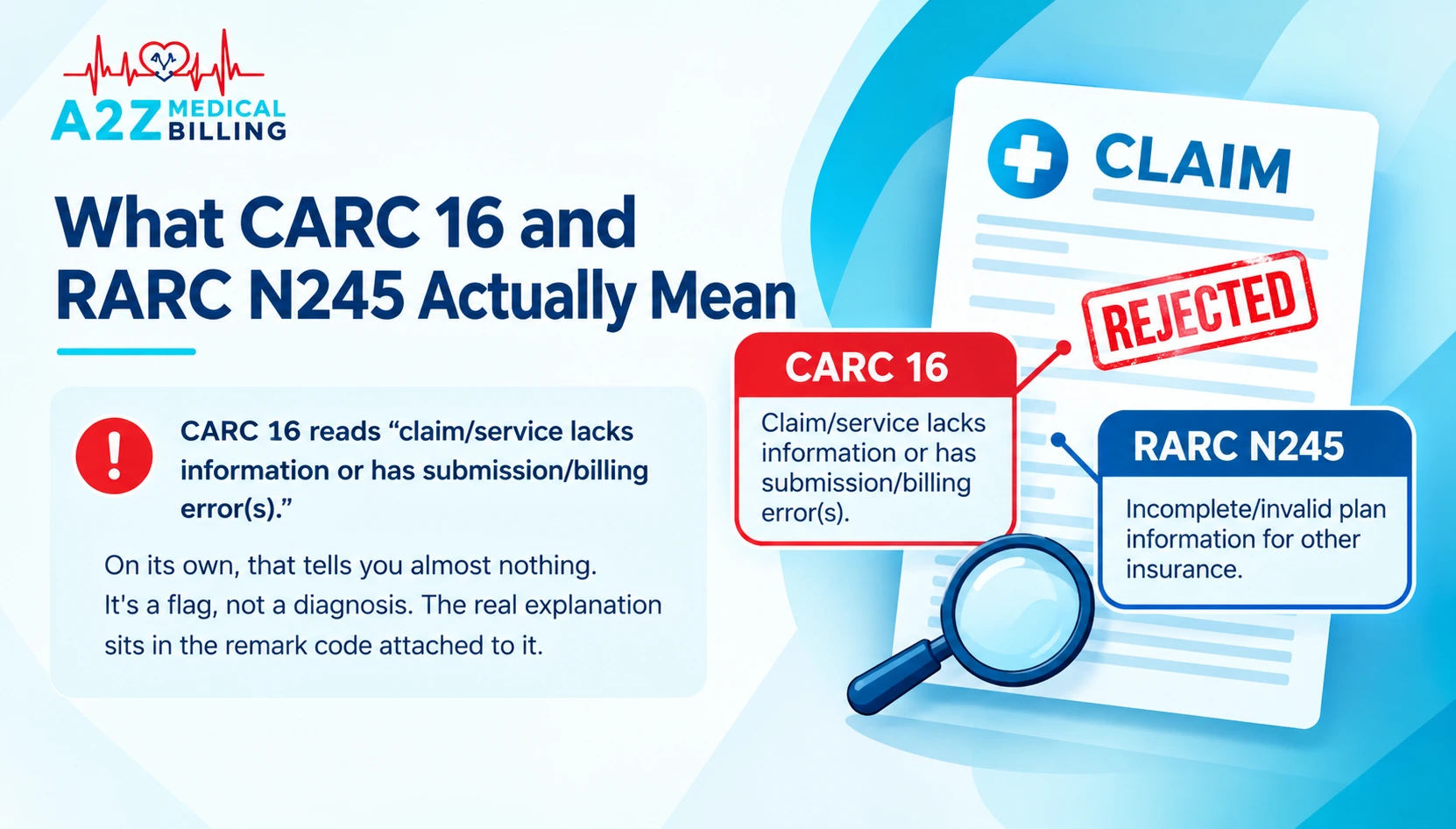
RARC N245 spells it out: "incomplete/invalid plan information for other insurance." Translation: Medicare's system doesn't recognize, or doesn't agree with, the details you submitted about the patient's other coverage. Sometimes a third code, N704, rides along with these two. N704 tells you that this particular rejection cannot be appealed through the mail, a fax, or the provider portal. The claim is considered unprocessable, not denied, which is a meaningful difference for how you fix it.
Why This Isn't a Simple Typo Problem
Every claim you send Medicare gets checked against a record already sitting in the Common Working File, the database that holds each beneficiary's known coverage history. That record didn't come from your claim. It came from a beneficiary questionnaire, a prior payer's report, an employer's coverage filing, or a correction made through the Benefits Coordination and Recovery Center.
So when your claim says the patient has group health coverage through an employer and lists a specific insurance type, and the Common Working File has a different type on file, or no active MSP record at all, the claim gets flagged. It doesn't matter how accurate your version is. Medicare adjudicates against its own record first.
The Real Reasons These Claims Keep Bouncing Back
A handful of specific gaps account for most of these rejections:
An outdated MSP record at the coordination center.
The patient's employer coverage ended, or a new group plan started, and nobody updated the record on file. Your claim reflects current reality. Medicare's system reflects last year.
The wrong insurance type code on the electronic claim.
The claim format has a specific field for the primary payer's type: working aged, disability, ESRD, no-fault, liability, and so on. If that code doesn't match what Medicare has, the claim fails before a human ever sees it.
Missing Value Codes for the MSP scenario.
Working aged claims need Value Code 12 and the amount the primary payer paid, taken straight from that payer's explanation of benefits. Disability and ESRD scenarios call for their own codes. Leave one off, or enter a number that doesn't tie to the primary EOB, and the claim gets kicked.
Missing Occurrence Codes on accident-related claims.
Auto, no-fault, and liability MSP claims need the date of the accident or injury entered as an occurrence code. Without it, Medicare has no way to confirm why another payer should be primary in the first place.
Incomplete adjustment segment information.
This is the part of the claim that mirrors what the primary payer's EOB actually showed: the paid amount, the paid date, the group code, and the reason codes for anything they didn't pay. If this doesn't match the primary EOB line for line, expect a rejection.
Group size thresholds that don't line up.
Working-age MSP only applies when the employer meets a specific size requirement, and disability MSP has its own threshold. If the coverage on file doesn't meet the rule Medicare is using, the secondary claim gets rejected outright.
CMS has actually been adding more of these mismatch codes to the Common Working File, specifically to catch conflicts between incoming claims and existing MSP records faster. That's good for data accuracy. It also means more claims are getting flagged for the exact reasons above, not fewer.
Why You Can't Just Appeal and Move On
Here's where a lot of billing teams lose time. CARC 16 with N704 attached is not appealable through your usual channels. Not by mail, not by fax, not through the provider portal. Medicare treats this as an unprocessable claim rather than a paid-or-denied decision, so there's nothing to formally dispute.
The only path forward is to build a corrected claim from scratch, with accurate coverage information, and submit it as a new claim. Anyone who spends days drafting an appeal letter for one of these is spending that time on something Medicare's own rules won't even accept.
What Fixing It Actually Takes
Getting one of these paid is a sequence, not a single fix:
- Confirm the patient's current MSP status directly through the eligibility tool before touching the claim again. Guessing at what changed wastes another submission cycle.
- If the record on file is wrong, contact the coordination center directly to get it corrected. This step alone resolves a large share of these rejections, because the claim was right and the file wasn't.
- Rebuild the claim with the correct insurance type code, the right Value Codes and amounts pulled straight from the primary payer's EOB, and any required Occurrence Codes for accident-related coverage.
- Match the adjustment segment to the primary EOB exactly: paid date, paid amount, group code, and any reason codes for unpaid balances.
- Submit as a brand new claim, not a correction or a resubmission tied to the old claim number.
Skip any one of these steps and you're likely to see the same rejection come back around.
What These Rejections Cost You If They Sit
A single rejected claim isn't a big deal. A pile of them is. Every claim held up by an MSP mismatch adds to your accounts receivable days, ties up staff hours chasing coverage details that should have been confirmed at the front desk, and pushes some claims dangerously close to timely filing deadlines while everyone figures out what went wrong. Practices that handle a steady volume of Medicare patients often have dozens of these sitting open at any given time, quietly draining revenue that's already been earned.
None of this requires new equipment, new software, or a policy change from CMS. It requires someone who checks eligibility before the claim goes out, knows exactly which Value and Occurrence Codes apply to which MSP scenario, and calls the coordination center the same day a mismatch turns up instead of letting it sit in a queue.
That's the entire job. With 150 plus years of combined experience across our billing team, this is a rejection pattern we've walked practices through more times than we can count, and the fix is almost always faster than people expect once someone who knows the rules gets involved.
Get Your MSP Claims Paid, Not Parked
If CARC 16 and RARC N245 are showing up on your remittance advice on a regular basis, the problem isn't your front desk and it isn't bad luck. It's a coverage record that needs correcting and a claim that needs to be rebuilt to match it, both of which take specific knowledge most in-house teams don't use often enough to stay sharp on.
A2Z Billings handles exactly this kind of claim correction every day, from checking eligibility and calling the coordination center to rebuilding the claim with the right codes and getting it back out the door clean. Reach out and we'll take a look at what's sitting in your MSP rejection queue right now.
Frequently Asked Questions
1. What does CARC 16 mean on a Medicare remittance advice?
CARC 16 tells you the claim couldn't be processed because something required for adjudication is missing or doesn't match Medicare's records. It's a general flag rather than a specific explanation, which is why it's always paired with a remark code that points to the actual issue, in this case coverage details for another payer.
2. What does RARC N245 specifically point to?
RARC N245 means the plan information you submitted for the patient's other insurance is incomplete or doesn't match what Medicare has on file for that beneficiary. It's almost always tied to a mismatch between your claim's coverage details and the Common Working File record.
3. Why does Medicare reject the claim instead of just denying it?
A rejection means Medicare's system couldn't process the claim far enough to make a payment decision. A denial means it reviewed the claim and decided not to pay. These MSP mismatches fall into the first category, which is why the fix is a corrected resubmission rather than a formal appeal.
4. Can I appeal a CARC 16 rejection with RARC N245?
Not through the standard appeal process. When RARC N704 accompanies the other two codes, Medicare specifically states the claim isn't eligible for appeal by mail, fax, or portal. You have to submit a new claim with corrected coverage information instead.
5. How do I find out what's actually wrong with the patient's MSP record?
Start with Medicare's eligibility verification tool to see what coverage type is currently on file. If it doesn't match what you know to be true, contact the Benefits Coordination and Recovery Center directly to get the record corrected before resubmitting.
6. What information does a working aged MSP claim require that other claims don't?
Working-age claims need Value Code 12 along with the exact amount the primary payer paid, matched to that payer's explanation of benefits, plus complete adjustment segment details showing the paid date, paid amount, and group code from that EOB.
7. How long does it typically take to resolve one of these rejections?
Once the actual cause is identified, correcting an MSP record through the coordination center and rebuilding the claim usually takes days, not weeks. The delays most practices experience come from not knowing which specific code or record needs fixing in the first place.
8. Can repeated MSP rejections push a claim past the timely filing deadline?
Yes, and this is one of the bigger risks with letting these sit. Every rejection cycle takes time to identify, correct, and resubmit, and if a claim bounces more than once, it can edge dangerously close to the filing window before it ever gets paid.