

You did the work. The patient was seen, the note was signed, the claim went out. Then the remittance lands and Cigna pays you nothing.
That happens more often than most practices admit, and the cause is rarely the care itself. It is usually one of three billing errors. Cigna's reimbursement policy names duplicate charges, incorrect coding, and missing or thin documentation as primary triggers for a denial. Knowing these Cigna denial reasons is the fastest way to protect your revenue, because all three can be fixed before the claim ever leaves your office.
At A2Z Billings, our team brings 150+ years of combined experience in medical billing, and we have watched these same three errors drain practices of money they had already earned. This guide shows what each one looks like, why it happens, and how to stop it.
What Cigna's Coding and Billing Accuracy Policy Says
Cigna's policy R46, called Coding and Billing Accuracy, spells out the charges and billing errors that are not eligible for payment. It applies to claims with dates of service on or after its start date, so it governs the claims you are sending right now.
Duplicate charges, incorrect coding, and services with no or insufficient supporting medical documentation sit at the top of the list. Below them is a longer set: charges unrelated to the documented care, cloned records, impossible or excessive units, modifiers the record does not support, an invalid site of service, and the wrong provider or group reported. Cigna says the list is not complete, so other errors can land in the same bucket.
Two more details matter. Cigna may ask for your medical records to back up what you billed. And it reviews claims both before and after payment, so a claim that clears today can still get questioned later. A clean claim is worth more than a fast appeal.
Duplicate Charges: The Denial You Cause Yourself
Duplicates are the most avoidable denial on this list. The same service gets billed twice, and Cigna rejects the second line or, sometimes, the whole claim.
Cigna's own reason-code guidance gives plain examples: two ventilator charges on the same day, or two implants billed when the procedure was done on one side only. Nobody meant to overbill. The claim just reads that way.
Duplicates usually come from a short list of habits:
- A claim gets resubmitted because payment feels slow, while the first one is still in process.
- A correction goes out as a brand new claim instead of a corrected one.
- A charge is entered by hand and also drops in from the charge master.
- Units get typed twice on a multi-line claim.
None of these is a coding problem. They are process gaps, and process gaps are cheap to close.
How to Stop Duplicate Denials
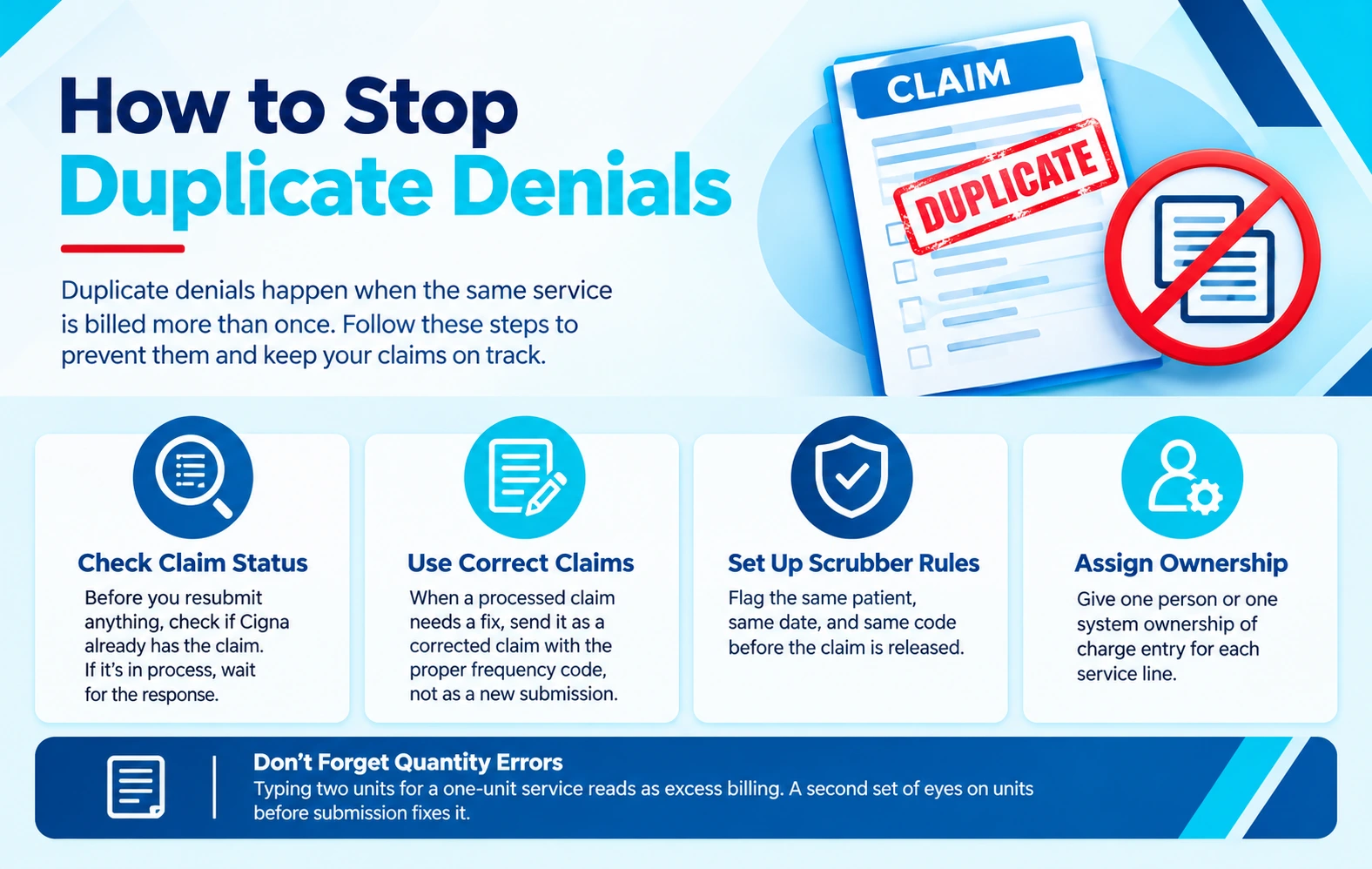
Check claim status before you resubmit anything. If Cigna has the claim, wait for its response. When a processed claim needs a fix, send it as a corrected claim with the proper frequency code, not as a fresh submission. Set a scrubber rule that flags the same patient, same date, and same code before release. Then give one person or one system ownership of charge entry for each service line.
Quantity errors are a close cousin. Typing two units for a one-unit service reads as excess billing. A second set of eyes on units before submission fixes it.
Incorrect Coding: Small Mismatches, Full Denials
Incorrect coding is a wide category, and Cigna's policy shows how wide. It covers the obvious, like a code that does not match the service, and the quiet mismatches a busy biller can miss.
Modifiers the documentation does not support.
Modifier 25 or 59 tells Cigna something extra happened. If the note does not show it, the modifier gets stripped or the line gets denied.
Services that do not match the code description.
The note says one thing and the CPT code says another. Cigna reads both.
Diagnosis codes left off the claim.
If the provider documented a condition and it never reached the claim, the procedure loses support. Pointing the right diagnosis to each procedure matters as much as the procedure code.
Impossible or excessive units.
Billing more units than a code can logically hold, or more than a patient could receive in one day, gets flagged fast.
Wrong provider, group, or site of service.
Payment follows the correct entity and the correct place of service. Errors here are treated as coding errors.
Unlisted codes without support.
An unlisted code needs a clear description and records that justify it. Without them, expect a denial.
Most of these share one root cause: the clinician and the coder are not working from the same page. The provider writes what happened. The coder picks codes from that note. Every gap in between shows up as a denial later.
How to Fix Coding Denials
Code from the full note, never from the superbill alone. Build payer-specific edits for your most-billed procedures. Audit modifier use every month, since that is where money leaks quietly. And send coding denials back to your providers, so the note gets better at the source.
Insufficient Documentation: If It Isn't in the Chart, It Didn't Happen
This is the denial that stings most, because the care was real. Cigna's policy rejects services billed with no supporting documentation and services billed with records too thin to back the charge. It also targets charges that do not line up with the documented care, billed items that were never ordered or documented, and cloned records.
Cloned notes deserve a warning. Copying the last visit forward saves a provider a couple of minutes and creates a record that looks the same from visit to visit. A reviewer reads that as a note that does not reflect this visit. Cigna lists cloned records in the policy by name.
Good documentation answers four questions without making the reader guess: what was done, why it was medically needed, who did it, and when. Time-based services need the time recorded. Procedures need the details that separate one code from the next. Anything billed as ordered needs an order in the chart.
When Cigna asks for records, speed and completeness both count. The Cigna provider portal lets you upload pended claim attachments and track their status, so use it and keep proof of what you sent. Send the complete relevant record, not a fragment, and label it so the reviewer can find the support for each line.
What These Three Errors Really Cost
A denial is never just a missing payment. Someone has to read the remittance, find the cause, fix the claim, resubmit it, and follow up. You pay for that time on every denial, and you keep paying every month if the cause never gets fixed.
Then there is the slow leak that never looks like a denial: lines that get cut, downcoded, or written off because the fix seemed bigger than the balance. Add post-payment review, and a claim you thought was closed can reopen.
The math is simple. Fixing a cause once costs less than fixing the same denial a hundred times.
A Pre-Submission Checklist for Cigna Claims
Run every claim through these checks before it goes out:
- Does this service already exist on another claim or another line?
- Do the units match what the note says was done?
- Does every modifier have proof in the documentation?
- Is every documented diagnosis on the claim and pointed to the right procedure?
- Are the rendering provider, group, and place of service correct?
- Is the note specific to this visit, with no copied text?
- Is any ordered service backed by an actual order?
Seven questions take a minute. A denial takes weeks.
What to Do When a Cigna Denial Lands
Start with the reason code and sort the denial into one of three buckets. A duplicate means checking whether the original was paid or is still pending before you touch anything. A coding denial usually calls for a corrected claim. A documentation denial calls for the records, or an appeal that attaches the note supporting the service.
Move quickly. Appeal windows are limited, and your contract sets the exact deadline, so confirm it rather than guess. Keep a log of what you sent and when, so a second request never starts from zero.
Stop Paying for Errors You Can Prevent
Duplicate charges, incorrect coding, and thin documentation are not mysteries. They are patterns, and patterns can be fixed. Practices that fix them keep more of what they bill and spend less time chasing Cigna.
That is the work A2Z Billings does every day. Our team catches these errors before the claim goes out, works the denials that still come back, and shows you exactly where your money was leaking. Send us your recent Cigna denials. We will sort them into these three buckets, show you which one costs you the most, and hand you the fix. Reach out today and let's get your claims paid the first time.
Frequently Asked Questions
1. What are the terms and conditions for Cigna to reimburse a claim for R46?
R46 is Cigna's Coding and Billing Accuracy policy. It includes charges/billing error that do not qualify for reimbursement, such as duplicate charges, incorrect coding, services that lack supporting documentation, or services for which insufficient documentation has been provided.
2. What is considered a duplicate charge with Cigna?
Same service billed more than once such as the same code, patient, and date on two lines or two claims. Charging two bills if the procedure was supposed to be one is included.
3. Is it possible to submit a claim to a duplicate denial?
Don't make the same claim again - it will result in a duplicate denial. First, determine if the original was paid or pending. If corrected, send a corrected claim with the correct frequency code.
4. How does Cigna refuse claims for modifiers?
Cigna's policy lists modifiers not supported by medical documentation as a billing error. If the modifier (25 or 59) is not explained in the note, the modifier may be deleted or the line may be denied.
5. During a claim review, Cigna requires what documentation.
Cigna reserves the right to request medical records to substantiate services billed. Attach the full, relevant document(s) detailing (what was done, why, by whom and when), along with any orders associated with the billed items.
6. Can Cigna review a claim after it is paid?
Yes. A claim may be reviewed even if it is paid because Cigna conducts both prepayment and post-payment reviews. At both times, you are safeguarded by clean coding and solid documentation.
7. What is the time frame for a Cigna appeal?
It will depend on your contract and the type of plan you have. Please review your provider agreement and the denial notice for the exact deadline and submit as soon as possible.