


A2Z Billings brings 150+ years of collective experience to this work. What follows is the playbook the team uses: why UHC denies claims, how to read the denial, and what to do in the first week so the claim gets paid instead of aging out.
Why UHC denials need their own playbook
Every payer runs its own rules. UHC has its own provider portal, its own list of services that need prior authorization, its own reimbursement policies, and filing windows that depend on your contract. A fix that works on a Blue Cross denial can fail on a UHC one.
Deadlines are the first trap. UHC's administrative guide gives participating commercial providers at least 90 days from the date of service to file, unless your participation agreement says otherwise. On commercial plans, both the reconsideration and the appeal have to be submitted within 12 months of the original EOB or remittance advice, or as the law or your agreement requires. Community Plan (Medicaid) windows are set by state and run shorter. UHC's Wisconsin quick reference guide, for example, asks for a claim reconsideration within 60 calendar days of the original remittance date.
So the first rule is boring and expensive to ignore. Open the participation agreement, find your actual windows, and put them on a calendar. Everything below depends on it.
Common reasons UHC denies claims, and the fix for each
The claim adjustment reason code on the 835 tells you where to look. These are the ones that show up most.
Eligibility and coverage (CO-27, CO-31)
CO-27 means the patient's coverage ended before the date of service. CO-31 means UHC can't match the name, birth date, or member ID to an insured person. Both start at the front desk and surface in billing weeks later.
Run an eligibility check at scheduling and again at check-in, and scan the card at every visit, because member IDs change when employers switch plans. Once a CO-27 lands, call the patient, get the current coverage, and bill the right payer.
Missing or invalid prior authorization (CO-197)
CO-197 means the authorization was absent, or it didn't match what was billed. UHC keeps its own list of services that need approval, and the list changes. Check the procedure code against the current list in the UHC provider portal before the patient is scheduled. Record the authorization number in the chart. Then confirm the CPT codes on the claim match the ones that were approved.
If the authorization exists but wasn't attached, appeal with the approval letter. If it was never requested, ask UHC whether a retroactive review is available. That depends on your contract and the plan.
Medical necessity (CO-50)
UHC decided the diagnosis doesn't support the service. Sometimes the chart backs a more specific diagnosis than the one billed, which is a coding fix. Sometimes the note never says why the test or procedure was needed, which is a documentation fix.
Pull the note, compare it against UHC's policy for that service, and appeal with the records plus a letter from the provider explaining the clinical reason. These denials get overturned by chart evidence, so lead with the chart.
Coding and modifier errors (CO-4, CO-11, CO-97)
A missing modifier, a diagnosis that doesn't fit the procedure, or a service UHC treats as bundled into another one. Modifier 25 on an office visit billed alongside a same-day procedure is the classic case. Most of these are fixable with a corrected claim.
Watch for UHC's own reimbursement policies, which sit on top of the national coding edits. A claim can pass the scrubber and still get bundled.
Timely filing (CO-29)
UHC says it received the claim after the contractual deadline. Sometimes that's true. Often the claim went out on time, got rejected at the clearinghouse for a formatting error, and nobody worked the rejection report.
If you can prove the claim went out in time, appeal with the clearinghouse acceptance report or the payer acknowledgment. To stop it from happening again, someone should read the rejection report every morning.
Duplicate claims (CO-18)
UHC thinks it already has this claim. A resubmission may have gone out as a new claim instead of a replacement, or the original may have been paid and never posted. Check the 835 history before you resubmit anything.
When a correction is needed, send it as a replacement claim with frequency code 7 and the original claim number. A fresh claim just collects another CO-18.
Coordination of benefits (CO-22)
UHC believes another payer is primary. It happens with patients who carry two plans or whose spouse's employer coverage started mid-year. Ask the patient to confirm every active plan, get the primary payer's remittance, and bill UHC as secondary with that remittance attached.
Missing or incomplete information (CO-16)
Something required was blank or wrong: a rendering provider NPI, a referring provider, a date. The remark code attached to the denial names the exact field. Fix it and send a corrected claim. These are the cheapest denials to prevent, since a claim scrubber catches most of them before the claim leaves the building.
Reconsideration, appeal, and what to attach
UHC treats these as two steps. A claim reconsideration comes first and asks UHC to look again, usually for a processing error or a missing document. If UHC upholds the denial, a formal appeal comes second. UHC's Wisconsin Community Plan guide gives UHC 45 calendar days to respond to each step. Check your plan type before you file, because the step order and the clock vary.
An appeal that gets paid tends to carry the same four things: the claim number and denial date, the exact reason UHC gave, the document that answers that reason (records, authorization letter, clearinghouse report), and a short letter that points straight to it. Skip the long narrative. A reviewer on the fortieth appeal of the day wants to find the proof on page one.
A weekly denial workflow
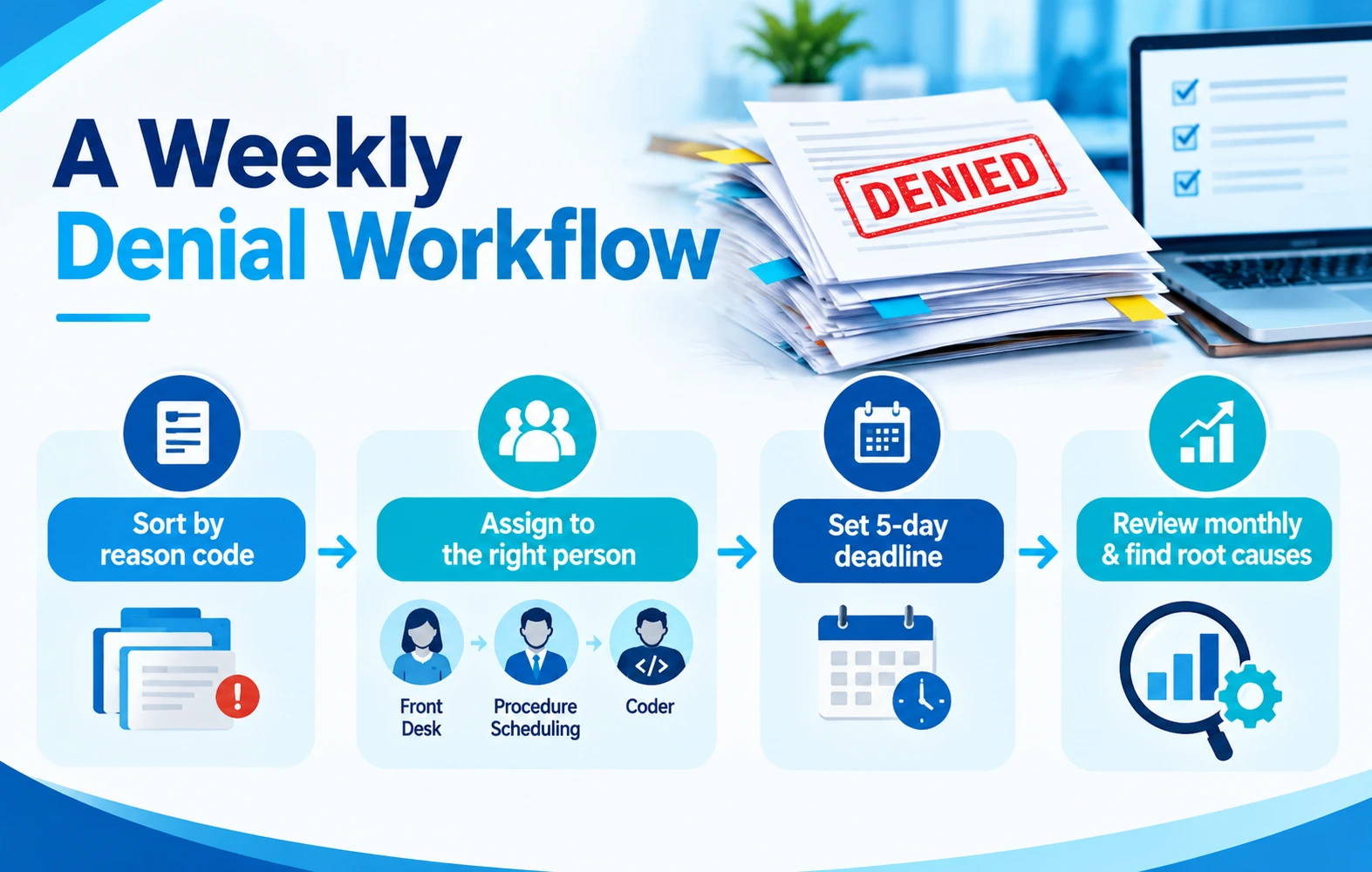
Pull every denial from the past week's 835s and sort them by reason code. Hand each group to the person who can fix it: eligibility to the front desk, authorization problems to whoever schedules procedures, coding and modifier denials to the coder. Set an internal deadline of five business days for a fix or an appeal, which keeps you far from the payer's deadline.
Once a month, count denials by reason, average the days it took to resolve them, and total the dollars recovered. The top two reasons on that list get a root-cause fix, such as a new check at scheduling or a documentation template for the provider. Without that monthly step, the same denials keep coming back.
Stopping repeat denials
Most repeat denials trace back to a short list of habits. Eligibility gets checked once instead of every visit. Authorizations live in someone's inbox instead of a tracker with expiration dates. The scrubber runs generic edits instead of ones built around the payers you bill most. Providers never hear which of their notes triggered a medical necessity denial.
Each of those is fixable in a week. A tracker, a scheduling checklist, and a standing 15-minute denial review with the providers cost almost nothing next to the claims they protect.
What a dedicated denial team changes
Most practices work denials when the front desk has a free hour. A team whose only job is denials works every day it lands, files appeals inside the window, and traces repeat denials back to the desk that causes them.
For a practice, that means the money your providers already earned actually arrives. It also means your staff stop rebuilding claims by hand and go back to patients. And you get a monthly report that says which UHC denials are costing you the most and what was done about them.
Frequently asked questions
1. How long do I have to appeal a UHC denial?
It depends on the plan and your contract. UHC's administrative guide allows 12 months from the original EOB or remittance advice for commercial plans, covering both the reconsideration and the appeal. Community Plan windows are set by state and can be as short as 60 calendar days. Check the denial letter and your participation agreement before assuming any number.
2. What is UHC's timely filing limit?
Participating commercial providers get at least 90 days from the date of service, unless the agreement sets another window. Nonparticipating commercial providers get up to 180 days, and noncontracted Medicare Advantage providers get 365 days from the date of service.
3. What is the difference between a corrected claim and a reconsideration?
A corrected claim fixes data on the claim itself, such as a modifier, a diagnosis, or an NPI, and goes out as a replacement with frequency code 7. A reconsideration asks UHC to review its decision when the claim was right as submitted.
4. How do I find out why UHC denied a claim?
Read the 835 or the EOB. The claim adjustment reason code gives the category, and the remark code narrows it to a specific field or policy. The claim status screen in the UHC provider portal shows the same information.
5. Should I appeal every denial?
No. Data errors like a wrong ID or a missing NPI are faster to fix with a corrected claim. Appeal when you believe UHC decided wrong and you have the proof. Before you write anything off, check whether the balance is large enough to justify the time, and whether the deadline is still open.
6. Can a claim denied for no authorization still get paid?
Sometimes. If the authorization existed but wasn't linked to the claim, an appeal with the approval letter often resolves it. If it was never requested, a retroactive review may be an option depending on your contract and plan, but it is harder to win.
7. How often should a practice work its denials?
Rejections from the clearinghouse should be read every morning. Denials from UHC should be sorted and assigned at least weekly. The longer a denial sits, the closer the filing deadline gets.
8. When does it make sense to outsource denials?
When denials pile up faster than your staff can work them, when aged A/R keeps growing past 90 days, or when the person who handled denials leaves and nobody picks it up.
Work every denial, fix every cause
A denied claim is money you've already earned and haven't been paid. The window to get it back closes on a date written into your contract, and it doesn't move.
A2Z Billings works on UHC denials from the first rejection through the final appeal, finds the repeat causes, and fixes them at the source, backed by 150+ years of collective experience. Send over your last 90 days of UHC denials, and the team will tell you which ones can still be recovered and what's causing the rest.