

Provider credentialing and enrollment act as gatekeepers in the medical billing process and directly impacts the care and reimbursement a healthcare provider can offer. Claims cannot be processed, payments get stalled, and the risk of non-compliance increases when a provider fails to get properly credentialed and enrolled with the payers. This guide will detail the meaning and differences of provider credentialing and enrollment, how the process varies among hospitals, private practices, and the insurance payers, and how encapsulated payer credentialing, delegated credentialing, enrollment timeframes, challenges, and activity participation best practices, are to A2Z Billing’s ongoing credentialing and enrollment services for uninterrupted revenue cycle.
Introduction: Why Credentialing and Enrollment Matter in Healthcare
Most of the time, the healthcare practice’s revenue cycle is affected the least, and the workflow for administrative tasks is the most. This appears to be how these tasks impact the most administrative burden, but in reality, the revenue loss and increased patient dissatisfaction due to billing these services as insurance providers, are the most profound impacts. However, there are substantial repercussions to an organization’s revenue cycle when administrative processes are not completed in a timely manner. A loss of revenue and increased patient dissatisfaction occur with a delay in revenue collection due to the process of credentialing and enrollment. Familiarity with the process of credentialing and enrollment allows providers to avoid disruption, loss due to denial, and the process of regulatory and payer compliance.What Is Provider Credentialing and Enrollment?
Provider credentialing is the process of verifying a healthcare provider’s scope of practice and whether or not the provider meets the professional and regulatory requirements to deliver care. This includes the examination of a provider’s education, training, and work history, as well as their current licensure and board certifications. Provider enrollment is the process of registering a provider with insurance companies. Enrollment is the process of linking a provider’s credentials to a particular payer, plan, and network, so the provider is able to submit claims and get paid.Together, credentialing and enrollment form the basis of medical billing and reimbursement.Difference Between Provider Credentialing and Enrollment
Provider credentialing and enrollment are often incorrectly treated as being the same. These phrases represent distinct processes. Enrollment is participation in a payer contract, while credentialing is the verification and approval of a provider’s qualifications. While qualification is the primary focus of credentialing, enrollment is primarily concerned with whether or not claims can be submitted and paid. Credentialing, along with enrollment, must be done before billing can begin.Credentialing in Medical Billing: How It Supports Reimbursement
In the practice of medical billing, credentialing makes sure that claims submitted under a provider’s name are capable of being paid. If a provider is not credentialed or if the credentials are incomplete or expired, insurance companies will deny a claim. Credentialing impacts reimbursement timelines, claim acceptance, and audit risk. Practices that manage credentialing more carefully report fewer denials and experience greater cash flow.Enrollment in Medical Billing Explained
Providers must be enrolled in Medicare, Medicaid, and commercial insurance payers in order to complete the administrative steps necessary for medical billing. This includes the submission of enrollment applications, contracts, tax documents, and employment/ practice information. Once enrollment is complete, the provider is automatically assigned a billing number within the payer’s system. Without this enrollment, the provider cannot get paid, even if they are properly credentialed.Provider Credentialing Process Flow
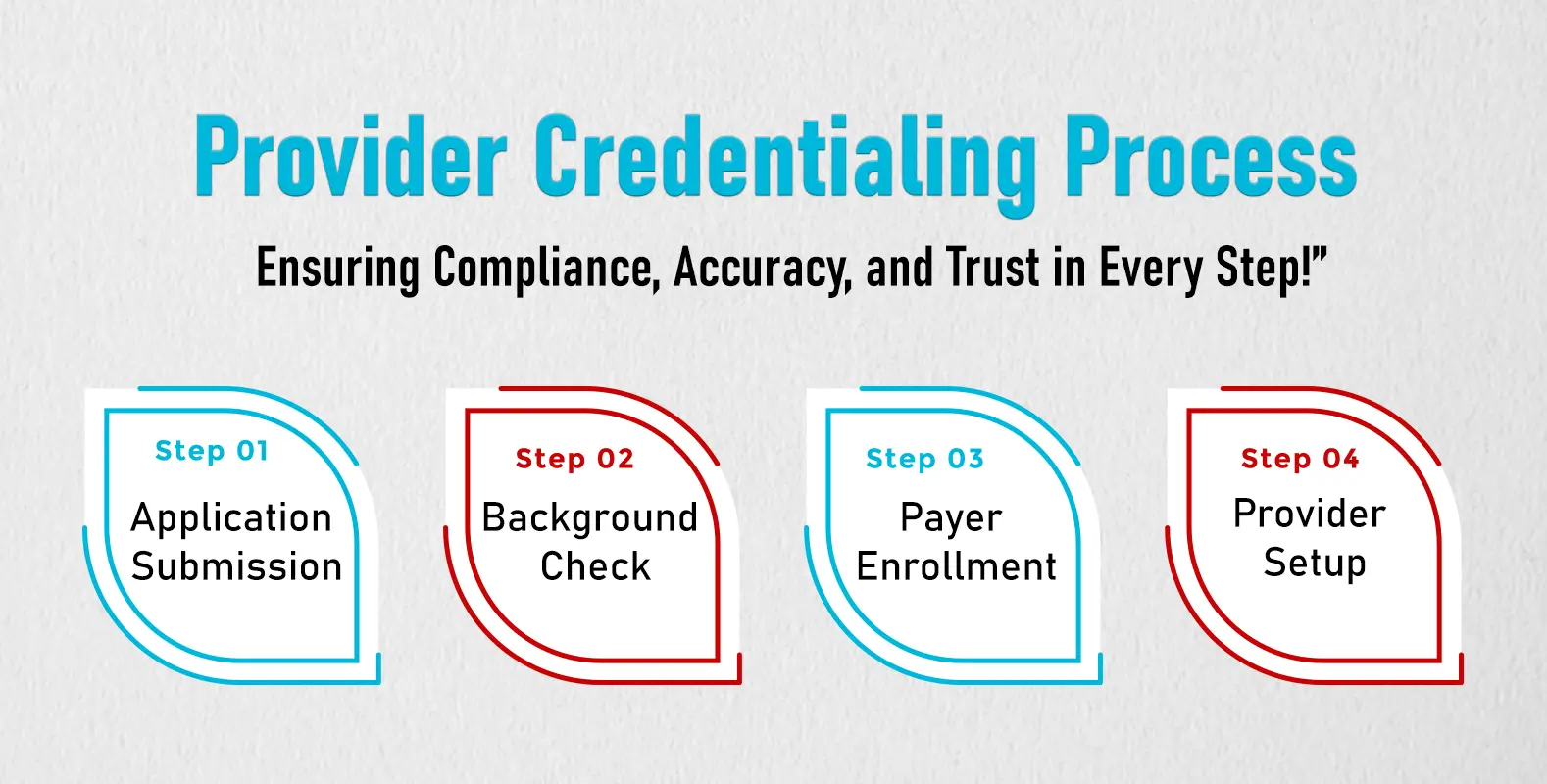
In simplest terms, the provider credentialing process is a cyclical process that starts and ends with a payer. First, a provider must complete the credentialing step, which involves the submission of personal, professional, and practice information for verification by the payer. A key step in this process is called primary source verification and this involves the direct verification of credentials with the issuing organization. Credentialing committee or payer approval is the last step to this process.Physician Credentialing Process Overview
For physicians, credentialing entails the review of medical school transcripts, residency, board certification, state license(s), and malpractice claim(s) history with accompanying professional references. In order to ensure that there is patient safety and a high quality of care, physicians are subjected to strict criteria by payers and hospitals. Any gaps in documentation can jeopardize prompt approval.Medical Provider Credentialing Process Across Specialties
There are different steps and requirements depending on which type of provider and which specialty. Each type of provider has different requirements. These include the physician, nurse practitioner, physician assistant, therapists, and behavioral health provider. Regardless of specialty, the goal of provider credentialing is the same. All credentialing is trying to assess whether or not the provider has the skills, rights, and the moral standing needed to be in the network of payers.Hospital Credentialing Process Explained
Credentialing in hospitals is more involved than payer credentialing, as it is the only instance where clinical privileges of a provider are determined. Hospitals evaluate not only the clinical credentials, but the entire scope of practice, clinical competency, and practice history. Most hospitals have a credentialing committee that reviews all applications for privileges on the committee and considers the closing. Privileges are renewed through a process called ‘re-credentialing’ and are often not guaranteed for life.Insurance Credentialing Process for Providers
Insurance credentialing is when a provider’s information is sent to payers for approval. The payers involved in Insurance credentialing include at least one commercial payer, Medicare, and Medicaid. Each payer has its own requirements and these include timelines and review criteria. The time it takes to receive approval depends on the workload the payer has and whether or not the application has a complete set of documents. This leads to a need for poor billing supervision.Payer Credentialing and Network Participation
Joining a network of payers is determined by payer credentialing. The factors that result from network participation include how easy it is for patients to access providers, how much reimbursement is available to the insurance companies, and how referrals are processed. Certain health providers choose not to credential certain payers, making the process of credentialing themselves more competitive for these providers. Well-done applications accompanied by follow-up communications, increase chances of securing payer relationships.Delegated Credentialing Process
Delegated credentialing typically allows for large healthcare systems to undertake credentialing on behalf of health insurance payers. In order to obtain this privilege, these large systems must adhere to a more rigorous practice, impose more quality controls, and remain more compliant. While the process is more streamlined, increased approval turnaround provides less operability for the system.Credentialing Process Flow Chart Explained in Practice
While there are many variations of credentialing process flow charts, organizations tend to design them to follow the same steps. In the credentialing process these steps consist of: application, verification, review, approval, and ultimately, enrollment. Familiarity with the proposed chart allows health systems to improve upon potential bottlenecks, positively impacting revenue growth.Provider Enrollment and Credentialing Timelines
Managing provider enrollment turnaround time is dependent on a few attributes, including system design, provider expertise, and the precision of submitted applications. Typically, processing Medicare enrollments are also very time consuming, and on the other extreme, commercialization of the payers typically results in delays of a few months. In order to avoid challenges in billing, organizations must engage in active collaborative processes with system partners, and begin the process of provider credentialing, long prior to initiating practitioner start dates.Common Challenges in Credentialing and Enrollment
The scope of the credentialing process must include the prevention of document stagnation. For example, expired documents, in the process of credentialing, involve provider data that must be monitored and kept up to date, in the process of credentialing. And finally, lack of malpractice coverage documented, or expired coverage also impedes the process.Recredentialing and Ongoing Maintenance
Credentialing is an ongoing process. To keep participating in the network and to keep hospital privileges, providers must recredential every couple of years. Not recredentialing can result in temporary or permanent exclusion from payer networks.Credentialing and Compliance Consideration
Credentialing is also essential from a risk management and regulatory compliance perspective for a practice. An exposure miscredentialing a practice can trigger audits, fines, or increased liability risk. Keeping credentialing records in good order is important for quality assurance and to protect the providers and the patients.Role of Credentialing in Revenue Cycle Management
Credentialing and enrollment are intertwined in revenue cycle management. Without adequate enrollment, claims can’t be processed, causing revenue to become at risk or become permanently lost. Streamlined credentialing processes, give providers the ability to submit claims and maintain a steady cash flow.How A2Z Billings Supports Credentialing and Enrollment
A2Z Billings facilitates streamlined credentialing and enrollment processes for providers to help practices maintain efficiency and avoid compliance pitfalls. Our staff takes care of the management of application submissions, payer follow-ups, recredentialing, and ongoing maintenance. A2Z Billings lets providers to concentrate on patient care while maintaining consistent reimbursement and payer participation.Best Practices for Successful Credentialing and Enrollment
The collection of sufficient documentation in a timely manner, assigned documentation for follow-up, and ongoing oversight are all needed for thorough credentialing to occur. Experienced credentialing support along with centralized documentation decreases delays immensely. Companies that engage in professional credentialing services consistently have less billing disruptions and faster approvals.Frequently Asked Questions
Provider credentialing verifies a healthcare provider’s qualifications to ensure they meet payer and regulatory standards.
Provider enrollment registers a credentialed provider with insurance payers so they can submit claims and receive payment.
Credentialing timelines vary by payer but typically range from several weeks to several months.
In most cases, billing cannot begin until credentialing and enrollment are approved, unless retroactive billing is permitted.
A2Z Billings manages end-to-end credentialing and enrollment to ensure timely approvals, compliance, and uninterrupted revenue.