


A front-desk medical assistant swabs a child’s throat, the rapid test line turns pink in under ten minutes, and the visit ends with an antibiotic prescription. That five-minute clinical moment turns into a coding decision that determines whether the practice gets paid correctly. Choosing the wrong strep test CPT code, or leaving off a required modifier, is one of the more common reasons pediatric and urgent care claims come back denied.
This guide walks through the specific codes used for strep testing in 2026: what each one describes, when it applies, which modifiers payers expect, and how the codes pair with ICD-10 diagnoses. It’s written for coders, billers, and clinicians who need more than a one-line definition.
Why strep test CPT code selection causes so many billing questions
Group A Streptococcus (Streptococcus pyogenes) causes an estimated 15% to 30% of pharyngitis cases in children and a smaller share in adults, according to the Infectious Diseases Society of America’s October 2025 guideline update, the first full revision of its strep pharyngitis recommendations since 2012. Because most sore throats are viral, testing exists specifically to avoid unnecessary antibiotics, and that testing generates three distinct types of lab claims: rapid antigen tests, molecular (PCR) tests, and throat cultures. Each has its own CPT code, and payers frequently reject claims when the wrong one is used or when a required piece of documentation is missing.
CPT code | Method | Read by | Typically CLIA-waived | QW modifier needed |
87880 | Rapid antigen immunoassay | Direct visual observation | Yes, in most kit formats | Yes |
87651 | Amplified nucleic acid probe (PCR-based) | Instrument/analyzer | Only with an FDA-cleared waived kit, since Jan. 1, 2016 | Yes |
87081 | Culture, presumptive screening | Lab technologist | No | No |
87430 | Multi-step immunoassay | Instrument, not direct visual read | No | No |
CPT code 87880: the rapid strep test
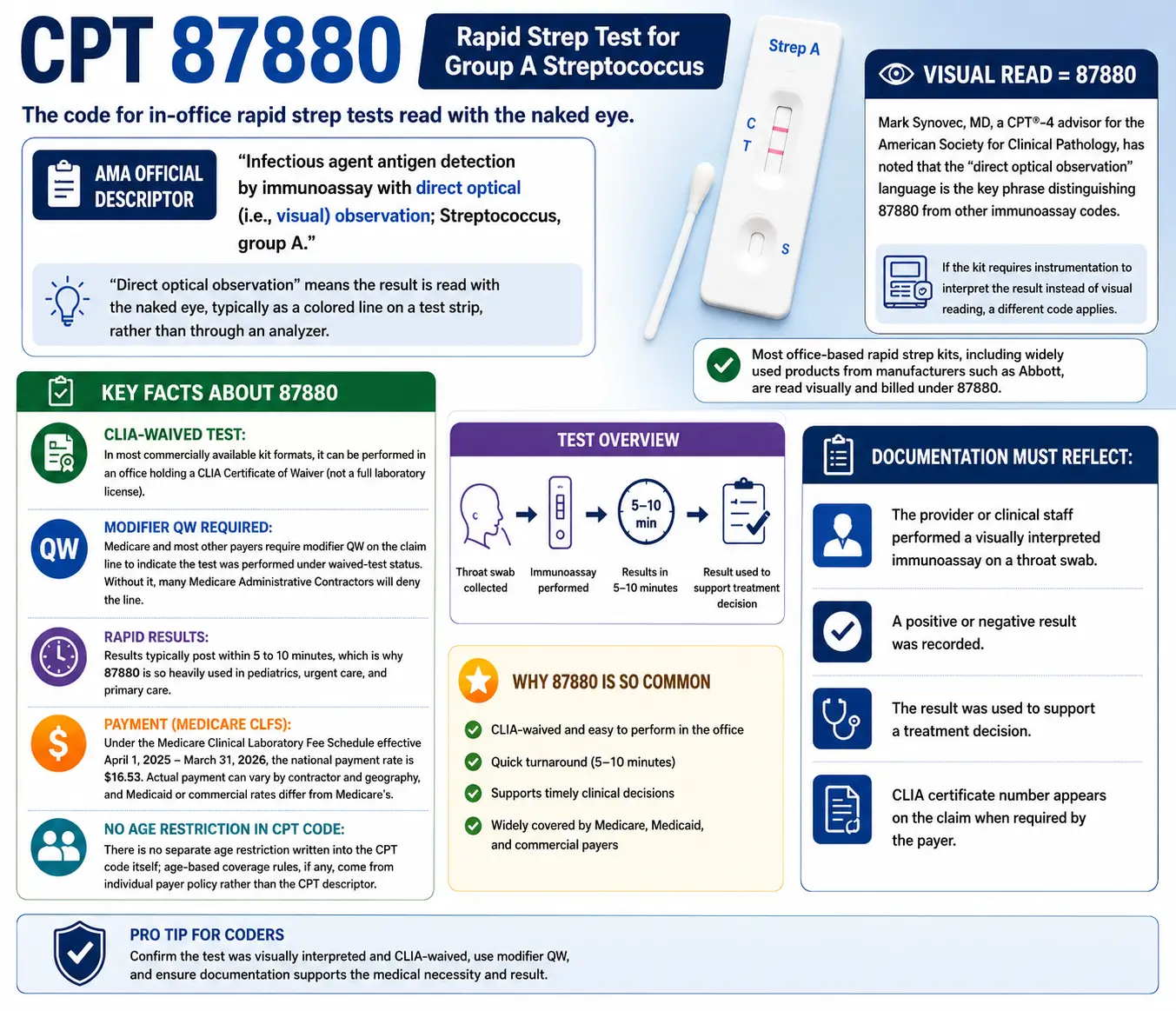
CPT 87880 is the code billed for the vast majority of in-office rapid strep tests. Its official AMA descriptor is: “Infectious agent antigen detection by immunoassay with direct optical (i.e., visual) observation; Streptococcus, group A.”
That phrase “direct optical observation” is doing real work in the descriptor. It means the result is read with the naked eye, typically as a colored line on a test strip, rather than through an analyzer. According to Mark Synovec, MD, a CPT-4 advisor for the American Society for Clinical Pathology, the defining feature of CPT code 87880 is the phrase “direct optical observation.” This indicates that the test result must be interpreted visually, such as by observing a colored line on the test device. If the assay requires an instrument or analyzer to read and interpret the result, CPT 87880 is not the appropriate code, and a different immunoassay code should be reported.
Most office-based rapid strep kits, including widely used products from manufacturers such as Abbott, are read visually and billed under 87880.
Key facts about 87880:
- It is a CLIA-waived test in most commercially available kit formats, meaning it can be performed in an office holding a CLIA Certificate of Waiver rather than a full laboratory license.
- Medicare and most other payers require modifier QW on the claim line to indicate the test was performed under waived-test status. Without it, many Medicare Administrative Contractors will deny the line.
- Results typically post within 5 to 10 minutes, which is why 87880 is so heavily used in pediatrics, urgent care, and primary care.
- Under the Medicare Clinical Laboratory Fee Schedule effective for the period running from April 1, 2025 through March 31, 2026, the national payment rate published by state Medicaid fee schedules that reference the CLFS lists 87880 at $16.53. Actual payment can vary slightly by contractor and geography, and Medicaid or commercial rates differ from Medicare’s.
- There is no separate age restriction written into the CPT code itself; age-based coverage rules, if any, come from individual payer policy rather than the CPT descriptor.
Documentation for 87880 should reflect that the provider or clinical staff performed a visually interpreted immunoassay on a throat swab, recorded a positive or negative result, and used that result to support a treatment decision. Coders should also confirm the CLIA certificate number appears on the claim when required by the payer.
CPT code 87651: the molecular (PCR) strep test
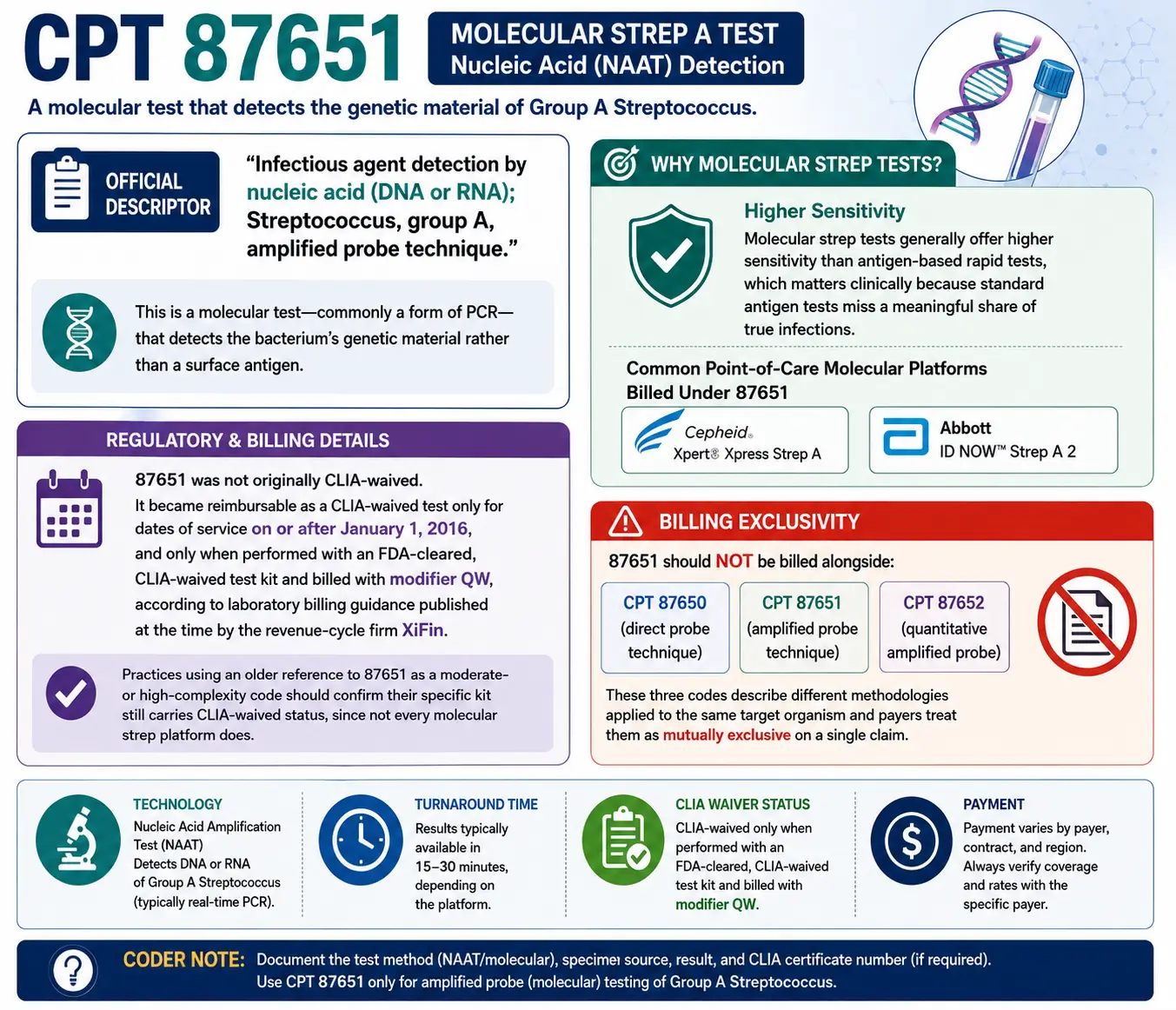
CPT 87651 covers a different technology entirely. Its descriptor reads: “Infectious agent detection by nucleic acid (DNA or RNA); Streptococcus, group A, amplified probe technique.” This is a molecular test, commonly a form of PCR, that detects the bacterium’s genetic material rather than a surface antigen.
Molecular strep tests generally offer higher sensitivity than antigen-based rapid tests, which matters clinically because standard antigen tests miss a meaningful share of true infections. A number of point-of-care molecular platforms, including Cepheid’s Xpert Xpress Strep A and Abbott’s ID NOW Strep A 2, are billed under 87651 when used in office settings.
A regulatory detail worth knowing: 87651 was not originally CLIA-waived. It became reimbursable as a CLIA-waived test only for dates of service on or after January 1, 2016, and only when performed with an FDA-cleared, CLIA-waived test kit and billed with modifier QW, according to laboratory billing guidance published at the time by the revenue-cycle firm XiFin. Practices using an older reference to 87651 as a moderate- or high-complexity code should confirm their specific kit still carries CLIA-waived status, since not every molecular strep platform does.
Coders should also note that 87651 should not be billed alongside CPT 87650 (direct probe technique) or 87652 (quantitative amplified probe) for the same specimen. Those three codes describe different methodologies applied to the same target organism, and payers treat them as mutually exclusive on a single claim.
CPT codes 87081 and 87430: the throat culture codes
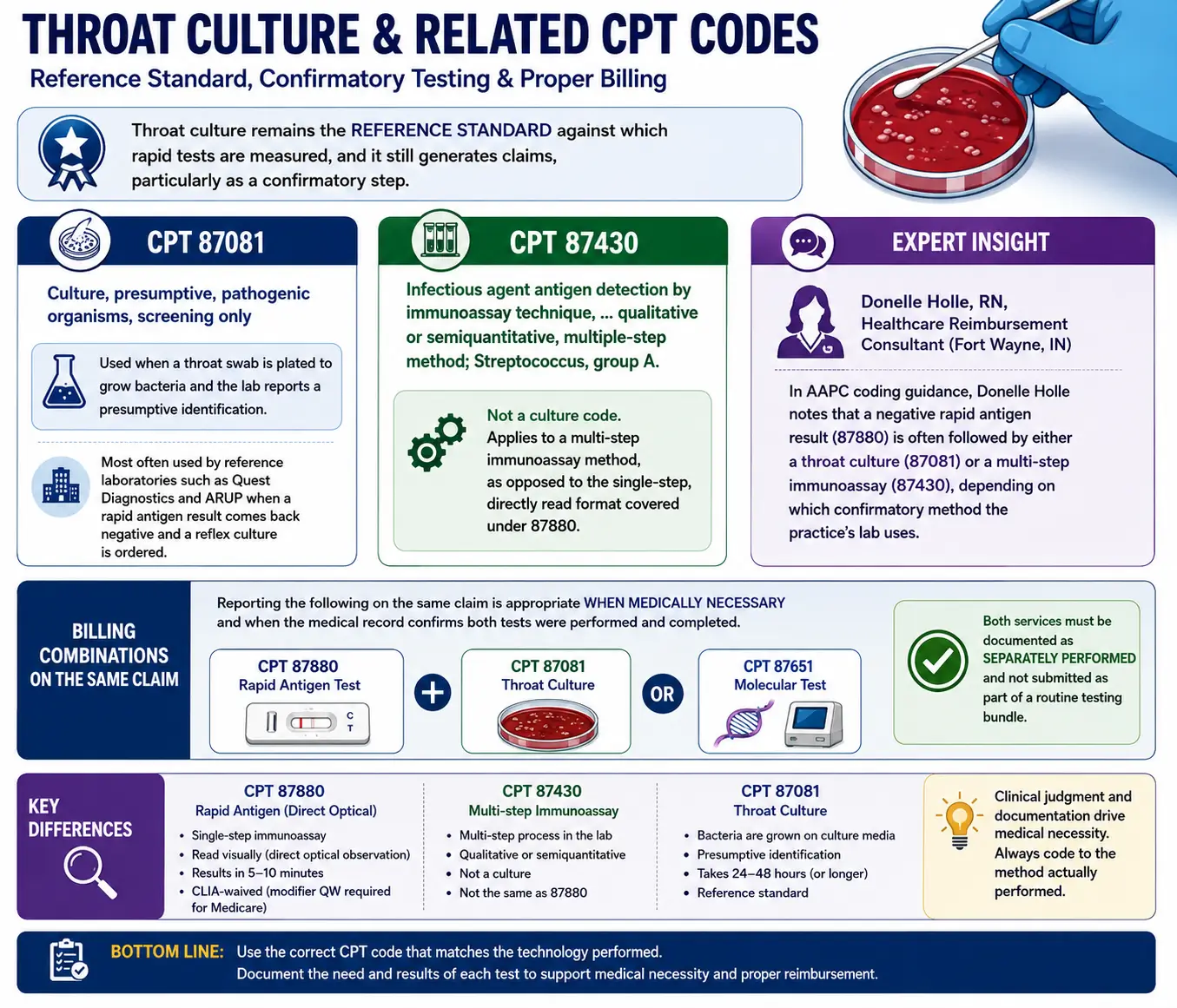
Throat culture remains the reference standard against which rapid tests are measured, and it still generates claims, particularly as a confirmatory step.
CPT 87081 describes “culture, presumptive, pathogenic organisms, screening only.” This is the code used when a throat swab is plated to grow bacteria and the lab reports a presumptive identification, most often used by reference laboratories such as Quest Diagnostics and ARUP when a rapid antigen result comes back negative and a reflex culture is ordered.
CPT 87430 describes “infectious agent antigen detection by immunoassay technique, … qualitative or semiquantitative, multiple-step method; Streptococcus, group A.” Despite the similar-sounding name, 87430 is not a culture code. It applies to a multi-step immunoassay method, as opposed to the single-step, directly read format covered under 87880. Donelle Holle, RN, a healthcare reimbursement consultant based in Fort Wayne, Indiana, has pointed out in AAPC coding guidance that a negative rapid antigen result (87880) is often followed by either a throat culture (87081) or a multi-step immunoassay (87430), depending on which confirmatory method the practice’s lab uses.
Reporting CPT codes 87880 and 87081 (or 87880 and 87651) on the same claim is appropriate when the medical record confirms that both the rapid test and the follow-up confirmatory test were medically necessary and completed. However, both services must be documented as separately performed rather than submitted as part of a routine testing bundle.
When a confirmatory culture is required, not optional
This is where clinical guidelines intersect directly with billing decisions, and it is a detail that trips up a surprising number of practices.
The CDC’s clinical guidance on Group A strep pharyngitis, and the IDSA’s original 2012 recommendations, both state that a negative rapid antigen detection test in a child or adolescent should be followed up with a throat culture, because rapid antigen tests carry a false-negative rate that clinical guidelines treat as clinically significant enough to require confirmation in a population where missing an infection carries a real, if small, risk of acute rheumatic fever. A positive RADT does not require a back-up culture in this population, because rapid tests are highly specific for true positives.
For adults, routine back-up culture after a negative rapid test is not considered necessary in typical circumstances, since the incidence of the illness and the risk of downstream rheumatic fever are both lower in adults than in children. The IDSA’s 2025 update largely preserved this age-based distinction while adding a new recommendation to use validated pretest scoring systems to decide who should be tested at all, an approach intended to reduce both over-testing and antibiotic overuse. Both the 2012 and 2025 guidelines continue to advise against routine Group A streptococcal testing in children younger than three years because strep pharyngitis is uncommon in this age group, and the risk of acute rheumatic fever is extremely low.
From a billing perspective, claims must align with the patient’s age and the clinical circumstances. For example, a claim reporting 87880 alone for a pediatric patient with a negative rapid test and no documented reason for omitting a confirmatory throat culture may be questioned for an incomplete diagnostic evaluation. Conversely, reporting both 87880 and 87081 for an adult with a negative rapid test, without documentation supporting a specific high-risk indication, may prompt payer review over the medical necessity of the additional confirmatory test.
Pairing the codes with ICD-10 diagnoses
Correct CPT-to-ICD-10 pairing matters as much as code selection itself.
- J02.0 (streptococcal pharyngitis) applies once a rapid test, molecular test, or culture confirms Group A strep. It should not be applied on the basis of symptoms alone.
- J02.9 (acute pharyngitis, unspecified) is the appropriate code when a rapid test comes back negative or when strep has not been confirmed.
- B95.0 (Streptococcus, group A, as the cause of diseases classified elsewhere) is used as a secondary code in some payer workflows to identify the causative organism alongside a primary diagnosis.
- Z20.818 (contact with and suspected exposure to other bacterial communicable diseases) applies to an asymptomatic patient being evaluated after known exposure to a confirmed strep case, not to a symptomatic patient awaiting results.
A common denial pattern shows up when a practice reports J02.0 on the same claim as a negative rapid strep result. Coders should hold the streptococcal pharyngitis diagnosis until a positive result, whether from 87880, 87651, 87081, or 87430, is actually documented in the chart.
Reimbursement mechanics worth understanding
Medicare pays for strep testing codes through the Clinical Laboratory Fee Schedule, not the Physician Fee Schedule, which is why these codes carry no work RVU. Payment rates under the CLFS are set using a weighted median of private payer rates collected from laboratories under the Protecting Access to Medicare Act (PAMA), a mechanism that has been repeatedly delayed by Congress since its original 2018 implementation. The most recent CMS update, effective January 1, 2026, confirmed there would be no phase-in payment reduction for 2026, with future limits on year-over-year cuts beginning in 2027. A new data reporting period for clinical diagnostic laboratory tests runs from May 1 through July 31, 2026, and the resulting data will factor into the next scheduled rate update.
For practices billing Medicaid or commercial payers directly, published fee schedules that reference the CLFS, such as the one issued by West Virginia’s Bureau for Medical Services, list 87880 with modifier QW at the same $16.53 national rate carried on the federal CLFS, underscoring how closely many state Medicaid programs track Medicare’s laboratory pricing rather than setting independent rates for these low-cost tests.
Common billing errors to watch for
- Missing the QW modifier on 87880 or 87651 when billing Medicare, resulting in a denial for a non-covered or improperly coded waived test.
- Reporting J02.0 with a negative test result, which creates a mismatch between the diagnosis and the documented clinical findings.
- Billing 87430 as if it were a culture code, when it actually describes a multi-step immunoassay method distinct from 87081.
- Omitting documentation of medical necessity when both a rapid test and a confirmatory culture appear on the same claim, particularly in adult patients where routine reflex culture is not the guideline-supported default.
- Using an outdated CLIA-waived status assumption for 87651, since that status depends on the specific test kit used, not the CPT code alone.
A practical takeaway for billing teams
The strep test CPT code set is small, but each code maps to a distinct testing method with its own documentation and modifier requirements. Getting 87880, 87651, 87081, and 87430 right, and pairing each with the correct ICD-10 code based on an actual result rather than a presenting symptom, prevents the two most common denial patterns in this claim category: missing modifiers and diagnosis-result mismatches. Practices that build a short reference sheet mapping test method to CPT code, modifier, and expected diagnosis logic tend to see fewer strep-related denials cross their desk.