


A screening mammogram looks like one of the simplest claims a radiology practice files. One procedure code. One diagnosis code. Then the denial lands in the work queue. Most rejections tied to the 77067 CPT code trace back to a mismatch between the procedure and the diagnosis, a frequency edit, or a modifier that should not be on the claim at all. This guide covers the pairing rules that keep these claims clean, with the specific codes, effective dates, and payer policies that coders and billers work with every day.
What is CPT code 77067?
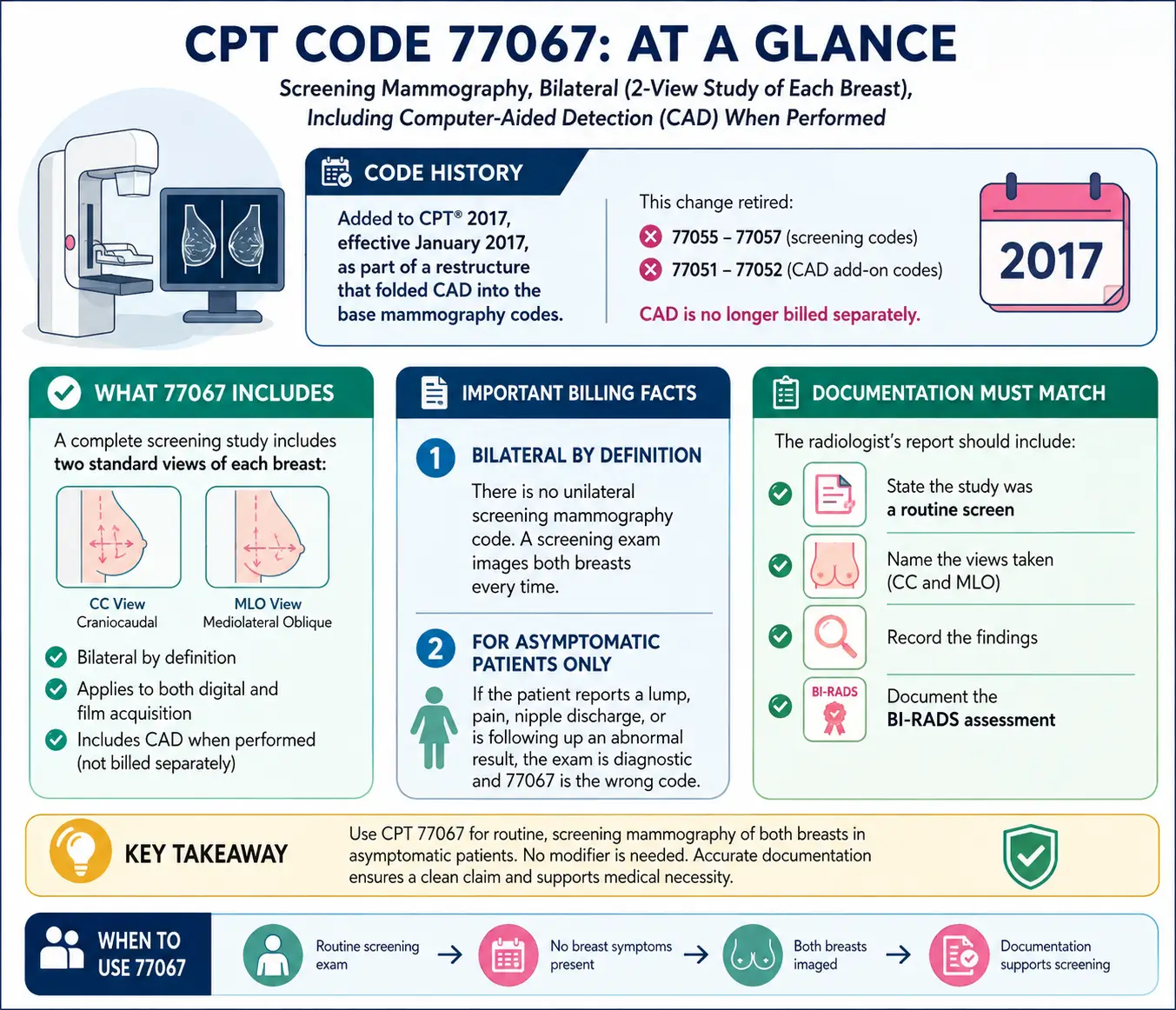
The official 77067 CPT code description reads: screening mammography, bilateral (2-view study of each breast), including computer-aided detection (CAD) when performed. The American Medical Association added it to the CPT 2017 code set, effective January 2017, as part of a restructure that folded CAD into the base mammography codes. That change retired the older screening codes (77055 through 77057) and the standalone CAD add-ons (77051 and 77052). CAD no longer bills on a line of its own.
A complete study captures two standard views of each breast, the craniocaudal (CC) view and the mediolateral oblique (MLO) view. The code applies to both digital and film acquisition.
Two facts inside that description drive most of the billing decisions.
First, 77067 is bilateral by definition. There is no unilateral screening mammography code. A screening exam images both breasts every time, so a laterality modifier has no place on the claim. Second, the code is for asymptomatic patients only. The moment a patient reports a lump, pain, nipple discharge, or arrives to follow up an abnormal result, the encounter becomes diagnostic and 77067 is the wrong code.
Documentation has to match. The radiologist’s report should state that the study was a routine screen, name the views taken, and record the findings and the BI-RADS assessment. When the note reads “screening” and the order agrees, the claim has a defensible basis.
How 77067 differs from its diagnostic siblings
The screening code sits inside a small family. Sorting the codes by clinical intent prevents most miscoding.
CPT code | Study | When it applies | Typical diagnosis |
77067 | Screening mammography, bilateral, with CAD | Asymptomatic patient, routine screen | Z12.31 |
77066 | Diagnostic mammography, bilateral, with CAD | Symptoms, abnormal finding, or active concern in both breasts | Symptom or finding code |
77065 | Diagnostic mammography, unilateral, with CAD | Symptom or finding in one breast | Symptom or finding code |
77063 | Screening tomosynthesis, bilateral (add-on) | 3D imaging added to a screen | Z12.31, billed with 77067 |
The ICD-10 side: Z12.31 does the heavy lifting
For a routine screen, one diagnosis code establishes medical necessity: Z12.31, encounter for screening mammogram for malignant neoplasm of breast. Most screening claims carry it alone. This is the ICD-10 code for a screening mammogram, and the bilateral version is included, because the screen images both breasts by nature. There is no separate bilateral screening diagnosis code to hunt for.
Put a diagnostic-intent code on a 77067 claim and the encounter reclassifies. The payer reads the diagnosis as proof the study was not preventive, and the claim denies, often under CO-11 (diagnosis inconsistent with the procedure).
One historical detail is worth knowing. ICD-9 split screening into high-risk and low-risk categories (V76.11 and V76.12). ICD-10 does not. Z12.31 covers every routine screen regardless of the patient’s risk level, so there is no “high-risk screening” code to reach for.
Secondary codes that support the screen
Risk factors ride as secondary diagnoses. They never replace Z12.31:
- Z80.3, family history of malignant neoplasm of breast, when a first-degree relative (mother, sister, daughter) has had breast cancer.
- Z85.3, personal history of malignant neoplasm of breast, for a patient who was treated and is now clinically stable.
- Z15.01, genetic susceptibility to malignant neoplasm of breast, documented for a carrier such as a BRCA patient.
A personal history alone does not force the visit into a diagnostic code. Without an active clinical concern, a patient coded Z85.3 can still receive a routine screening 77067. Read the radiologist’s note before assigning the code, because ongoing surveillance often shifts to a diagnostic study once a concern is present.
When Z12.31 no longer applies
Suppose a patient arrives for a routine screen. The radiologist reviews the images and calls her back the same day for additional views of one breast. That study has converted to diagnostic. The diagnosis now reflects the finding, not the screen. Abnormal results fall in the R92 range: R92.2 for an inconclusive mammogram, R92.8 for other abnormal findings on breast imaging, and R92.0 and R92.1 for microcalcifications and calcifications. Under ICD-10-CM guidelines for a screening encounter with an incidental finding, Z12.31 can remain the first-listed code with the abnormal finding added as secondary, but the procedure code and the patient’s cost-sharing change from that point forward.
Each Medicare Administrative Contractor publishes a billing and coding article (for example, A56448) listing the diagnosis codes that support a mammography claim. Checking that list against the order at intake catches mismatches before they reach the payer.
The Medicare G-code myth still causing denials
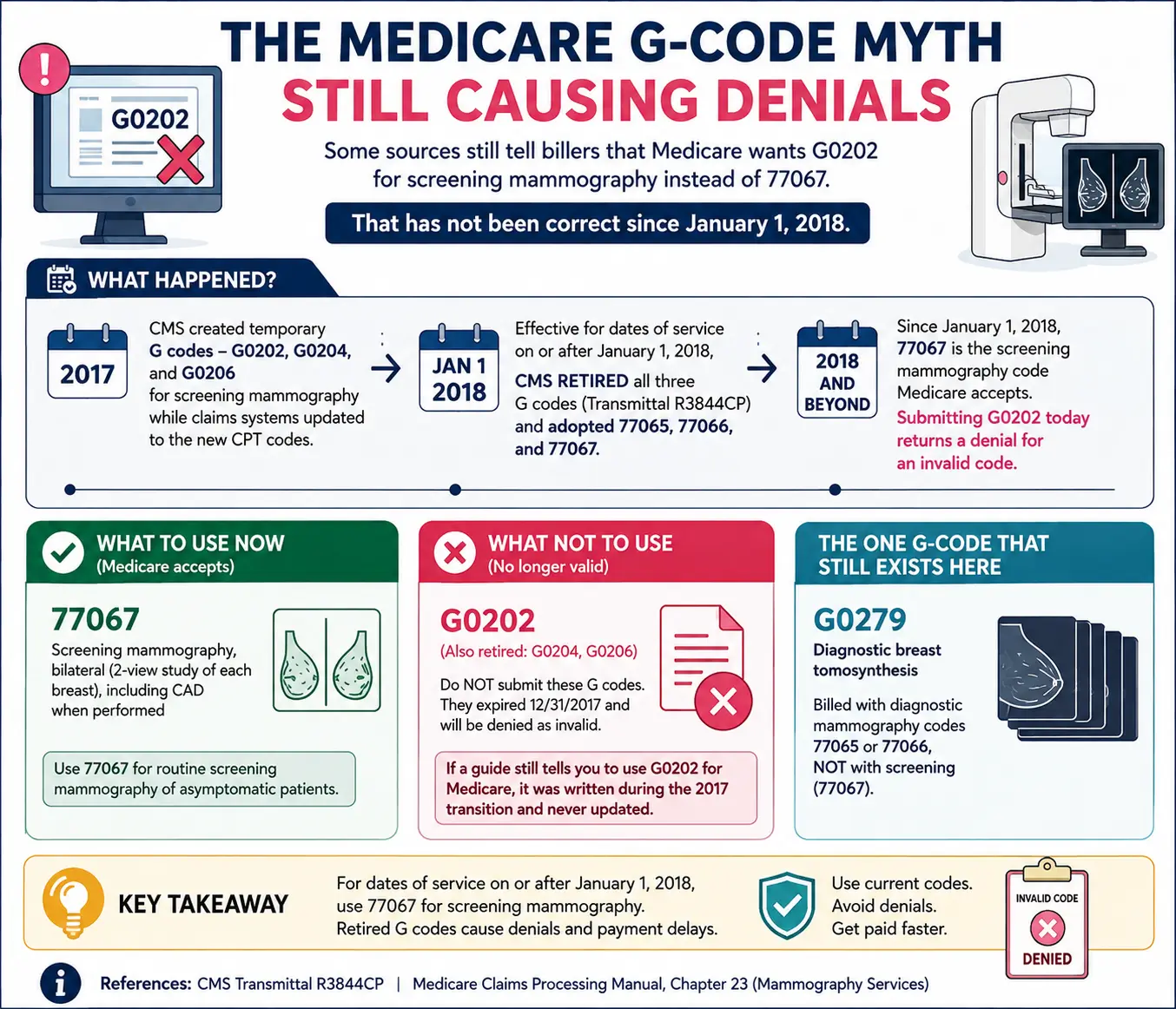
Here is an error that survives in charge masters and in published billing guides years after it stopped being true. Some sources still tell billers that traditional Medicare wants G0202 for screening mammography instead of 77067. That has not been correct since January 1, 2018.
CMS introduced G0202, G0204, and G0206 for 2017 while its claims systems caught up with the new CPT codes. Effective for dates of service on or after January 1, 2018, CMS retired all three G codes (Transmittal R3844CP) and adopted 77065, 77066, and 77067. Since that date, 77067 is the screening mammography code Medicare accepts. Submitting G0202 today returns a denial for an invalid code.
If a coding reference still instructs you to send G0202 to Medicare, it was written during the 2017 transition and never updated. One Medicare G code in this area does survive: G0279 reports diagnostic breast tomosynthesis and is billed alongside 77065 or 77066, not with the screening pair.
77067 frequency limit and age rules
Medicare screening mammography coverage is set by statute and administered through the Medicare Claims Processing Manual, Chapter 18. The frequency and age rules are specific:
- Women age 40 and older: one screening mammogram every 12 months.
- Ages 35 to 39: one baseline screening, allowed once.
- Under age 35: no payment for screening mammography.
“Every 12 months” is stricter than it reads. Medicare requires at least 11 full months to pass after the month of the last screening. A patient screened in March becomes eligible again the following March, not February. Booking a patient a few weeks early is one of the most common causes of a 77067 frequency limit denial, and those denials often go unworked because each one looks like a small write-off. Across a full schedule they are not small.
For a covered screen billed with Z12.31, Medicare waives both the Part B deductible and the 20 percent coinsurance. The patient owes nothing when the provider accepts assignment. That preventive status is one reason getting the diagnosis pairing right matters so much: a diagnostic reclassification pulls the deductible and coinsurance back onto the patient’s bill.
Can CPT 77063 and 77067 be billed together?
Yes, and this pairing is the intended use of 77063. CPT 77063 reports screening digital breast tomosynthesis (3D mammography), bilateral. It is an add-on code. It never bills on its own.
The FDA requires that a standard mammogram accompany digital breast tomosynthesis when used for screening, so CMS designed 77063 to sit on top of the 2D study. Report it on the same claim as 77067. Send 77063 by itself and the claims contractor denies it. Do not pair 77063 with the diagnostic codes (77065, 77066, or G0279), which describe diagnostic tomosynthesis and use different add-ons (77061 and 77062).
Under Medicare, 77063 is a preventive service, exempt from coinsurance and deductible when billed with 77067. On the commercial side, watch for plans that cover the 2D component at no cost but treat the 3D add-on as a separate patient charge. That split shows up as two line items on the patient’s statement and surprises people who expected one free screening. More than 40 states now mandate coverage of 3D screening, though self-insured employer plans under ERISA may fall outside those state rules.
Does CPT 77067 require a modifier?
For a standard global screening claim, no. 77067 stands on its own. Modifiers come in for specific situations:
- Modifier 26 for the professional component (the radiologist’s interpretation) when the facility and physician bill separately.
- Modifier TC for the technical component (equipment, staff, image capture).
- Modifier 52 for reduced services, used for a unilateral screen on a post-mastectomy patient, since no unilateral screening code exists.
- Modifier GG on Medicare claims when a screening mammogram converts to a diagnostic study on the same day. Bill the screening (77067) and the diagnostic code together, with GG on the diagnostic line.
- Modifier 33 on some commercial claims to flag the service as preventive so the plan waives cost-sharing. Medicare does not require it.
One modifier does not belong to this code. Modifier 50 (bilateral procedure) is wrong on 77067, because the code already describes a bilateral exam. Adding it double-reports laterality and invites a denial.
The USPSTF and Medicare frequency gap
Providers field a recurring patient question: is it every year or every two years? Both answers are correct, depending on which standard applies.
In April 2024, the U.S. Preventive Services Task Force finalized a Grade B recommendation for biennial (every two years) screening mammography for women from age 40 through 74. The earlier 2016 guidance had left the decision to begin screening in the 40s to individual judgment. Because the Affordable Care Act ties private-plan cost-sharing to USPSTF grades, the 2024 update reinforced that commercial plans must cover screening starting at 40 with no out-of-pocket cost.
Medicare sets its own payment frequency, which stays annual for women 40 and older. So the clinical recommendation (every two years) and the Medicare payment rule (every year) diverge. Neither changes the code. A screen billed at either interval is still 77067 with Z12.31.
A short pre-submission check
Before a 77067 claim leaves the practice, confirm:
- The order says screening and the patient is asymptomatic.
- The diagnosis is Z12.31, with any risk codes (Z80.3, Z85.3, Z15.01) as secondary only.
- Enough time has passed since the last screen (11 full months for Medicare).
- CAD is not billed on a separate line (it is built into 77067).
- Any 3D imaging is on the claim as 77063, not standalone.
- Medicare claims use 77067, never the retired G0202.
Most denials in this code family come from five sources: a diagnostic diagnosis paired with a screening code, a frequency edit, a missing component modifier, a retired CAD or G code left in the charge master, and a missing or mismatched order. Each one is preventable at intake rather than at billing.
The core pairing rule for 77067 claims
The 77067 CPT code reports a bilateral screening mammogram with CAD for an asymptomatic patient, and it pairs with one diagnosis code, Z12.31, to establish medical necessity. Medicare covers it once every 12 months for women 40 and older (with a single baseline for ages 35 to 39) and waives the deductible and coinsurance, and it has accepted 77067 in place of G0202 since January 1, 2018. Add 77063 for 3D screening, keep diagnostic codes off the screening claim, and leave modifier 50 out. Set the code and diagnosis correctly at the point of order, and the claim clears on the first pass.