


Data published by the American Medical Association indicates that medical practices spend an average of $3.01 to process a clean medical claim, yet that cost jumps to $13.66 when staff must manage a denial. The document that alerts billers to these financial outcomes is the EOB (Explanation of Benefits) in medical billing. Upon receiving this data, revenue cycle staff determine whether a claim requires payment posting, an appeal, or a transition to the patient’s balance.
Medical coders and billers rely on this documentation to track the exact financial lifecycle of a specific date of service. Prior to the adoption of the Health Insurance Portability and Accountability Act in 1996, insurance carriers mailed unstandardized letters detailing their reimbursement decisions. Today, federal regulations mandate specific data elements, creating a uniform communication method across the healthcare industry.
What is an EOB (Explanation of Benefits) in medical billing?
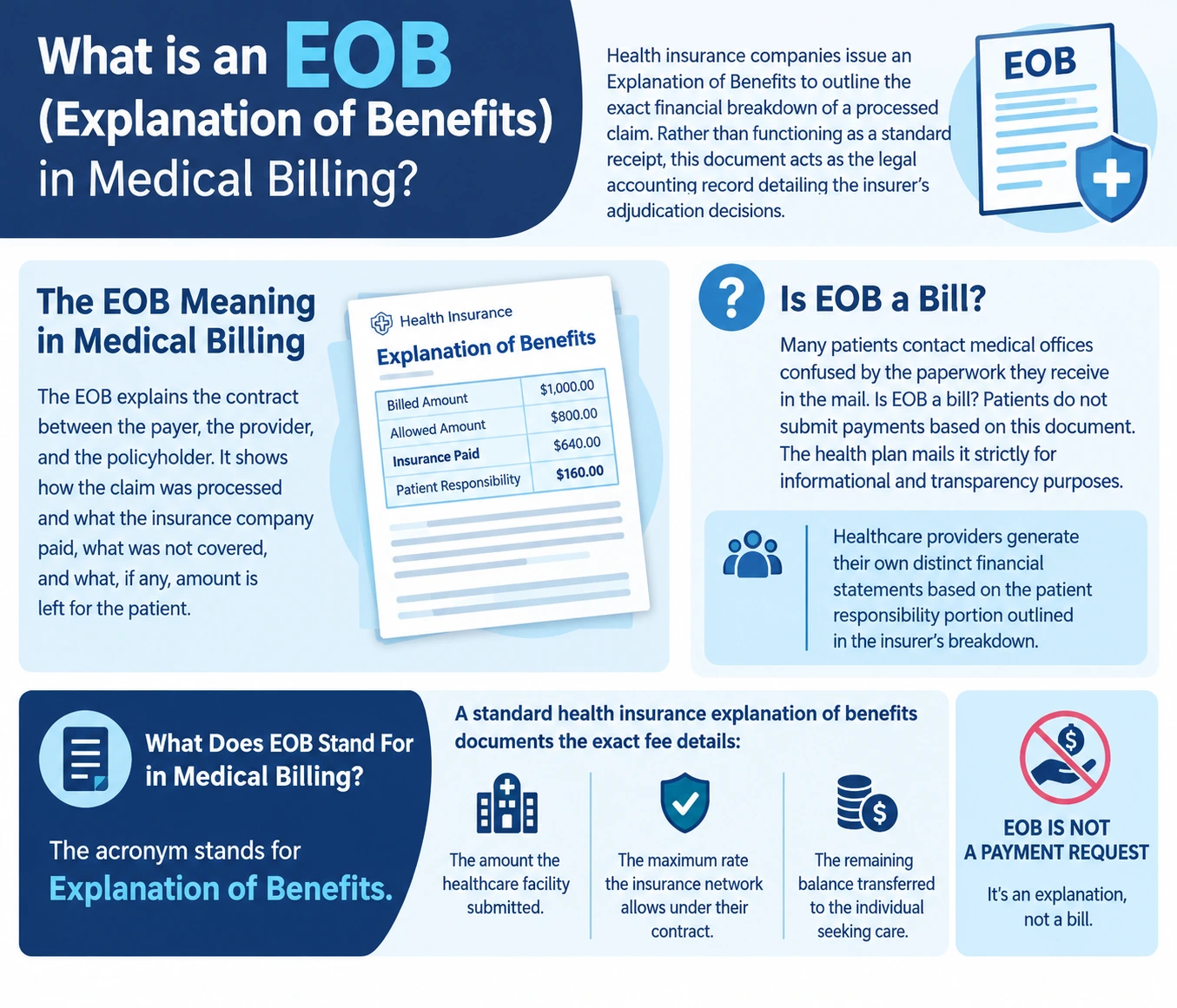
Health insurance companies issue an Explanation of Benefits to outline the exact financial breakdown of a processed claim. Rather than functioning as a standard receipt, this document acts as the legal accounting record detailing the insurer’s adjudication decisions. The EOB meaning in medical billing centers on the contract between the payer, the provider, and the policyholder.
Many patients contact medical offices confused by the paperwork they receive in the mail. Is EOB a bill? Patients do not submit payments based on this document. The health plan mails it strictly for informational and transparency purposes. Healthcare providers generate their own distinct financial statements based on the patient responsibility portion outlined in the insurer’s breakdown.
What does EOB stand for in medical billing? The acronym stands for Explanation of Benefits. A standard health insurance explanation of benefits documents the exact fee the healthcare facility submitted, the maximum rate the insurance network allows under their contract, and the remaining mathematical balance transferred to the individual seeking care.
How to read an EOB and navigate its structure
Interpreting these documents requires an understanding of standardized insurance logic. Visual layouts differ across commercial payers such as Cigna, Humana, and Anthem, but the core financial mathematics remain consistent.
Locating the document heading
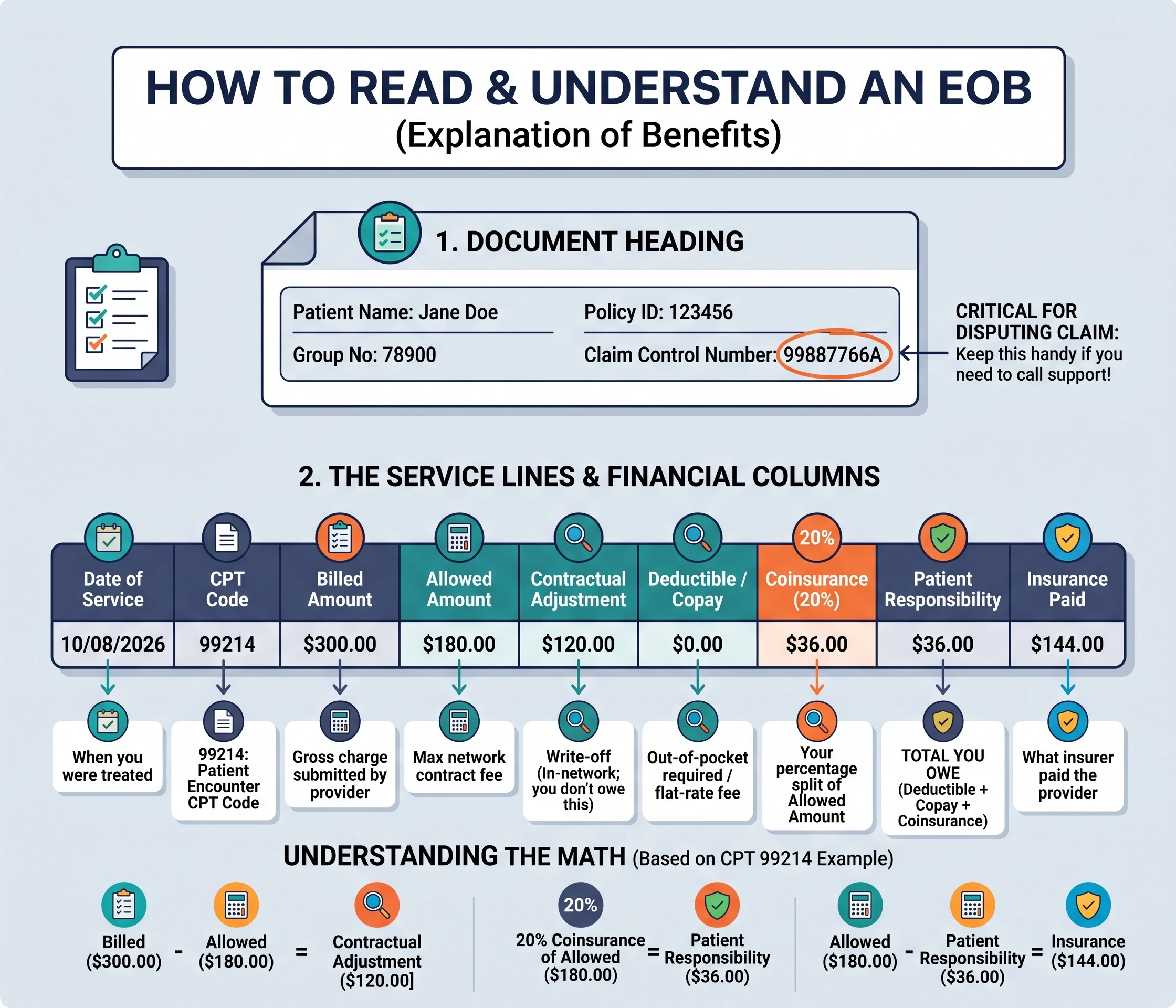
A sample EOB in medical billing features a distinct header containing policyholder demographics. This section identifies the patient’s legal name, policy identification number, group network number, and a unique claim control sequence generated by the payer’s software system. Medical billers must locate this specific claim control number before calling a provider representative to dispute a denied service.
Analyzing the service lines and financial columns
Below the demographic header, the service line details specify the dates of treatment alongside the exact Current Procedural Terminology (CPT) codes submitted on the claim form. The financial columns adjacent to these codes form the mathematical core of an EOB in medical billing example:
- Billed Amount: The gross charge the healthcare facility submitted for the treatment.
- Allowed Amount: The maximum legal fee the insurance carrier will recognize for a specific service based on their active provider network contract.
- Contractual Adjustment: The strict financial difference between the billed charge and the allowed fee. In-network providers must mathematically write off this specific amount.
- Deductible: The mandated out-of-pocket dollar threshold the patient must satisfy before the insurance carrier assumes financial liability.
- Copay: A predetermined, flat-rate fee the policyholder owes for a specific service, typically collected at the front desk.
- Coinsurance: The percentage split of the allowed amount that the patient must pay after satisfying their annual deductible.
- Patient Responsibility: The combined sum of the unmet deductible, standard copay, policy coinsurance, and any non-covered clinical charges the patient legally owes.
To illustrate the mathematics, consider an internal medicine provider who bills $300 for a moderate-complexity patient encounter (CPT 99214). The insurance carrier’s maximum allowed amount sits at $180. The billing software must register a contractual adjustment of $120. If the patient’s specific policy carries a 20 percent coinsurance rate, the patient owes $36. The insurance carrier then issues a final reimbursement check for $144.
Understanding EOB codes: CARC and RARC
Insurance carriers utilize standardized alphanumeric identifiers to explain their financial decisions. The X12 standards organization maintains the national electronic data interchange sets under federal law. They organize EOB codes into two primary categories.
CARC (Claim Adjustment Reason Codes) identify exactly why a payer altered the original billed amount. If a health plan issues a reimbursement lower than the submitted fee, a CARC code prints directly next to the affected service line. The industry utilizes universally recognized adjustments:
- CARC 1: Identifies an amount applied to the patient’s deductible.
- CARC 2: Identifies an amount applied to the patient’s coinsurance.
- CARC 3: Identifies an amount applied to the patient’s copayment.
- CARC 45: Indicates the submitted charge exceeds the legislated fee arrangement or contracted maximum allowable rate.
When an insurance carrier refuses to pay, billers investigate the specific EOB denial codes. Common rejections include CARC 16, indicating the service lacks necessary information or contains a coding error, and CARC 18, identifying an exact duplicate submission.
RARC (Remittance Advice Remark Codes) provide the granular details a CARC cannot deliver alone. These EOB remark codes supply specific supplemental context. For example, if CARC 16 signals a denial for missing information, the attached RARC will specify exactly which document the adjudication team requires, such as an operative report, a physical therapy flow sheet, or an emergency room discharge summary.
Analyzing the difference between EOB, EOP, ERA, and COB
Healthcare revenue cycle departments process multiple financial documents that carry similar abbreviations but trigger entirely different administrative workflows.
Term | Definition | Primary User |
Explanation of Benefits (EOB) | A detailed outline sent to the patient and the healthcare facility explaining claim adjudication logic and final patient liability. | Patients, Front-Desk Staff, Billers |
Explanation of Payment (EOP) | A financial ledger sent strictly to the medical provider detailing the actual monetary reimbursement totals for a bulk batch of claims. | Billers, Accounting Departments |
Electronic Remittance Advice (ERA) | The raw electronic data file format (835 file) of an EOP that practice management systems read to automate payment applications. | Back-End Billers |
Coordination of Benefits (COB) | The hierarchical rule set determining which insurance carrier acts as the primary payer when an individual holds multiple active policies. | Billers, Payer Adjudication Systems |
An explanation of payment vs explanation of benefits comparison reveals that the EOP functions explicitly as a banking remittance document. It arrives physically tied to a paper check or an Electronic Funds Transfer notice, containing bank routing numbers and bulk deposit totals.
An EOB vs ERA comparison demonstrates the healthcare industry’s shift away from manual data entry. A medical EOB exists as a human-readable document. Conversely, an ERA exists as raw machine code. Billing software consumes the ERA file and directly applies the corresponding financial data to individual patient ledgers.
COB vs EOB clarifies a common terminology mix-up. Coordination of benefits is an administrative rule dictating the legal billing sequence. The explanation of benefits is the physical document reporting the outcome of that sequence.
The EOB payment posting and reconciliation process
After the health plan finalizes the claim adjudication, the medical facility receives their corresponding data alongside the monetary reimbursement. EOB payment posting involves the physical or digital entry of these financial variables into the provider’s centralized billing system.
During manual EOB posting, back-office staff transfer the exact reimbursement, the mandatory contractual adjustments, and the precise patient responsibility amounts directly from the paper record to the individual patient’s account. EOB reconciliation requires the accounting team to confirm that the physical bulk check deposited into the bank matches the exact penny-for-penny sum of the individual claims listed on the document. Mathematical discrepancies during this process expose internal data entry errors, lost checks, or software mapping failures.
Managing the zero-pay EOB
Medical billers routinely process a zero-pay EOB. This specific scenario occurs when an insurance carrier processes a claim completely but issues no actual money to the healthcare facility. A zero-pay EOB surfaces under highly specific conditions. The entire approved fee might fall under the patient’s unmet annual deductible. The carrier might deny the entire procedure for lacking clinical medical necessity. In other instances, the payer will withhold the current funds to offset an overpayment they accidentally issued on a previous transaction.
Regardless of the financial outcome, EOB processing remains mandatory. The billing department must log the zero-dollar payment alongside the appropriate adjustment codes. This action correctly updates the internal ledger and triggers the software to generate a final statement for the patient.
The role of the clearinghouse
A large percentage of medical facilities no longer receive these documents directly from insurance companies through the postal service. They rely on digital clearinghouses. A clearinghouse operates as a secure intermediary server that translates external payer data into a format the internal billing software can read.
The 2022 Index report released by the Council for Affordable Quality Healthcare revealed that electronic remittance accounts for 89 percent of claim payments across the industry. When an ERA file hits the clearinghouse, the software instantly reads the internal CARC and RARC data, applies the approved fees, and calculates patient balances without manual typing. Human staff then isolate and manage only the specific denials the computer cannot resolve automatically.
Medicare EOB and Medicaid variations
The terminology printed on these documents changes depending on whether a private commercial entity or a state government program processes the medical claim.
A Medicare EOB mailed to a beneficiary operates under the title Medicare Summary Notice (MSN). The Centers for Medicare & Medicaid Services distributes this notice to enrolled individuals once every three months. This quarterly statement logs all clinical services billed under their Medicare identification number during that specific timeframe. Healthcare providers never receive the MSN. The government sends the facility a Standard Paper Remittance or a corresponding ERA containing the exact financial data required for reconciliation.
A Medicaid EOB operates under strict state-specific variations. Because individual state governments manage Medicaid funds under federal supervision, their documents emphasize aggressive balance billing protections. Healthcare providers who accept Medicaid contracts legally agree to view the state’s allowed amount as payment in full. The document clearly warns providers against billing Medicaid-enrolled individuals for any remaining balances beyond nominal, state-regulated copayments.
When an individual qualifies for both Medicare and Medicaid, the revenue cycle generates sequential explanations of benefits. Medicare processes the data first as the primary liability holder and creates an initial EOB. Their computer system then automatically transmits the remaining financial data directly to the state Medicaid agency through an automated crossover process. The state agency processes the secondary balance and generates an additional EOB outlining the final payment.
Identifying underpayments and managing denials
Accurate EOB analysis dictates a medical facility’s financial stability. A 2023 analysis conducted by the Healthcare Financial Management Association determined that hospitals face an initial claim denial rate of 11 percent. Identifying precise EOB reason codes the moment the document arrives gives billing departments the maximum amount of time to correct and resubmit data before the payer’s timely filing limit expires.
When the document indicates a rejected service, staff review the exact CARC and RARC combinations to execute a corrective workflow. Denials split into two categories. Soft denials require basic clerical fixes. If the document indicates a rejection for an invalid member ID, the front-desk staff retrieves the patient’s current insurance card, corrects the policy number in the computer, and triggers a clean rebill.
Hard denials mandate complex clinical intervention. If a payer issues an EOB stating a surgical procedure lacks medical necessity, correcting a demographic typo will not yield a payment. A certified medical coder must extract the operating physician’s exact clinical notes. The revenue cycle department then writes a formal appeal letter and mails it to the insurance carrier alongside the medical records to prove the intervention met the payer’s strict clinical coverage criteria.
Tracking these specific adjustment codes on a monthly basis allows practice administrators to audit their internal operational workflows. If the monthly EOB reconciliation report flags a high volume of CARC 16 rejections linked to missing patient data, the administrator can modify front-desk registration protocols. Catching data-entry mistakes at the front desk based on historical back-end EOB data permanently reduces claim adjustments and stabilizes practice revenue.