


Incision and drainage of a skin abscess is one of the most routine procedures in urgent care, primary care, and dermatology. It is also one of the easiest to bill incorrectly. A single word in the operative note, or a missing modifier on the same-day office visit, can turn a clean claim into a denial or, worse, an upcoding flag. The 10060 CPT code sits at the center of that risk. Getting it right depends less on knowing the procedure and more on knowing how payers read the documentation behind it.
This guide covers what the code describes, when to use it instead of 10061, which modifiers matter, and what Medicare actually pays under the 2026 fee schedule.
What the 10060 CPT code describes
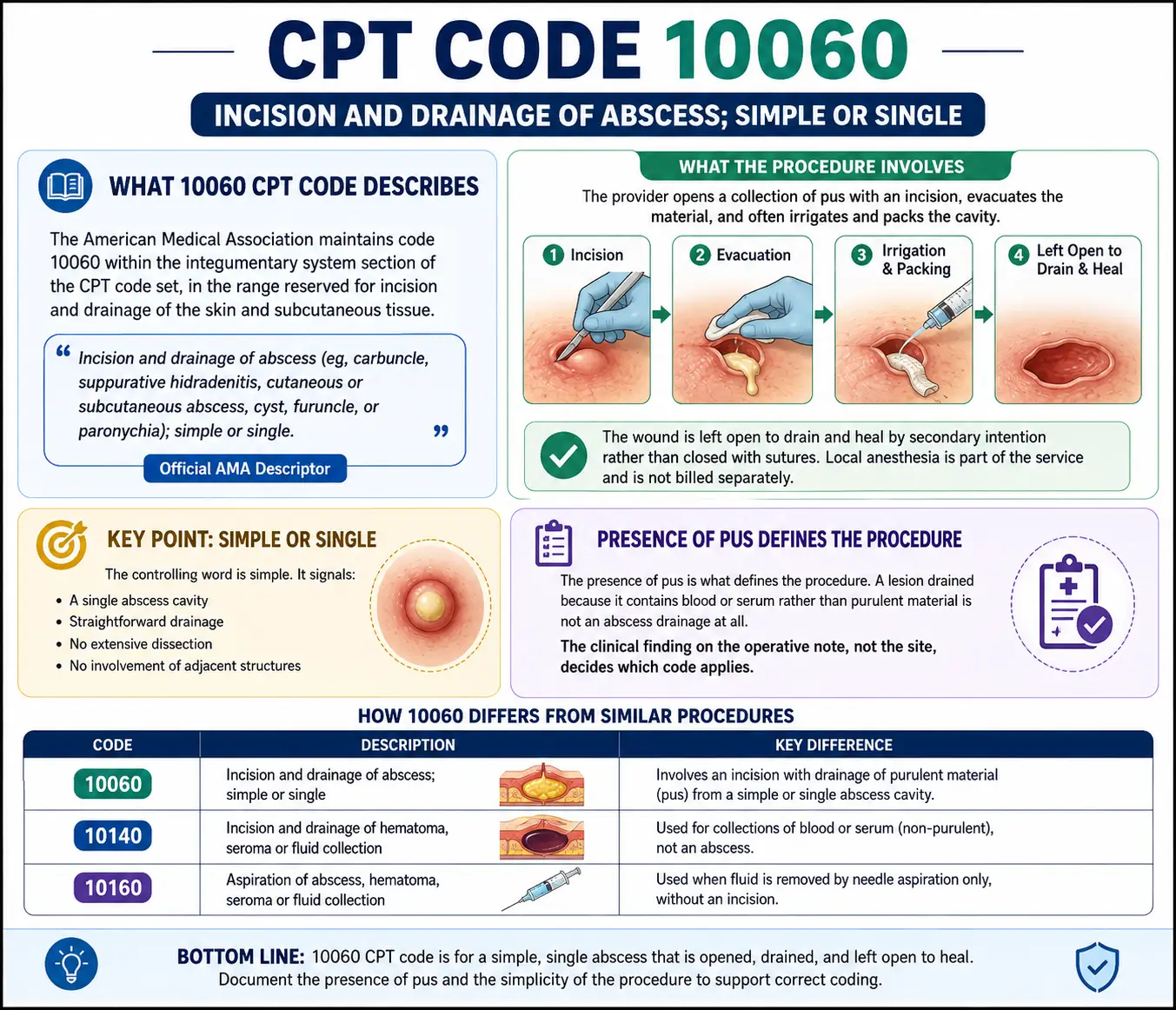
The American Medical Association maintains code 10060 within the integumentary system section of the CPT code set, in the range reserved for incision and drainage of the skin and subcutaneous tissue. The official AMA descriptor reads: Incision and drainage of abscess (eg, carbuncle, suppurative hidradenitis, cutaneous or subcutaneous abscess, cyst, furuncle, or paronychia); simple or single.
In clinical terms, the provider opens a collection of pus with an incision, evacuates the material, and often irrigates and packs the cavity. The wound is left open to drain and heal by secondary intention rather than closed with sutures. Local anesthesia is part of the service and is not billed separately.
The controlling word is simple. It signals a single abscess cavity, straightforward drainage, and no extensive dissection or involvement of adjacent structures. When the note describes anything more involved, the code changes.
One point that surprises new coders: the presence of pus is what defines the procedure. A lesion drained because it contains blood or serum rather than purulent material is not an abscess drainage at all. A hematoma or seroma maps to a different code (10140), and a needle aspiration rather than an incision maps to another (10160). The clinical finding on the operative note, not the site, decides which code applies.
Choosing between 10060 and 10061
The most consequential decision in abscess billing is not whether to code an I&D, but which of the two to report. Code 10061 shares the same descriptor language but ends with complicated or multiple rather than simple or single. That distinction carries roughly double the work value, which is exactly why auditors watch it.
Factor | 10060 | 10061 |
AMA descriptor | Simple or single abscess | Complicated or multiple abscesses |
Clinical picture | One cavity, standard drainage | Multiple cavities, carbuncle, extensive dissection, or interconnected tracts |
Work RVU (2026 MPFS) | 1.19 | 2.39 |
Global period | 10 days | 10 days |
Audit exposure | Low when documented | High if billed for a simple case without supporting detail |
The safe rule is to code from the note, not from the clinical impression. If the record says the abscess was incised and drained without describing multiple sites, a carbuncle, or extensive tissue involvement, 10060 is the correct choice. Reserve 10061 for cases where the documentation explicitly supports the added complexity: several abscesses treated in one session, a carbuncle requiring wider dissection, or suppurative hidradenitis with connected tracts.
Billing 10061 on the strength of a thin note (something as brief as “I&D performed”) is the single most audited upcoding pattern in skin procedure coding. The payment difference is real, but so is the recoupment risk when a post-payment review finds no complexity in the chart.
Modifiers that decide whether a 10060 claim pays
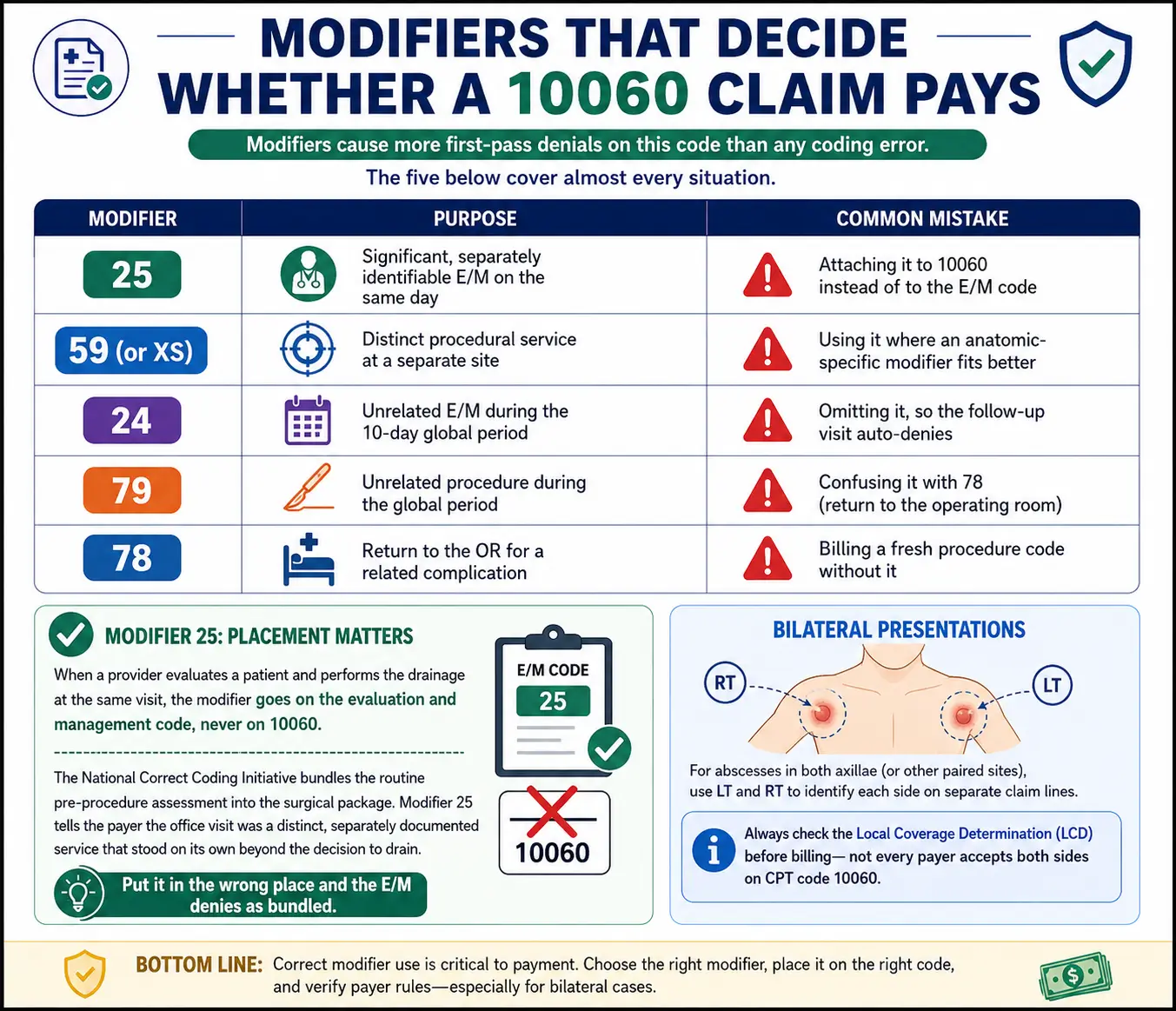
Modifiers cause more first-pass denials on this code than any coding error. The five below cover almost every situation.
Modifier | Purpose | Common mistake |
25 | Significant, separately identifiable E/M on the same day | Attaching it to 10060 instead of to the E/M code |
59 (or XS) | Distinct procedural service at a separate site | Using it where an anatomic-specific modifier fits better |
24 | Unrelated E/M during the 10-day global period | Omitting it, so the follow-up visit auto-denies |
79 | Unrelated procedure during the global period | Confusing it with 78 (return to the operating room) |
78 | Return to the OR for a related complication | Billing a fresh procedure code without it |
Modifier 25 deserves particular attention because the placement error is so common. When a provider evaluates a patient and performs the drainage at the same visit, the modifier goes on the evaluation and management code, never on 10060. The National Correct Coding Initiative bundles the routine pre-procedure assessment into the surgical package. Modifier 25 tells the payer the office visit was a distinct, separately documented service that stood on its own beyond the decision to drain. Put it in the wrong place and the E/M denies as bundled.
For bilateral presentations, such as abscesses in both axillae, LT and RT identify each side on separate claim lines, but the local coverage determination should be checked first, since not every payer accepts both sides on this code.
What Medicare pays for 10060 in 2026
Medicare payment runs through the Resource-Based Relative Value Scale. Each code carries three relative value units (work, practice expense, and malpractice), which are adjusted for local costs and then multiplied by an annual conversion factor.
Here are the national relative value units for 10060 under the CY 2026 Medicare Physician Fee Schedule:
Component | Value (2026 MPFS) |
Work RVU | 1.19 |
Practice expense RVU (non-facility) | 2.53 |
Practice expense RVU (facility) | 1.69 |
Malpractice RVU | 0.13 |
Total RVU (non-facility) | 3.85 |
Total RVU (facility) | 3.01 |
2026 is the first year Medicare uses two conversion factors. As required by the Medicare Access and CHIP Reauthorization Act, clinicians who qualify as advanced alternative payment model participants are paid at $33.5675, while everyone else is paid at $33.4009 (both confirmed in the CMS final rule released October 31, 2025, and summarized by the American College of Cardiology). Both figures rose from the single 2025 factor of $32.3465, helped by a temporary 2.5 percent increase Congress passed in the One Big Beautiful Bill Act.
Applying the non-qualifying factor, a 10060 performed in an office setting returns roughly $129 before geographic adjustment (3.85 total RVUs multiplied by $33.4009). The same procedure in a hospital or ambulatory surgery center returns closer to $100, because the facility bills its own separate fee and the practice expense component drops. The place-of-service code on the claim therefore changes the payment by about a quarter, which is why a POS error, non-facility billed for a facility encounter, triggers overpayment recovery.
One 2026 change worth noting when comparing year over year: CMS applied a 2.5 percent efficiency adjustment that trimmed the work RVUs on most non-time-based procedures, 10060 included. That is why its work value reads 1.19 this year rather than the 1.22 that appeared in prior schedules. The numbers reset every January, so confirm current values through the CMS Physician Fee Schedule lookup tool before setting a practice fee schedule.
Advanced practice providers are paid differently. A nurse practitioner or physician assistant who performs and bills 10060 under their own National Provider Identifier is reimbursed at 85 percent of the physician rate. When the service qualifies as incident-to a supervising physician, it bills under the physician’s identifier at the full amount instead.
The 10-day global period, and where claims fall apart
Code 10060 carries a 10-day global period. Medicare folds all routine pre- and post-procedure care related to the abscess into the single surgical payment for those 10 days. A wound recheck, a repack, and the day-of-procedure evaluation (when the decision to drain was made at that visit) are already paid for. Billing them again produces a duplicate that denies.
What falls outside the package can be billed, with the right modifier:
- An evaluation for an unrelated condition inside the window (Modifier 24 on the E/M)
- A separate, unrelated procedure inside the window (Modifier 79)
- A related complication that requires a return to the operating room (Modifier 78)
The recurring failure point is the unrelated follow-up. A patient returns during the 10 days for a completely different complaint, the office bills a normal E/M, and the system denies it as part of the global package because no one appended Modifier 24. Tracking open global periods against the appointment schedule is the practical fix. A biller who can see that a patient is still inside a 10060 window knows to ask whether the visit is related before the claim goes out.
Documentation Medicare expects to see
Medical necessity is not assumed from the code. CMS spells out its expectations in the Medicare Coverage Database billing and coding article for incision and drainage of skin abscess (Article A56766). The record has to show that surgical drainage was clinically indicated, not just that a procedure occurred.
A defensible 10060 note includes:
- The abscess location, size, and character, and whether it was single or multiple
- The clinical course: onset, duration, any prior treatment such as antibiotics or warm compresses, and exam findings
- The technique: incision, drainage method, irrigation, and packing material if used
- Whether a specimen went to culture or pathology, and if not, why
- Post-procedure findings and patient instructions
- A signature and date of service
That article also flags a specific trap. Billing an I&D for paronychia of the foot when the same condition is treated by avulsion or resection of the toenail is not appropriate, and CMS notes that pus-producing paronychia without an ingrown toenail is uncommon on the foot. Providers billing that combination should expect to produce records on request.
A note that reads only “I&D performed,” with no site, size, or complexity, is the leading reason 10060 claims fail a post-payment audit. The detail that would have supported 10061 is often the same detail missing from the chart entirely.
Billing mistakes that trigger audits
Most 10060 problems fall into a short list. Each maps to a predictable denial code.
- Upcoding to 10061 without documented complexity. The most reviewed error on this code. One abscess, one incision, standard drainage means 10060.
- Modifier 25 in the wrong place. It belongs on the same-day E/M, not on the surgical line. Misplaced, the office visit denies as bundled (denial code CO-97).
- Using 10060 for a pilonidal cyst. Pilonidal cyst drainage has its own codes, 10080 and 10081. Substituting 10060 generates a payer edit.
- Using 10060 for a Bartholin gland abscess. That structure and technique carry a separate code, 56420.
- Unspecified diagnosis when a specific one exists. An unspecified site code such as L02.91 draws denials when a site-specific L02.x code was available. Document the anatomic location and use it.
- Wrong place-of-service code. Billing non-facility for a facility encounter overpays and invites recovery.
If denial reports show CO-4 (procedure inconsistent with modifier) or CO-97 (bundled into global) among the top codes, the problem sits in the documentation template, not the billing keystroke. Fixing the note structure so it captures site, technique, and complexity at the point of care removes most of these errors before a claim is ever built.
The bottom line for accurate 10060 billing
The 10060 CPT code covers simple, single abscess drainage, carries a 10-day global period, and pays roughly $129 in an office setting under the 2026 non-qualifying conversion factor of $33.4009. Its accuracy rests on three things a biller cannot control from the claim form: an operative note that matches the descriptor, a Modifier 25 placed on the E/M rather than the procedure, and a global-period modifier on any billable follow-up. Coders who verify those three against the chart, and confirm the current RVUs through the CMS lookup tool each January, submit clean 10060 claims and keep the code well clear of an audit list.