


Medical coders use the 76942 CPT code to report ultrasonic guidance for needle placement. This code applies when a physician uses ultrasound imaging to guide a needle during procedures such as biopsies, aspirations, and injections. Proper reimbursement requires exact documentation of the imaging process and adherence to payer-specific bundling rules. The American Medical Association sets the primary guidelines, while Medicare Administrative Contractors enforce specific coverage determinations based on regional policies.
Clinical Definition of CPT 76942
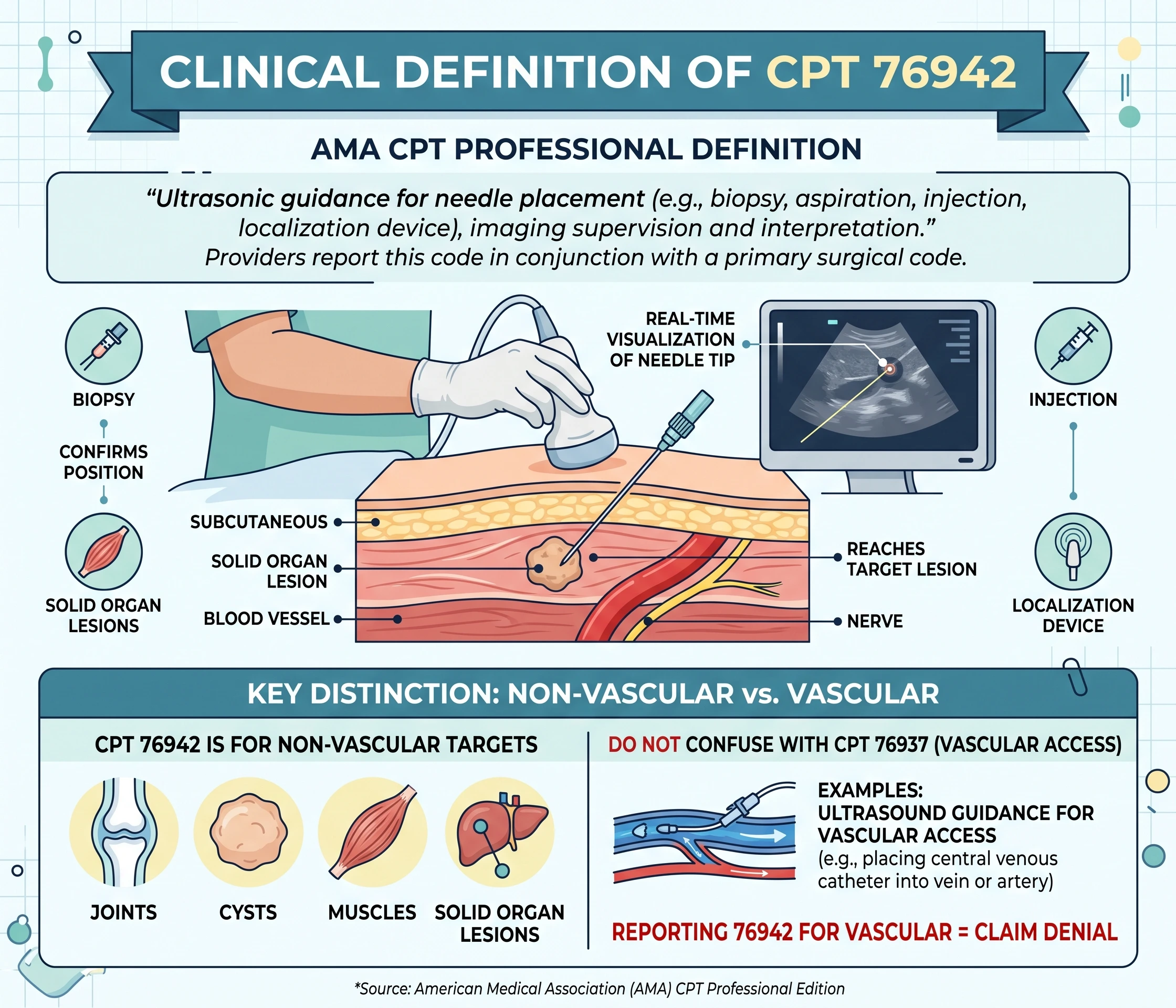
According to the American Medical Association (AMA) CPT Professional Edition, 76942 describes “Ultrasonic guidance for needle placement (e.g., biopsy, aspiration, injection, localization device), imaging supervision and interpretation.” Providers report this code in conjunction with a primary surgical code.
The ultrasound machine provides real-time visualization of the needle tip. The physician watches a monitor as the needle passes through the skin and subcutaneous tissue. This visual confirmation allows the provider to avoid adjacent nerves and blood vessels while reaching the precise target lesion.
Distinction from Vascular Codes
Coders frequently confuse this code with 76937. CPT 76937 applies specifically to ultrasound guidance for vascular access, such as placing a central venous catheter into a vein or artery. CPT 76942 applies to non-vascular targets like joints, cysts, muscles, and solid organ lesions. Reporting 76942 for a vascular procedure will result in a claim denial.
Mandatory Documentation Standards
Billing 76942 requires specific elements in the medical record. Missing components routinely lead to audit failures and recouped payments.
The American College of Radiology dictates that a procedure note must explicitly detail the use of ultrasound guidance. A single sentence stating “ultrasound was used” fails federal documentation standards. The physician must document three distinct phases of the procedure.
First, the note must describe the preliminary ultrasound evaluation of the potential puncture site. Second, the physician must document the real-time visualization of the needle passing through the tissue to the target. Finally, the provider must issue a written report of the imaging interpretation.
Image Retention Requirements
A permanently recorded image is mandatory. The patient’s medical record or the facility’s Picture Archiving and Communication System (PACS) must store this image. During a post-payment review, Medicare Administrative Contractors will request the physical or digital image. If the clinic cannot produce the saved image, the MAC will demand a full refund for the service. Facilities must retain these images according to their state’s medical record retention laws, which typically span seven to ten years.
NCCI Unbundling Rules and Coverage Limitations
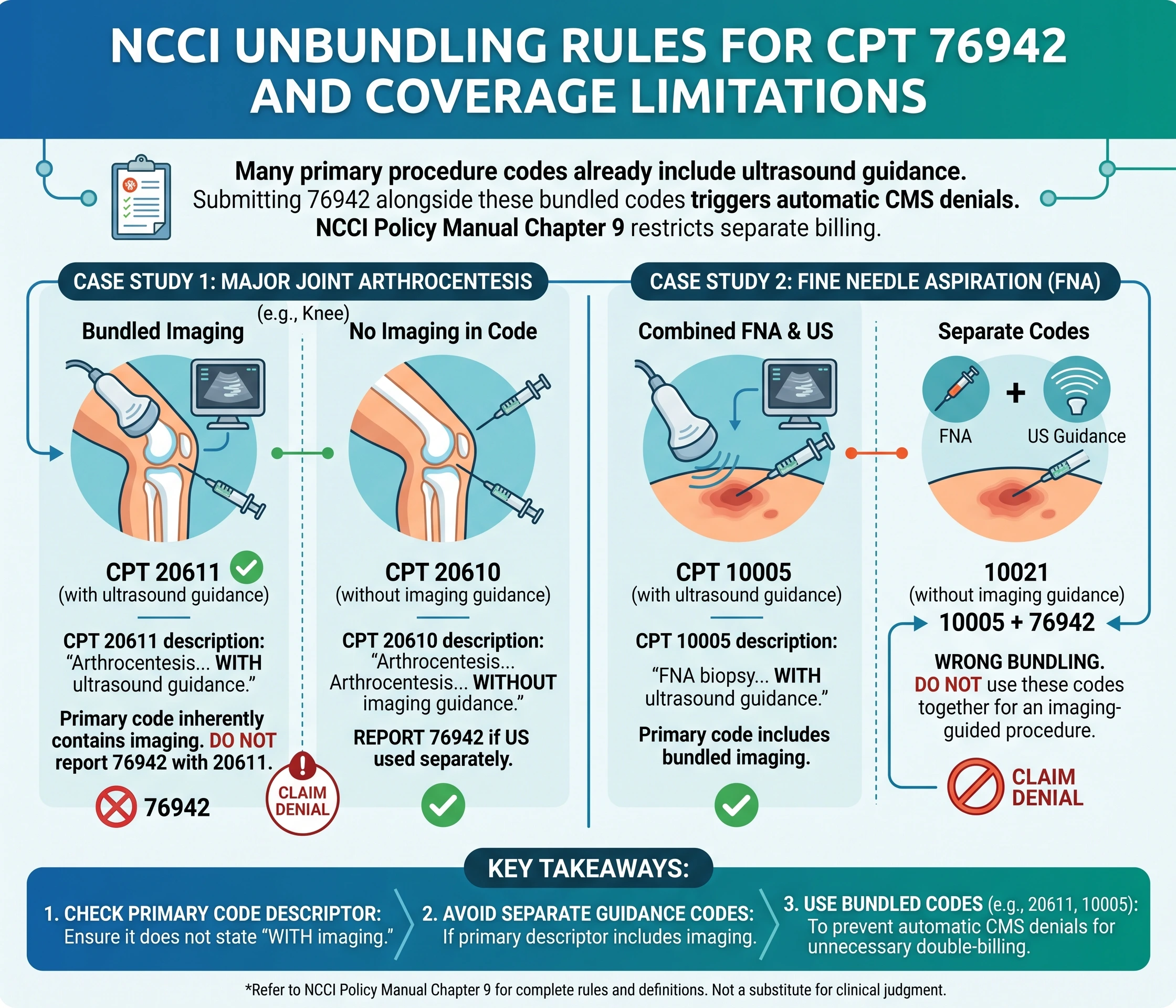
Many primary procedure codes already include ultrasound guidance. Submitting 76942 alongside these bundled codes triggers automatic denials from the Centers for Medicare & Medicaid Services (CMS).
Chapter 9 of the National Correct Coding Initiative (NCCI) Policy Manual details these restrictions. The manual specifically prohibits billing separate guidance codes when the primary procedure descriptor includes imaging.
For example, CPT code 20611 describes arthrocentesis of a major joint or bursa with ultrasound guidance. The primary code inherently contains the imaging component. A coder cannot report 76942 with 20611. Conversely, providers can report 76942 with CPT code 20610. Code 20610 describes the exact same arthrocentesis procedure performed without ultrasound guidance.
Fine Needle Aspiration Bundling
Fine needle aspirations follow a similar logic. In 2019, the AMA deleted the old guidelines for FNA and introduced highly specific codes. CPT 10005 describes an FNA biopsy with ultrasound guidance. CPT 10021 describes an FNA biopsy without imaging guidance. A clinic cannot bill 10021 and 76942 together. They must use the bundled code 10005.
Appropriate Modifiers for 76942
Applying the correct modifier depends on the place of service, the anatomical site, and the provider’s equipment ownership.
Modifier | Application | Example Scenario |
Modifier 26 | Professional component | A physician performs a liver biopsy in a hospital setting using hospital-owned equipment. The physician bills 76942-26. |
Modifier TC | Technical component | An outpatient imaging center bills for the use of the ultrasound machine, the room, and the technical supplies. |
Modifier 50 | Bilateral procedure | A rheumatologist uses ultrasound guidance to inject both the left and right knee joints during a single patient encounter. |
Modifier RT / LT | Right or Left side | The provider performs a unilateral procedure and specifies the side to match the primary surgical code. |
Modifier 59 | Distinct procedural service | The physician performs needle placements on two completely separate anatomical sites that are not typically bundled. |
CMS introduced the X modifiers as subsets of modifier 59. Coders should use XS (Separate Structure) or XU (Unusual Non-Overlapping Service) instead of 59 when Medicare is the primary payer. These modifiers provide higher specificity regarding why the guidance is separate and distinct.
Reporting Multiple Lesions
Medical coders must understand the difference between multiple needle passes and multiple lesions.
According to AMA coding clinics, 76942 is reported per distinct lesion evaluated, regardless of how many times the physician inserts the needle into that specific lesion. If a physician aspirates a single large cyst in the right breast but requires three separate needle passes to drain it completely, the clinic reports 76942 only once.
If the physician aspirates three distinct cysts in different quadrants of the same breast, they may report 76942 multiple times. The coder must append the appropriate anatomical modifiers or modifier 59 to indicate that the guidance applied to entirely separate lesions.
Prior Authorization and Medical Necessity
Commercial insurers maintain strict medical necessity rules for radiological guidance. UnitedHealthcare and Aetna regularly update their imaging policies to require pre-approval for 76942 when performed in a standard office setting.
The authorization request must include the primary surgical code and the corresponding diagnosis code (ICD-10). The clinical notes must explain why unguided needle placement carries a high risk for the specific patient.
Payers accept specific anatomical and clinical challenges as proof of medical necessity. Obesity obscures physical landmarks, making blind injections dangerous. Deep anatomical targets, such as the hip joint or spinal nerve roots, require imaging to avoid major arteries. Superficial injections in healthy patients rarely meet the criteria for authorized ultrasound guidance.
Local Coverage Determinations
Local Coverage Determinations dictate specific diagnosis codes that Medicare accepts. A commercial payer might cover ultrasound guidance for a difficult thyroid biopsy but deny it for a routine trigger point injection if the patient lacks documented prior failed attempts. Medical billers must query their specific MAC jurisdiction’s database to verify which ICD-10 codes currently support medical necessity for 76942 in their state.
Application in Specific Medical Specialties
Different medical specialties utilize 76942 for distinct clinical targets.
Endocrinologists use this code during fine needle aspirations of thyroid nodules. The ultrasound measures the nodule dimensions. It ensures the needle extracts cells from the solid component of the nodule rather than a fluid-filled cystic area.
Pain management specialists rely on 76942 for peripheral nerve blocks. Real-time imaging confirms the physical spread of the local anesthetic around the nerve sheath. This visual confirmation prevents accidental intravascular injection of the medication.
Rheumatologists apply it for diagnostic joint aspirations. The ultrasound identifies small fluid effusions in complex joints like the hip or shoulder. Drawing this fluid allows the laboratory to test for gout crystals or bacterial infections.
Impact of the Medicare Physician Fee Schedule
CMS publishes the Medicare Physician Fee Schedule annually. This schedule sets the Relative Value Units (RVUs) for 76942. The actual dollar payment varies based on whether the service occurs in a facility or a non-facility setting.
In a private office setting, the non-facility rate applies. This rate includes reimbursement for both the physician’s clinical work and the practice expense. The practice expense covers the depreciation of the ultrasound machine, the ultrasound gel, and the medical assistant’s time.
In a hospital or ambulatory surgical center, the facility rate applies. The physician only bills for the professional component using Modifier 26. This carries a lower RVU because the physician does not bear the overhead cost of the equipment. The facility bills the technical component (Modifier TC) to recover the cost of the machine and the room.
Audits and Common Billing Errors
The federal government frequently targets radiology add-on codes for compliance reviews. Reports from the Office of Inspector General indicate that unbundled imaging services account for millions in improper Medicare payments annually.
The most common error identified by auditors is billing 76942 without an accompanying recorded image. Clinics sometimes delete old ultrasound images from their local hard drives to save digital storage space. When a MAC requests a claim record from three years prior, the clinic fails the audit due to the missing file.
Mismatched Diagnosis Codes
Another common error involves mismatched diagnosis codes. The ICD-10 code attached to the 76942 claim must match the ICD-10 code attached to the primary procedure. If the primary joint injection points to osteoarthritis of the right knee, the ultrasound guidance must point to the exact same diagnosis. Entering a generic code for “ultrasound” on the guidance line while listing a specific anatomical condition on the surgical line triggers an automated denial from the clearinghouse.
Successful claims for the 76942 CPT code rely entirely on accurate procedure notes and retained digital images. Coders must cross-reference the primary surgical code against the NCCI edits to prevent unbundling. Applying the correct modifiers based on the place of service ensures that both the physician and the facility receive accurate compensation. Adhering to these strict documentation standards protects medical practices during routine CMS audits and commercial payer reviews.