


Nuclear cardiology produces some of the highest-dollar claims a cardiology practice submits, and the 78452 CPT code sits near the center of that revenue. It is also one of the codes payers examine most closely. A missing report, a screening diagnosis, or the wrong pairing with a stress-test code can turn a four-hundred-dollar study into a denial. This article explains what the code means, when to report it, how to document it, which modifiers apply, and what Medicare pays for it in 2026.
What the 78452 CPT code description covers
CPT 78452 reports myocardial perfusion imaging performed with tomographic single photon emission computed tomography (SPECT) as multiple studies. The American Medical Association descriptor also folds in attenuation correction, wall motion, and ejection fraction (measured by first pass or gated technique) when those are performed. It covers imaging at rest and/or stress, whether the stress is achieved by exercise or by a pharmacologic agent, and it accounts for redistribution or rest reinjection when the protocol calls for them.
The word doing the heavy lifting is “multiple.” Two or more acquisitions have to be performed to report this code. The patient is usually imaged once at rest and again after stress, using two separate radiopharmaceutical doses, one for each acquisition. The two image sets are then compared to locate areas of reduced blood flow.
Bracco Reimbursement, a coding resource run by the imaging company Bracco, points out that rest plus stress is the most frequent pairing, but rest plus redistribution is acceptable when medical necessity supports it. The single-study version of this exam, imaged at rest only or stress only, uses a different code (78451).
Is 78452 a nuclear stress test, a radiology code, or a PET scan?
It is the imaging half of a nuclear stress test. The exam shows how blood perfuses the heart muscle and reveals ischemia, infarction, and viability, which is why cardiologists order it to evaluate coronary artery disease, assess damage after a heart attack, and check whether a bypass graft or stent is still doing its job.
Two clarifications save a lot of denials here. First, 78452 is a nuclear medicine code, not a diagnostic radiology (CT or MRI) code, even though a low-dose CT scan is often acquired for attenuation correction. Second, it is not a PET scan. PET myocardial perfusion imaging is reported with 78491 for a single study and 78492 for multiple studies. Assigning a SPECT code to a PET study, or the reverse, is a recurring error.
78451, 78452, 78453, and 78454 compared
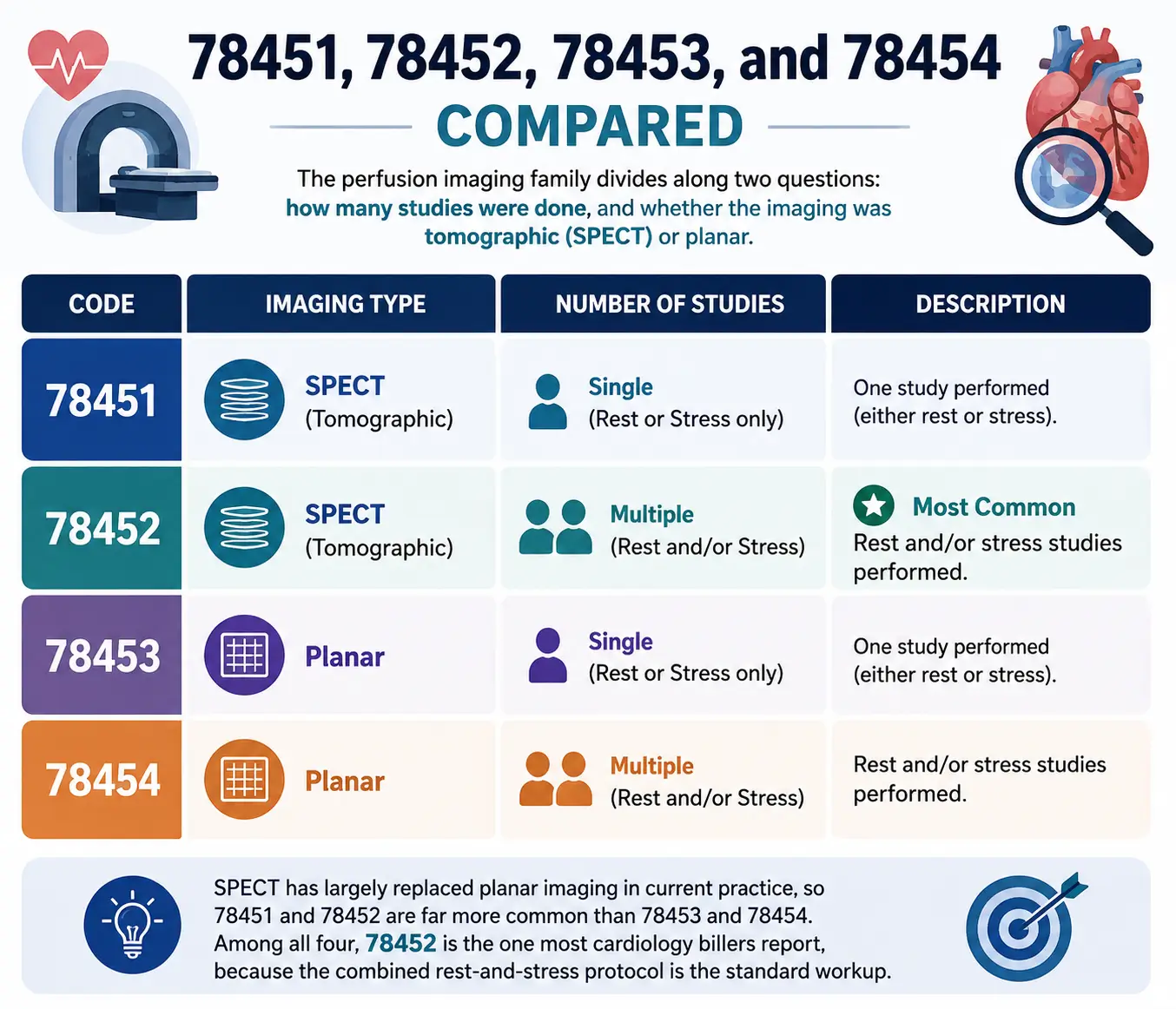
The perfusion imaging family divides along two questions: how many studies were done, and whether the imaging was tomographic (SPECT) or planar.
Code | Imaging type | Number of studies |
78451 | SPECT (tomographic) | Single (rest or stress only) |
78452 | SPECT (tomographic) | Multiple (rest and/or stress) |
78453 | Planar | Single (rest or stress only) |
78454 | Planar | Multiple (rest and/or stress) |
SPECT has largely replaced planar imaging in current practice, so 78451 and 78452 are far more common than 78453 and 78454. Among all four, 78452 is the one most cardiology billers report, because the combined rest-and-stress protocol is the standard workup.
When to report 78452
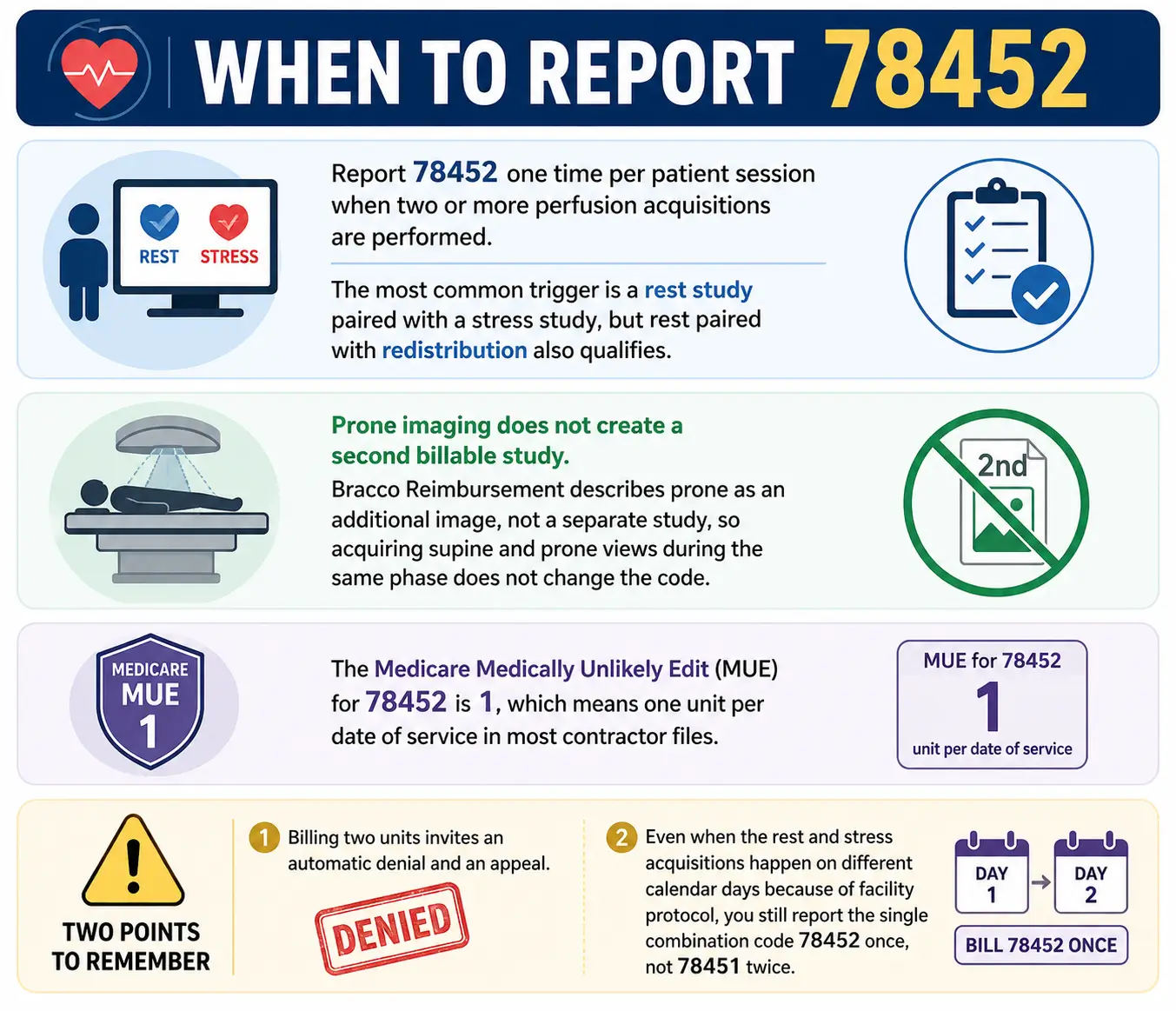
Report 78452 one time per patient session when two or more perfusion acquisitions are performed. The most common trigger is a rest study paired with a stress study, but rest paired with redistribution also qualifies.
Prone imaging does not create a second billable study. Bracco Reimbursement describes prone as an additional image, not a separate study, so acquiring supine and prone views during the same phase does not change the code.
The Medicare Medically Unlikely Edit (MUE) for 78452 is 1, which means one unit per date of service in most contractor files. Two points follow from that. Billing two units invites an automatic denial and an appeal. And even when the rest and stress acquisitions happen on different calendar days because of facility protocol, you still report the single combination code 78452 once, not 78451 twice.
The stress test itself is billed separately
CPT 78452 pays for imaging. It does not pay for the stress event. The exercise treadmill or pharmacologic challenge, along with its supervision and monitoring, is reported from the 93015 to 93018 family:
- 93015 is the global cardiovascular stress test code, used when one entity supervises the test, runs the tracing, and interprets it, and owns the equipment.
- 93016 covers physician supervision only.
- 93017 covers the technical component (the tracing) only.
- 93018 covers interpretation and report only.
Two setups appear over and over. When a practice owns its equipment and performs the study in the office, billers typically report 78452 as a global charge with 93015. When the study is done at a hospital and the cardiologist only reads it, the professional pieces are reported instead, so the claim reads 78452 with modifier 26, plus 93016 and 93018. This pattern is confirmed repeatedly in AAPC coding forum discussions among practicing coders.
A rule worth memorizing: 93015 cannot be billed on the same date for the same test as 93016, 93017, or 93018. The global code already contains those parts, so pairing them is duplicate billing.
Three more pairings deserve attention:
- Attenuation correction is already inside 78452. Bracco Reimbursement advises against reporting 78830 (SPECT) alongside 78452 when a low-dose CT is used only for attenuation correction, because 78452 already includes SPECT, and adding 78830 codes SPECT twice.
- Radiopharmaceuticals and stress drugs are separate line items. The technetium tracer is billed under an A-series supply code such as A9500 (Tc-99m sestamibi), and a pharmacologic agent like regadenoson (Lexiscan) is billed under its own J-code (J2785). These are not part of 78452.
- A separate E/M on the same day needs modifier 25. If the physician performs a distinct, separately identifiable evaluation on the same date, append modifier 25 to the E/M code, or expect it to bundle.
Documentation requirements for 78452
Payers approve or deny 78452 on the strength of the record, not the claim form. A defensible chart for this code contains:
- A physician or qualified non-physician order that states the clinical indication.
- The type of stress performed (exercise or pharmacologic) and, when pharmacologic, the agent used, such as regadenoson, adenosine, dipyridamole, or dobutamine.
- The radiopharmaceutical name, dose, and route of administration for each injection.
- Evidence that both acquisitions (rest and stress, or rest and redistribution) were actually performed, since “multiple studies” is the defining feature of the code.
- A signed, written interpretation and report. This is what supports the professional component. CMS guidance in the Medicare Claims Processing Manual (Chapter 13) is explicit that a one-line review note is not the same as a written report, and that gap is a leading cause of modifier 26 denials.
When a practice bills for the purchased radiopharmaceutical, CMS local coverage articles such as A56743 direct providers to keep the supplier invoice on file, showing dose administered, unit price, drug name, and total charge, available on request.
Medical necessity and LCD coverage
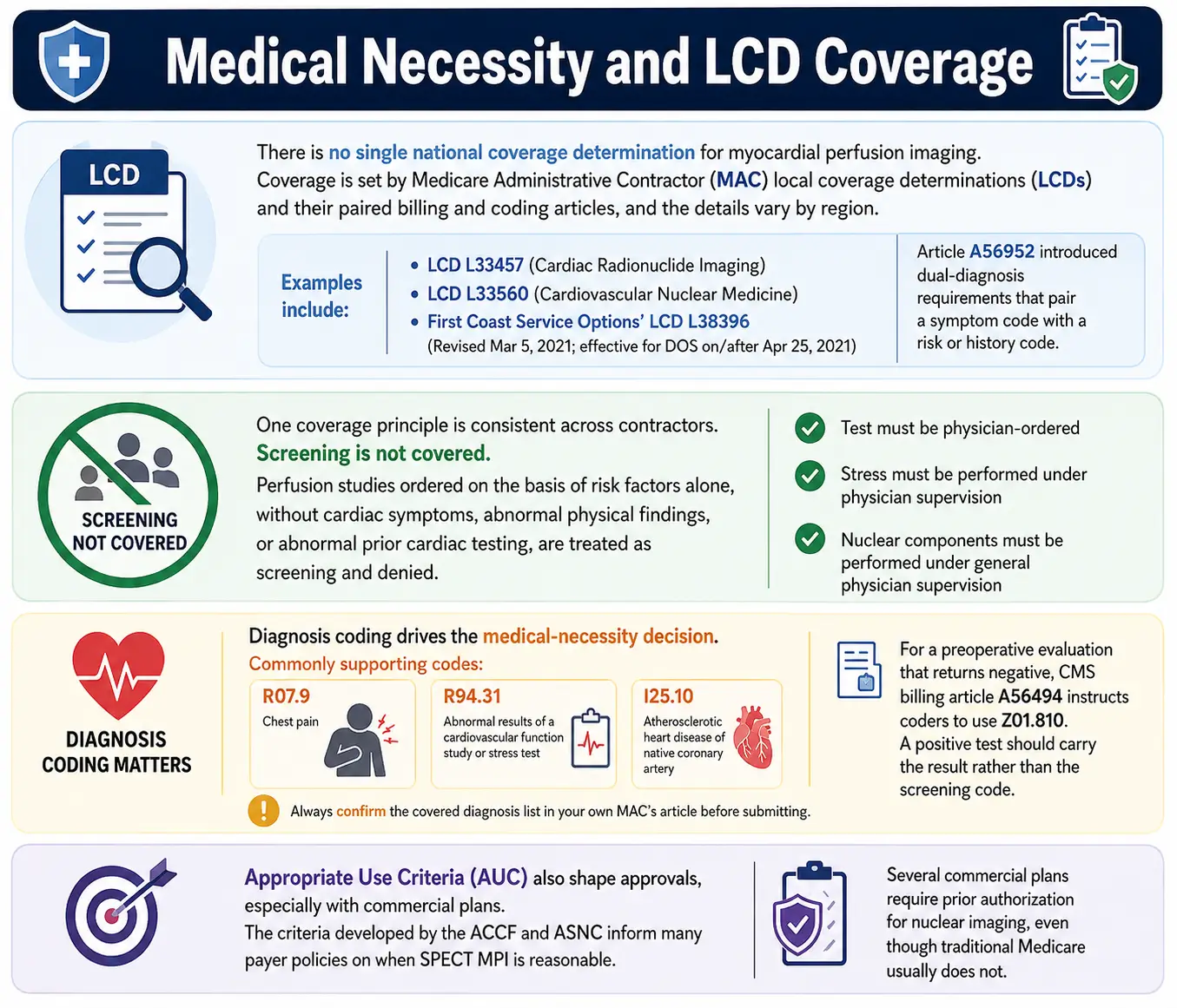
There is no single national coverage determination for myocardial perfusion imaging. Coverage is set by Medicare Administrative Contractor (MAC) local coverage determinations (LCDs) and their paired billing and coding articles, and the details vary by region. Examples include LCD L33457 (Cardiac Radionuclide Imaging), LCD L33560 (Cardiovascular Nuclear Medicine), and First Coast Service Options’ LCD L38396 (Cardiology Non-emergent Outpatient Stress Testing), which First Coast revised on March 5, 2021, effective for dates of service on and after April 25, 2021. Its companion article, A56952, introduced dual-diagnosis requirements that pair a symptom code with a risk or history code on covered claims.
One coverage principle is consistent across contractors. Screening is not covered. The Cardiovascular Nuclear Medicine LCD (L33560) states that perfusion studies ordered on the basis of risk factors alone, without cardiac symptoms, abnormal physical findings, or abnormal prior cardiac testing, are treated as screening and denied. The same policy requires that the test be physician-ordered, that stress be performed under physician supervision, and that the nuclear components be performed under general physician supervision.
Diagnosis coding drives the medical-necessity decision. Codes that commonly support the study include chest pain (for example R07.9), abnormal results of a cardiovascular function study or stress test (R94.31), and atherosclerotic heart disease of native coronary artery (I25.10). For a preoperative evaluation that returns negative, the CMS billing article A56494 instructs coders to use Z01.810, while a positive test should carry the result rather than the screening code. Always confirm the covered diagnosis list in your own MAC’s article before submitting.
Appropriate Use Criteria also shape approvals, especially with commercial plans. The criteria developed by the American College of Cardiology Foundation and the American Society of Nuclear Cardiology (ASNC) inform many payer policies on when SPECT MPI is reasonable, and several commercial plans require prior authorization for nuclear imaging even though traditional Medicare usually does not.
Modifier use for 78452
CPT 78452 carries a Medicare PC/TC indicator of 1, which means it splits into a professional component and a technical component. That single fact governs most modifier decisions.
Modifier | Meaning | Typical use with 78452 |
26 | Professional component | Physician interprets and writes the report but does not own the equipment (common in hospital reads) |
TC | Technical component | Facility supplies the camera, isotope, and staff, with no interpretation |
(none) | Global service | One entity owns the equipment and interprets, the usual office setting |
52 | Reduced services | The planned multiple-study protocol was cut short, for example only the rest phase was completed |
53 | Discontinued procedure | The study was started and then stopped, such as an adverse reaction to a stress agent |
76 / 77 | Repeat procedure | The same (76) or a different (77) physician repeats the study; uncommon and requires documentation |
Modifier 26 deserves special care, because the work value of the professional component is identical to the physician-work portion of the global service, so the report has to stand on its own as a signed interpretation. When distinct services on the same date genuinely need to be unbundled, a distinct-service modifier such as 59 or XU may apply, but only when the documentation clearly supports separate, non-overlapping work. Contractors cross-check these, so use them sparingly and accurately.
78452 work RVU and 2026 cost
CMS released the CY 2026 Medicare Physician Fee Schedule final rule on October 31, 2025. The 2026 national conversion factor is $33.4009 for clinicians who are not qualifying Advanced Payment Model participants. The physician-work value of 78452 is modest, roughly 1.8 work RVUs in recent fee-schedule data, which reflects the interpretation effort rather than the equipment.
The money in this code lives in the technical side. Because the practice-expense component has to absorb the cost of the gamma camera, the radioactive isotope, and specialized staff, it dominates the total value, running above ten practice-expense RVUs in the office setting. That is why the global payment is high relative to the physician work.
According to CareRoute, which publishes cost data sourced from the CMS Physician Fee Schedule and updated in May 2026, 78452 pays about $427.87 in the non-facility (office) setting nationally in 2026, before geographic adjustment. The same source reports that the study is performed close to 700,000 times a year on Medicare beneficiaries, and that the 2023 national average provider charge was $1,203.08, roughly 2.8 times the Medicare allowable. Because the practice-expense component is so large, geographic variation is wide, so the locality-adjusted payment in a low-cost state can run well below the national figure while a high-cost state runs above it.
For context, a nuclear stress test of this type costs several times more than a plain treadmill stress test (93015), which is one reason appropriate-use screening and prior authorization focus on it.
Where 78452 claims fail
Most denials on this code trace back to a short list of causes. Screening indications with no symptoms get denied under LCD policy. A professional-component claim without a signed written report fails on modifier 26. Reporting more than one unit runs into the MUE of 1. Pairing the global stress code 93015 with its own component codes triggers duplicate-billing edits. And adding 78830 to 78452 double-counts SPECT.
Read the descriptor literally, document both acquisitions and the interpretation, match the diagnosis to your MAC’s covered list, and keep the stress-test and radiopharmaceutical codes on their own lines. That is what separates a clean 78452 claim from an appeal.