


Medicare Part B paid $406.7 million for the Comprehensive Metabolic Panel in 2024, making it the second-largest lab expenditure of the year behind a genetic test for infectious agents. That figure comes from the data snapshot the HHS Office of Inspector General released on January 28, 2026, which also found that panel utilization did not change between 2023 and 2024. Meanwhile, Medicare pays $10.56 for a single panel.
Those two numbers define the work. Nobody gets rich on one panel, and nobody notices a small coding habit until it has repeated forty thousand times. Handling the 80053 CPT code well is a volume discipline, not a high-dollar one.
What follows covers the panel definition, the payment rules, the modifiers that genuinely apply, and the places where audits tend to land.
What the 80053 CPT code covers
CPT 80053 describes the Comprehensive Metabolic Panel (CMP), a fixed set of 14 chemistry analytes reported under one code. The AMA built organ and disease-oriented panels as coding constructs, not clinical protocols, and the code applies only when the laboratory performs and reports every listed component. Run 12 of the 14, and 80053 is the wrong code.
Analyte | Component CPT code |
Albumin | 82040 |
Alkaline phosphatase | 84075 |
ALT (SGPT) | 84460 |
AST (SGOT) | 84450 |
Bilirubin, total | 82247 |
Calcium, total | 82310 |
Carbon dioxide (bicarbonate) | 82374 |
Chloride | 82435 |
Creatinine | 82565 |
Glucose | 82947 |
Potassium | 84132 |
Protein, total | 84155 |
Sodium | 84295 |
Urea nitrogen (BUN) | 84520 |
CMS published this exact list in MLN Matters article MM11248 (released May 3, 2019, implemented October 7, 2019), with the instruction that when all 14 are performed on the same date of service, the panel code is reported and the components are not.
Two codes generate recurring errors. The creatinine inside the panel is blood creatinine, 82565. Code 82570 is creatinine from another source, usually urine, and it sits outside the panel entirely. Similarly, total bilirubin (82247) belongs to the CMP, while direct bilirubin (82248) does not.
How 80053 compares with the neighboring panel codes
Code | Panel | Components | CY 2026 national limit |
80047 | Basic metabolic panel, ionized calcium | 8 | $13.73 |
80048 | Basic metabolic panel, total calcium | 8 | $8.46 |
80051 | Electrolyte panel | 4 | $7.01 |
80053 | Comprehensive Metabolic Panel | 14 | $10.56 |
80069 | Renal function panel | 10 | $8.68 |
80076 | Hepatic function panel | 7 | $8.17 |
Notice that payment does not track the number of analytes. Code 80047 covers eight tests and pays $13.73. Code 80053 covers 14 and pays $10.56. That inversion is a residue of PAMA repricing, which pushed each code toward its own private payer benchmark rather than toward any relative valuation. Billing staff who assume a bigger panel always pays more will misread their own remittance data.
CPT guidance prohibits reporting two panel codes that share any constituent test from a single patient collection. When the ordered tests span more than one panel, the rule is to report the panel that absorbs the greatest number of them and bill the remainder as individual codes.
Here is how that plays out. A physician orders a basic metabolic panel and a hepatic function panel on one specimen. Together those 15 tests contain all 14 CMP components plus direct bilirubin. The correct claim is 80053 with 82248 reported separately, not 80048 with 80076.
What Medicare pays for the 80053 CPT code in 2026
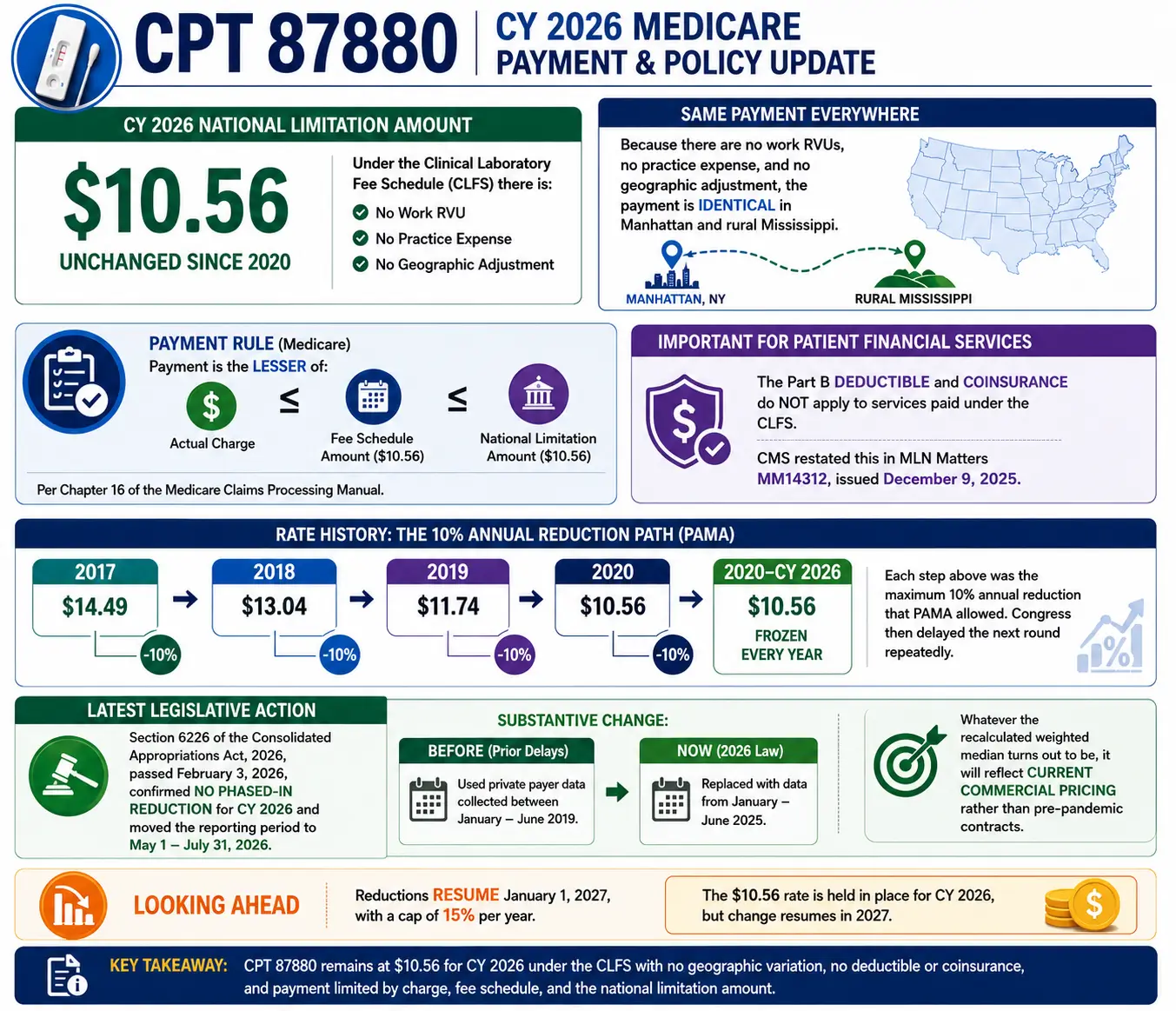
The CY 2026 national limitation amount is $10.56, unchanged since 2020. Under the Clinical Laboratory Fee Schedule there is no work RVU, no practice expense component, and no geographic adjustment, so the number is identical in Manhattan and rural Mississippi. Payment is the lesser of the actual charge, the fee schedule amount, or the national limitation amount, per Chapter 16 of the Medicare Claims Processing Manual.
One detail worth passing to patient financial services: the Part B deductible and coinsurance do not apply to services paid under the CLFS. CMS restated this in MLN Matters MM14312, issued December 9, 2025.
The rate history explains why the code sits where it does:
- 2017: $14.49
- 2018: $13.04
- 2019: $11.74
- 2020: $10.56, and frozen every year since
Each of those steps was the maximum 10 percent annual reduction PAMA allowed. Congress then delayed the next round repeatedly. The most recent action was section 6226 of the Consolidated Appropriations Act, 2026, passed February 3, 2026, which confirmed no phased-in reduction for CY 2026 and moved the reporting period to May 1 through July 31, 2026.
The substantive change in that legislation is easy to miss. Earlier delays kept recycling private payer data collected between January and June 2019. The 2026 law replaced it with data from January through June 2025. Whatever the recalculated weighted median turns out to be, it will reflect current commercial pricing rather than pre-pandemic contracts. Reductions resume January 1, 2027, capped at 15 percent per year.
Modifiers that apply to 80053
Most CMP claims need no modifier at all. Adding one reflexively invites scrutiny. These are the ones that carry real meaning:
QW identifies a test performed under a CLIA certificate of waiver. Contrary to a common assumption, a waived CMP does exist. CMS added 80053QW for the Abaxis Piccolo Blood Chemistry Analyzer running the Comprehensive Metabolic Panel reagent disc, effective October 20, 2021, per MLN Matters MM12581. The waived and non-waived versions pay the same $10.56, so QW is a certification statement, not a payment lever. Use it only if the panel actually ran on a waived system.
91 reports a medically necessary repeat of a clinical diagnostic laboratory test on the same day, such as a potassium recheck after treatment. NCCI is explicit that repeats performed to confirm an initial result because of a specimen or equipment problem are not separately reportable.
59, or the more specific XE, XP, XS, and XU bypass NCCI procedure-to-procedure edits when a component test is legitimately repeated alongside the panel. CPT instructs against modifier 59 when a more descriptive modifier exists, which usually points back to 91 for laboratory work.
90 identifies a reference (outside) laboratory when the billing entity did not perform the test.
AY applies to ESRD beneficiaries. Renal dialysis services are bundled into the ESRD Prospective Payment System, so a laboratory billing a CMP for an ESRD patient must append AY to signal the test was not furnished for the treatment of ESRD. Without it, consolidated billing edits reject the claim.
GA, GX, GY, and GZ handle patient liability. A screening CMP with no diagnostic indication is statutorily excluded, which calls for GY, or GX when a voluntary notice was issued. GA signals a properly executed Advance Beneficiary Notice for a service expected to be denied as not reasonable and necessary. GZ, which flags an expected denial with no notice on file, is an admission of a process failure.
Medical necessity, orders, and documentation
Coverage for a CMP rests on two statutory pillars. Section 1862(a)(1)(A) of the Social Security Act limits payment to services reasonable and necessary for diagnosis or treatment. Section 1862(a)(7) excludes routine physical checkups outright, which is why an annual wellness panel ordered without a clinical indication is not a coverage question but a benefit-category exclusion.
Under 42 CFR 410.32(a), the test must be ordered by the treating physician or qualified nonphysician practitioner who is managing a specific medical problem and who uses the result in that management. Tests ordered outside that relationship are, by regulation, not reasonable and necessary.
There is no national coverage determination for the CMP. The 23 negotiated laboratory NCDs that took effect November 25, 2002, following the rulemaking committee convened under section 4554(b)(1) of the Balanced Budget Act of 1997, cover tests such as thyroid testing, lipid panels, and hepatitis panels. The metabolic panel is not among them. Coverage therefore turns on the ordering documentation, the submitted ICD-10 code, and any applicable local coverage article. Diagnoses that routinely support the panel include chronic kidney disease, diabetes with monitoring, hepatic disease, diuretic or ACE inhibitor therapy, and documented symptoms such as fatigue or nausea, provided the chart note reflects the same reasoning as the claim.
Unbundling, NCCI edits, and the MUE
Before PAMA, Medicare used Automated Test Panel logic that rolled component charges up to the panel rate automatically. That logic is gone. CMS replaced it with hard editing, and MM11248 spells out the consequence: claims that report the components instead of the panel are returned to the provider on institutional claims or rejected as unprocessable on professional claims, carrying CARC 236, RARC N657, and group code CO.
Two more edits govern the code. NCCI pairs 80053 as a column one code against every component test, so a same-day component billed without justification denies. And the Medically Unlikely Edit caps 80053 at one unit per patient per date of service, which means a second panel on the same day requires modifier 91 and documentation of why a second reportable result was clinically needed.
Date of service and the 14-day rule
Under 42 CFR 414.510, the date of service for a clinical laboratory test is the date the specimen was collected, with narrow exceptions for stored specimens, molecular pathology, and certain advanced diagnostic laboratory tests. When the collection date controls and the specimen came from a hospital outpatient encounter, the test belongs to the hospital claim, and the performing laboratory looks to the hospital for payment rather than billing Medicare directly.
The Department of Justice has treated manipulation of this rule as a False Claims Act matter. In a qui tam settlement reported by Hall Render on January 29, 2025, a laboratory and health system paid $388,667 to resolve allegations that, between March 2012 and November 2023, they held physician orders until 14 days after discharge so that the laboratory could bill Medicare directly instead of billing the hospital. The dollar figure is modest. The precedent is not.
A pre-submission check for 80053 claims
Five questions catch most of what goes wrong:
- Did the laboratory perform and report all 14 components?
- Is any component also billed separately without modifier 91 and a documented reason?
- Does the claim carry the CLIA certification number, and does QW match the actual test system?
- Does the submitted ICD-10 code appear in the ordering provider’s note, not just in the billing system?
- Is the date of service based on the specimen collection date, and does the patient’s hospital or ESRD status determine who submits the bill?
Firms like A2Z Billings build these into front-end scrubbing rather than post-denial appeals, for arithmetic reasons. At $10.56 per panel, a single rework cycle usually costs more than the claim collects.
One deadline is worth putting on the calendar right now. The PAMA reporting window closes July 31, 2026. Laboratories that meet the applicable laboratory definition, meaning more than half of their Medicare revenue comes from the CLFS and Physician Fee Schedule and they received at least $12,500 in CLFS revenue during the collection period, must report their January through June 2025 private payer rates. The rates those submissions produce begin taking effect January 1, 2027, and after eight years of a frozen $10.56, the next number will be built from data that laboratories are entering this month.