


Every vaccine visit generates two charges, not one. There is a charge for the vaccine product and a separate charge for the work of putting it into the patient. The 90471 CPT code covers that second part for the first injectable vaccine given at a visit. Bill only the product and the claim gets rejected. Bill only the administration and you leave money on the table. Getting this code right is one of the most repeated tasks in pediatrics, family medicine, and pharmacy-based clinics, and it is also one of the most common sources of preventable denials.
This guide explains what CPT 90471 actually pays for, how it differs from its neighbors, when Medicare refuses it, and what current fee schedules show.
What CPT 90471 covers
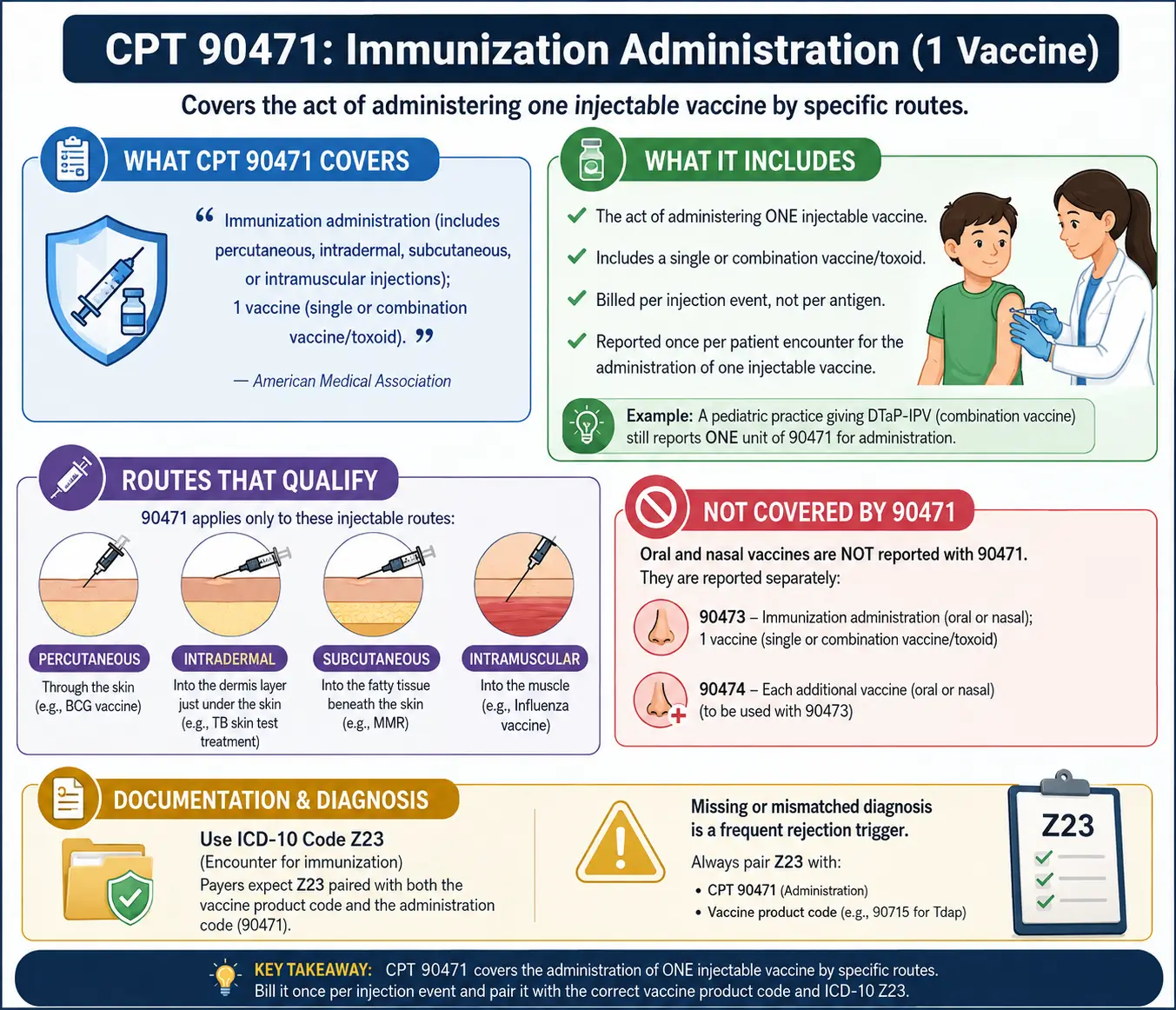
The American Medical Association defines the code as: Immunization administration (includes percutaneous, intradermal, subcutaneous, or intramuscular injections); 1 vaccine (single or combination vaccine/toxoid).
Read that carefully. It describes the act of administering one injectable vaccine and nothing else. The vaccine product itself is billed on a separate line using its own product code (for example, 90715 for Tdap or a vaccine-specific CPT code for influenza). A pediatric practice giving a combination vaccine such as DTaP-IPV still reports a single unit of 90471 for the administration, because the code counts one injection event, not the number of antigens inside the vial.
The four routes named in the descriptor are the only ones that qualify: percutaneous, intradermal, subcutaneous, and intramuscular. A subcutaneous MMR and an intramuscular flu shot both map to 90471 for the administration component. Oral and nasal vaccines fall outside this code. Those route to 90473 for the first vaccine and 90474 for each additional one.
One documentation detail supports almost every immunization claim. The diagnosis is reported with ICD-10 code Z23 (encounter for immunization). Payers expect Z23 paired with the administration and product codes, and a missing or mismatched diagnosis is a frequent rejection trigger.
When to use 90471 versus 90460, 90461, and 90472
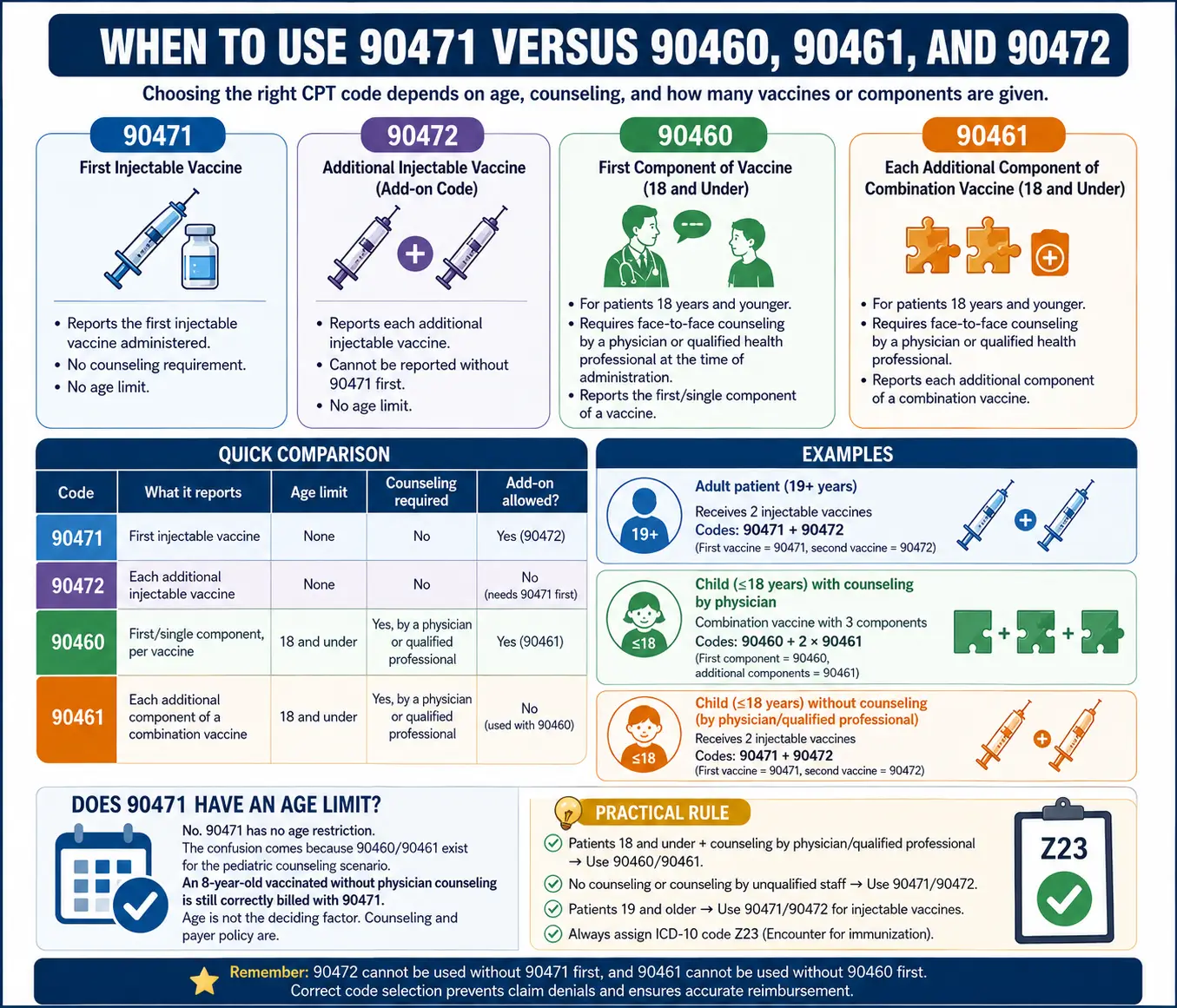
CPT 90471 rarely travels alone in coding decisions. Three sibling codes determine which one you should actually report.
90472 is the add-on. It reports each additional injectable vaccine administered at the same encounter. It cannot stand on its own. A patient who receives three injectable vaccines in one visit generates one 90471 and two units of 90472. Reporting 90472 without 90471 first is a sequencing error that payers catch.
90460 and 90461 replace the 90471 family entirely under specific conditions. They apply to patients 18 years of age and younger when a physician or other qualified health professional provides face-to-face counseling about the vaccine at the time of administration. Code 90460 covers the first component of a vaccine, and add-on 90461 covers each additional component of a combination vaccine. The distinction that trips up new coders: 90460 counts components (antigens), while 90471 counts injections.
Here is how the four codes separate:
Code | What it reports | Age limit | Counseling required |
90471 | First injectable vaccine | None | No |
90472 | Each additional injectable vaccine | None | No |
90460 | First/single component, per vaccine | 18 and under | Yes, by a physician or qualified professional |
90461 | Each additional component of a combination vaccine | 18 and under | Yes |
The practical rule for a child under 19: if the clinician counsels the family, use 90460/90461. If no counseling occurs, or the counseling is done by staff who do not meet the payer’s definition of a qualified professional, use 90471/90472. For every patient 19 and older, the 90471 family is the default for injectable vaccines.
Does 90471 have an age limit?
The code itself carries no age restriction. Confusion arises because 90460 exists specifically for the pediatric counseling scenario, which pulls many under-18 vaccinations away from 90471 in day-to-day practice. An 8-year-old vaccinated without physician counseling is still correctly billed with 90471. Age is not the deciding factor. Counseling and payer policy are.
Does 90471 need a modifier?
In most cases, no. Multiple vaccines at one visit are handled through code sequencing (90471 plus 90472), not through modifier 51 for multiple procedures. Modifier 50 for bilateral procedures does not apply, since a vaccine is not a bilateral service. If you see modifier 50 or 51 attached to 90471, treat it as a probable error.
The modifier that does matter sits on a different code. When a provider performs a significant, separately identifiable evaluation and management service on the same day as the vaccination, modifier 25 goes on the E/M code, not on 90471. A routine vaccine-only visit does not support a separate E/M charge. Under the CMS National Correct Coding Initiative, the minimal nurse-visit code 99211 is not separately reportable with vaccine administration codes 90460 through 90474.
Does Medicare cover 90471?
This is where many practices bill incorrectly. For three preventive vaccines, Medicare Part B does not accept 90471 at all. It uses its own HCPCS administration codes:
- G0008 for influenza vaccine administration
- G0009 for pneumococcal vaccine administration
- G0010 for hepatitis B vaccine administration
Submit 90471 for a Medicare flu shot and the claim will typically reject. Use the matching G code instead. For all other vaccines given to a Medicare beneficiary that fall outside those three preventive categories, the standard CPT administration codes apply.
Medicare Advantage plans complicate the picture. They may choose to accept either the G codes or the CPT administration codes, so verifying the individual plan’s policy before submission avoids rework.
One coverage nuance worth remembering: Medicare defines the flu season as August 1 through July 31, not the calendar year. A beneficiary vaccinated in September and again the following February can generate two covered influenza administrations across that window when clinically appropriate.
90471 reimbursement figures
The administration payment for the Medicare preventive-vaccine G codes tracks the fee associated with 90471, which gives a reliable anchor for what the administration work is worth. According to First Coast Service Options, a Medicare administrative contractor, the national payment rate for G0008, G0009, and G0010 was $32.57 in 2024, $33.71 in 2025, and $34.62 for the 2026 to 2027 period. These are national figures, and CMS adjusts them geographically, so two practices in different regions can be paid different amounts for the same code.
For vaccines given in a patient’s home, CMS pays an additional amount reported with HCPCS code M0201. For calendar year 2025, that supplemental payment was roughly $40 on top of the standard administration fee of about $34, for a combined payment near $74 per qualifying in-home visit, per CMS guidance. The additional amount is paid once per patient per date of service in a given home.
Commercial reimbursement for 90471 is set by contract and varies widely between payers, so the national Medicare figures are a reference point rather than a guarantee. The vaccine product is reimbursed separately. Under Medicare Part B, most vaccine products are paid at 95 percent of the average wholesale price.
Common scenarios and denials to watch
Billing the administration with the product. A Tdap booster for a commercial patient produces two lines: 90471 for the administration and 90715 for the vaccine product. Yes, 90471 and 90715 are billed together, because they describe two different things. Omitting either line is one of the fastest ways to trigger a rejection.
Two vaccines, correct sequencing. A patient receives Tdap and an injectable flu vaccine at the same commercial visit. Report 90471 once for the first administration and 90472 once for the second, plus each vaccine product code. For the same two vaccines under Medicare, the flu shot shifts to G0008 while the Tdap administration stays on the CPT family.
Mixing code families. Under the CMS NCCI policy in effect for 2026, immunization administration for vaccines other than the Medicare preventive set should use one code family per date of service for a patient, either 90460/90461 or 90471/90474, not both. Combining the two on the same date triggers a bundling edit.
Missing the diagnosis. Claims without Z23, or with a diagnosis that does not match the vaccine, remain a leading denial reason across payers.
CPT 90471 looks simple on the surface, and for a single commercial flu shot it is. The complications sit at the edges: the Medicare G-code carve-out for flu, pneumococcal, and hepatitis B; the pediatric shift to 90460 when counseling occurs; the strict sequencing of 90472; and the requirement to always pair administration with a separate product line. A billing team that checks those four points before submission clears most immunization claims on the first pass.