


Vascular testing produces some of the most frequently denied claims in outpatient medicine, and the 93922 CPT code sits close to the center of that problem. Many billers treat it as the code for an ankle-brachial index. That single assumption generates rejected claims across podiatry, vascular surgery, and primary care. This article covers what the procedure actually documents, how it separates from the codes billed alongside it, what a payable report contains, and what Medicare and commercial plans pay for it in 2026.
What is CPT code 93922?
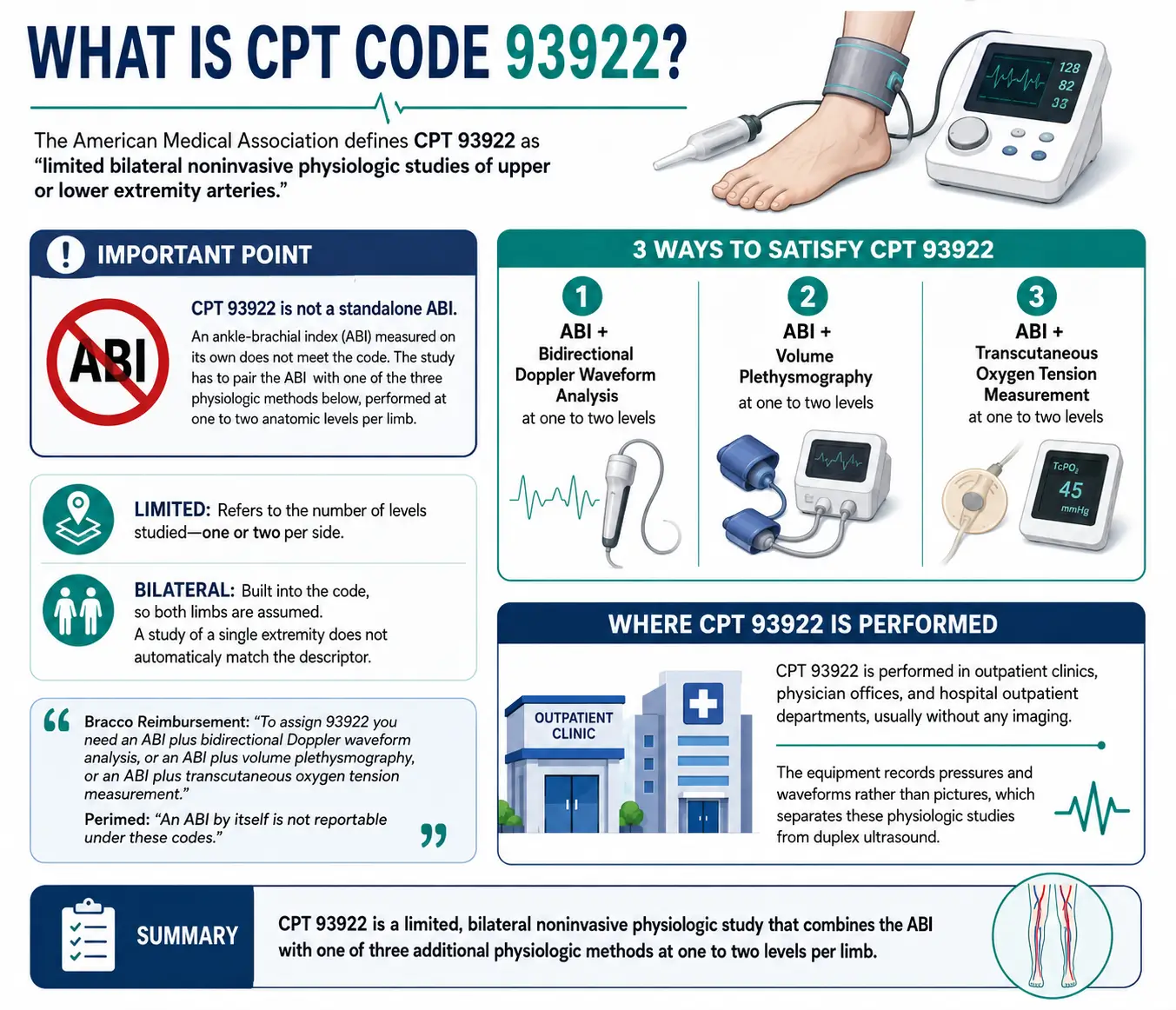
The American Medical Association defines CPT 93922 as limited bilateral noninvasive physiologic studies of upper or lower extremity arteries. The descriptor then lists three acceptable ways to satisfy it. For the lower extremity, that means ankle/brachial indices at the distal posterior tibial and anterior tibial (dorsalis pedis) arteries plus bidirectional Doppler waveform recording and analysis at one to two levels, or those same indices plus volume plethysmography at one to two levels, or those indices with transcutaneous oxygen tension measurement at one to two levels.
Read that descriptor closely. It answers the most common question about the code.
CPT 93922 is not a standalone ABI. An ankle-brachial index measured on its own does not meet the code. The study has to pair the ABI with one of the three physiologic methods above, performed at one or two anatomic levels per limb. Bracco Reimbursement states the point directly: to assign 93922 you need an ABI plus bidirectional Doppler waveform analysis, or an ABI plus volume plethysmography, or an ABI plus transcutaneous oxygen tension measurement. Perimed makes the same distinction, noting that an ABI by itself is not reportable under these codes.
Two words in the descriptor carry weight. Limited refers to the number of levels studied, one or two per side. Bilateral is built into the code, so both limbs are assumed. A study of a single extremity does not automatically match the descriptor, a point that affects modifier use later in this article.
93922 belongs to the noninvasive extremity arterial studies family. It is performed in outpatient clinics, physician offices, and hospital outpatient departments, usually without any imaging. The equipment records pressures and waveforms rather than pictures, which separates these physiologic studies from duplex ultrasound.
What the 93922 procedure code measures
The purpose is to detect and grade peripheral arterial disease. Reduced ankle pressures relative to brachial pressures, blunted Doppler waveforms, or dampened plethysmographic tracings all point toward arterial narrowing or occlusion in the legs or arms.
A normal resting ABI generally falls between 1.00 and 1.40. Values at or below 0.90 are commonly read as evidence of arterial obstruction. The physiologic component added to the ABI, whether Doppler waveforms, plethysmography, or oxygen tension, gives the interpreting physician additional data on where and how severely flow is compromised. That combination is what the code pays for, and it is why documentation of only an ABI number rarely survives an audit.
CPT 93922 vs 93923 vs 93924
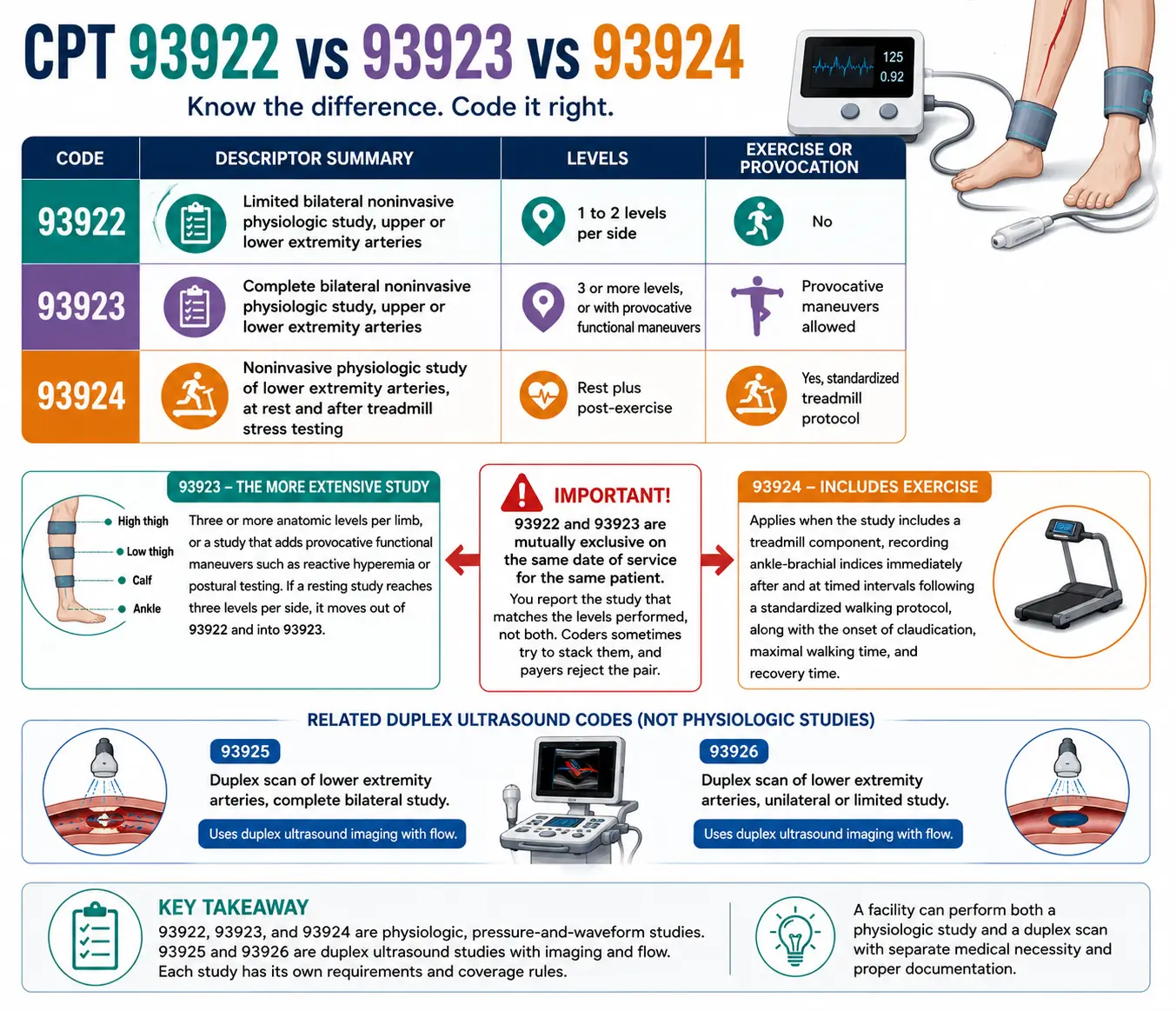
The single most useful thing a coder can learn about 93922 is where it stops and the next code begins. The distinction is the number of levels and whether exercise is involved.
Code | Descriptor summary | Levels | Exercise or provocation |
93922 | Limited bilateral noninvasive physiologic study, upper or lower extremity arteries | 1 to 2 levels per side | No |
93923 | Complete bilateral noninvasive physiologic study, upper or lower extremity arteries | 3 or more levels, or with provocative functional maneuvers | Provocative maneuvers allowed |
93924 | Noninvasive physiologic study of lower extremity arteries, at rest and after treadmill stress testing | Rest plus post-exercise | Yes, standardized treadmill protocol |
93923 describes the more extensive study: three or more anatomic levels per limb, or a study that adds provocative functional maneuvers such as reactive hyperemia or postural testing. If a resting study reaches three levels per side, it moves out of 93922 and into 93923.
93924 applies when the study includes a treadmill component, recording ankle-brachial indices immediately after and at timed intervals following a standardized walking protocol, along with the onset of claudication, maximal walking time, and recovery time.
93922 and 93923 are mutually exclusive on the same date of service for the same patient. You report the study that matches the levels performed, not both. Coders sometimes try to stack them, and payers reject the pair.
Two related codes round out lower-extremity arterial testing, and they are frequently confused with the physiologic codes because they involve the same anatomy:
- 93925 covers a duplex scan of lower extremity arteries, complete bilateral study.
- 93926 covers a duplex scan of lower extremity arteries, unilateral or limited study.
The difference is method. 93925 and 93926 use duplex ultrasound imaging with flow. 93922, 93923, and 93924 are physiologic, pressure-and-waveform studies. A facility can, with separate medical necessity and proper documentation, perform both a physiologic study and a duplex scan, but each has its own requirements and its own coverage rules.
Medical necessity and ICD-10 coding for 93922
Coverage for 93922 turns on documented signs and symptoms, not risk factors alone. Medicare Administrative Contractors handle this through local coverage. The widely referenced policy is LCD L35761, Non-Invasive Peripheral Arterial Vascular Studies, with its companion billing and coding article A57593, which lists the ICD-10-CM diagnosis codes a contractor will accept.
The pattern across payer policies is consistent. Acceptable indications generally include:
- Intermittent claudication that interferes with the patient’s occupation or daily activity
- Ischemic rest pain
- Non-healing ulcers, gangrene, or tissue loss suggesting arterial insufficiency
- Diminished or absent peripheral pulses on examination
- Known peripheral arterial disease under surveillance
- Diabetic patients with signs or symptoms of vascular complications
- Follow-up after arterial bypass or endovascular intervention
Diagnoses that commonly support the code map to the atherosclerosis of native arteries of the extremities family (the I70.2 series, with additional characters specifying claudication, rest pain, ulceration, or gangrene), peripheral vascular disease codes such as I73.9, and diabetes-with-peripheral-angiopathy codes such as E11.51. These are examples, not a coverage list. The controlling document is the billing and coding article tied to your MAC, because contractors differ on which codes they accept and which require a seventh character for encounter type.
Screening is where claims fall apart. A study ordered for an asymptomatic patient who carries only risk factors, with no documented symptom or abnormal finding, reads as screening and is usually not reimbursed. As one 2026 billing analysis from A2Z Precise Medical Billing put it, studies documented with only elevated risk factors and no symptoms are treated at a screening level and typically denied.
One procedural requirement is easy to overlook. The treating physician must specifically order the study in writing. CMS local coverage guidance is explicit that noninvasive vascular procedures performed on the internal protocol of the testing facility, rather than on a written physician order tied to the individual patient, are not covered.
Documentation requirements for 93922
A payable 93922 report is more than a printout of numbers. Reviewers look for a defined set of elements.
The order and the clinical indication come first. The chart should show the ordering provider, the specific symptom or finding prompting the test, and a diagnosis that matches an accepted indication. The report itself should identify the arteries examined, the levels studied (remember, one or two for 93922), the actual pressures and calculated indices for each side, the waveform or plethysmographic findings, and a signed interpretation with a clinical conclusion.
Bilaterality should be visible in the record. Because the descriptor assumes both limbs, a report that documents only one side raises a coding question that documentation has to answer.
The interpretation matters as much as the tracing. A study that captures data but carries no physician interpretation and clinical impression is incomplete for billing purposes, since the professional component of the code pays specifically for that reading.
93922 CPT code reimbursement in 2026
Payment for 93922 comes from the same relative value formula CMS uses for every physician service. The code carries roughly 2.46 total non-facility relative value units, of which only about 0.25 is physician work. The remaining value is practice expense, which reflects the equipment and technician time the test consumes.
Recent Medicare payments give a sense of scale. Using the published RVUs, the national non-facility amount for 93922 was about $83 in 2023 and roughly $81 in 2024, before geographic adjustment. For 2026, CMS set the non-qualifying-provider conversion factor at $33.4009, up from $32.3465 in 2025, an increase of about 3.26 percent that reflects statutory updates including a one-time increase from the 2025 budget legislation. Applied to the code’s published RVUs, that conversion factor places the national non-facility payment for 93922 near the low $80s again, before local geographic indices move it up or down by a few percent. Treat any single figure as an estimate; your Medicare Administrative Contractor applies geographic practice cost indices that shift the final allowed amount by locality.
Two billing mechanics affect what actually lands on the remittance:
- Professional and technical split. 93922 has a professional component (the interpretation, modifier 26) and a technical component (the equipment and staff, modifier TC). When one entity owns the equipment and another reads the study, each bills its component. When a practice performs and interprets the study in-office, it bills the code globally and collects the full amount. Because work RVUs are small relative to practice expense, the technical component carries most of the payment.
- Unilateral studies. The descriptor is written as a bilateral study. When only one extremity is examined, many payers expect modifier 52 (reduced services), since the work performed is less than the code assumes. Right and left modifiers (RT, LT) are generally not used here, because both sides are already built into the descriptor.
Commercial reimbursement varies more widely than Medicare. Plans set their own allowed amounts and their own medical necessity criteria, and several publish vascular-study medical policies that mirror the Medicare indications while adding their own frequency limits. Checking the specific plan’s policy before the study, rather than after a denial, is the difference between clean payment and an appeal.
Common denial reasons and how to prevent them
Four patterns account for most 93922 rejections.
Screening diagnoses. A risk-factor-only indication with no symptom or physical finding will not clear medical necessity. Document the claudication, rest pain, ulcer, or abnormal pulse exam that justifies the test.
ABI-only documentation. If the record shows an ankle-brachial index but no Doppler waveform, plethysmography, or oxygen tension measurement, the study does not meet the descriptor. Confirm that the report contains the required physiologic component.
Stacking 93922 with 93923. These codes cannot both be billed for the same patient on the same date. Report the one that matches the number of levels performed.
Repeat studies without changed status. Many policies limit how often a physiologic study is covered without a documented change in the patient’s clinical condition or a new intervention. A repeat study needs a reason in the chart.
The through-line across all four is the same. 93922 pays for a specific, documented, physician-ordered physiologic study, matched to a symptom-based diagnosis. When the record shows exactly that, the 93922 CPT code is one of the more predictable claims in vascular billing. When the record shows an ABI number attached to a risk factor, it is one of the least. Verify the descriptor elements and the accepted diagnosis before the claim goes out, and confirm your MAC’s current article, since the accepted ICD-10 list and the conversion factor both change year to year.