


Medical coding systems reserve the 99205 CPT code for the most complex new patient encounters in a clinical or outpatient setting. To justify this highest evaluation and management (E/M) tier, the American Medical Association (AMA) requires providers to document either high-level medical decision making or a specific time expenditure.
Medicare and commercial payers closely monitor this code. Because a 99205 submission carries substantial relative value units (RVUs), insurance auditors routinely review these claims for overbilling. Precise CPT 99205 documentation requirements serve two functions: they secure correct payment for intensive medical work and shield a practice from recoupment penalties.
Establishing new patient status
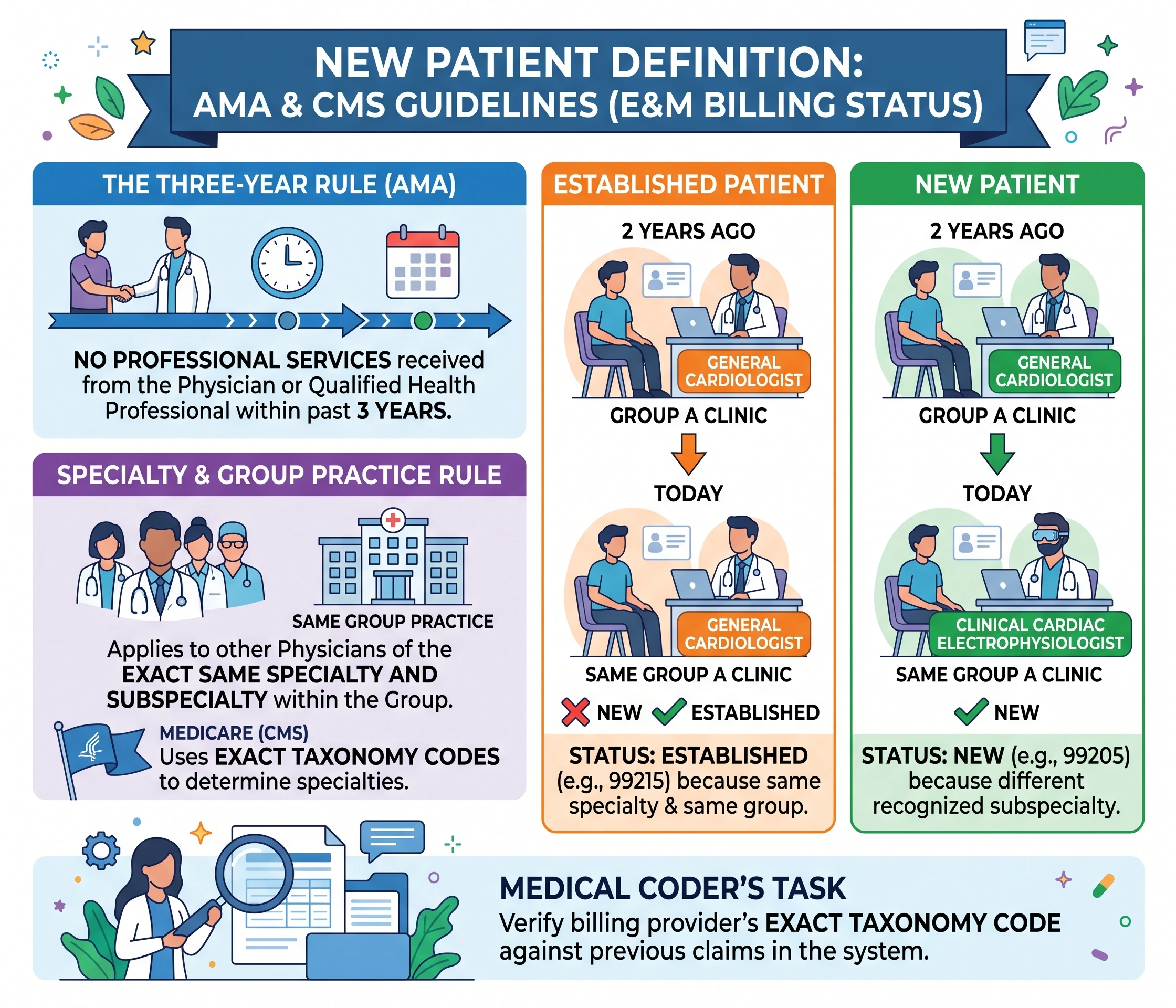
Providers cannot bill this specific code without first confirming the patient’s relationship to the clinic. The AMA dictates a strict three-year window for new patients.
The three-year specialty rule
If an individual received face-to-face services from any physician in your practice within the last 36 months, they usually count as an established patient. This restriction extends across the same specialty and subspecialty within a group practice. For example, if an internal medicine doctor treated a patient two years ago, a different internal medicine doctor in the same medical group cannot bill a 99205 for that patient today. They must select an established code like 99215.
The Centers for Medicare & Medicaid Services (CMS) relies on taxonomy codes to track these specialties. A patient transitioning from a general cardiologist to a cardiac electrophysiologist within the same clinical group resets the clock. They qualify as a new patient for the electrophysiologist due to the distinct subspecialty designation.
Meeting 99205 medical decision making criteria
Current coding standards eliminate the old practice of counting physical exam elements or history bullet points to hit a billing level. While physicians still record clinical histories and conduct exams as medically appropriate, the complexity of the patient’s case now drives the code selection. Providers aiming to fulfill the 99205 medical decision making standard must hit a high complexity threshold in two out of three specific categories.
Volume and severity of medical problems
The attending provider must treat conditions that create severe risks for the patient. A high-complexity issue involves an injury or illness that immediately threatens a patient’s life or bodily functions. Treating a severe psychiatric crisis, acute respiratory failure, or a sudden myocardial infarction meets this bar. Providers also satisfy this category by managing one or more chronic conditions currently presenting with severe progression or dangerous treatment side effects.
Reviewing and analyzing clinical data
Reaching the high-level mark in this category requires extensive data analysis. Coders look for documentation satisfying two of three distinct sub-groups.
First, the provider might review external medical records, analyze independent test results, and gather history from a separate historian, such as a family caregiver. Second, the physician could independently interpret a diagnostic test originally performed by an outside facility, assuming they aren’t billing a separate CPT code for that interpretation. Third, the provider can discuss the patient’s care plan directly with an external physician. Standard automated referral notes do not count; the interaction must involve a two-way clinical discussion.
Evaluating patient risk and treatment mortality
The physician’s proposed treatment plan must introduce high risks to the patient. Deciding to admit a patient to the hospital qualifies immediately. Planning major emergency surgery or scheduling elective surgery that carries specific, identified patient risk factors also clears this threshold. Furthermore, prescribing medications that demand intensive toxicity monitoring satisfies the CMS definition for high-risk management.
Calculating the CPT 99205 time requirement
When a patient’s clinical complexity does not reach the high medical decision making tier, providers have a secondary path. They can bill based entirely on minutes spent. The CPT 99205 time requirement explicitly demands between 60 and 74 minutes of total provider time on the exact calendar day of the visit.
Acceptable time-based activities
CMS maintains strict rules regarding which minutes count. Physicians and qualified healthcare professionals can aggregate time spent reviewing charts before the patient arrives, obtaining medical histories, performing evaluations, and counseling family members. Time spent ordering labs, typing clinical notes into the electronic health record, and speaking with other medical professionals also applies.
Clinical staff time never counts. If a registered nurse spends 20 minutes taking a history, the physician cannot claim those minutes. Additionally, physicians cannot count time spent reviewing records the night before the appointment, nor can they include general administrative travel time.
Prolonged services and HCPCS G2212
Patient encounters lasting 75 minutes or longer require prolonged service codes. Medicare rules diverge from private payer guidelines here. For Medicare beneficiaries, practices use the HCPCS code G2212. CMS mandates that the provider must surpass the 74-minute upper limit of the 99205 code by 15 full minutes before applying the add-on. Therefore, a provider must document 89 minutes to bill a 99205 plus one unit of G2212. An 85-minute visit only qualifies for a standalone 99205.
Comparing 99204 vs 99205 guidelines
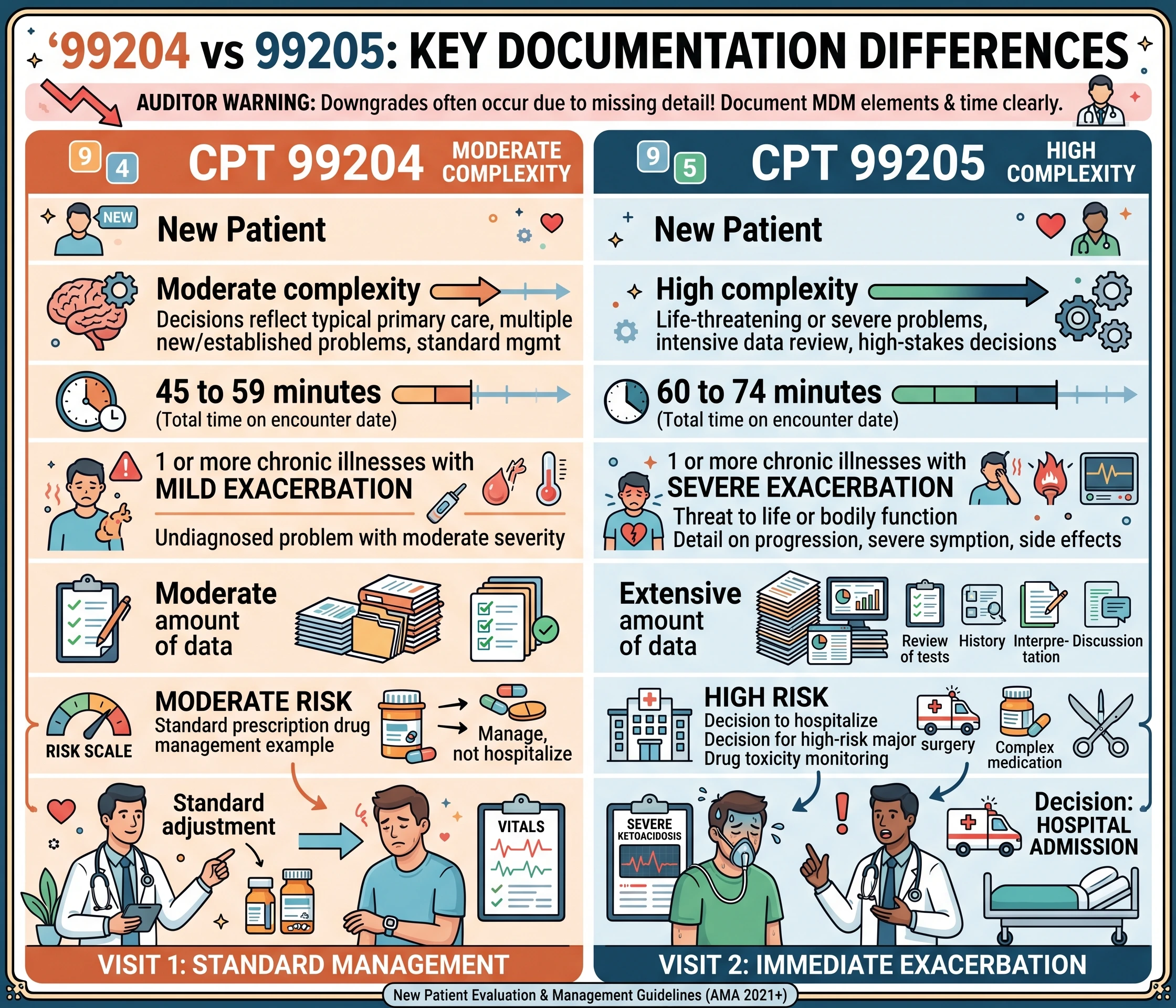
Claim downgrades often occur when documentation hovers between Level 4 and Level 5. While both codes apply to new patients, their thresholds differ sharply.
Feature | CPT 99204 | CPT 99205 |
Patient Status | New to practice or specialty (3 years) | New to practice or specialty (3 years) |
MDM Classification | Moderate complexity | High complexity |
Required Time | 45 to 59 minutes | 60 to 74 minutes |
Clinical Problem | Chronic illness with mild exacerbation | Chronic illness with severe exacerbation or life threat |
Information Analyzed | Moderate volume of data | Extensive volume of data |
Management Risk | Moderate (e.g., standard prescriptions) | High (e.g., hospital admission, intensive monitoring) |
Practical CPT 99205 documentation example
A 72-year-old new patient arrives at a pulmonology clinic experiencing acute hypoxia and coughing up blood. The pulmonologist spends time reviewing lab results forwarded from an urgent care center earlier that morning. After a physical evaluation and an immediate office spirometry test, the specialist diagnoses a massive acute pulmonary embolism. The physician contacts the local hospital’s intensive care unit director to arrange an emergency admission and coordinates an immediate ambulance transfer.
This clinical scenario easily fulfills the 99205 requirements via medical decision making. The acute pulmonary embolism acts as a direct threat to the patient’s life, satisfying the high-complexity problem category. Coordinating an emergency ICU admission meets the high-risk management criteria. Achieving these two distinct high-level MDM categories allows the provider to bill 99205, regardless of whether the visit took 30 minutes or 65 minutes.
Clinical 99205 documentation checklist
Medical auditors look for specific charting components during a claim review. To meet CPT 99205 billing requirements, providers should verify that their encounter notes contain the following details.
- Confirmation of new patient status across all practice locations and identical specialties for the past 36 months.
- A clearly stated chief complaint validating the medical necessity of the visit.
- An exact list of all diagnoses managed that day, noting whether the conditions pose an active threat to life or bodily function.
- Itemized lists of all external lab results, imaging reports, or historical medical records reviewed.
- Documentation of medical history gathered from secondary sources, such as caregivers or spouses, if the patient cannot provide it.
- Specific notes regarding any test results independently interpreted during the visit.
- Detailed descriptions of the clinical risks tied to the chosen treatment plan.
- A precise time statement if billing by minutes, such as: “I spent exactly 62 minutes on the date of this encounter performing direct clinical evaluation and reviewing medical data.”
99205 Medicare reimbursement mechanics
The CMS Physician Fee Schedule assigns 3.17 work RVUs to the 99205 code, recognizing the intense clinical labor involved in high-complexity intake. To determine the actual 99205 Medicare reimbursement dollar amount, Medicare Administrative Contractors combine this work RVU with practice expense and malpractice RVUs, then apply a geographic practice cost index multiplier.
Because Level 5 codes pay significantly more than Level 3 or 4 visits, they attract federal scrutiny. Medicare monitors the billing distribution of every enrolled provider. A physician who bills 99205 for half of their new patient encounters will likely fall outside the standard bell curve for their specific specialty. This mathematical outlier status triggers targeted medical reviews to verify the validity of those claims.
Federal audit triggers and billing errors
The Office of Inspector General (OIG) continuously flags evaluation and management upcoding as an enforcement priority. One persistent error involves duplicate credit for diagnostic tests. If a physician bills a 93010 code to receive payment for interpreting an electrocardiogram, they cannot simultaneously count that same EKG interpretation to boost their MDM data score for the 99205 code.
Copy-and-paste charting also causes claim denials. Pulling forward massive blocks of text from a patient’s intake questionnaire artificially inflates the note’s length. Auditors ignore cloned histories. They look exclusively at the active clinical reasoning, the data analyzed that day, and the specific risks managed during the encounter.
Finally, vague time documentation frequently fails audits. Writing statements like “spent more than 45 minutes” invalidates a 99205 claim, as the code strictly mandates a 60-minute minimum. Furthermore, splitting time across midnight disqualifies the time. All minutes counted toward the threshold must occur on the exact calendar day of the face-to-face appointment.
Billing the 99205 code successfully requires physicians to align their clinical severity with exact administrative standards. A practice must firmly establish the patient’s three-year absence from their specialty group before proceeding. From there, the charting must definitively prove 60 to 74 minutes of dedicated provider time on the encounter date, or demonstrate medical decision making that involves high risks, extensive data review, and life-threatening clinical problems. Mastering these specific parameters protects clinical revenue while keeping the practice compliant with federal auditing protocols.