


CPT code 99212 covers a large share of everyday outpatient medicine, and it is also one of the more inconsistently applied codes in the E/M family. It describes an office or other outpatient visit for an established patient involving straightforward medical decision making, or, for practices that bill by time, 10 to 19 minutes of total time on the date of the encounter. That sentence contains most of what separates 99212 from the codes around it: the patient must already be known to the practice, the decision making has to stay simple, and a physician or other qualified health care professional, not clinical staff alone, has to do the work. This guide covers the current billing rules for 99212, what the documentation needs to show, what payers pay for it in 2026, and how it compares with 99211 and 99213.
What is CPT code 99212?
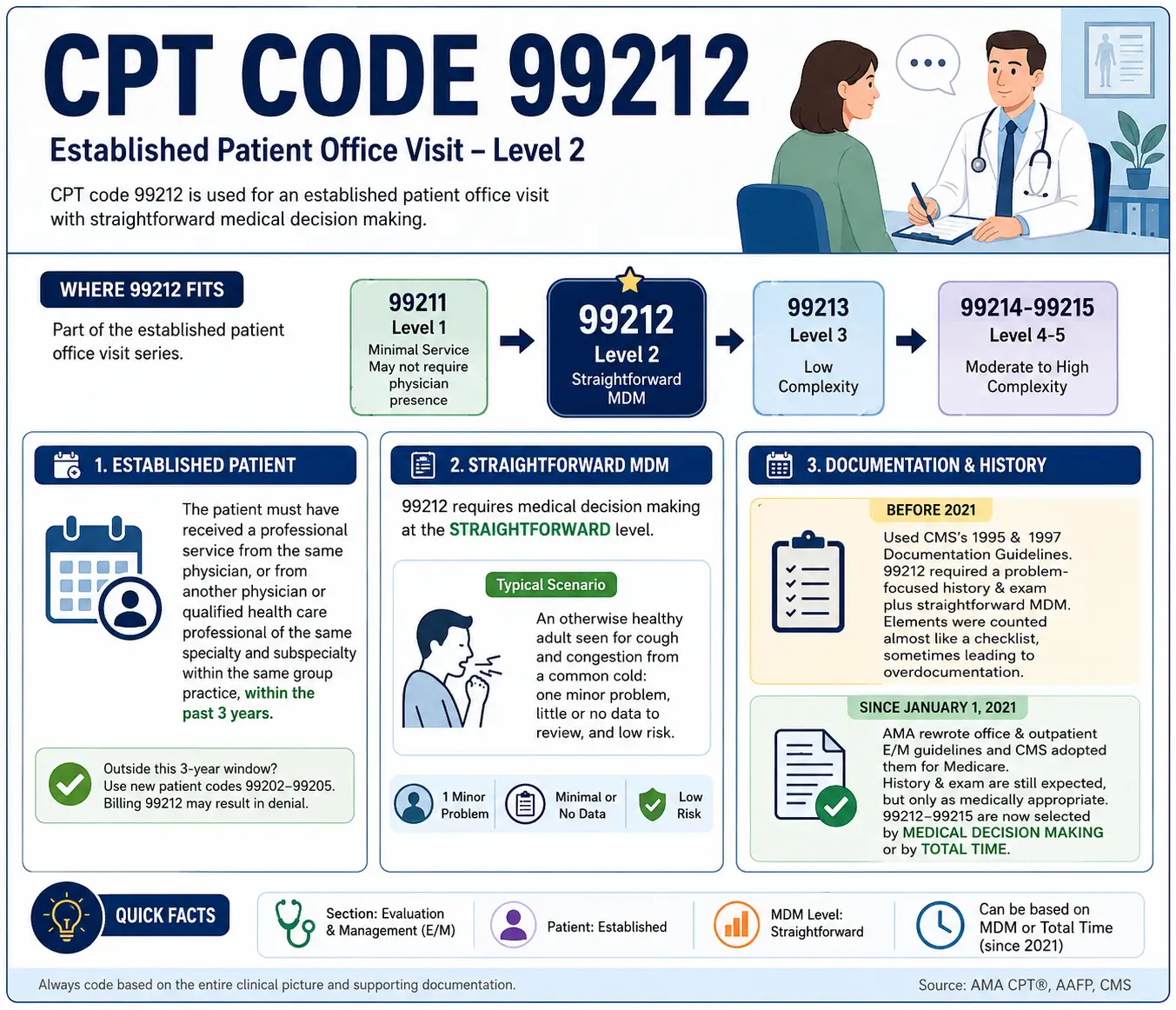
CPT code 99212 is the level two code in the established patient office visit series, positioned between 99211 (a code that may not even require a physician’s presence) and 99213 through 99215, which involve progressively more complexity. The American Medical Association maintains the code within the Evaluation and Management section of the CPT code set, tying it to three conditions: the patient has to be established, the provider performs whatever history and exam the clinical picture calls for, and the medical decision making stays at the straightforward level.
“Established” has a specific meaning. It refers to a patient who has received a professional service from the same physician, or from another physician or qualified health care professional of the same specialty and subspecialty within the same group practice, within the past three years. Bill 99212 for a patient outside that window and the claim is likely to be denied, since new patients belong in the separate 99202 to 99205 series.
“Straightforward” sets the complexity ceiling. The American Academy of Family Physicians, writing in its Family Practice Management journal, describes the classic 99212 scenario as an otherwise healthy adult seen for cough and congestion from a common cold: one minor problem, little or no data to review, and low risk.
The code itself predates 2021, but the way a clinician earns it does not. Through 2020, coders relied on CMS’s 1995 and 1997 Documentation Guidelines, and 99212 required a problem-focused history and exam alongside straightforward decision making, counting elements almost like a checklist, a system that pushed some practices toward padding notes just to reach a bullet count. The AMA rewrote the office and outpatient E/M guidelines effective January 1, 2021, and CMS adopted the change for Medicare. History and exam are still expected, but only to the extent medically appropriate; they no longer decide the code level. Since that date, 99212 through 99215 have been selected by medical decision making or by total time.
How code selection works: medical decision making or time
Straightforward medical decision making for 99212
Medical decision making has three components under the current framework: the number and complexity of problems addressed at the encounter, the amount and complexity of data reviewed and analyzed, and the risk of complications or morbidity from the management decisions made. Two of the three components have to point to the same level for that level to apply.
For 99212, that works out to one self-limited or minor problem (a mild rash, a refill for a stable condition, a single uncomplicated acute complaint), minimal or no data to review, and minimal risk. Compare that with 99213, which requires two or more self-limited or minor problems, one stable chronic illness, or one acute uncomplicated illness or injury, plus at least a low level of data review or risk. In practice, the jump from 99212 to 99213 usually happens the moment a second condition enters the visit, a medication gets adjusted, or a test gets ordered.
Time requirement for CPT 99212
For time-based billing, CPT 99212 requires a minimum of 10 minutes and a maximum of 19 minutes of total time on the date of the encounter. This range has applied since January 2021 and remains unchanged for 2026. Nineteen minutes and one second moves the visit into 99213’s 20-to-29-minute range, so accurate tracking directly affects which code applies.
Total time is broader than the minutes spent face to face. Per AMA and CMS guidance, it includes preparing to see the patient, taking a separately obtained history, performing the exam, counseling, ordering medications or tests, and documenting the encounter, all on the date of service. It does not include time spent by nurses or medical assistants rooming the patient. Only the billing provider’s personal time counts, and if the chart does not state a specific number of minutes or a start and stop time, a time-based code has nothing to stand on if a payer requests records.
Documentation requirements for CPT 99212
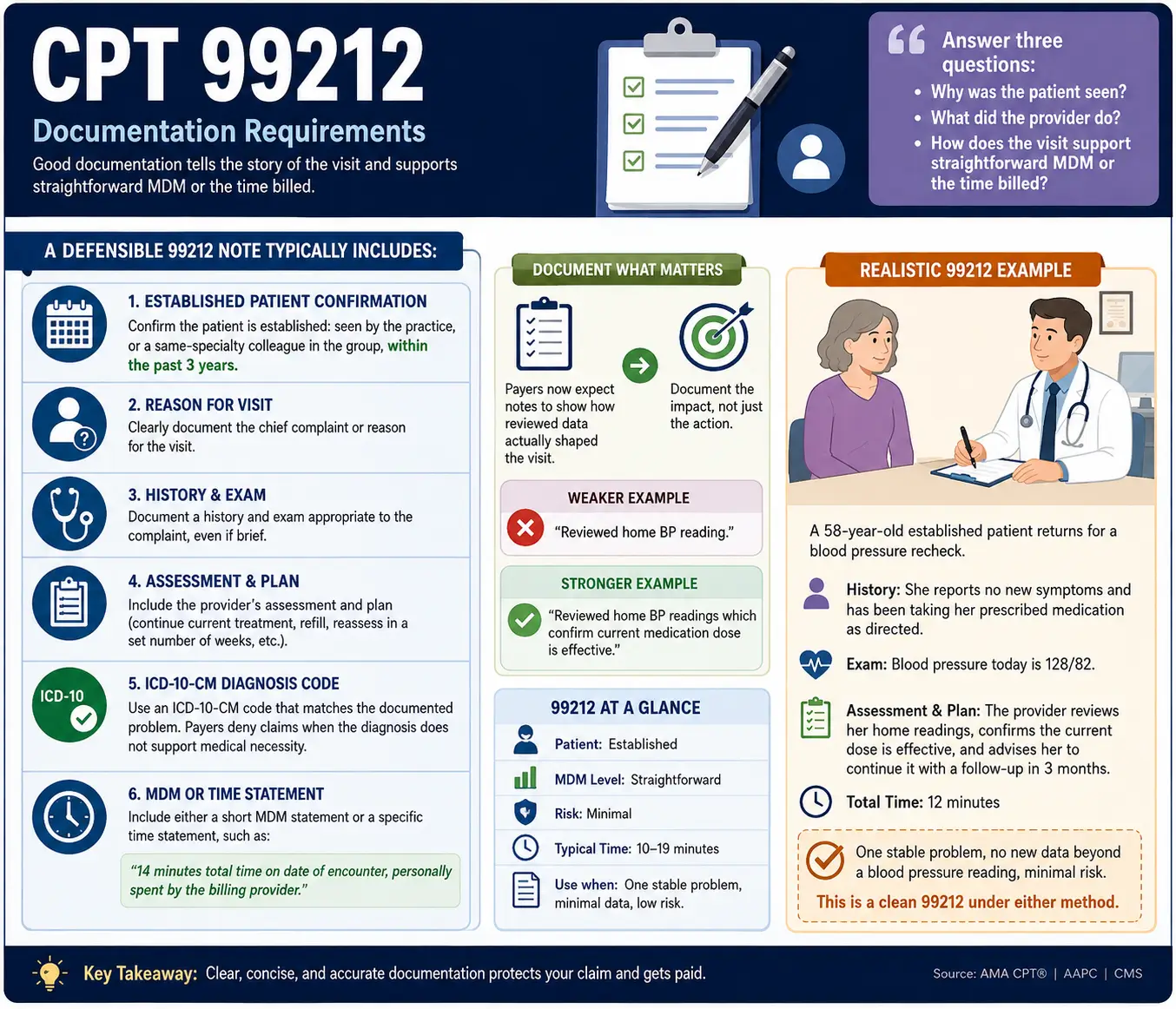
Good documentation for 99212 does not need to be long. It needs to answer three questions: why the patient was seen, what the provider actually did, and how the visit supports either straightforward MDM or the time billed. A defensible note typically includes:
- Confirmation that the patient is established (seen by the practice, or a same-specialty colleague in the group, within three years)
- The reason for the visit
- A history and exam appropriate to the complaint, even if brief
- The provider’s assessment and plan (continue current treatment, refill, reassess in a set number of weeks)
- An ICD-10-CM diagnosis code that matches the documented problem, since payers deny claims where the diagnosis does not support medical necessity
- Either a short MDM statement or a specific time statement, such as “14 minutes total time on date of encounter, personally spent by the billing provider”
Marcella Bucknam, a revenue cycle analyst who wrote about the 2021 changes for AAPC, has noted that payers now expect notes to show how reviewed data actually shaped the visit, not just that it was reviewed. A line noting a home reading was checked is weaker than one noting the reading confirmed the current medication dose was working.
A realistic 99212 example: a 58-year-old established patient returns for a blood pressure recheck. She reports no new symptoms and has been taking her prescribed medication as directed. Blood pressure today is 128/82. The provider reviews her home readings, confirms the current dose is effective, and advises her to continue it with a follow-up in three months. Total time: 12 minutes. One stable problem, no new data beyond a blood pressure reading, minimal risk. That is a clean 99212 under either method.
How to bill CPT 99212: modifiers, place of service, and telehealth
Most 99212 claims go out without a modifier. A few situations call for one:
- Modifier 25 (significant, separately identifiable E/M service) applies when 99212 is billed on the same date as a separately identifiable procedure, such as a minor in-office injection. Leave it off and payers frequently bundle the visit into the procedure and deny the E/M line.
- Modifier 95 identifies a synchronous, real-time audio-video telehealth visit. Most commercial payers expect it on telehealth claims for 99202 through 99215; Medicare relies more on place of service than on the modifier itself, though many practices append it anyway for consistency across payers.
- Modifier 93 marks an audio-only encounter, used where the payer allows a phone-only visit to be billed as an E/M service.
Place of service has to match where the visit happened. POS 11 identifies a traditional office. POS 02 applies to telehealth delivered somewhere other than the patient’s home; POS 10 applies when the patient is at home, which typically pays the higher non-facility rate. The location code is not a formality; it changes which fee schedule rate applies to the claim.
One add-on code is worth knowing: HCPCS G2211. CMS finalized this visit complexity add-on in the 2021 Physician Fee Schedule rule, but a three-year moratorium under the Consolidated Appropriations Act, 2021 delayed it until January 1, 2024. G2211 recognizes the added cost of serving as a patient’s continuing point of contact, rather than a one-time visit, and can be billed alongside 99212 through 99215. CMS modeling at the time put potential eligibility at roughly 38 percent of office E/M visits, though real-world use varies by specialty. It generally cannot be billed with modifier 25 on the same claim, except since January 2025, when the E/M visit falls on the same day as certain preventive services such as the annual wellness visit.
Telehealth billing for 99212 gained more certainty in 2026. The Consolidated Appropriations Act, 2026, signed February 3, extended most Medicare telehealth flexibilities, including home-based visits and audio-only care for non-behavioral health, through December 31, 2027.
CPT 99212 reimbursement and RVU values
Medicare pays for 99212 using the Resource-Based Relative Value Scale. Each code carries three RVU components (work, practice expense, and malpractice), adjusted for local cost differences through the Geographic Practice Cost Index and multiplied by an annual conversion factor.
For 2026, 99212 carries a work RVU of approximately 0.70. Combined with practice expense and malpractice components, the total non-facility RVU comes to roughly 1.78, and the facility RVU to about 0.93. New for 2026, CMS finalized two separate conversion factors based on a practice’s participation in Alternative Payment Models: $33.4009 for standard practices and $33.5675 for qualifying APM participants. Applying the standard factor produces a national average, unadjusted Medicare payment of roughly $59 for 99212 in a physician’s office, and roughly $31 in a hospital outpatient setting. These are national averages before geographic adjustment; the CMS Physician Fee Schedule Look-Up Tool gives the exact figure for any ZIP code.
Commercial insurance typically pays more than Medicare, though the multiplier depends entirely on the payer contract. Industry benchmarks commonly place commercial reimbursement for established patient E/M codes between 100 and 150 percent of the Medicare rate, which for 99212 puts most commercial payments roughly between $60 and $90 in the office setting.
99212 vs 99213 vs 99211
Confusing these three codes is one of the most common leveling mistakes in established patient billing.
Feature | 99211 | 99212 | 99213 |
Provider required | No, may be staff-only | Yes, physician or QHP | Yes, physician or QHP |
MDM level | Not applicable | Straightforward | Low complexity |
Time (2021+ rules) | No defined range | 10-19 minutes | 20-29 minutes |
Typical scenario | Blood pressure check by a nurse, INR draw | Single stable problem, simple refill | Two or more stable conditions, or a medication change |
2026 Medicare non-facility payment (national average) | ~$24 | ~$59 | ~$95 |
99211 vs 99212. The deciding question is whether a physician, nurse practitioner, or physician assistant actually evaluated the patient and made a decision. If a medical assistant checks a blood pressure with nothing for the provider to interpret, that is 99211. The moment any clinical judgment is required, even minimal, the visit moves to 99212.
99212 vs 99213. The deciding factor is complexity, not how long the visit felt to the provider. A single stable problem with no medication change and nothing new to review stays at 99212. Add a second condition, adjust a prescription, or order and review a test, and the documentation now supports 99213. With roughly a $36 reimbursement gap between the two in the office setting, this distinction has a real effect on a practice’s revenue over a year of visits.
Common coding errors and audit risk
E/M coding draws more audit attention than most other parts of the CPT set. A 2014 Office of Inspector General report, examining a sample of 2010 Medicare Part B claims, found that 42 percent of E/M claims were incorrectly coded, split between upcoding and downcoding, and cited CMS’s own error-rate testing showing E/M services are paid in error roughly 50 percent more often than other Part B services. That data is more than a decade old, but it explains why Medicare contractors still scrutinize E/M levels closely.
For 99212 specifically, the recurring problems are not exotic. Billing it for a patient outside the three-year established-patient window is an easy denial. Selecting the code by time without a specific minute count or start and stop time in the chart leaves nothing to defend if records are requested. And billing 99212 for a visit that actually involved a second problem, a medication change, or ordered testing quietly undercodes revenue that 99213 exists to capture.
Getting 99212 billing right
CPT code 99212 will keep showing up on more claims than almost any other E/M code, simply because so much of outpatient medicine is routine, established-patient follow-up. Getting it right comes down to a few habits: confirming the patient genuinely qualifies as established, matching documented complexity or time to the code billed, and keeping the modifier and telehealth rules current as CMS updates them. Practices that build those habits into their templates tend to see fewer denials and a clearer picture of what their office visits are actually worth.