


The 99222 CPT code sits in the middle of the initial hospital care family, and that middle position is exactly where hospitalists, specialists, and coders disagree most. Under-document it and the physician gives up earned revenue. Push it above its level without support in the note and the claim becomes an audit target. Coding 99222 well is mostly a matter of knowing where its two boundaries sit.
This guide covers what the code represents, the 2023 rules that reshaped it, how to select the level by medical decision making or by time, the documentation a payer expects, how it compares to the codes around it, and what Medicare actually pays in 2026.
What the 99222 CPT code covers
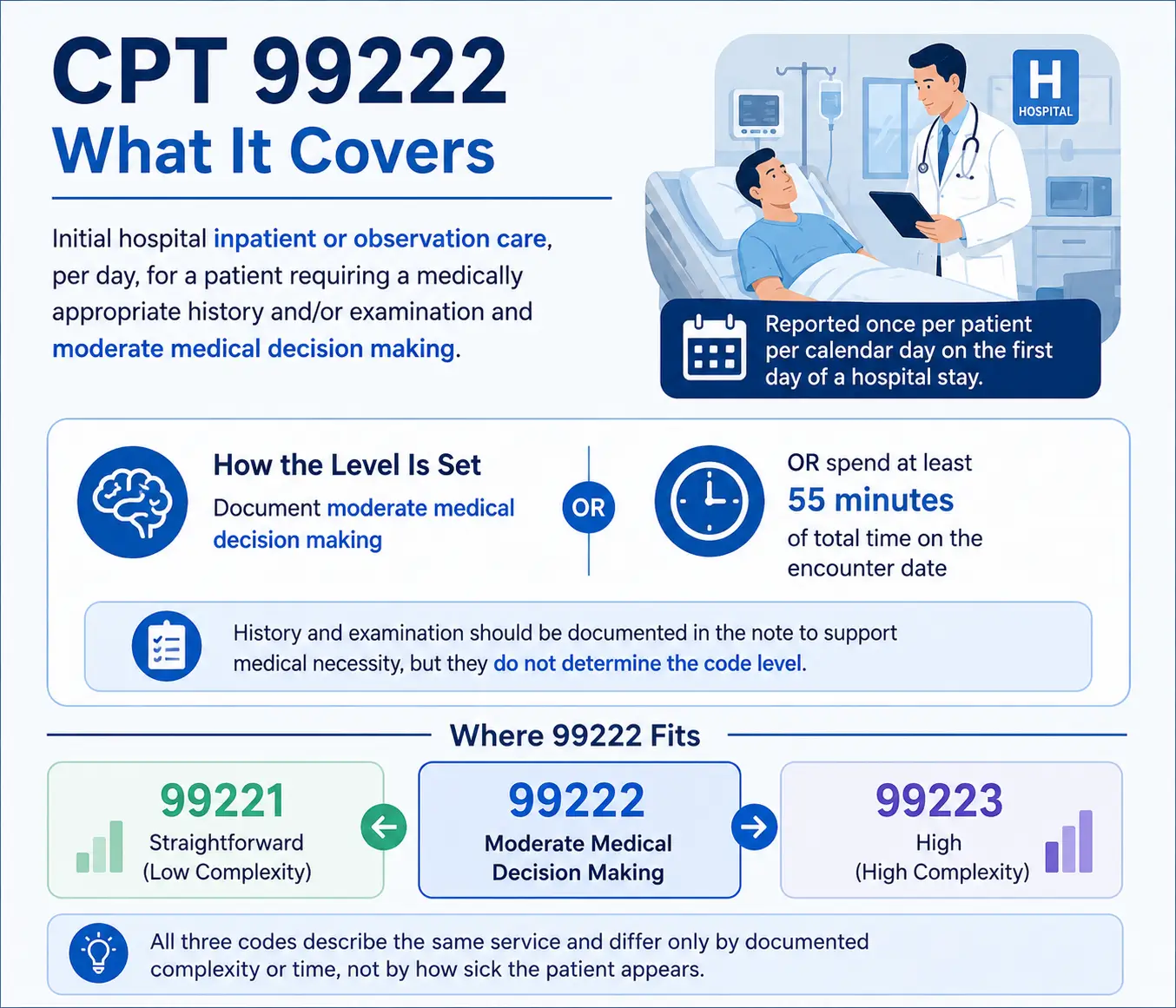
The American Medical Association defines CPT code 99222 as initial hospital inpatient or observation care, per day, for a patient who needs a medically appropriate history and/or examination and moderate medical decision making. It is reported once per patient per calendar day, on the first day of a hospital inpatient or observation stay, and it applies whether the patient is new to the physician or already established. That is the whole of the 99222 CPT code description in plain terms: the first-day hospital visit for a moderately complex admission.
Two things set the level. The physician either documents moderate medical decision making, or spends at least 55 minutes of total time on the encounter date. History and examination still belong in the note because they support medical necessity, but neither one decides the code anymore. That last point trips up experienced coders who learned the pre-2021 rules.
99222 is the middle of three codes. Below it sits 99221 (straightforward or low complexity). Above it sits 99223 (high complexity). All three describe the same service and differ only by documented complexity or time, not by how sick the patient looks on paper at first glance.
What changed in 2023, and why old habits still cause denials
Before January 1, 2023, observation care had its own set of codes. The AMA deleted them in the 2023 restructuring of evaluation and management coding. Gone were 99217 (observation discharge), 99218 through 99220 (initial observation care), and 99224 through 99226 (subsequent observation care). The first day of an observation stay now uses the same initial hospital care codes as an inpatient admission: 99221, 99222, or 99223.
A claim that reports any of the deleted observation codes for a date of service after December 31, 2022 is rejected automatically. Practices that carried old templates or superbills into 2023 without updating them saw denials pile up for a reason that had nothing to do with clinical documentation.
The 2023 changes also finished the shift, begun in 2021 for office visits, away from scoring history and exam bullet points. A thorough review of systems no longer lifts a note from 99221 to 99222. Only the complexity of the decision, or the minutes spent, does that. Coders should still check the current AMA CPT evaluation and management guidelines directly rather than rely on any paraphrase, including this one, because the MDM table has fine print that a summary flattens.
Choosing the level by medical decision making
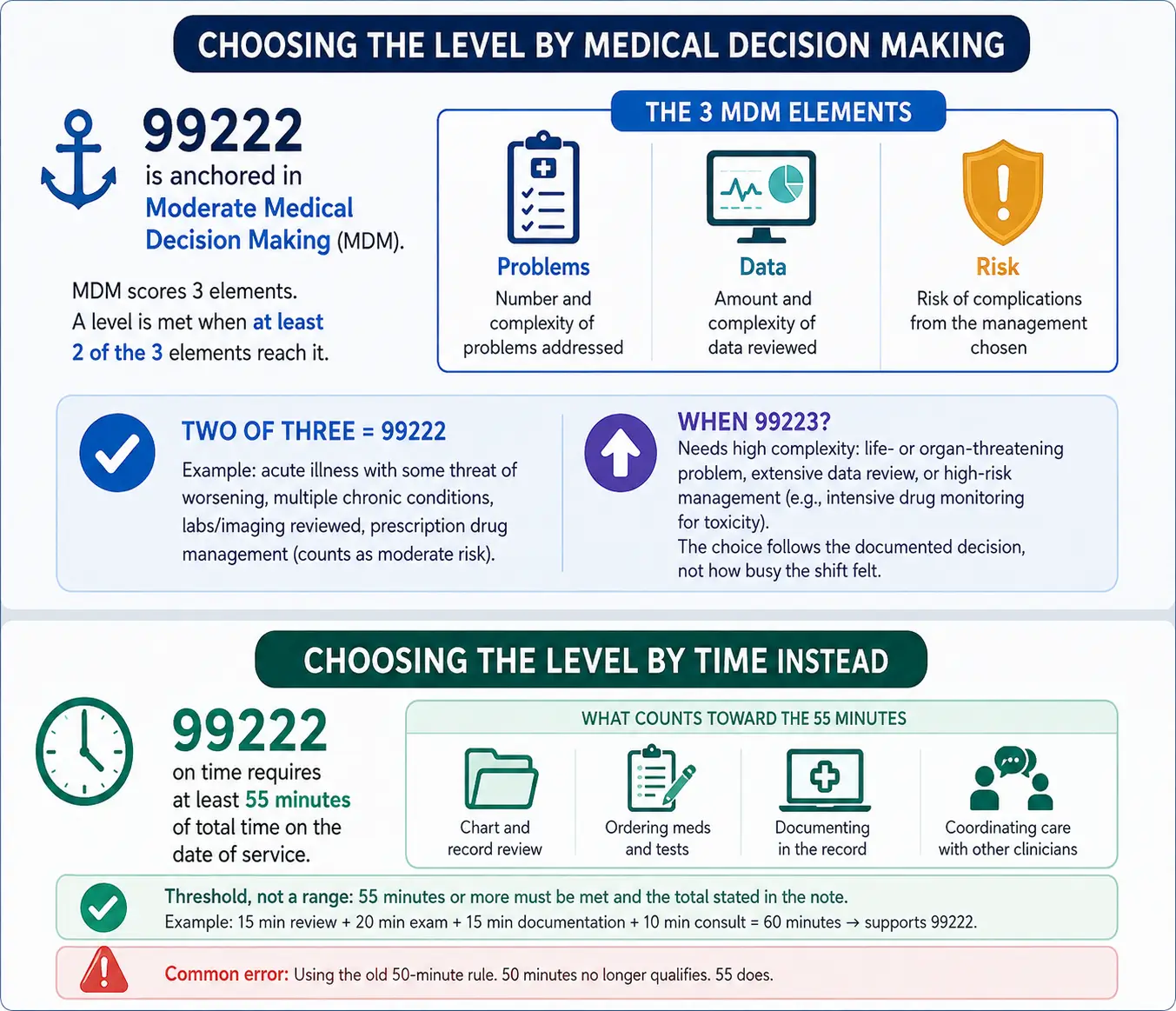
Moderate medical decision making is the anchor for 99222. The AMA MDM table scores three elements: the number and complexity of problems addressed, the amount and complexity of data reviewed, and the risk of complications from the management chosen. A visit reaches a given level when at least two of those three elements meet it.
For 99222, that means two of the three elements reach moderate. In practice, a moderate admission often looks like this: a patient admitted with an acute illness that carries some threat of worsening, a handful of chronic conditions managed at the same time, laboratory and imaging results reviewed, and prescription drug management as part of the plan. Prescription drug management on its own satisfies the moderate risk element, which is why it appears in so many 99222 notes.
Where does 99222 stop and 99223 begin? 99223 needs high complexity, which usually means a problem that threatens life or bodily function, extensive data review, or a high-risk management decision such as drug therapy that requires intensive monitoring for toxicity. A patient with five stable chronic conditions and no acute change usually stays at 99222. A patient with one condition actively threatening an organ system moves toward 99223. The choice follows the documented decision, not how busy the shift felt or how long the problem list ran.
Choosing the level by time instead
Time is the alternative basis for the code. When a physician bills 99222 on time, the encounter needs at least 55 minutes of total time on the date of service. That total counts far more than face-to-face minutes. It includes chart and record review, ordering medications and tests, documenting in the record, and coordinating care with other clinicians, all performed on the encounter date.
The 99222 time requirement is a threshold, not a range. The minutes must be met or exceeded, and the note has to state the total explicitly. So a physician who reviews outside records for 15 minutes, examines the patient for 20, writes the note for 15, and calls a consultant for 10 has documented 60 minutes and supports 99222 on time even if the decision making sat closer to low. A common and avoidable error comes from coders still applying the older 50-minute reference point. Fifty minutes no longer qualifies. Fifty-five does.
99221 vs 99222 vs 99223 at a glance
Code | Medical decision making | Time on the date of service | Approx. 2026 Medicare facility payment (non-QP) |
99221 | Straightforward or low | At least 40 minutes | About $90 to $95 |
99222 | Moderate | At least 55 minutes | About $117 |
99223 | High | At least 75 minutes | About $156 |
Payment figures apply the 2026 non-qualifying conversion factor of $33.4009 to the national facility total RVU, before any geographic adjustment. The work RVU is 2.60 for 99222 and 3.50 for 99223, so the step from moderate to high complexity carries real revenue. That is part of why auditors watch the boundary between the two.
99222 vs 99232: initial care is not subsequent care
The most frequent mix-up outside the initial care family is between 99222 and 99232. They are not interchangeable. 99222 reports the first qualifying encounter of the stay. 99232 reports a subsequent hospital inpatient or observation visit, meaning the daily follow-up work after admission. 99232 also uses moderate medical decision making, but its time threshold is 35 minutes rather than 55, and its work RVU is 1.39 against 99222’s 2.60. At the 2026 non-qualifying conversion factor, a 99232 pays roughly $69 at the national facility rate, compared with roughly $117 for 99222.
The rule is simple to state. The admitting or first-encountering physician bills initial care once. Every visit after that, during the same admission, moves to the subsequent care series (99231 through 99233). A specialist called in for the first time during the stay bills initial care for that first visit, even if the attending has already rounded several times, then switches to subsequent care for later visits.
Documentation and medical necessity
Moderate medical decision making is the level auditors question most, because it is easy to assert and harder to prove. Medicare Administrative Contractors downcode 99222 to 99221 when the note claims moderate complexity but shows only one moderate element, when the second element is implied rather than documented, when prescription management is mentioned but not framed as a decision, or when data review is listed without being counted correctly.
A defensible 99222 note does a few specific things. It names the problems addressed and their status, not just a diagnosis list. It shows the data actually reviewed, such as specific labs, imaging, or outside records, rather than a generic statement that records were reviewed. It ties the risk element to a real decision, most often prescription drug management or a diagnostic choice that carries its own risk. When the code is billed on time, it records the total minutes on the encounter date.
Medical necessity sits underneath all of this. A note can score to moderate on paper and still be reduced if the admission itself does not look medically necessary for hospital-level care. The history and exam, no longer counted toward the level, carry weight here by showing why the patient needed to be in the hospital in the first place.
When a physician and an advanced practice provider share the encounter, a split or shared visit, current CMS policy lets the substantive portion be defined by time or by medical decision making, and the clinician who performed that portion bills the code. The specific documentation standard shifts with each fee schedule cycle, so verify the current split or shared rule before relying on it for a 99222 claim.
Place of service, modifiers, and frequency limits
The place of service code affects payment. 99222 is reported with POS 21 for an inpatient and POS 22 for an on-campus outpatient (the status used for observation patients). The POS code sets the facility versus non-facility rate, so an incorrect one is its own denial trigger, separate from any documentation problem. POS 11, the office code, on a hospital encounter is an immediate reject.
Modifier AI identifies the principal physician of record, the admitting or attending physician who oversees the patient’s overall care. CMS created modifier AI in 2010 so that more than one physician could bill initial hospital care for the same patient without the claims reading as duplicates. Only one physician per group per admission appends it. Consulting specialists who bill 99221 through 99223 for their own first visit leave modifier AI off, unless they take on the attending role.
That consulting rule exists because of a policy many clinicians still find surprising. Medicare stopped recognizing consultation codes for Part B claims on January 1, 2010, and the policy has held for more than fifteen years. A patient who would once have generated an inpatient consultation code now generates an initial hospital care code (99221 through 99223) for the consultant’s first visit, then subsequent care codes after that. The frequency limit follows from the structure: one initial hospital care code per admission from a given physician or group, on the first day, and subsequent care codes for the rest of the stay.
99222 RVU and reimbursement in 2026
For 99222, the 2026 CMS Medicare Physician Fee Schedule assigns a work RVU (wRVU) of 2.60 and a national facility total RVU of about 3.50. Applying the 2026 non-qualifying conversion factor of $33.4009 gives a national payment near $117 before geographic adjustment. Physicians who qualify as advanced alternative payment model participants are paid on a slightly higher conversion factor, $33.5675, under the two-factor system that began in 2026.
Those two conversion factors are new. The CMS calendar year 2026 Medicare Physician Fee Schedule final rule, released October 31, 2025, set separate rates for qualifying participants ($33.5675) and everyone else ($33.4009), increases of 3.77 percent and 3.26 percent over the 2025 factor of $32.3465. The same rule applied a negative 2.5 percent efficiency adjustment to the work RVUs of many non-time-based services but exempted evaluation and management codes, so 99222’s work RVU was not cut on that basis. Changes to facility practice expense in the rule did move hospital-based E/M payments modestly.
Actual payment always depends on locality. The geographic practice cost indices adjust each RVU component by region, so the same 99222 claim pays more in a high-cost metropolitan area than in a rural one, and commercial payers set their own rates, often above Medicare. For a specific figure, the CMS Physician Fee Schedule Look-Up Tool returns the locality-adjusted amount for any code and region.
One number captures why 99222 deserves this much attention. The gap between a downcoded 99221 and a properly documented 99222 is roughly $25 per admission at the Medicare facility rate, and the gap between 99222 and a supported 99223 is close to $40. Across a year of hospital rounding, that difference reaches into the tens of thousands of dollars, and it turns almost entirely on whether the note shows moderate decision making or records 55 minutes. Match the documented complexity or time to the level, and let the note prove it. That is the whole discipline of coding the 99222 CPT code well.