


The 99283 CPT code is the middle rung of the emergency department E/M ladder, and it is also the code coders second-guess most. It sits between the low-acuity 99282 and the high-volume 99284 inside the 99281 through 99285 family. Get the level right and the claim clears. Reach too high without documentation and you invite a recoupment request. Reflexively code down to avoid an audit and you leave money on the table across a full year of shifts.
This guide covers what CPT 99283 represents in 2026, the exact relative value units and Medicare payment behind it, the documentation that supports a Level 3, and how it stacks up against the codes on either side.
What the 99283 CPT code covers
CPT 99283 describes an emergency department visit that requires a medically appropriate history and/or examination paired with a low level of medical decision making (MDM). That is the full 2023 American Medical Association descriptor, and it is worth reading closely because the wording changed in a way that still trips people up.
Before January 2023, ED visit levels rested on three components: history, examination, and decision making. You counted elements to justify a level. That framework is gone. The American College of Emergency Physicians confirmed that the 2023 revision removed history and physical exam as standalone determinants for code selection. Both are now documented only when clinically appropriate, not to prop up a level.
One detail sets ED codes apart from office visits. The 99281 through 99285 codes are selected on medical decision making alone. There is no time-based alternative. Office and outpatient codes such as 99213 and 99214 let a provider choose between MDM and total time, but the emergency department family does not offer that option. Time on the chart does not move a 99283 to a 99284.
Place of service matters too. CPT 99283 is billed under place of service 23, the code for a hospital-based emergency department. An urgent care center operating under place of service 20 cannot bill the ED family for an equivalent visit and would report an outpatient office code instead.
2026 fee schedule, RVUs, and payment rate for CPT 99283
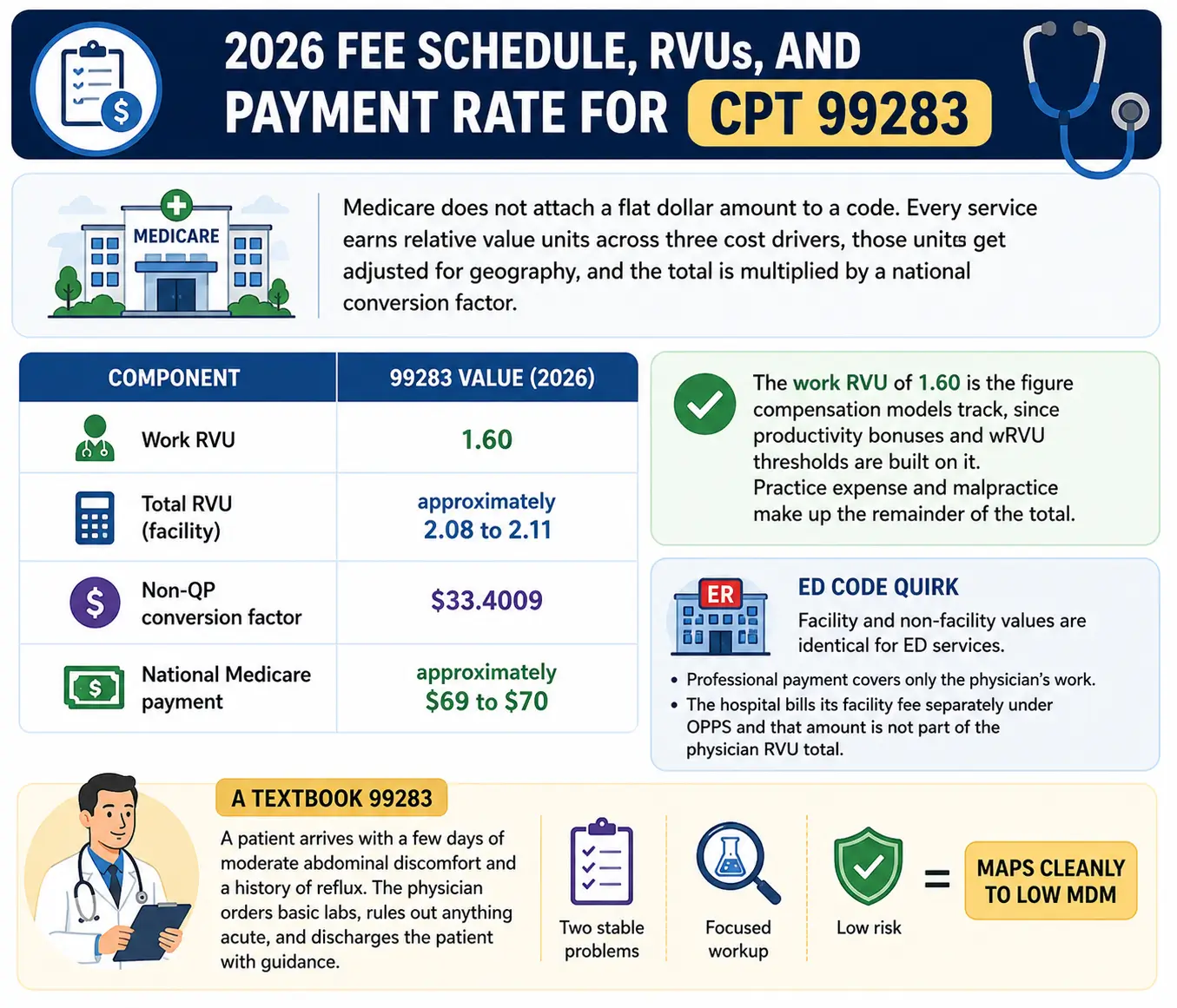
Medicare does not attach a flat dollar amount to a code. Every service earns relative value units across three cost drivers, those units get adjusted for geography, and the total is multiplied by a national conversion factor.
For 2026, the 99283 CPT code carries these values:
Component | 99283 value (2026) |
Work RVU | 1.60 |
Total RVU (facility) | approximately 2.08 to 2.11 |
Non-QP conversion factor | $33.4009 |
National Medicare payment | approximately $69 to $70 |
The work RVU of 1.60 is the figure compensation models track, since productivity bonuses and wRVU thresholds are built on it. Practice expense and malpractice make up the remainder of the total.
Emergency department codes have one quirk in the fee schedule. Facility and non-facility values are identical, because ED services are inherently hospital-based and carry a single practice-expense calculation rather than the office-versus-facility split you see on most codes. The professional payment covers only the physician’s work. The hospital bills its facility fee separately under the Outpatient Prospective Payment System, and that amount does not appear anywhere in the physician RVU total.
A textbook 99283 looks like this. A patient arrives with a few days of moderate abdominal discomfort and a history of reflux. The physician orders basic labs, rules out anything acute, and discharges the patient with guidance. Two stable problems, a focused workup, low risk. That maps cleanly to low MDM.
How the 2026 payment is calculated
The Medicare formula runs as follows:
Payment = [(Work RVU x Work GPCI) + (PE RVU x PE GPCI) + (MP RVU x MP GPCI)] x Conversion Factor
The Geographic Practice Cost Index (GPCI) adjusts each RVU component for local cost differences, so the same code pays more in a high-cost metro than in a rural county. The conversion factor is the final multiplier, and 2026 introduced a wrinkle worth flagging.
For the first time, CMS set two conversion factors. The calendar year 2026 Medicare Physician Fee Schedule final rule, released October 31, 2025, established a non-qualifying conversion factor of $33.4009 (rounded to $33.40) and a qualifying APM conversion factor of $33.5675 (rounded to $33.57). The split reflects a statutory requirement that pays clinicians who are Qualifying Participants in Advanced Alternative Payment Models at a slightly higher rate than everyone else. According to the CMS fact sheet dated October 31, 2025, the non-QP factor rose 3.26 percent from the 2025 rate of $32.3465, and the QP factor rose 3.77 percent. Both increases include a temporary 2.5 percent bump enacted through the One Big Beautiful Bill Act of 2025.
Most emergency physicians bill under the non-QP factor, so $33.4009 is the number that produces the roughly $69 to $70 estimate for 99283. Apply the QP factor and the payment nudges up by about 50 cents.
Two other 2026 policies from the final rule shape the wider fee schedule, though they land more heavily on procedure codes than on E/M visits. CMS finalized a negative 2.5 percent efficiency adjustment applied to the work RVUs of certain non-time-based services, a reduction it plans to revisit every three years. It also cut the indirect practice-expense allocation for facility-based services to half the amount allocated in the non-facility setting. For a visit code like 99283, the conversion factor remains the dominant lever on payment.
Documentation that supports low medical decision making
Since MDM alone drives the level, the chart has to show the decision making, not just the orders. Low MDM under the 2023 framework generally reflects two or more self-limited or minor problems, one stable chronic illness, or one acute uncomplicated illness or injury, combined with limited data review and a low risk of complications.
Practical documentation for a defensible 99283 includes:
- A chief complaint and a history of present illness sufficient to frame the problem
- An examination scaled to the presentation
- A visible decision-making narrative that names the differential considered, the data ordered, and why the risk landed where it did
Vague templates that record findings and orders without capturing the reasoning are the most common reason a legitimate Level 3 gets questioned or quietly underpaid. The narrative is what an auditor reads to confirm the level.
99282 vs 99283 vs 99284: reading the ER Level 3 CPT code against its neighbors
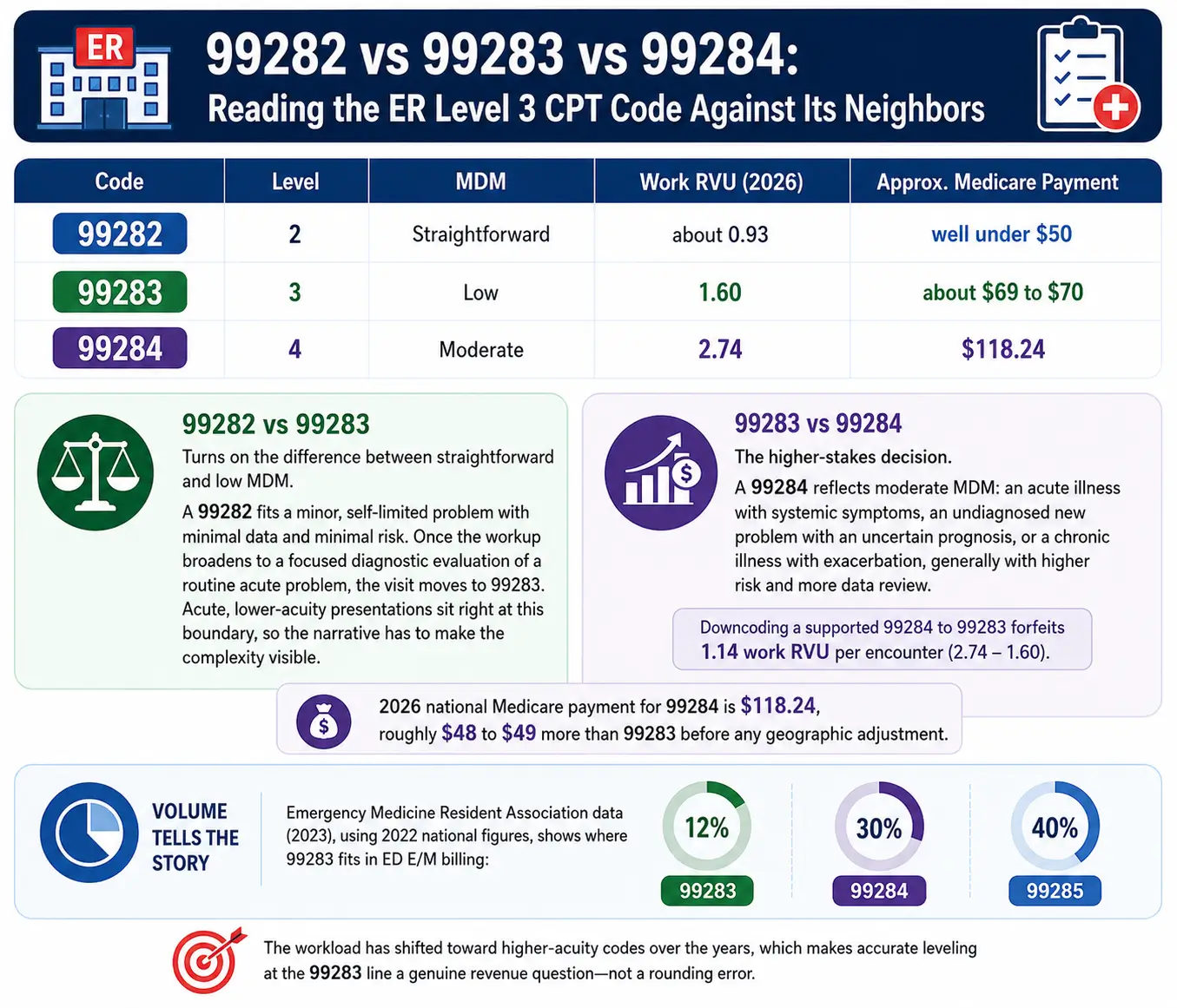
Choosing 99283 correctly means understanding the codes on either side, because the payment gaps are not small.
Code | Level | MDM | Work RVU (2026) | Approx. Medicare payment |
99282 | 2 | Straightforward | about 0.93 | well under $50 |
99283 | 3 | Low | 1.60 | about $69 to $70 |
99284 | 4 | Moderate | 2.74 | $118.24 |
99282 vs 99283 turns on the difference between straightforward and low MDM. A 99282 fits a minor, self-limited problem with minimal data and minimal risk. Once the workup broadens to a focused diagnostic evaluation of a routine acute problem, the visit moves to 99283. The acute, lower-acuity presentations that flow through both emergency rooms and urgent care sit right at this boundary, so the narrative has to make the complexity visible.
99283 vs 99284 is the higher-stakes decision. A 99284 reflects moderate MDM: an acute illness with systemic symptoms, an undiagnosed new problem with an uncertain prognosis, or a chronic illness with exacerbation, generally with higher risk and more data review. The financial distance is real. Downcoding a supported 99284 to 99283 forfeits 1.14 work RVU per encounter (2.74 minus 1.60), and that compounds fast across a year of shifts. The 2026 national Medicare payment for 99284 is $118.24, roughly $48 to $49 more than 99283 before any geographic adjustment.
Volume tells its own story about where 99283 fits. Emergency Medicine Resident Association data published in 2023, drawing on 2022 national figures, put 99283 at about 12 percent of ED E/M billing, with 99284 at 30 percent and 99285 at 40 percent. The workload has shifted toward higher-acuity codes over the years, which makes accurate leveling at the 99283 line a genuine revenue question rather than a rounding error.
Modifier 25 and same-day procedures
Emergency physicians frequently perform a minor procedure during the same encounter, such as suturing a laceration or splinting a fracture. When the E/M service is significant and separately identifiable from that procedure, append modifier 25 to the 99283. Without it, the visit can bundle into the procedure and deny.
The documentation has to support separate work. A distinct chief complaint or a history and examination that stand apart from the procedure note make the case for a separately reportable E/M service. Modifier 25 is a well-known audit target across payers, so the separate work should be legible on the chart, not implied.
CPT 99283 carries a global period indicator of XXX, meaning no post-operative day restrictions apply. It can be billed on the same day as a procedure with modifier 25, or during another code’s global period with modifier 24 when the E/M is unrelated to the earlier procedure.
Downcoding, audit exposure, and the cost of coding scared
Two failure modes surround the 99283 CPT code, and they pull in opposite directions.
The first is defensive downcoding. Coding a chart at 99283 when the documentation genuinely supports 99284, out of a general fear of scrutiny, quietly bleeds revenue. At 1.14 work RVU per downgraded encounter and a busy shift schedule, the annual figure runs into real money for a single physician, and more for a group.
The second is upcoding without support. Reaching for a 99284 on a chart that only documents low MDM invites recoupment and, with a pattern, an audit. ED downcoding and upcoding are both recognized audit priorities for hospital-based emergency medicine, which is why the safest path is neither conservative nor aggressive but accurate: code the level the MDM narrative actually supports.
The through line for both problems is the same. The chart, not the intent, decides the level. A 99283 that reads like a Level 3, with a documented differential and a clear risk assessment, holds up. One that reads like a checklist does not, regardless of what the physician was thinking.
The bottom line on CPT 99283 in 2026
CPT 99283 is a Level 3 emergency department visit defined by low medical decision making, selected on MDM alone with no time-based alternative. Under the 2026 Medicare Physician Fee Schedule it carries a 1.60 work RVU and roughly 2.08 to 2.11 total RVU, which produces a national payment near $69 to $70 at the non-QP conversion factor of $33.4009. The descriptor and RVU values held steady into fiscal year 2026, so the main variables that move the actual check are geography, payer contract, and, new for 2026, whether the billing clinician is a Qualifying APM Participant. Accurate documentation of the decision-making narrative is what separates a clean 99283 from a downcoded 99284 or a denied claim, and at more than a full work RVU per encounter, that distinction is where the money lives.