


CPT code 99396 covers the routine adult physical, the visit a patient books once a year and thinks of as a checkup. It applies to established patients between 40 and 64 years old. Most commercial and Affordable Care Act plans pay it, often in full and with no copay. One payer does not. Traditional Medicare denies it outright, and that fact decides more of these claims than any documentation detail.
This guide covers what the code reports, its 2026 reimbursement math, the age and frequency rules that trigger automatic denials, and how to pair it with a problem visit without losing the second line of the claim.
Quick reference for billers:
- Age band: established patient, 40 through 64 years, measured on the date of service
- Medicare: not payable (route to G0438 or G0439)
- Frequency: usually once per benefit year or per 365 days, set by the payer
- Same-day problem visit: allowed with modifier 25 on the problem code, not on 99396
- Preventive diagnosis: Z00.00 (no abnormal findings) or Z00.01 (abnormal findings)
What is CPT code 99396?
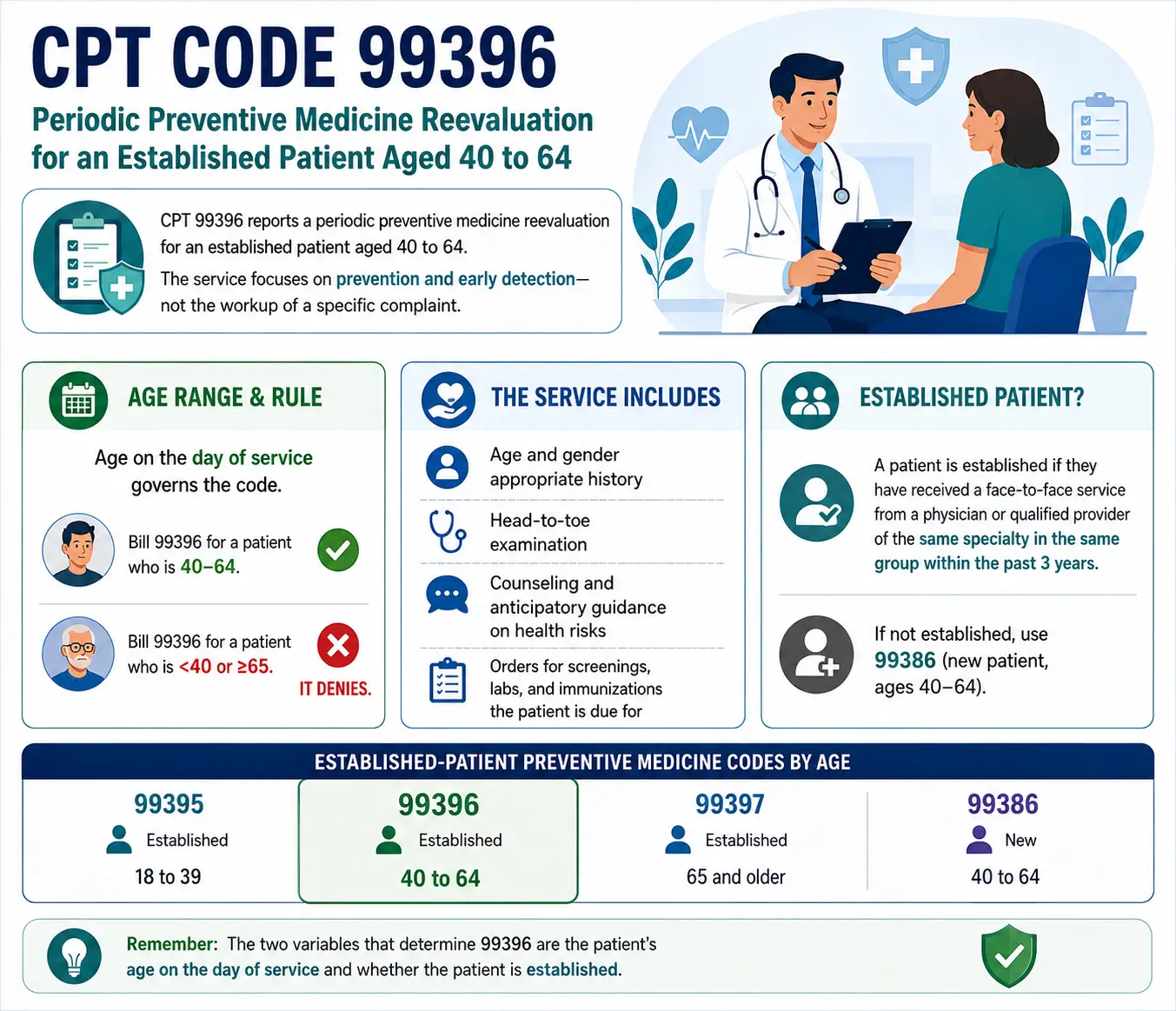
The 99396 procedure code reports a periodic preventive medicine reevaluation for an established patient aged 40 to 64. The American Medical Association, which owns and maintains CPT, groups it in the preventive medicine family that runs from 99381 to 99397. The service includes an age and gender appropriate history, a head-to-toe examination, counseling and anticipatory guidance on health risks, and orders for the screenings, labs, and immunizations the patient is due for. The point of the visit is prevention and early detection, not the workup of a specific complaint.
That distinction matters at the claim level. A problem-oriented office visit (99212 through 99215) is scored on medical decision-making or time. The 99396 code is not. Two variables decide it: the patient’s age on the day of service, and whether the patient is new or established.
99396 age range and the date-of-service rule
The age band is not a guideline. Payer systems validate the patient’s age against the code at submission, and a mismatch rejects the claim automatically. Bill 99396 for a patient who is 39, and it denies. Bill it for a patient who turned 65 before the appointment, and it denies. These are coding errors rather than coverage disputes, so an appeal will not overturn them.
The trap sits at the boundaries. A long-standing patient who turns 65 moves from 99396 to 99397, and the claim will keep going out under the old code unless someone catches the birthday. The MedSoler RCM billing guide, updated in April 2026, recommends running a date-of-birth check as part of every pre-visit eligibility screen and flagging patients within six months of aging out of the range. The age on the day of service governs, not the age when the visit was booked.
Here is how the established-patient series divides by age:
CPT code | Patient status | Age band |
99395 | Established | 18 to 39 |
99396 | Established | 40 to 64 |
99397 | Established | 65 and older |
99386 | New | 40 to 64 |
What “established” means
A patient is established if they have received a face-to-face service from a physician or qualified provider of the same specialty in the same group within the past three years. If not, the new-patient code for ages 40 to 64 is 99386, which pays more because the first visit takes more work. Sending an established patient’s claim out under 99386, or a new patient’s under 99396, produces a denial for the same reason an age error does.
99396 CPT code reimbursement rate and RVUs
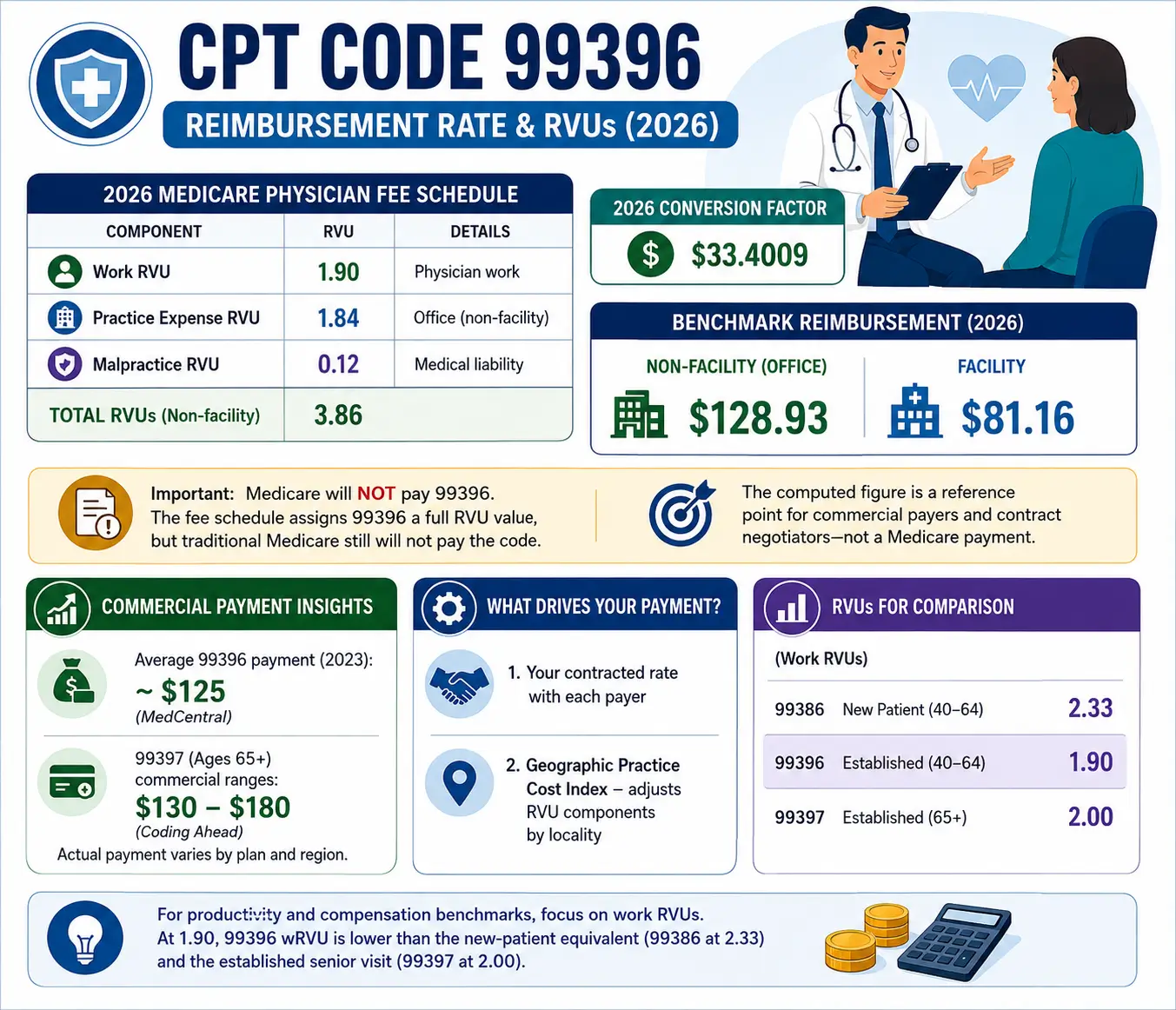
Under the CMS 2026 Medicare Physician Fee Schedule, 99396 carries a work RVU of 1.90. Adding practice expense (1.84) and malpractice (0.12) brings the non-facility total to 3.86 RVUs. Multiplying by the 2026 conversion factor of $33.4009 yields a benchmark of about $128.93 in an office (non-facility) setting and roughly $81.16 in a facility setting.
Read that number carefully. The fee schedule assigns 99396 a full RVU value, but traditional Medicare still will not pay the code (more on why below). The computed figure works as a reference point that commercial payers and contract negotiators often anchor to, not as a Medicare check that ever clears.
Actual commercial payment varies by plan and region. A 2023 analysis in MedCentral put the average 99396 payment at roughly $125. Reported commercial ranges for the adjacent 65-and-older code (99397) run higher, around $130 to $180, according to a billing reference published by Coding Ahead. Two facts move your real reimbursement more than the national average: your contracted rate with each payer, and the geographic practice cost index that adjusts every RVU component by locality.
For anyone benchmarking productivity rather than payment, the work RVU is the figure that matters, since compensation formulas track wRVUs directly. At 1.90, the 99396 wRVU sits below the new-patient equivalent (99386 at 2.33) and below the established senior visit (99397 at 2.00).
Does Medicare cover 99396?
No. Original Medicare does not pay for 99396, or for any code in the 99381 to 99397 range. Routine physical examinations are excluded from coverage by statute under the Social Security Act, so the denial is built into the program rather than left to a payer’s discretion. Billing it to traditional Medicare returns an automatic non-covered result.
Medicare covers prevention through a different set of services with their own HCPCS codes:
- G0402, the Welcome to Medicare visit (Initial Preventive Physical Examination), available in the first 12 months of Part B enrollment
- G0438, the initial Annual Wellness Visit
- G0439, subsequent Annual Wellness Visits in following years
The Annual Wellness Visit is not a hands-on physical. As the CodeICD Medicare coding guide notes, it centers on a health risk assessment, a personalized prevention plan, and screening review, and does not require a head-to-toe exam. Confusing the AWV with a routine physical is one of the most common billing errors in primary care. G0438 pays roughly 50 percent more than G0439 because the initial visit builds the record that later visits update.
Two caveats. Medicare Advantage plans set their own rules, and some do cover the preventive CPT codes in addition to the AWV, so verify the specific plan before billing. And because the physical is statutorily excluded, a patient who wants one anyway owes the charge whether or not an Advance Beneficiary Notice is signed. A voluntary ABN is still worth using as a courtesy so the cost is not a surprise.
99396 billing guidelines and documentation
A defensible 99396 note contains five elements: an age and gender appropriate history, a physical examination, counseling and anticipatory guidance, risk-factor reduction, and orders for age-appropriate screenings or immunizations. A generic intake template that could apply to any adult will not hold up under payer review, because the history and exam are supposed to reflect the specific risks of a 40-to-64-year-old.
Diagnosis coding follows the visit’s purpose. Use Z00.00 for a general adult medical examination with no abnormal findings, and Z00.01 when the exam turns up an abnormal finding. A wellness visit coded to a disease diagnosis reads as problem care and invites a denial, so the encounter’s primary diagnosis should signal prevention.
One optional modifier applies to the preventive line itself. Modifier 33 flags a service covered under the ACA preventive-care mandate, which some payers use to waive cost-sharing. Contracts differ on whether it is required, so confirm each payer’s policy rather than appending it to every claim.
99396 frequency limit: how often can 99396 be billed?
Most plans allow one preventive visit per patient per benefit year. The catch is how the year resets. Some payers count by calendar year, others by a rolling 365 days from the last preventive visit. A patient seen in March of one year and February of the next has technically had two visits inside 12 months under a 365-day rule, and the second claim denies as too frequent even though it falls in a new calendar year.
The practical fix lives in scheduling, not billing. Track the frequency rule for each payer and build it into how appointments are booked, so a patient is not brought in a few weeks early only to have the claim rejected.
Can 99396 and 99214 be billed together?
Yes, when the encounter includes both a preventive visit and a significant, separately identifiable problem. If a 52-year-old comes in for her annual physical and also needs her worsening knee or two chronic conditions evaluated, the claim can carry 99396 for the preventive service and a problem-oriented E/M (99213 or 99214, whichever the work supports) for the rest.
The rule that trips up billing staff: modifier 25 goes on the problem E/M code, not on 99396. Put it on the preventive line and the claim denies. The AMA’s guidance is explicit that the office/outpatient code is the one that carries the modifier to show a separate service was performed the same day.
Documentation has to justify two services. A reviewer should be able to see a complete preventive visit on one side and a problem evaluation that stands on its own on the other. Reusing the same history and exam to prop up both codes is the leading audit finding in this code family. The problem E/M must be independently supported.
Expect a payer haircut on the second line. Many plans reduce payment on the problem visit when it rides alongside a preventive one. UnitedHealthcare’s published policy, for example, pays the preventive service in full plus 50 percent of the problem-oriented E/M billed with modifier 25. Some payers bundle the two entirely, so verify the specific policy before promising the practice full payment on both.
The same logic applies to 99213. Bill 99396 with 99213-25 when a smaller problem is addressed, keeping the two notes distinct.
99396 vs 99214
These codes answer different questions, and they are not interchangeable.
99396 | 99214 | |
Visit type | Preventive, established patient | Problem-oriented, established patient |
Age rule | 40 to 64 required | No age restriction |
How it is selected | Age and established status | Medical decision-making or time |
Traditional Medicare | Not payable | Payable |
Typical diagnosis | Z00.00 or Z00.01 | Condition-specific |
Same-day modifier | 33 (optional, ACA) | 25 (when paired with a preventive visit) |
Related preventive codes: 99386 and 99397
Three codes surround 99396, and mixing them up is the most frequent error in adult preventive billing.
99386 is the new-patient version for the same 40-to-64 age band. It reports the first full preventive visit for a patient the practice has not seen within three years, carries a work RVU of 2.33, and pays more than 99396 for that reason.
99397 picks up established patients at 65 and older, with a work RVU of 2.00. This is where the Medicare problem compounds: a patient who ages into 99397 is often Medicare-primary at the same time, which means the code both changes and becomes non-payable to Original Medicare. The visit routes to G0438 or G0439 instead.
99395 is the established-patient code for ages 18 to 39, one step down the same ladder.
Keeping the four straight comes down to two checks before the claim goes out: the patient’s age on the date of service, and new-versus-established status. Get both right and 99396 clears most commercial payers without friction.
The single rule worth pinning above a biller’s desk is the one that causes the most denials. Traditional Medicare does not pay the 99396 CPT code. For patients with commercial or ACA coverage, it is the correct code for the adult preventive visit at ages 40 to 64, it usually pays in full, and it holds up when the age band, the frequency limit, and the modifier placement are handled correctly.