


Choosing clinical software is one of the larger operational decisions a small practice makes, and it is harder than the marketing suggests. A solo family physician and a three-provider cardiology group have different billing patterns, different reporting obligations, and different tolerances for setup time. This guide looks at the best EHR and EMR systems for small practices through the factors that actually govern the choice: federal certification, interoperability rules, reimbursement programs, and total cost.
Adoption is close to universal. The Office of the National Coordinator for Health Information Technology (ONC) reported that 91 percent of office-based physicians had adopted a certified EHR as of 2024, part of a rise from 42 percent using any electronic record in 2008. Most practices have already adopted one. The harder question is which one fits.
EHR vs EMR: the distinction that affects billing and reporting
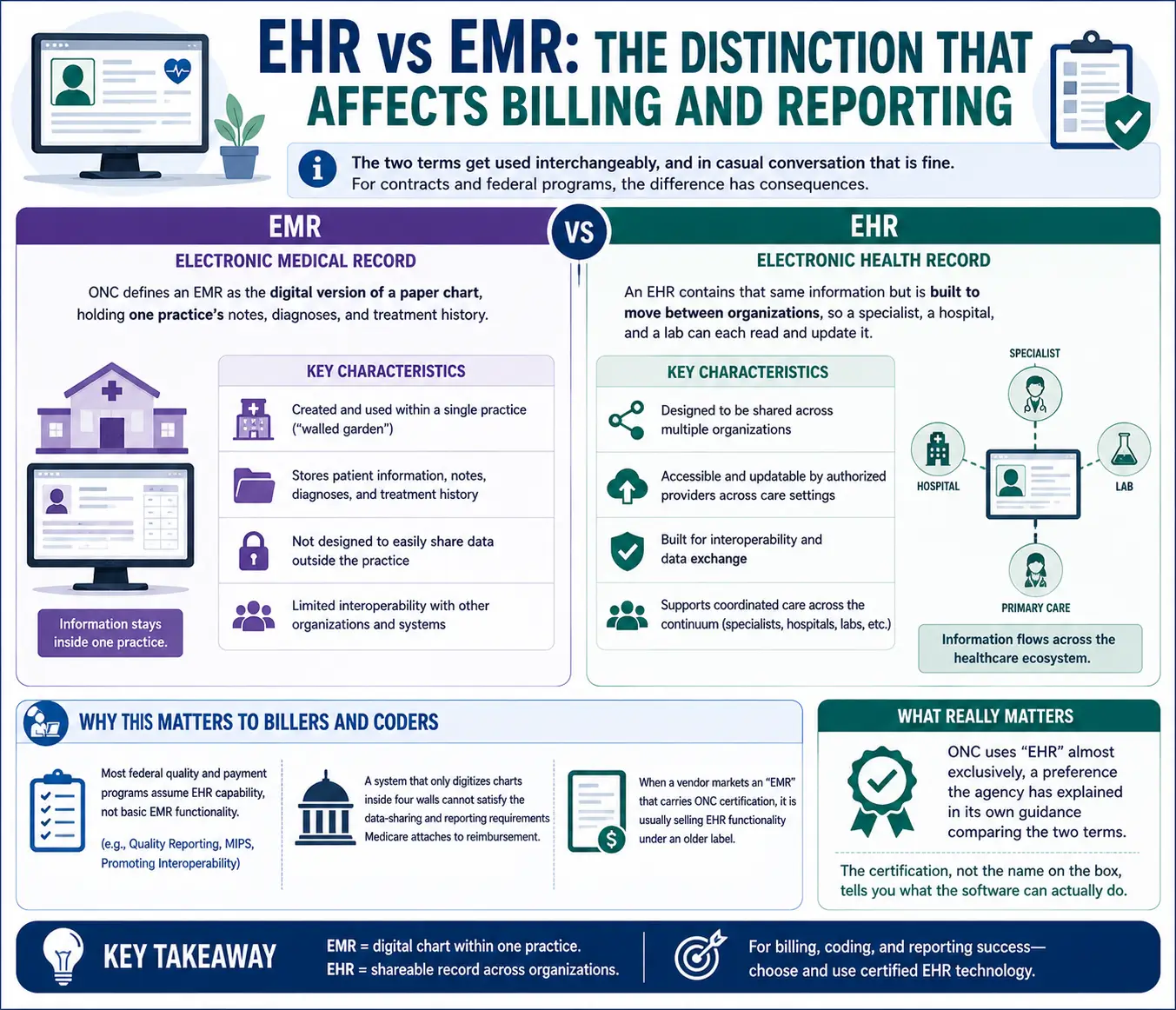
The two terms get used interchangeably, and in casual conversation that is fine. For contracts and federal programs, the difference has consequences. ONC defines an electronic medical record (EMR) as the digital version of a paper chart, holding one practice’s notes, diagnoses, and treatment history. An electronic health record (EHR) contains that same information but is built to move between organizations, so a specialist, a hospital, and a lab can each read and update it. The ONC primarily uses the term “EHR,” a preference the agency has outlined in its guidance comparing “EHR” and “EMR.
Why does this matter to a biller or coder? Most federal quality and payment programs assume EHR capability, not basic EMR functionality. A system that only digitizes charts inside four walls cannot satisfy the data-sharing and reporting requirements Medicare attaches to reimbursement. When a vendor markets an “EMR” that carries ONC certification, it is usually selling EHR functionality under an older label. The certification, not the name on the box, tells you what the software can actually do.
Start with certification, not features
Before comparing dashboards, check whether a system is certified. The ONC Health IT Certification Program sets the technical, security, and interoperability requirements that software must meet, and every certified product appears on the Certified Health IT Product List (CHPL), a public database at chpl.healthit.gov. A product earns its listing after testing by an ONC-Accredited Testing Laboratory and certification by an ONC-Authorized Certification Body. Practices cannot use a product to report Medicare’s Promoting Interoperability measures unless it is listed on the CHPL.
Certification also carries interoperability obligations. The criterion known as (g)(10), the Standardized API for Patient and Population Services, requires certified software to expose a data interface built on the FHIR standard and to support every data element in the United States Core Data for Interoperability (USCDI). That is the machinery that lets patients pull their records into a smartphone app and lets one system hand data to another.
Certification is a floor, not a guarantee of good conduct. In January 2020, the Department of Justice announced a $145 million settlement with Practice Fusion, then owned by Allscripts, in what the DOJ described as the first criminal case against an EHR vendor. Practice Fusion admitted taking a $1 million kickback from an opioid manufacturer to build clinical decision support alerts that pushed physicians toward prescribing. Investigators also found the company had obtained ONC certification by claiming its software met 2014 Edition data-portability requirements, then disabled the export feature after certification. The conduct predated the Allscripts acquisition, and the company later revised its compliance program. For a small practice, the lesson is practical. Confirm that data export works before you depend on it, because getting your records out is exactly where some vendors have cut corners.
The Cures Act rules every practice now works under
Since April 5, 2021, the information blocking provisions of the 21st Century Cures Act (signed into law in December 2016) have applied to physicians. The rule prohibits practices, vendors, and health information networks from interfering with the access, exchange, or use of electronic health information, subject to eight defined exceptions. At first the requirement covered only the data elements in USCDI. As of October 6, 2022, it expanded to the full set of electronic protected health information in the designated record set, which in most cases means nearly the entire chart.
Enforcement has teeth for some actors and is still developing for others. Health IT developers, health information exchanges, and health information networks that commit information blocking face civil monetary penalties of up to $1 million per violation. For clinicians, the government set “disincentives” through a separate rule effective July 31, 2024, tied to Medicare programs rather than direct fines. A later certification update, the HTI-1 final rule, took effect on January 15, 2025.
Alongside these rules, the government has stood up TEFCA (the Trusted Exchange Framework and Common Agreement), a voluntary nationwide framework meant to let certified networks exchange records under one common set of terms. Most small practices connect to it through their EHR vendor rather than joining directly, which is one more reason the vendor’s interoperability track record matters.
One naming note trips people up in current documents. ONC was renamed ASTP/ONC in July 2024, then HHS reversed that change on March 31, 2026, returning the agency to its original name. The regulations did not change, only the letterhead.
Best EHR and EMR systems for small practices
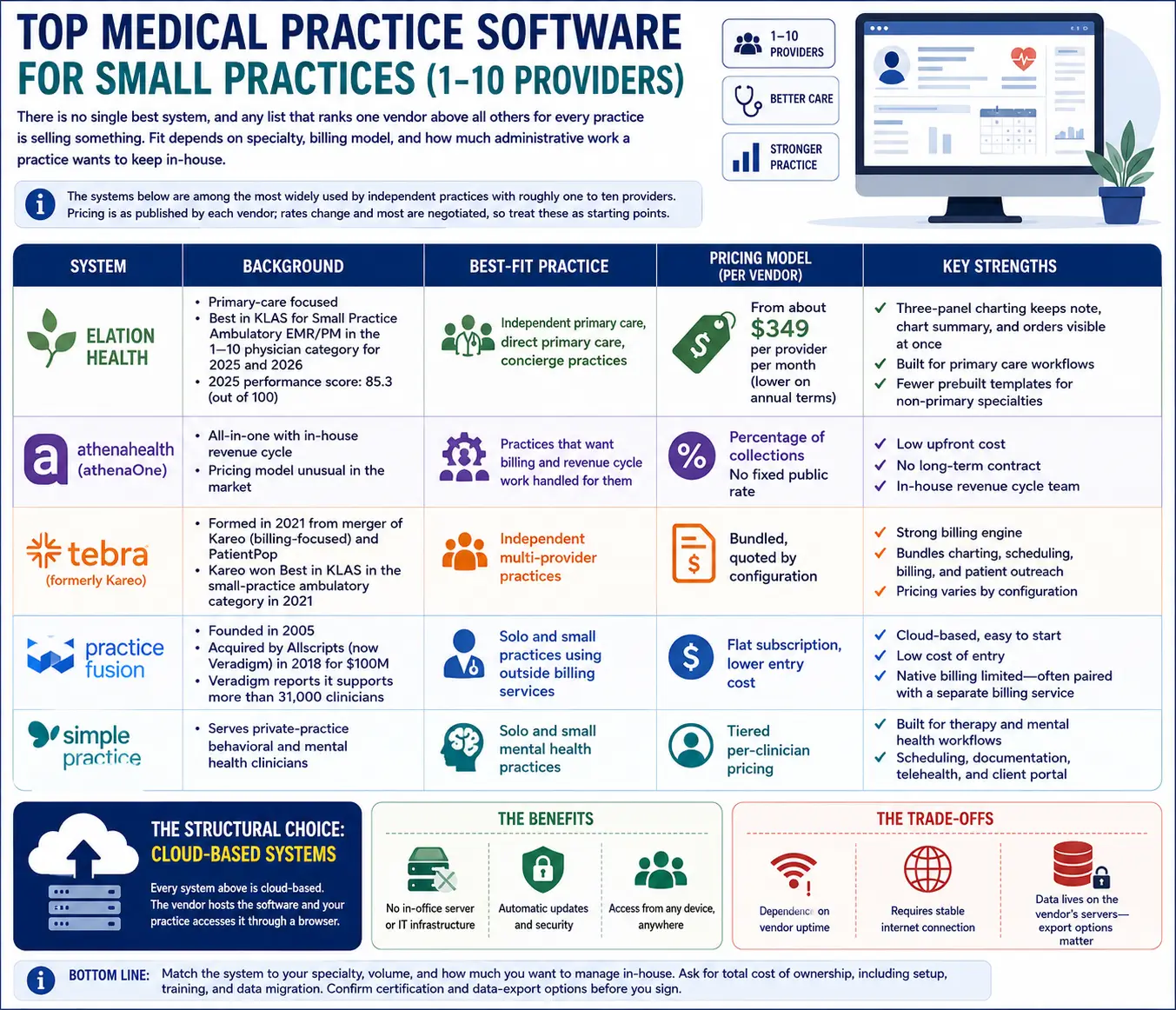
There is no single best system, and any list that ranks one vendor above all others for every practice is selling something. Fit depends on specialty, billing model, and how much administrative work a practice wants to keep in-house. The systems below are among the most widely used by independent practices with roughly one to ten providers. Pricing is as published by each vendor; rates change and most are negotiated, so treat these as starting points.
Elation Health was named Best in KLAS for Small Practice Ambulatory EMR/PM in the one-to-ten-physician category for both 2025 and 2026, with a 2025 performance score of 85.3 on the firm’s 100-point scale. KLAS bases its rankings on interviews with verified customers rather than vendor submissions. Elation is built around primary care, with a three-panel charting screen that keeps the note, chart summary, and orders visible at once. The company lists pricing starting near $349 per provider per month, lower on annual terms. Specialty groups outside primary care will find fewer prebuilt templates.
athenahealth (its athenaOne product) uses a pricing model unusual among these vendors. Instead of a flat per-provider fee, it charges a percentage of what the practice actually collects. The company does not publish a fixed rate; independent buyer guides commonly estimate 4 to 8 percent of net collections, and athenahealth’s own materials emphasize low upfront cost and no long-term contract. The model suits offices that want billing and revenue cycle work handled for them, and it can cost more than a flat-fee system once collections per provider climb.
Tebra was formed in 2021 from the merger of Kareo, a billing-focused platform for independent practices, and PatientPop. Kareo had won Best in KLAS in the small-practice ambulatory category in 2021, and the billing engine remains the product’s strength. Tebra bundles charting, scheduling, billing, and patient outreach. It does not publish a fixed price list, so quotes vary by configuration.
Practice Fusion, founded in 2005 and acquired by Allscripts (now Veradigm) in 2018 for $100 million, is a cloud system aimed at small and solo practices that want minimal setup. Veradigm reports it supports more than 31,000 clinicians. Its base subscription is comparatively low, but native billing has historically been limited, so many practices pair it with a separate billing service.
SimplePractice serves private-practice behavioral and mental health clinicians and publishes tiered per-clinician pricing. Its documentation and scheduling suit solo therapists more than multi-specialty medical groups.
System | Background | Best-fit practice | Pricing model (per vendor) |
Elation Health | Primary-care focused; Best in KLAS 2025 and 2026 (1-10 physicians) | Independent primary care, direct primary care, concierge | From about $349 per provider per month |
athenahealth (athenaOne) | All-in-one with in-house revenue cycle | Practices that want billing handled for them | Percentage of collections, no fixed public rate |
Tebra (formerly Kareo) | Billing-strong; Kareo won Best in KLAS 2021 | Independent multi-provider practices | Bundled, quoted by configuration |
Practice Fusion | Cloud, entry-level; owned by Veradigm | Solo and small practices using outside billing | Flat subscription, lower entry cost |
SimplePractice | Behavioral and mental health focus | Solo and small mental health practices | Tiered per-clinician |
One structural choice sits underneath all of these. Every system named here is cloud-based, meaning the vendor hosts the software and the practice reaches it through a browser. Cloud delivery removed the need for an in-office server and the staff to maintain it, which is why nearly all products aimed at small practices now work this way. The trade-off is dependence on the vendor’s uptime and on a stable internet connection, and it raises the stakes on the data-export question, since the records physically sit on the vendor’s servers rather than in the office.
How your system choice affects MIPS and reimbursement
For practices that bill Medicare, the software decision feeds directly into the Merit-based Incentive Payment System (MIPS), and small practices receive specific accommodations. CMS defines a small practice as one with 15 or fewer MIPS-eligible clinicians billing under the same taxpayer identification number. That threshold changes the math in three ways worth knowing.
First, the Promoting Interoperability category, normally 25 percent of the MIPS final score, is automatically reweighted to zero for small practices unless they choose to report it. When that happens, the weight shifts mostly to Quality. Second, small practices receive a bonus of six points added to their Quality score. Third, a practice that does report Promoting Interoperability must use ONC Certified Health IT and must cover a performance period of at least 180 continuous days, up from the 90-day minimum in earlier years.
The payment consequences arrive on a delay. A clinician’s 2025 performance sets a positive or negative adjustment to Medicare Part B payments in 2027. Only clinicians who exceed the low-volume threshold, which includes billing more than $90,000 in Medicare Part B allowed charges, are required to participate. For a biller or coder, this is where system choice and daily work meet. The codes captured in the EHR become the quality and cost data CMS scores, so accurate documentation inside the system is what protects the reimbursement.
Questions to answer before you sign
The demo will look fine. The contract is where the surprises live. A few questions separate a system that fits from one a practice regrets.
- What is the total first-year cost, not the headline price? Implementation, data migration, training, and per-provider minimums often add several thousand dollars per provider beyond the advertised subscription.
- How do you get your data out? Ask for the export format and test it during a trial. The Practice Fusion case is a reminder that portability can be an afterthought.
- Is billing included or separate? A low EHR price paired with a third-party billing service can total more than an all-in-one system, and the reverse is also true.
- Does the certified listing match what you are buying? Confirm the exact product and version on the CHPL, since certification applies to specific listings rather than to a brand.
- How long is implementation? Vendors quote anywhere from a couple of weeks for a solo cloud setup to two or three months for a multi-provider office that must complete payer enrollment.
A small practice does not need the system a hospital runs. Among the best EHR and EMR systems for small practices, the right one for a given office is the system that reports the programs the practice participates in, releases its own data on request, and fits the billing model without absorbing hours that belong to patients. Confirm certification on the CHPL, match the pricing model to your collections, and test data export before the contract renews. The choice that works is the one that disappears into the workflow and leaves the reimbursement intact.