


AdvancedMD is a cloud-based software platform that independent medical practices use to run scheduling, clinical charting, and billing from a single login. Knowing how AdvancedMD works matters because the software touches almost every administrative and financial task in a practice, from the moment a patient books an appointment to the day an insurance claim gets paid. According to AdvancedMD, roughly 65,000 practitioners across 14,000 practices, plus about 900 medical billing companies, run on the system. This guide covers what the software includes, how the pieces connect, what it costs, and the kinds of practices it suits.
Who owns AdvancedMD and where it came from
AdvancedMD launched in 1999. It was one of the first companies to deliver medical practice software entirely over the internet instead of installing it on servers inside each office. That web-based model is now standard, but it was uncommon when the company started. AdvancedMD is headquartered in South Jordan, Utah, and employs approximately 700 people.
Ownership has changed hands several times, which is worth knowing if you plan to commit to the software for years. Francisco Partners first acquired the company in 2008 and sold it to ADP in 2011. Marlin Equity Partners bought it in 2015, then sold it to the payment-technology firm Global Payments in 2018 for $700 million in cash, a figure reported by Fortune in March 2024. In October 2024, Global Payments agreed to sell AdvancedMD back to Francisco Partners. Financial data provider MarketScreener reported the total consideration at roughly $1.1 billion, and the deal closed on December 16, 2024. The sale returned AdvancedMD to a standalone company. As part of the transaction, President Amanda Sharp added the title of chief executive officer, and Global Payments stayed on as a long-term payment-processing partner.
For a practice buying software, this history has a practical upside. Under Francisco Partners, AdvancedMD is again its own business rather than one product line inside a large payments company, which the firm said would sharpen its focus on the software itself.
How the platform is built
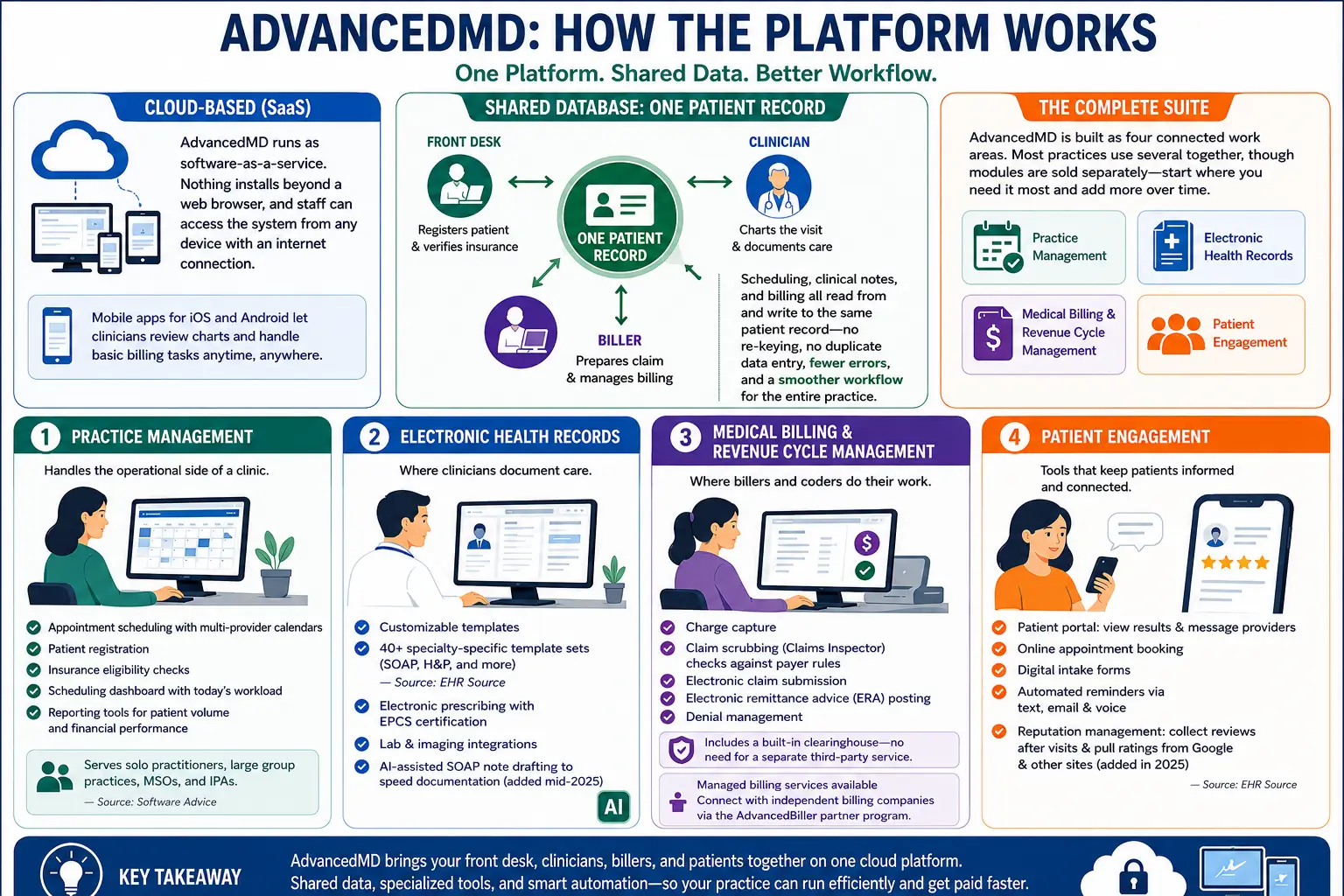
AdvancedMD runs as software-as-a-service. Nothing installs on a practice’s own computers beyond a web browser, and staff reach the system from any device with an internet connection. The company also offers mobile apps for iOS and Android, so clinicians can review charts and handle basic billing tasks away from the front desk.
The design point that shapes how the software works day to day is a shared database. Scheduling, clinical notes, and billing all read from and write to the same patient record. When a front-desk employee registers a patient and verifies insurance, that information is available to the clinician charting the visit and to the biller preparing the claim, without re-keying it into separate systems. Reducing duplicate data entry is one of the main reasons practices consolidate onto a single platform.
The suite breaks into four working areas: practice management, electronic health records, medical billing and revenue cycle management, and patient engagement. Most practices use several of these together, though the modules are sold separately, so a practice can start with billing and add clinical charting later.
Practice management
The practice management module handles the operational side of a clinic. It covers appointment scheduling with multi-provider calendars, patient registration, insurance eligibility checks, and a scheduling dashboard that groups the day’s workload into one view. It also includes reporting tools that track patient volume and financial performance. Reviewers at software directory Software Advice note that the system serves solo practitioners as well as larger group practices, management services organizations, and independent practice associations.
Electronic health records
The EHR module is where clinicians document care. It supports customizable templates, and EHR review site EHR Source reports that AdvancedMD ships with more than 40 specialty-specific template sets covering formats such as SOAP notes and history and physical documentation. Practices can adjust those templates without vendor help. The module includes electronic prescribing, with certification for prescribing controlled substances (EPCS), plus lab and imaging integrations. In mid-2025, the company added an AI-assisted feature that drafts SOAP notes to speed up documentation, a change reported by several EHR review sites covering the platform.
Medical billing and revenue cycle management
This is the part of AdvancedMD that medical billers and coders work in most. The billing module covers charge capture, claim scrubbing, electronic claim submission, electronic remittance advice (ERA) posting, and denial management. It includes a built-in clearinghouse, so practices do not have to route claims through a separate third-party service. A scrubbing tool the company calls Claims Inspector checks each claim against payer rules before it goes out, flagging coding problems that would otherwise trigger a denial. For practices that would rather not staff a billing team, AdvancedMD runs a managed billing service and also connects practices with independent billing companies through its AdvancedBiller partner program.
Patient engagement
The patient-facing tools include an online portal where patients view results and message their provider, online appointment booking, digital intake forms, and automated reminders sent by text, email, and voice. In 2025, according to EHR Source, AdvancedMD added reputation-management features that ask patients for online reviews after visits and pull review scores together from Google and other sites.
How a claim moves through the system
For billing and coding students, the clearest way to understand AdvancedMD is to follow a claim from start to finish.
A visit begins with charge capture, where the services provided are coded and entered, often carried over from the clinical note so the coder is not starting from a blank screen. The charge then passes through Claims Inspector, which validates it against the relevant payer’s rules and holds anything that looks likely to be rejected. Once a claim clears scrubbing, it submits electronically through the built-in clearinghouse to the payer. When the payer responds, ERA files post payments and adjustments back into the system automatically, and anything denied lands in a worklist for staff to correct and resubmit. Throughout, financial dashboards track figures billers care about, including days in accounts receivable, clean claim rate, and collection percentage.
AdvancedMD reports processing about 8.8 million insurance claims each month across its billing platform, which gives a sense of the volume the system is built to handle. Practices that outsource billing to AdvancedMD’s own team pay for that service as a percentage of what they collect, reported by several review sites at 4% to 8% of monthly collections rather than a flat software fee.
How billing companies work inside AdvancedMD
Because part of the target audience for this software is people training as medical billers and coders, it helps to understand how third-party billing firms use the same system. AdvancedMD sells its platform not only to clinics but to independent billing companies, and the company reports that roughly 900 of them run on it. These firms log into a practice’s AdvancedMD instance and handle claims on the clinic’s behalf, working the same charge capture, scrubbing, and denial tools a clinic’s in-house biller would use.
Two features support that arrangement. The AdvancedBiller program connects practices that want to outsource with billing companies in AdvancedMD’s partner network, and it gives those partners tools built for managing multiple client practices at once. A central billing office workflow lets a single team oversee claims across several clinics from one place. For anyone entering the field, this means AdvancedMD skills transfer across employers: the same interface shows up whether you work for a clinic directly or for a billing service that contracts with dozens of them.
Getting data out of the system
Practices sometimes need their information for reporting tools or accountants outside the platform. According to Software Advice, AdvancedMD includes an open database connectivity (ODBC) interface that gives read-only access to practice data. That matters for larger groups that build their own reports or feed practice figures into separate business-intelligence software, since it means the data is not locked behind the vendor’s own reporting screens.
Certifications and compliance
Certification determines whether an EHR can be used for federal quality-reporting programs, so it is a real buying factor rather than a marketing label. AdvancedMD’s health IT module is certified to the ONC 2015 Edition Cures Update criteria, and the company’s certification page states the software has been certified by an ONC-authorized certification body. That certification supports participation in the Merit-based Incentive Payment System (MIPS) and meets requirements tied to MACRA. AdvancedMD publishes annual real-world testing plans and results, which the ONC program requires of certified developers, with reports available for each year through 2025.
On security, the company offers two-factor authentication as an option that a practice administrator can require across all users and locations. Its billing and clinical operations run under HIPAA rules, and third-party billing firms working inside the platform reference SOC 2 controls.
What AdvancedMD costs
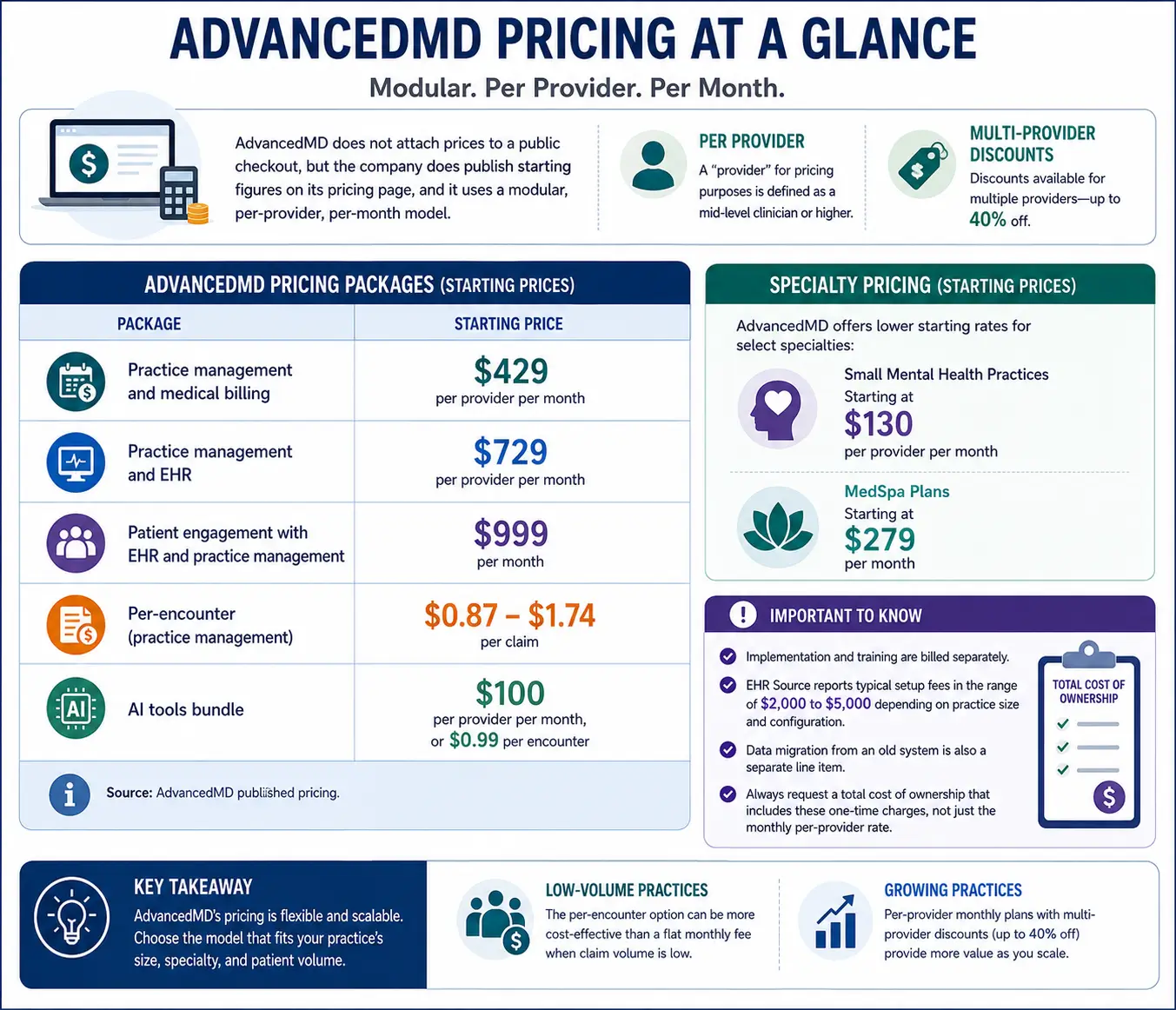
AdvancedMD does not attach prices to a public checkout, but the company does publish starting figures on its pricing page, and it uses a modular, per-provider, per-month model. A “provider” for pricing purposes is defined as a mid-level clinician or higher, and multi-provider discounts run up to 40 percent.
Package | Starting price |
Practice management and medical billing | $429 per provider per month |
Practice management and EHR | $729 per provider per month |
Patient engagement with EHR and practice management | $999 per month |
Per-encounter (practice management) | $0.87 to $1.74 per claim |
AI tools bundle | $100 per provider per month, or $0.99 per encounter |
Source: AdvancedMD published pricing.
The per-encounter option matters for low-volume practices. Instead of a flat monthly fee, they pay per submitted claim, which can cost less than a subscription when patient volume is light. AdvancedMD also lists specialty pricing that starts lower than its general rates, including plans for small mental health practices beginning at $130 per provider per month and MedSpa plans at $279 per month.
Two costs sit outside these figures. Implementation and training are billed separately, and EHR Source reports typical setup fees in the range of $2,000 to $5,000 depending on practice size and configuration. Data migration from an old system is also a separate line item. Any practice comparing quotes should ask for a total cost of ownership that includes these one-time charges, not just the monthly per-provider rate.
Which practices it fits, and where it falls short
AdvancedMD is built for ambulatory, outpatient practices rather than hospitals or inpatient settings. Review sites consistently describe it as a strong fit for small and mid-sized independent clinics that want scheduling, charting, and billing in one system. Its long history in billing is the feature reviewers most often single out.
The software has limits worth weighing. Because pricing is modular, add-ons such as appointment reminders, telemedicine, API access, and advanced reporting stack on top of the base rate, and third-party pricing guides note that these can surprise buyers who budgeted only for the core package. Reviewers on directory sites also report a learning curve during setup and mixed experiences with customer service. Practices evaluating alternatives commonly compare AdvancedMD with athenahealth, which charges a percentage of collections rather than a per-provider fee, along with eClinicalWorks and Tebra, each of which prices differently. The right choice depends on patient volume, how much billing a practice wants to handle in-house, and whether a flat monthly fee or a collections-based model fits its cash flow.
For a practice deciding how AdvancedMD works for its own situation, the summary is straightforward. It is a cloud platform, founded in 1999 and owned since December 2024 by Francisco Partners, that combines practice management, ONC-certified electronic health records, medical billing, and patient engagement in one shared database used by about 65,000 practitioners. Software starts at $429 per provider per month for billing and practice management, rising to $729 with clinical charting added, with per-encounter and specialty options for smaller or lower-volume practices. The strongest reasons to choose it are its integrated billing tools and single-system workflow; the main cautions are add-on costs and the setup effort any practice should plan for before going live.