


Medical practices lose significant revenue when processing paper claims. According to the 2023 CAQH Index, the U.S. healthcare system could save approximately $1.7 billion each year by replacing paper-based claims processing with electronic claims submission. A single paper claim costs an average of $6 to process, whereas an electronic claim costs approximately $0.90. Transitioning to a digital workflow requires specific infrastructure. This is where medical billing clearinghouse software becomes necessary.
A healthcare clearinghouse acts as an electronic intermediary between healthcare providers and insurance payers. When medical billers submit patient data, the software translates the files into standard formats, checks the data for errors, and securely routes the claims to the correct insurance companies. Choosing the best clearinghouse for medical billing directly impacts a clinic’s cash flow, denial rate, and administrative workload.
What is a Medical Billing Clearinghouse?
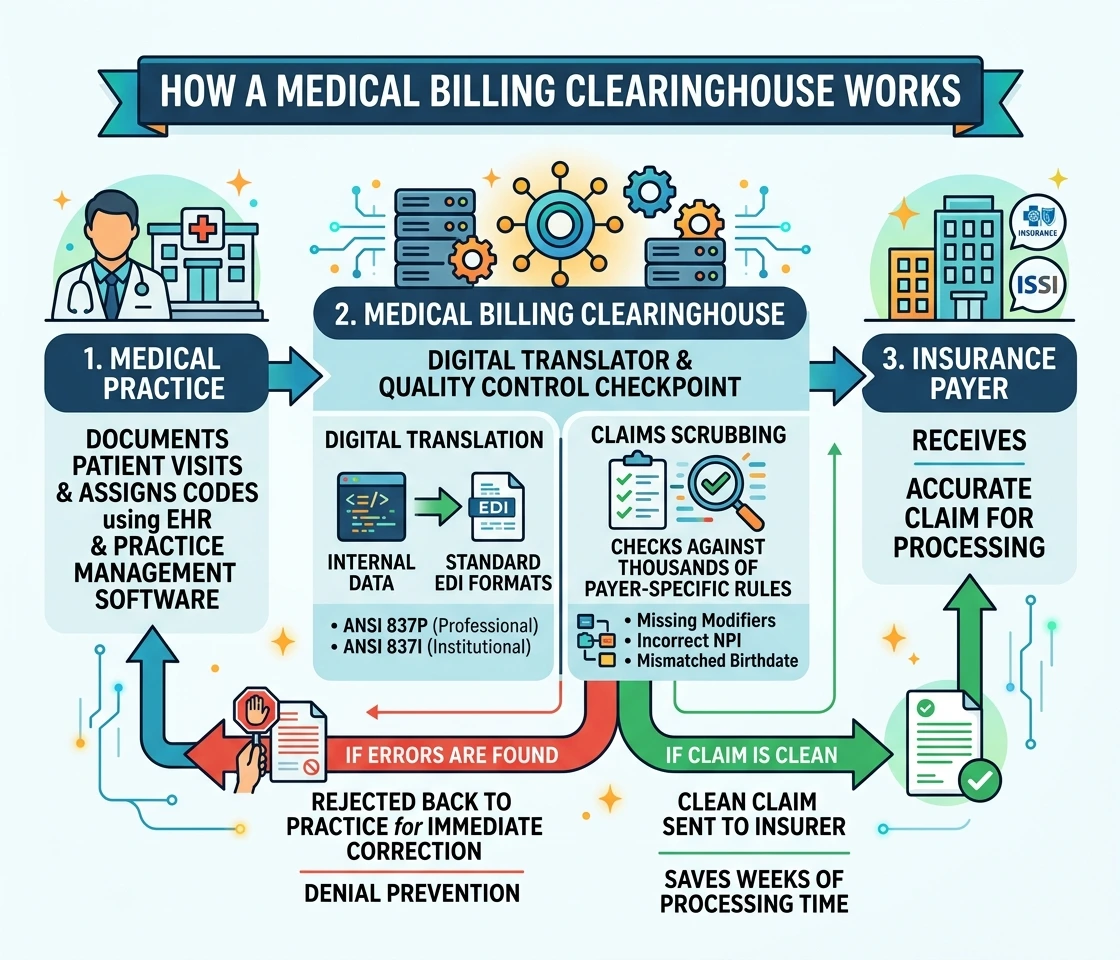
A medical claims clearinghouse functions as a digital translator and quality control checkpoint. Medical practices use electronic health records (EHR) and practice management software to document patient visits and assign medical codes. However, insurance companies require claims submitted in highly specific electronic formats.
When a practice submits a batch of claims, the clearinghouse converts the internal data into the standard Electronic Data Interchange (EDI) format required by the payer. For professional medical claims, this format is known as the ANSI 837P. For institutional claims, it is the ANSI 837I.
Before transmission, the clearinghouse software performs claims scrubbing. This validation process checks the claim against thousands of payer-specific rules. If the software finds a missing modifier, an incorrect National Provider Identifier (NPI), or a mismatched patient birthdate, it rejects the claim back to the practice for immediate correction. This denial prevention step happens before the insurance company ever sees the claim, saving weeks of processing time.
Top 10 Medical Billing Clearinghouse Software
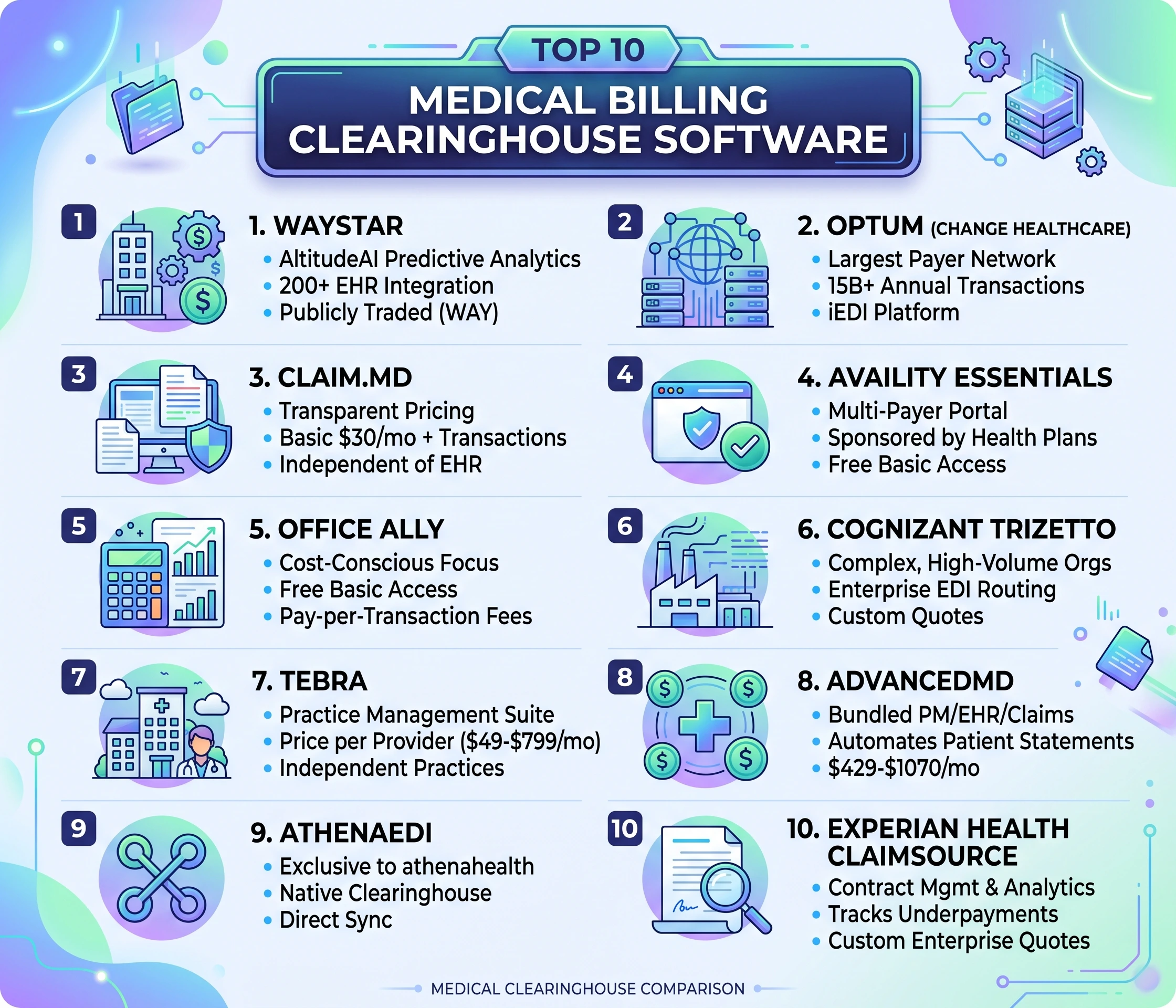
The medical clearinghouse companies listed below vary in scale, pricing, and specific technical capabilities. Some focus on independent practitioners, while others build infrastructure for large hospital networks.
1. Waystar
Waystar processes more than 7.5 billion transactions annually. The company became publicly traded on the NASDAQ under the ticker symbol WAY in June 2024. Waystar relies heavily on its predictive analytics engine, AltitudeAI, to identify high-risk claims prior to submission. The platform integrates with over 200 EHR systems, including Epic and Cerner. Pricing typically ranges from $200 to $800 per month for standard subscriptions, or $0.20 to $0.35 per individual claim.
2. Optum (Change Healthcare)
Optum acquired the Change Healthcare technology infrastructure and currently operates the largest payer network in the United States. The network processes more than 15 billion transactions a year, representing over $1.5 trillion in medical claims. The system provides direct, free claims routing to UnitedHealthcare via its iEDI platform. In February 2024, the Change Healthcare network experienced a severe cyberattack affecting an estimated 100 million individuals, forcing many practices to implement backup clearinghouse routes.
3. Claim.MD
Claim.MD operates with public, transparent pricing tiers, making it highly visible to independent clinics. A basic plan costs $30 per month and bills users by transaction volume. A $60 monthly small volume plan includes 100 claims, 100 electronic remittance advice (ERA) responses, and 100 eligibility transactions. The platform supports both professional and institutional claims, and users can operate the system independently of their primary EHR.
4. Availity Essentials
Availity Essentials functions as a multi-payer portal sponsored directly by health plans. Practices can access the basic tier for free. This free access includes patient eligibility and benefits verification, authorization requests, claim status checks, and payer notifications. While it serves well as a primary clearinghouse for specific participating payers, many large groups use Availity as a secondary route alongside a paid clearinghouse.
5. Office Ally
Office Ally targets cost-conscious medical and mental health practices. The primary Service Center starts with free basic access, though the company charges specific transaction fees. For example, the software charges $10 for the first 100 eligibility transactions and $0.10 for each subsequent check. Claim attachments cost $0.55 each. Office Ally accepts multiple file upload methods, including direct SFTP connections, which accommodates practices using older medical billing software with clearinghouse limitations.
6. Cognizant TriZetto
TriZetto Provider Solutions serves complex, high-volume healthcare organizations. The system handles extensive enterprise EDI routing and requires custom pricing quotes based on exact transaction volume. TriZetto provides deep connectivity for hospital-linked specialty groups that require specific compliance tools and high-speed batch processing.
7. Tebra
Previously known as Kareo, Tebra packages clearinghouse capabilities directly into an independent practice suite. Instead of charging per claim, Tebra prices its software per provider. Monthly costs generally run between $49 and $799 per provider, depending on the selected modules. This combined system provides a single interface for scheduling, charting, and electronic claims submission.
8. AdvancedMD
AdvancedMD functions as a bundled practice management, EHR, and claims option. The vendor does not sell the clearinghouse as a standalone product. Medical packages range from $429 to $1,070 per provider each month. The system heavily automates patient statements and ERA reconciliation within a single database.
9. athenaEDI
athenaEDI operates exclusively within the athenahealth ecosystem. Clinics using athenahealth for their clinical documentation use this native clearinghouse to route claims and track financial performance. Pricing is custom or bundled directly into the master practice agreement.
10. Experian Health ClaimSource
Experian Health focuses heavily on contract management and analytics. ClaimSource tracks exactly what an insurance company owes a practice based on negotiated fee schedules. If a payer underpays a claim, the software flags the discrepancy automatically. Pricing requires a custom enterprise quote.
How Do You Choose Clearinghouse Software?
Selecting the correct clearinghouse requires analyzing your practice’s specific billing volume, existing software, and payer mix.
First, verify EHR integration capabilities. If a clearinghouse cannot communicate directly with your current medical records software, billers must manually export and upload files daily. This manual step introduces human error and slows down cash flow. Ensure the vendor supports API or SFTP connections for your specific EHR version.
Second, evaluate the claims scrubbing engine. The primary financial value of a clearinghouse comes from catching errors. Ask vendors for their first-pass clean claim rate. A clean claim passes all edits and requires no manual intervention. You want software that allows you to build custom scrubbing rules tailored to your specific medical specialty.
Third, review the ERA and EFT capabilities. When an insurance company finalizes a payment, they send an Electronic Remittance Advice (ERA, or ANSI 835 file) back to the clearinghouse. The clearinghouse then posts this data into your practice management system. Simultaneously, the payer deposits an Electronic Funds Transfer (EFT) into the clinic’s bank account. Your software must automatically match the ERA data to the specific EFT batch to maintain accurate accounting.
Frequently Asked Questions
Can a clearinghouse connect to multiple payers?
Yes. A single commercial clearinghouse maintains direct data connections with thousands of insurance companies, including regional Blue Cross Blue Shield plans, commercial carriers, Medicare administrative contractors, and state Medicaid programs. You submit one standardized batch of claims, and the software automatically separates and routes the data to the correct destinations.
Are medical clearinghouses HIPAA compliant?
Under the Health Insurance Portability and Accountability Act (HIPAA), a healthcare clearinghouse is explicitly defined as a covered entity. This legal classification means clearinghouses must comply with exactly the same privacy, security, and breach notification rules as hospitals and health insurance plans. They must encrypt patient data in transit and at rest, and they must undergo regular security audits.
How does a medical clearinghouse work for patient eligibility?
Before a patient arrives for an appointment, billers use clearinghouse software to run an electronic eligibility verification check (an ANSI 270 request). The payer responds (an ANSI 271 response) with the patient’s active coverage status, deductible balance, copayment requirements, and specific service authorizations. Verifying this data electronically takes seconds, whereas calling an insurance company can take an hour.
How much does a medical clearinghouse cost?
Clearinghouse pricing falls into three categories. Transactional models charge a small fee per claim or eligibility check, usually between $0.10 and $0.35. Subscription models charge a flat monthly fee, such as $60 to $120, for a set block of transactions. Enterprise models require a custom contract based on total annual volume and specific analytics modules.
Final Selection Factors
Implementing a new medical claims clearinghouse requires dedicated IT resources, provider credentialing updates, and staff training. The operational disruption of switching vendors means clinics should select a system capable of handling their projected growth over the next five years. Review your top three choices by comparing their specific payer lists, testing their denial analytics dashboards, and verifying exactly how their customer support teams handle missing batch files. Evaluating these practical elements ensures your practice maintains a steady, predictable revenue cycle.