


For ten years, the ICD-10 code for multiple sclerosis was one of the easiest assignments in a neurology chart. Every patient with MS, whatever their disease course or activity, was coded G35. That stopped on October 1, 2025. The FY2026 ICD-10-CM update turned G35 into a parent code and added eight billable subcodes that name the specific type of MS and state whether the disease is active. A claim that still carries a bare G35 for a date of service on or after that date can be rejected. This guide walks through the new structure, the documentation each code needs, and the related codes that coders most often confuse with MS.
What is the ICD-10 code for multiple sclerosis?
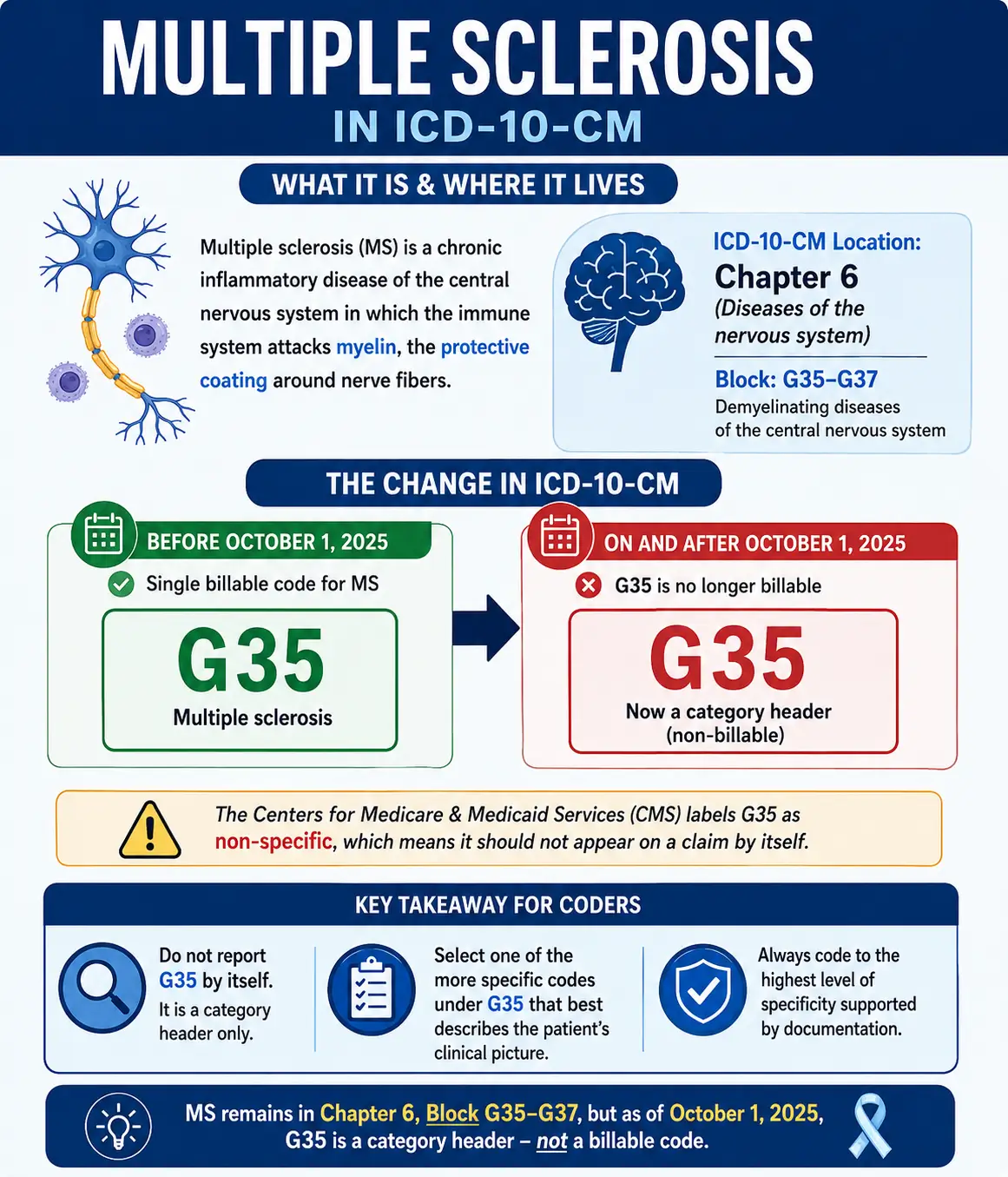
Multiple sclerosis is a chronic inflammatory disease of the central nervous system in which the immune system attacks myelin, the protective coating around nerve fibers. In ICD-10-CM it lives in Chapter 6 (Diseases of the nervous system), inside the block G35 to G37, Demyelinating diseases of the central nervous system.
Since ICD-10-CM took effect in the United States in October 2015, MS carried a single code: G35. As of October 1, 2025, G35 is no longer billable. It became a category header, and coders now select one of the more specific codes beneath it. The Centers for Medicare and Medicaid Services labels G35 as non-specific, which means it should not appear on a claim by itself.
Why the multiple sclerosis ICD-10 codes changed for 2026
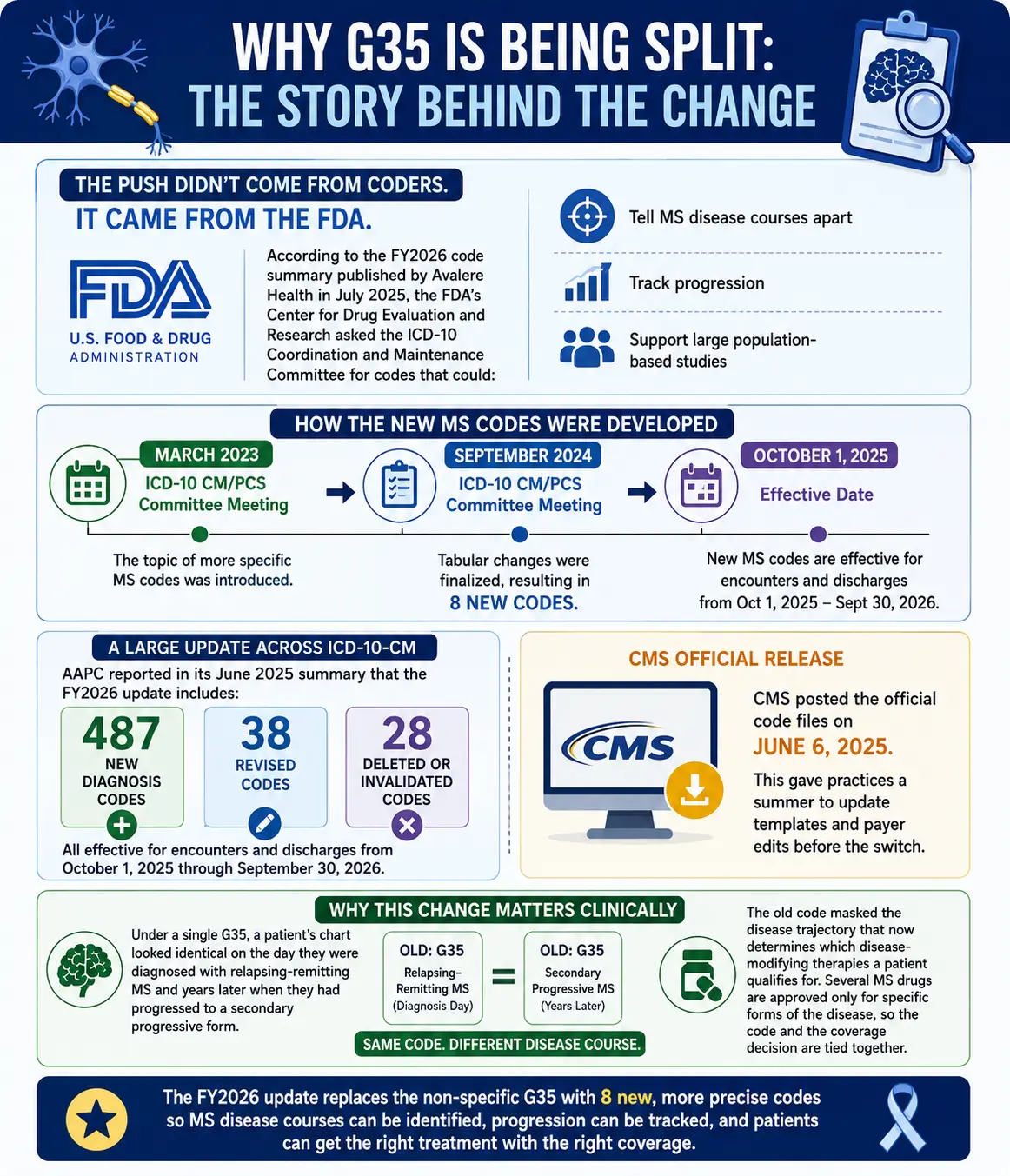
The push to split G35 did not come from coders. It came from the Food and Drug Administration.
According to the FY2026 code summary published by Avalere Health in July 2025, the FDA’s Center for Drug Evaluation and Research asked the ICD-10 Coordination and Maintenance Committee for codes that could tell MS disease courses apart, track progression, and support large population-based studies. The topic first appeared at the March 2023 committee meeting. The tabular changes were finalized at the September 2024 meeting, which produced eight new codes.
The wider release was one of the larger updates in recent years. AAPC reported in its June 2025 summary that the FY2026 update added 487 new diagnosis codes, revised 38, and deleted or invalidated 28, all effective for encounters and discharges from October 1, 2025 through September 30, 2026. CMS posted the official code files on June 6, 2025, which gave practices a summer to update templates and payer edits before the switch.
There was a clinical reason behind the request. Under a single G35, a patient’s chart looked identical on the day they were diagnosed with relapsing-remitting MS and years later when they had progressed to a secondary progressive form. The old code masked the disease trajectory that now determines which disease-modifying therapies a patient qualifies for. Several MS drugs are approved only for specific forms of the disease, so the code and the coverage decision are tied together.
The complete list of ICD-10 codes for multiple sclerosis
The expanded family contains nine codes. Eight are billable. G35 itself, along with the two subcategory headers G35.B and G35.C, cannot stand alone on a claim.
Code | Description | Billable |
G35 | Multiple sclerosis (category header) | No |
G35.A | Relapsing-remitting multiple sclerosis | Yes |
G35.B | Primary progressive multiple sclerosis (subcategory) | No |
G35.B0 | Primary progressive multiple sclerosis, unspecified | Yes |
G35.B1 | Active primary progressive multiple sclerosis | Yes |
G35.B2 | Non-active primary progressive multiple sclerosis | Yes |
G35.C | Secondary progressive multiple sclerosis (subcategory) | No |
G35.C0 | Secondary progressive multiple sclerosis, unspecified | Yes |
G35.C1 | Active secondary progressive multiple sclerosis | Yes |
G35.C2 | Non-active secondary progressive multiple sclerosis | Yes |
G35.D | Multiple sclerosis, unspecified | Yes |
This structure is confirmed in the CDC’s own FY2026 ICD-10-CM tool and in the AHA Coding Clinic notice that accompanied the expansion. The next four sections cover what each subtype means and when to reach for it.
Relapsing-remitting multiple sclerosis (G35.A)
This is the form most patients start with. The National Multiple Sclerosis Society reports that about 85 percent of people with MS are initially diagnosed with the relapsing-remitting type. Patients have distinct attacks of new or worsening symptoms, called relapses, followed by periods of partial or full recovery.
G35.A has no separate active and non-active options. Relapses are part of the definition of the phenotype, so the code stands on its own without an activity digit. That single-digit simplicity makes G35.A one of the more forgiving codes in the set, but it still requires the provider to have documented a relapsing-remitting course.
Primary progressive multiple sclerosis (G35.B0 to G35.B2)
Primary progressive MS describes steady worsening of neurologic function from the onset, without the clear relapses and recoveries seen in the relapsing-remitting form. It is less common. Figures from the National MS Society and the Multiple Sclerosis Association of America place primary progressive MS at roughly 10 to 15 percent of diagnoses.
Three codes describe it. Use G35.B1 when there is evidence of inflammatory disease activity, G35.B2 when there is none, and G35.B0 when the record does not state activity status. B0 is the fallback, not the default, and a provider query is the cleaner path when the note is silent.
Secondary progressive multiple sclerosis (G35.C0 to G35.C2)
Secondary progressive MS is the phase that can follow years of relapsing-remitting disease, when disability begins to accumulate steadily rather than in discrete attacks. The National MS Society has cited earlier research suggesting that, before disease-modifying therapies were available, about half of people with relapsing-remitting MS transitioned to a secondary progressive course within 10 years and roughly 90 percent within 25 years. Newer treatments appear to slow that shift.
The activity split mirrors the primary progressive codes: G35.C1 for active disease, G35.C2 for non-active, and G35.C0 when activity is not documented. A patient who moves from relapsing-remitting to secondary progressive MS moves from G35.A to a G35.C code, and the chart should show the transition rather than leaving both under the old G35.
Multiple sclerosis, unspecified (G35.D)
G35.D applies only when the provider has documented MS but not its type. The tabular lists disseminated multiple sclerosis and generalized multiple sclerosis as terms that map here. G35.D is billable, so it will pass a claims edit, but it carries less clinical detail and, on repeated encounters, invites payer scrutiny. Treat it as a signal to query the provider for the phenotype rather than a comfortable landing spot.
Active versus non-active MS: the distinction that drives the code
For the progressive forms, the whole choice between codes rests on one word: active.
In ICD-10-CM terms, active MS means there is evidence of inflammatory disease activity. In clinical practice that evidence takes the form of a documented relapse, new or enlarging lesions on MRI, gadolinium-enhancing lesions, or documented disease progression that prompts a change in treatment. Non-active MS means the disease is stable, with no recent relapse and no new imaging findings.
Activity is not a fixed trait. A patient can be active at one visit and non-active at the next, so the status has to be pulled from the current encounter rather than carried forward from an old note. Coders who assume last year’s activity status still applies will misstate the disease and, in some payer models, misstate the patient’s risk.
How to code a multiple sclerosis exacerbation or flare
There is no separate ICD-10 code for an MS exacerbation. Coders searching for a dedicated multiple sclerosis flare code will not find one, and that is by design.
Under the old single code, “Exacerbation of multiple sclerosis” was listed as an inclusion term beneath G35. The 2026 structure captures the same clinical event through the combination of type and activity. A flare in a patient with progressive disease is reflected by an active code, G35.B1 or G35.C1. A relapse in a patient with relapsing-remitting MS stays at G35.A, because relapses are built into that phenotype.
A relapse itself is usually defined as new or worsening neurological symptoms that persist for at least 24 hours in the absence of fever or infection. The treatment of the flare, such as a course of intravenous or oral corticosteroids, is captured through the appropriate procedure or drug codes, not through the MS diagnosis code.
Clinically isolated syndrome and the G37.9 code
A common error is coding a first demyelinating episode as MS. Clinically isolated syndrome (CIS) is the first episode of neurological symptoms caused by inflammation and demyelination, lasting at least 24 hours. Not everyone who experiences CIS goes on to develop MS.
CIS does not belong under G35. It maps to G37.9, Demyelinating disease of central nervous system, unspecified, which lists clinically isolated syndromes as an inclusion term in the tabular. Assigning a G35 code to a CIS patient records a diagnosis the clinician has not confirmed. Only once the patient meets the diagnostic criteria for MS does a G35 code become appropriate.
History of multiple sclerosis: personal and family history codes
Two history scenarios come up often, and they are handled differently.
For personal history, MS is a lifelong condition, so a patient who has MS is still coded with the active G35 code at every encounter. There is no routine “personal history of multiple sclerosis” assignment, because personal-history Z codes describe conditions that no longer exist. Z86.69, personal history of other diseases of the nervous system and sense organs, is a valid code, but it does not fit an MS diagnosis that is still present and being managed.
For family history, when a patient’s relative has MS and the patient does not, the code is Z82.0, family history of epilepsy and other diseases of the nervous system. MS falls within the “other diseases of the nervous system” this code covers. Z82.0 cannot serve as a principal diagnosis and is exempt from present-on-admission reporting, so it supports a visit rather than driving it.
Documentation that supports the new G35 codes
The expanded codes only work if the note supports them. To land on a specific code rather than G35.D, the record needs two things: the MS subtype (relapsing-remitting, primary progressive, or secondary progressive) and, for the progressive forms, the activity status at that encounter.
Manifestations of MS get their own additional codes under the etiology and manifestation convention. Dementia due to multiple sclerosis, for example, is reported as G35.D with F02.80, or F02.81 when there is a behavioral disturbance, with the codes sequenced together. Symptoms such as spasticity, bladder dysfunction, or optic involvement are coded separately when they are documented and clinically relevant.
For inpatient stays, MS still groups to the same three MS-DRGs in the FY2026 definitions: DRG 058 (multiple sclerosis and cerebellar ataxia with major complication or comorbidity), DRG 059 (with complication or comorbidity), and DRG 060 (without either). The new subtype detail does not change the DRG, but it does feed the risk-adjustment models that many payers apply on the outpatient side.
The ICD-10 code for multiple sclerosis is now a family of nine codes, eight of them billable, replacing the single G35 that coders used from 2015 to 2025. Two facts decide the code: the MS subtype and, for progressive disease, whether it is active. Charts that record both let the claim through. Charts that stop at “multiple sclerosis” leave the coder with G35.D or a denial. Building those two questions into the documentation template is the step that prevents both.