


An abnormal electrocardiogram is one of the most frequent results a coder handles, and it produces some of the most avoidable denials in cardiology billing. The reason is short. An abnormal EKG is a finding, not always a diagnosis. That single distinction sits underneath every Abnormal EKG ICD-10 decision, and it decides whether you report R94.31 or a more specific cardiac code.
This guide walks through what R94.31 covers, when to assign it, which findings get their own code, and the mistakes that push clean claims into the denial pile.
What R94.31 actually codes
R94.31 is the ICD-10-CM code for Abnormal electrocardiogram [ECG] [EKG]. It is a billable, specific code, valid for fiscal year 2026 (October 1, 2025 through September 30, 2026), according to the code set published by CMS and the National Center for Health Statistics.
The code lives in Chapter 18 of ICD-10-CM, “Symptoms, signs and abnormal clinical and laboratory findings, not elsewhere classified” (R00 through R99). More precisely, it falls in block R90 through R94, “Abnormal findings on diagnostic imaging and in function studies, without diagnosis.” AHRQ’s Clinical Classifications Software Refined (CCSR) files it under “Abnormal findings without diagnosis.” Every piece of its placement points to the same idea: R94.31 describes a test result, not a confirmed condition.
A few facts worth keeping in front of you:
- R94.31 crosswalks directly from the old ICD-9-CM code 794.31, Nonspecific abnormal electrocardiogram, per the 2026 CMS General Equivalence Mappings. The word “nonspecific” carried over in spirit, even though it dropped from the descriptor.
- ICD-10-CM does not separate “ECG” from “EKG.” They name the same test, and both route to the same code.
- The code is not a CC or MCC (complication/comorbidity or major complication/comorbidity), so on the inpatient side it does not raise the DRG on its own. It groups to MS-DRG 314 through 316 when it lands as a principal diagnosis.
- R94.31 carries one Excludes1 note: long QT syndrome (I45.81). An Excludes1 note means the two codes are never reported together.
When R94.31 is correct, and when it is not
The rules here come straight from the ICD-10-CM Official Guidelines for Coding and Reporting, not from payer folklore.
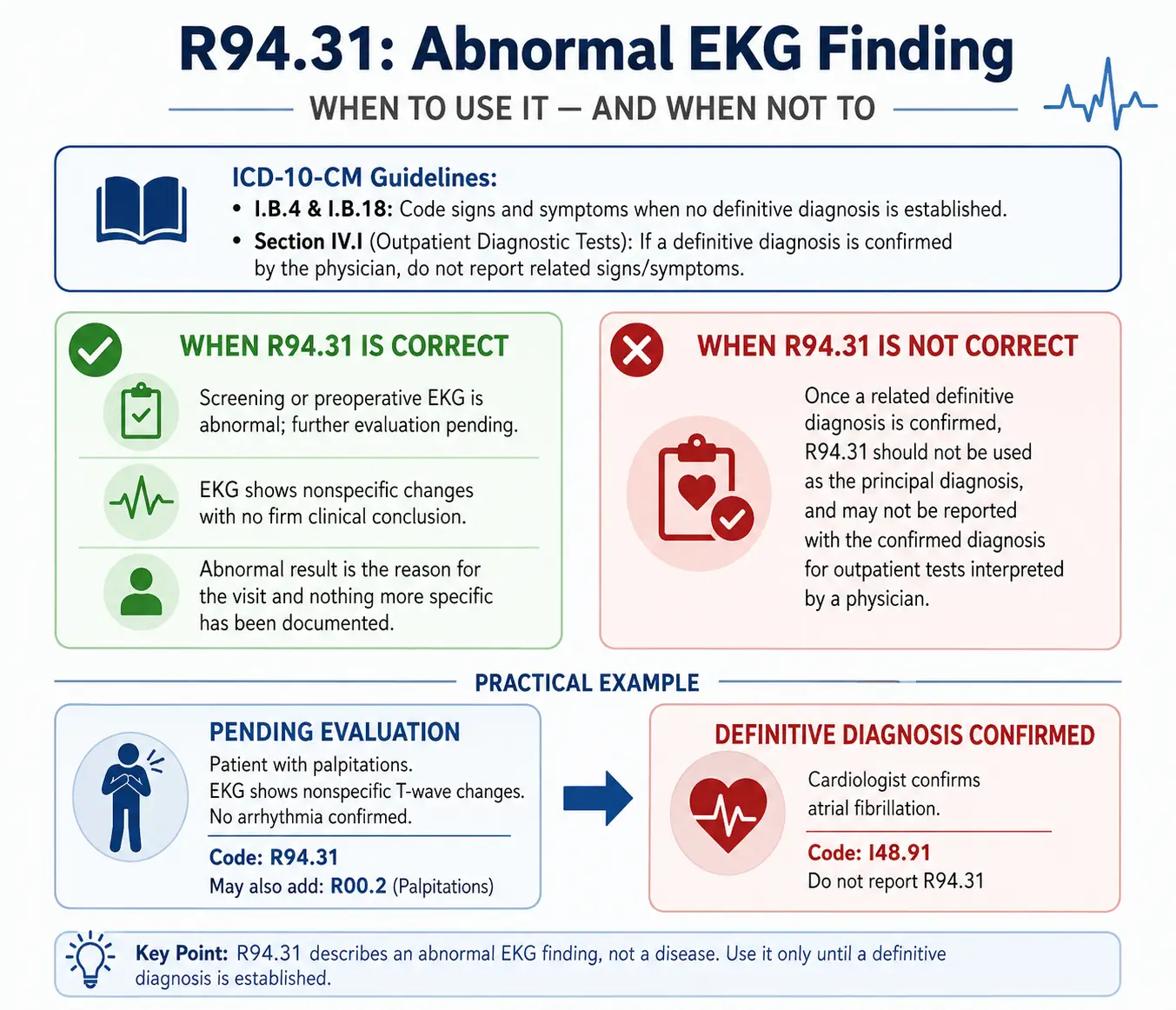
Section I.B.4 states that codes describing symptoms and signs are acceptable for reporting when a related definitive diagnosis has not been established by the provider. Section I.B.18 adds that if a definitive diagnosis has not been established by the end of the encounter, reporting the sign or symptom in lieu of a diagnosis is appropriate. So R94.31 has a legitimate, guideline-supported home.
The limit shows up in two places. Chapter 18 codes are not used as a principal diagnosis once a related definitive diagnosis is confirmed. And Section IV.I, which governs outpatient diagnostic tests, is even more direct: for tests interpreted by a physician where the final report is available at the time of coding, you code the confirmed diagnosis and do not report the related signs and symptoms as additional codes.
Put those together and R94.31 fits cleanly in situations like these:
- A screening or preoperative EKG is read as abnormal, and further evaluation is still pending.
- The tracing shows nonspecific changes with no firm clinical conclusion.
- The abnormal result is the reason for the visit and nothing more specific has been documented.
A practical example. A patient reports palpitations. The EKG shows nonspecific T-wave changes, and the provider has not confirmed an arrhythmia. R94.31 supports the encounter, and you may add the symptom code for palpitations (R00.2) if it is separately documented. Now change one detail. The cardiologist reviews the study and confirms atrial fibrillation. At that point I48.91 becomes the diagnosis, and R94.31 drops off. The abnormal reading was the doorway to the diagnosis, not the diagnosis itself.
Findings that stay under R94.31 versus findings that earn a specific code
This is where most of the day-to-day confusion sits. Many descriptive EKG phrases have no dedicated ICD-10-CM code. They are nonspecific findings, and ICD-10-CM captures all of them under R94.31 because that is where the old “nonspecific abnormal EKG” concept maps.
The findings below have no separate ICD-10-CM code. Assign R94.31:
EKG finding as documented | ICD-10-CM code |
Nonspecific ST-T wave abnormality | R94.31 |
Nonspecific T-wave abnormality or T-wave inversion (isolated) | R94.31 |
Nonspecific ST-segment change or ST depression (not attributed to a condition) | R94.31 |
Low-voltage QRS | R94.31 |
Poor R-wave progression | R94.31 |
Left axis deviation | R94.31 |
Right axis deviation | R94.31 |
Borderline ECG | R94.31 |
A different group of findings names an actual, confirmed condition. When the provider documents these, the specific code replaces R94.31:
Confirmed finding | ICD-10-CM code |
First-degree atrioventricular block | I44.0 |
Complete (third-degree) AV block | I44.2 |
Left bundle-branch block | I44.7 |
Right bundle-branch block, unspecified | I45.10 |
Long QT syndrome | I45.81 |
Atrial fibrillation, unspecified | I48.91 |
Old (healed) myocardial infarction with residual changes | I25.2 |
The dividing line is documentation, not the EKG machine’s interpretive statement. A machine printout that reads “abnormal ECG, consider anterior ischemia” is not a physician diagnosis of ischemia. Until the provider signs off on a specific condition, the nonspecific finding rules the code.
R94.31 against its neighbors: R94.30 and R94.39
Three codes sit close together, and mixing them up is a common source of low-level denials.
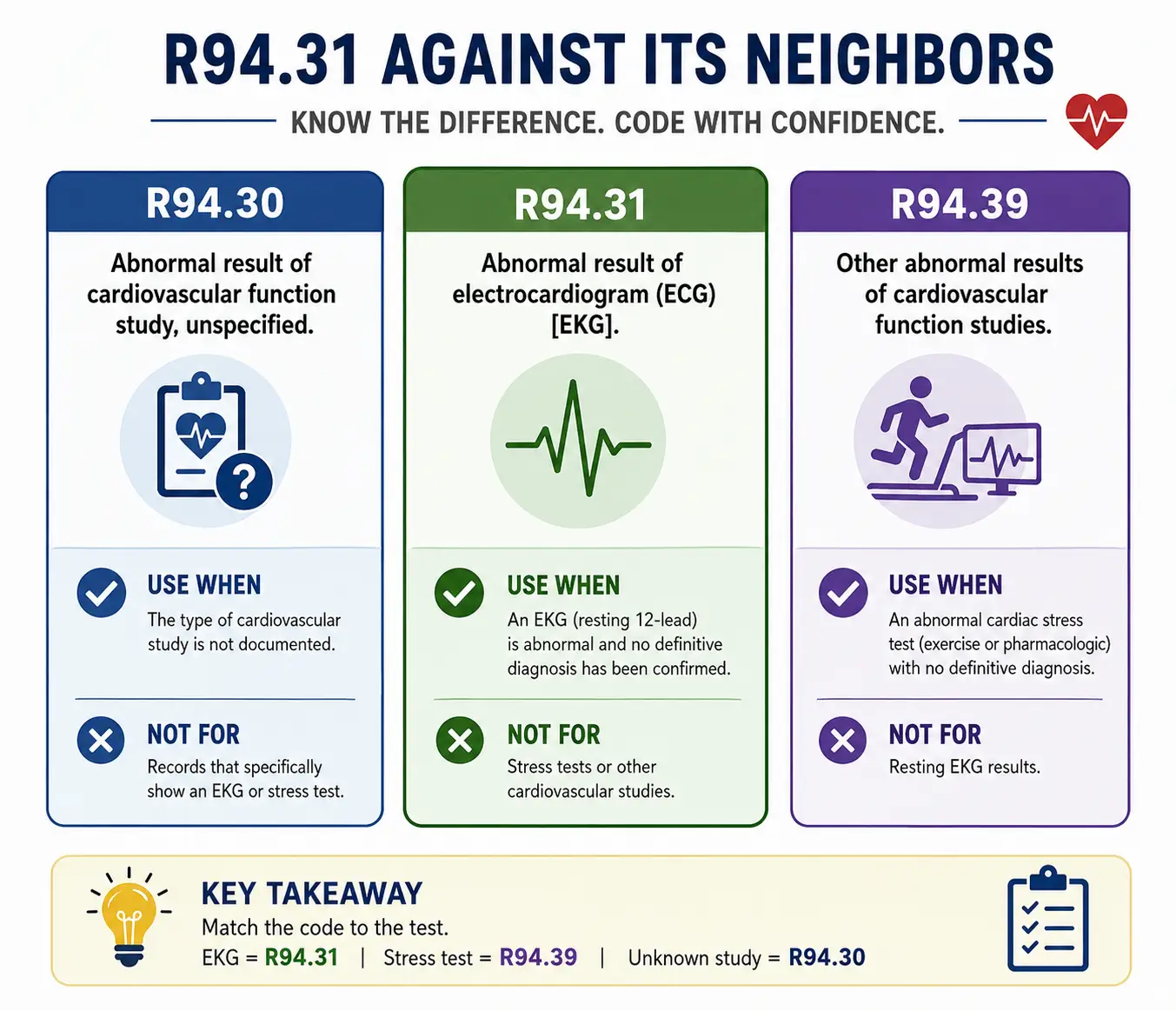
R94.30 is “Abnormal result of cardiovascular function study, unspecified.” Reserve it for cases where the type of cardiovascular test is genuinely not documented. If the record shows an EKG, R94.30 is the wrong, less precise choice, and R94.31 is correct.
R94.39 is “Other abnormal results of cardiovascular function studies.” This is the usual code for an abnormal cardiac stress test (exercise or pharmacologic) when no definitive diagnosis has been confirmed. Reaching for R94.31 on a stress test result is a mismatch, because a stress test is a different function study than a resting 12-lead EKG.
Common abnormal EKG coding errors
These are the recurring problems that show up in audits and remittance advice.
- Reporting R94.31 after the read confirms a diagnosis. If the physician’s interpretation on the same report names atrial fibrillation, a bundle-branch block, or ischemic changes tied to a diagnosis, Section IV.I says to code that condition and drop the abnormal-finding code. Keeping R94.31 on the claim is a guideline violation and a frequent denial reason.
- Coding from the word “abnormal” alone. An interpretation that says only “abnormal EKG,” with no specific finding recorded, gives an auditor little to stand on. Documentation should name what was abnormal (for example, ST depression or T-wave flattening) to support medical necessity. Thin documentation invites a records request and a downgrade.
- Pairing R94.31 with I45.81. The Excludes1 note forbids reporting the abnormal-EKG code with long QT syndrome. When long QT is confirmed, I45.81 stands alone.
- Substituting R94.30 for a documented EKG. The unspecified cardiovascular-study code is not interchangeable with the EKG-specific code. Use R94.31 whenever the test type is on the record.
- Using R94.31 for a stress test. Abnormal stress test results belong to R94.39, not R94.31.
- Dropping the pregnancy sequencing. When an abnormal EKG appears during pregnancy, most payers expect a two-code combination: the trimester-specific O99.41- code (Diseases of the circulatory system complicating pregnancy, childbirth and the puerperium) sequenced first, followed by R94.31 to name the finding. A third-trimester patient with palpitations and nonspecific T-wave changes, for instance, would read O99.413 first, then R94.31.
Documentation that holds up
R94.31 is easy to assign and easy to defend, provided the note supports it. Two elements matter. First, the provider must explicitly state that the EKG is abnormal, not leave it implied. Second, the specific abnormal finding should appear in the note. Recording “nonspecific ST-T changes” or “low-voltage QRS” does more for the claim than “abnormal tracing” ever will, because it demonstrates that a clinician reviewed the study and reached a real, if nonspecific, observation.
For coders working from interpreted outpatient studies, one habit prevents most rework: read the full interpretation before assigning anything. If a definitive condition is named, code it. If only a nonspecific finding is named, R94.31 is the honest answer, and it is a defensible one.
What is current for FY2026
The FY2026 ICD-10-CM code set took effect on October 1, 2025 and runs through September 30, 2026. R94.31 carries into this cycle unchanged. It remains billable, keeps its Excludes1 note for long QT syndrome, groups to MS-DRG 314 through 316, and continues to sit outside the CC/MCC categories.
Because DRG grouping logic (currently MS-DRG version 43.0) is adjusted every fiscal year, the safe practice is to confirm grouper rules against the patient’s discharge date rather than assume last year’s mapping still applies. The annual guideline refresh is also worth a genuine read each October, since the sign-and-symptom rules that govern R94.31 are periodically reworded even when the code itself stays put.
The short version of Abnormal EKG ICD-10 coding: R94.31 is the code for a documented but unexplained abnormal tracing, it covers the nonspecific findings that have no code of their own, and it steps aside the moment a specific cardiac diagnosis is confirmed. Assign it to the finding, document what was abnormal, and replace it once the record names the condition. That sequence keeps the claim clean and the audit trail intact.
333985
wish you best and best