


A chart note reads: “Factor V Leiden, heterozygous, on prophylactic anticoagulation before a planned procedure.” The coder opens the encoder, types “Factor V Leiden,” and gets one usable result: D68.51. That’s the short answer to most searches under Factor V Leiden ICD-10, but it isn’t the whole job. The coding gets harder once pregnancy, family history, genetic testing claims, and payer medical necessity rules enter the picture, and those are exactly where claims come back denied. This guide covers the D68.51 diagnosis code, the codes it’s routinely confused with, how to sequence it during pregnancy, and what a note needs for the claim to hold up. It covers ICD-10-CM specifically, the clinical modification used for US diagnosis coding; the World Health Organization’s international ICD-10 classifies the same condition differently and isn’t used for US billing.
What is Factor V Leiden thrombophilia?
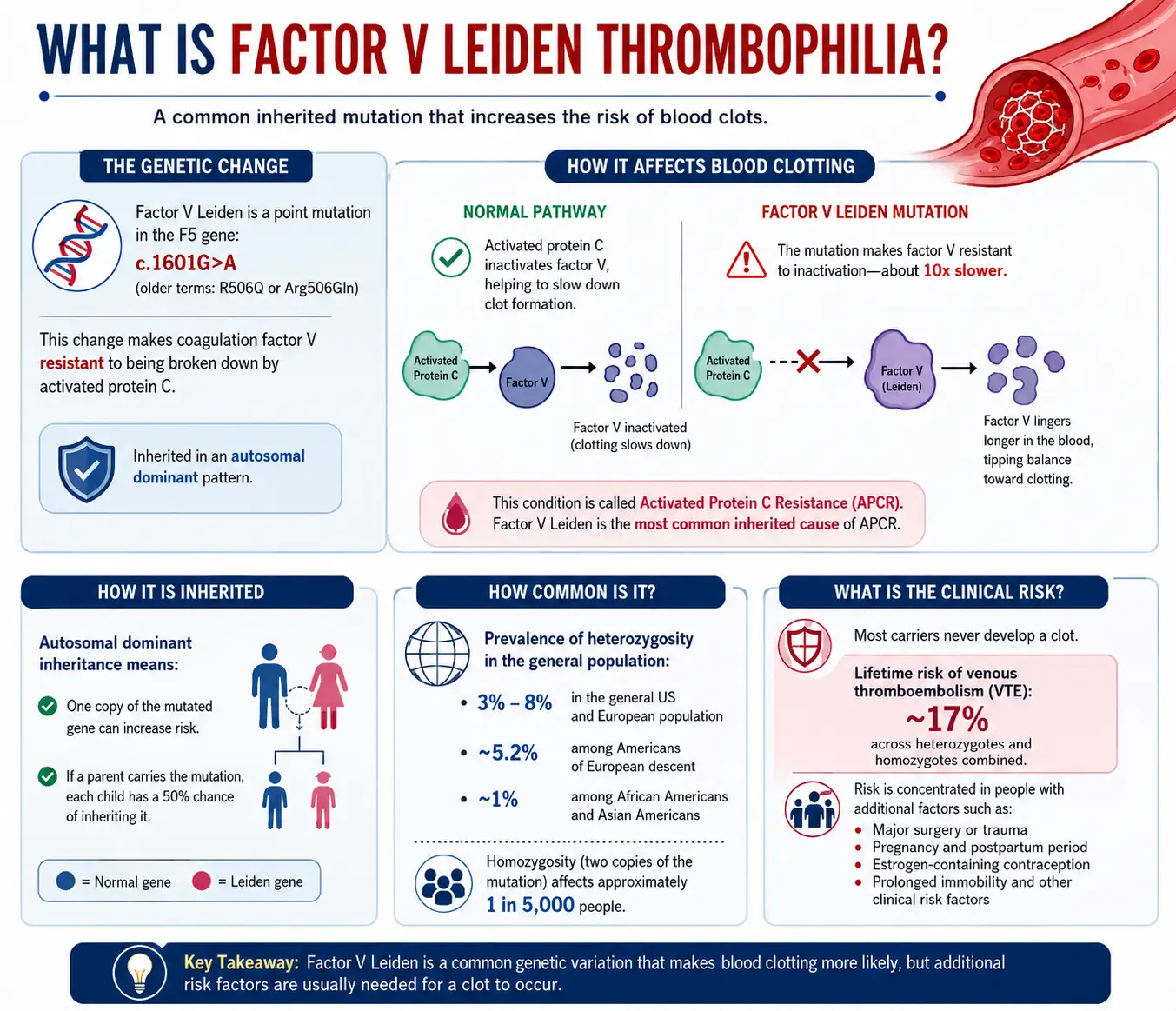
Factor V Leiden is a point mutation in the F5 gene, written in current nomenclature as c.1601G>A (older literature calls it R506Q or Arg506Gln), that makes coagulation factor V resistant to being broken down by activated protein C. Activated protein C normally limits clot formation by inactivating factor V. With the Leiden variant, that inactivation runs roughly tenfold slower, so factor V lingers in circulation and the blood tips toward a mildly hypercoagulable state. The lab finding on that pathway is called activated protein C resistance, and Factor V Leiden is its most common inherited cause by a wide margin.
The mutation is inherited in an autosomal dominant pattern and is common enough that most coders will see it on a chart sooner or later. According to GeneReviews, the clinical genetics reference maintained through the National Institutes of Health, heterozygosity runs between 3% and 8% of the general US and European population, with rates around 5.2% among Americans of European descent versus close to 1% among African Americans and Asian Americans. Homozygosity affects roughly 1 in 5,000 people. Most carriers never develop a clot; GeneReviews puts lifetime venous thromboembolism (VTE) risk at around 17% across heterozygotes and homozygotes combined, concentrated in people who also have surgery, pregnancy, or estrogen-containing contraception layered on top.
The Factor V Leiden ICD-10-CM code: D68.51
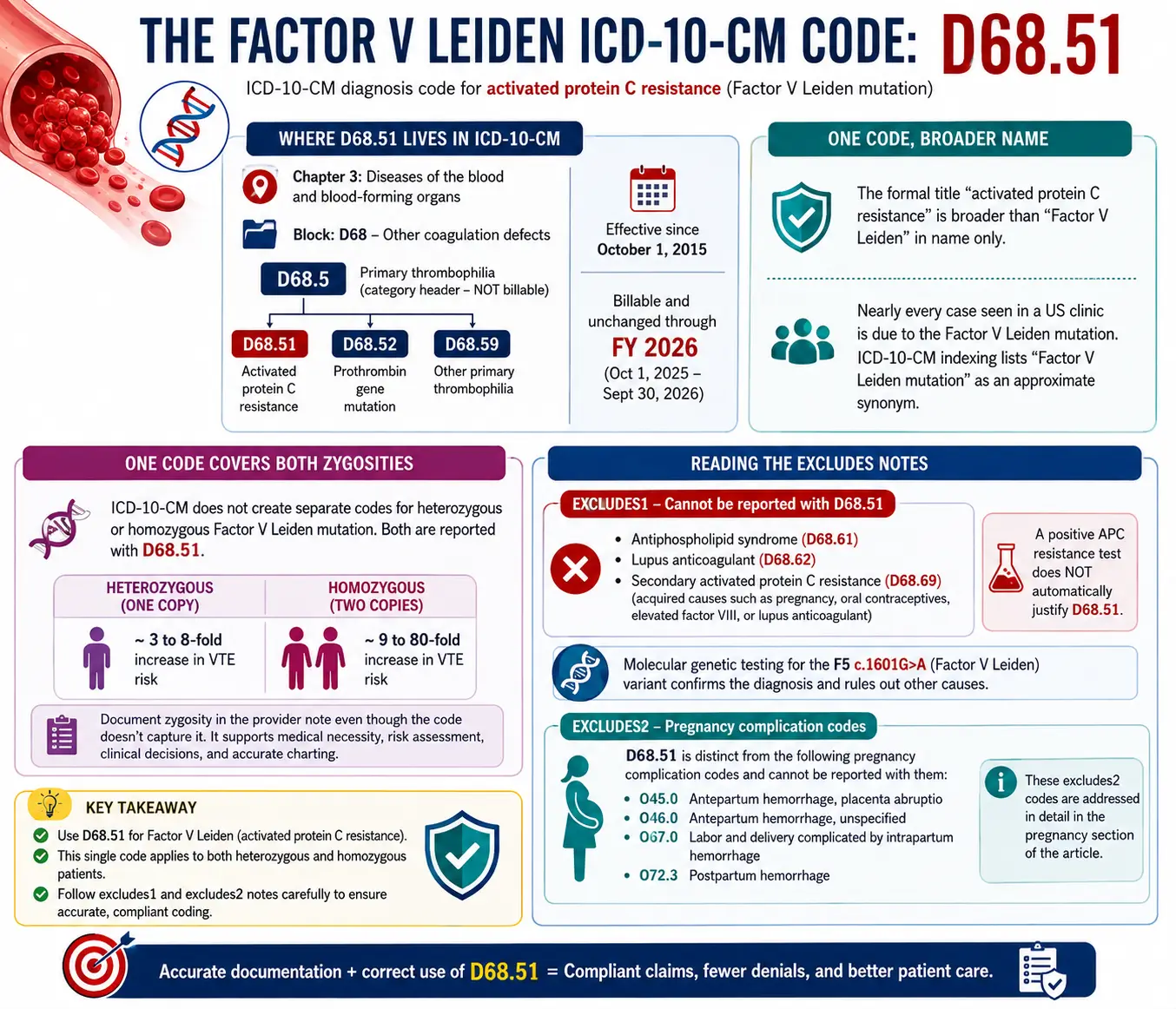
D68.51, activated protein C resistance, is the ICD-10-CM diagnosis code for the Factor V Leiden mutation. It sits inside category D68.5 (primary thrombophilia), part of the D68 block for other coagulation defects, in chapter 3, diseases of the blood and blood-forming organs. D68.5 alone is a category header and won’t process on a claim; billing requires one of its three children: D68.51, D68.52 (prothrombin gene mutation), or D68.59 (other primary thrombophilia). D68.51 has been part of ICD-10-CM since the code set launched on October 1, 2015, and remains billable and unchanged through fiscal year 2026 (October 1, 2025 through September 30, 2026).
The code’s formal title, activated protein C resistance, is broader than “Factor V Leiden” in name only. Nearly every case seen in a US clinic traces back to the Leiden variant, so the two terms function as synonyms in practice, and ICD-10-CM’s own indexing lists Factor V Leiden mutation as an approximate synonym.
One code covers both zygosities
Anyone searching for a heterozygous Factor V Leiden ICD-10 code, or a separate homozygous Factor V Leiden mutation ICD-10 code, will land on the same answer either way: D68.51. ICD-10-CM doesn’t split the diagnosis by allele count. That doesn’t make zygosity clinically irrelevant, though. GeneReviews cites roughly a three- to eightfold increase in VTE risk for heterozygotes, against estimates running from nine-fold to as much as eightyfold for homozygotes, and that gap shapes anticoagulation decisions, surgical risk assessment, and some of the payer rules covered later in this article. The provider’s note should still state the zygosity even though the code itself doesn’t capture it, both because it supports medical necessity for related services and because it keeps the chart clinically accurate.
Reading the excludes notes
D68.51 carries a long excludes1 list, meaning the listed conditions can never be reported alongside it because they represent a separate, mutually exclusive diagnosis: antiphospholipid syndrome (D68.61), lupus anticoagulant (D68.62), and secondary activated protein C resistance (D68.69), among others. That last one is easy to miss and worth flagging. Secondary, or acquired, APC resistance, meaning a low resistance result from something other than the Leiden mutation itself (pregnancy, oral contraceptives, elevated factor VIII, or lupus anticoagulant can all cause it), gets coded to D68.69, not D68.51. A positive APC resistance assay on its own doesn’t automatically justify D68.51; GeneReviews is specific that molecular genetic testing for the F5 c.1601G>A variant is what establishes the diagnosis and rules out these other causes of a low result.
A separate excludes2 note distinguishes D68.51 from a handful of pregnancy complication codes (O45.0, O46.0, O67.0, O72.3). That distinction gets its own explanation in the pregnancy section below, since it trips people up regularly.
Related thrombophilia codes coders confuse with D68.51
D68.51 sits in a cluster of similarly worded codes. The ones below get mixed up often enough to be worth a direct comparison, either because the diagnoses sound alike or because they share a lab testing panel.
Code | Description | When to use it |
D68.51 | Activated protein C resistance (Factor V Leiden) | Confirmed Factor V Leiden mutation, heterozygous or homozygous, or APC resistance the record attributes to that mutation |
D68.52 | Prothrombin gene mutation | F2 20210G>A variant; a different gene and a different lab test than Factor V Leiden |
D68.59 | Other primary thrombophilia | Confirmed protein C deficiency, protein S deficiency, antithrombin deficiency, or unspecified hypercoagulable state |
D68.61 | Antiphospholipid syndrome | Acquired autoimmune clotting disorder, not inherited |
D68.62 | Lupus anticoagulant syndrome | Positive lupus anticoagulant testing |
D68.69 | Other thrombophilia | Secondary (acquired) APC resistance or hypercoagulable state without the Leiden mutation itself |
The gap between D68.51 and D68.59 causes the most rework in practice. D68.59 covers genuinely different, confirmed deficiencies; it isn’t a default for a suspected-but-unconfirmed Factor V Leiden diagnosis. If molecular testing hasn’t resulted yet, a finding code such as R79.1 (abnormal coagulation profile) is usually the more defensible interim choice than guessing among the D68.5 family.
Coding family history and personal history of Factor V Leiden
Family history: Z83.2
When a patient is evaluated because a parent or sibling has Factor V Leiden, and that family history is the reason for the visit, the code is Z83.2, family history of diseases of the blood and blood-forming organs and certain disorders involving the immune mechanism. Z83.2 is billable and exempt from present-on-admission reporting, but it can’t stand alone as a principal or first-listed diagnosis. Coding Clinic guidance from the American Hospital Association also cautions against pulling a history code automatically from a chart’s family history module; the documentation needs to tie that family history to the actual reason for today’s encounter, not just list it as background.
Personal history and the “history of” trap
This is where otherwise careful coding tends to go wrong. The ICD-10-CM Official Guidelines (Section I.C.21.c.4) define personal history codes as covering a patient’s past condition that no longer exists, isn’t receiving treatment, but carries a potential for recurrence. Z86.2, personal history of diseases of the blood and blood-forming organs, exists and is billable. But Factor V Leiden is a permanent genetic finding, not a resolved illness the way a past pneumonia or a healed fracture is. If the mutation still affects how the patient is managed, whether that’s anticoagulation, contraceptive counseling, or preoperative risk assessment, D68.51 is the more accurate code, not Z86.2. A provider who writes “history of Factor V Leiden” without meaning to imply resolution can unintentionally steer a coder toward the wrong code family; documenting “Factor V Leiden, heterozygous, ongoing” keeps the chart and the claim aligned.
A different history code family, Z86.71 (personal history of venous thrombosis and embolism), with subcodes Z86.711 and Z86.718, covers something else entirely: a past clot the patient actually had, as distinct from the inherited tendency toward one. A patient can carry both codes at once. Someone with confirmed Factor V Leiden and a prior deep vein thrombosis, now stable off anticoagulation, may need D68.51 and a Z86.71-series code together, depending on what the visit addresses.
Coding Factor V Leiden during pregnancy
Pregnancy is where this topic trips up even experienced coders, largely because two chapters of the manual want a say in the same encounter.
Chapter 15 governs anything related to pregnancy, and its sequencing rule is explicit: chapter 15 codes take priority over codes from every other chapter. For a pregnant patient being monitored or treated because of Factor V Leiden, the first-listed code comes from category O99.11, other diseases of the blood and blood-forming organs complicating pregnancy, not D68.51. O99.11 branches by trimester: O99.111 for the first, O99.112 for the second, O99.113 for the third, and O99.119 when the trimester isn’t documented, a code worth avoiding if the chart supports something more specific. Childbirth gets O99.12, and the puerperium gets O99.13. The instructional note at O99.1 calls for an additional code to identify the specific condition, which is where D68.51 belongs, listed second.
A separate branch of codes, O45.0, O46.0, O67.0, and O72.3, covers coagulation defects when they actually cause a hemorrhagic complication (placental abruption, antepartum hemorrhage, intrapartum hemorrhage, or postpartum hemorrhage). Those sit under an excludes2 note relative to O99.1 for a reason: they describe a bleeding event the coagulation defect caused, not the underlying disorder being monitored during an otherwise uncomplicated pregnancy. Mixing the two up produces a code set that doesn’t match the clinical picture.
Clinical guidance, not just coding mechanics, informs a lot of that documentation. The American College of Obstetricians and Gynecologists addresses this in Practice Bulletin No. 197, Inherited Thrombophilias in Pregnancy, originally published in Obstetrics & Gynecology in July 2018 and reaffirmed in 2025. The American Society of Hematology’s 2018 venous thromboembolism guideline, led by Bates and colleagues in Blood Advances, draws a sharp line by zygosity: heterozygous carriers without a personal VTE history generally don’t need antepartum anticoagulation regardless of family history, while homozygous carriers, and patients with two different thrombophilia mutations, usually do. The absolute numbers back up that split. GeneReviews puts pregnancy-related VTE risk at roughly 1% for heterozygotes with no other risk factors, rising to about 3% with a positive family history, and at 2.2% to 4.8% for homozygotes. None of that changes which ICD-10-CM code applies, but it explains why the chart needs to state which one the patient has.
Documentation that supports the code
A confirmed diagnosis and a clean claim aren’t automatically the same thing. Payers and auditors look for specific details, and their absence is a preventable reason claims get returned. A note that supports accurate coding usually states:
- Zygosity (heterozygous or homozygous), as reported by the lab or the ordering provider
- How the diagnosis was established: molecular analysis of the F5 c.1601G>A variant versus a functional APC resistance assay, since the two carry different diagnostic weight
- Personal VTE history, including the type of event (DVT, PE, or an unusual site such as a cerebral or splanchnic vein) and whether it’s being actively managed
- Family history detail, connected explicitly to the current encounter
- Pregnancy status and trimester, or postpartum status, when relevant
- Current anticoagulation and the specific indication for it
- The reason for the visit: screening after a personal or family VTE, preoperative risk assessment, pregnancy planning, or contraceptive counseling, since that reason often determines which additional codes belong on the claim
CPT codes and payer coverage for Factor V Leiden testing
The lab test that confirms Factor V Leiden bills under CPT 81241, F5 (coagulation factor V) gene analysis, Leiden variant. It’s frequently ordered alongside CPT 81240, the prothrombin gene analysis for the F2 20210G>A variant, since the two inherited thrombophilias are often screened together. They aren’t interchangeable on a claim: 81241 pairs with the Factor V Leiden diagnosis (D68.51), and 81240 pairs with the prothrombin mutation diagnosis (D68.52). Billing one CPT code against the other condition’s diagnosis code is a mismatch that denies on its own.
Coverage for the test is narrower than many providers expect. Palmetto GBA, the Medicare Administrative Contractor that maintains Local Coverage Determination L36089 (MolDX: Genetic Testing for Hypercoagulability/Thrombophilia, revised effective July 20, 2023), treats routine Factor V Leiden and prothrombin testing as non-covered for most indications, including general cardiovascular risk assessment. The policy carves out an exception for pregnant patients with a personal history of VTE tied to a transient risk factor who aren’t already on anticoagulant therapy. Commercial payers publish comparable medical necessity criteria; a policy from Moda Health, for instance, excludes routine population screening, newborn or asymptomatic-child testing, and testing of asymptomatic first-degree relatives ordered solely to guide primary prophylaxis. None of that means the test can’t be billed successfully. It means the ordering documentation has to name which recognized indication applies, since family history alone, without more, often isn’t sufficient under these policies.
Coding errors that trigger denials
A short list accounts for most of the Factor V Leiden claims that come back unpaid:
- Reporting D68.5 alone. It’s a category header, not a billable code; only D68.51, D68.52, or D68.59 will actually process.
- Swapping CPT 81240 and 81241, or pairing either one with the wrong D68.5 diagnosis code.
- Defaulting to Z86.2 once a patient has been stable on anticoagulation for years. The mutation hasn’t gone anywhere, so D68.51 generally still belongs on the claim if it’s part of why the patient is managed the way they are.
- Sequencing D68.51 ahead of the pregnancy code. Chapter 15 codes have sequencing priority; O99.11- comes first, D68.51 second.
- Auto-populating Z83.2 from a family history module without documentation tying it to the current visit.
- Ordering CPT 81241 without recording one of the indications a payer’s policy actually recognizes.
Most of these share a root cause. The code itself is rarely the hard part. D68.51 is a single, stable entry that hasn’t changed since ICD-10-CM launched. What trips up claims is everything built around it: sequencing, history versus active status, and matching the CPT code to the diagnosis it was actually ordered to confirm. Getting those pieces right the first time is generally faster than fighting a denial after the fact.