


Medical coding accuracy directly impacts reimbursement rates and practice compliance. According to the Medical Group Management Association (MGMA), average practice denial rates hover between 7% and 11%, with lacking diagnostic specificity serving as a primary driver for rejected claims. For healthcare providers and medical billers documenting dorsalgia, the ICD 10 code for thoracic pain is frequently applied incorrectly. The Centers for Medicare and Medicaid Services (CMS) routinely audit claims for specificity. Inaccurate coding, particularly the reliance on symptom codes when definitive diagnoses exist, contributes to claim denials and delayed payments. Medical coders must understand the strict guidelines governing thoracic spine diagnoses to maintain accurate billing records.
Understanding the primary M54.6 diagnosis code
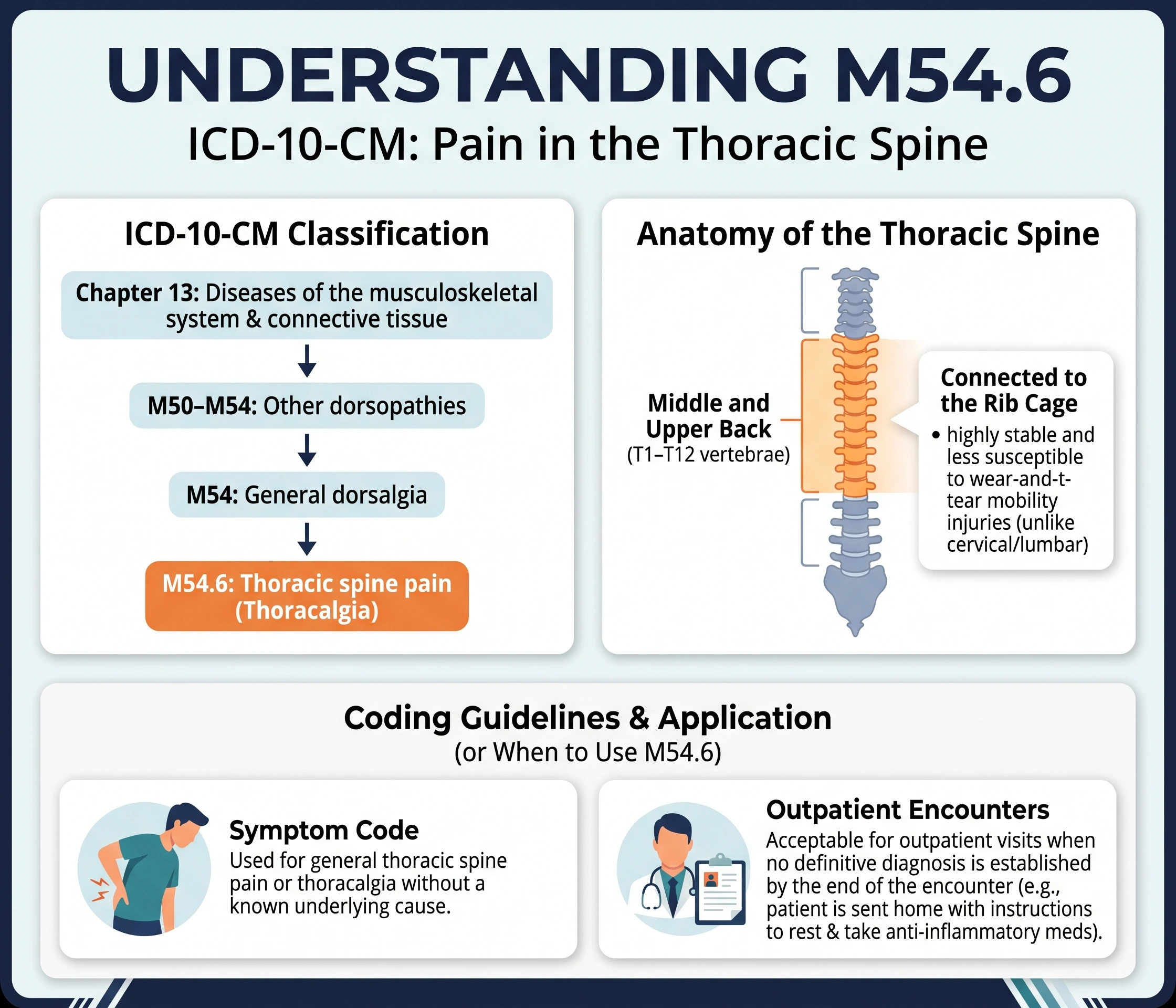
The official ICD-10-CM designation for pain in the thoracic spine is M54.6. This code falls under Chapter 13, Diseases of the musculoskeletal system and connective tissue. It belongs to the M50-M54 block for other dorsopathies, specifically categorizing under M54 for general dorsalgia.
The M54.6 diagnosis code describes pain occurring in the middle and upper back. This anatomical region contains the 12 thoracic vertebrae, designated T1 through T12. Unlike the cervical and lumbar regions, the thoracic spine connects to the rib cage, making it highly stable and less susceptible to the type of daily wear-and-tear mobility injuries seen in the lower back.
Coders apply the M54.6 ICD 10 code when a patient presents with thoracalgia ICD 10 or general thoracic spine pain without a known underlying cause. It functions strictly as a symptom code. According to the ICD-10-CM Official Guidelines for Coding and Reporting, symptom codes are acceptable for outpatient encounters when the physician has not established a definitive diagnosis by the conclusion of the patient visit. If a patient leaves the clinic with instructions to rest and take anti-inflammatory medication for unexplained mid back pain ICD 10, M54.6 is the correct primary diagnosis.
Excludes1 and Excludes2 notes for thoracic dorsalgia
Understanding the tabular list instructions prevents billing errors. The M54.6 diagnosis code description includes specific exclusions that coders must review before submitting a claim to clearinghouses.
An Excludes1 note dictates that two conditions cannot be billed together because they cannot logically occur at the same time. The ICD 10 code for thoracic back pain carries an Excludes1 note for pain due to intervertebral disc disorders. If the clinical documentation indicates the patient has pain caused by a thoracic disc disorder, the coder must use a code from category M51 instead of M54.6.
An Excludes2 note indicates that a specific condition is not part of the primary code, but a patient may possess both conditions simultaneously. If a patient experiences M54.6 pain in thoracic spine alongside another condition listed in the Excludes2 notes, the coder may report both codes on the same claim without triggering an automatic clearinghouse rejection.
Common errors when coding thoracic spine pain
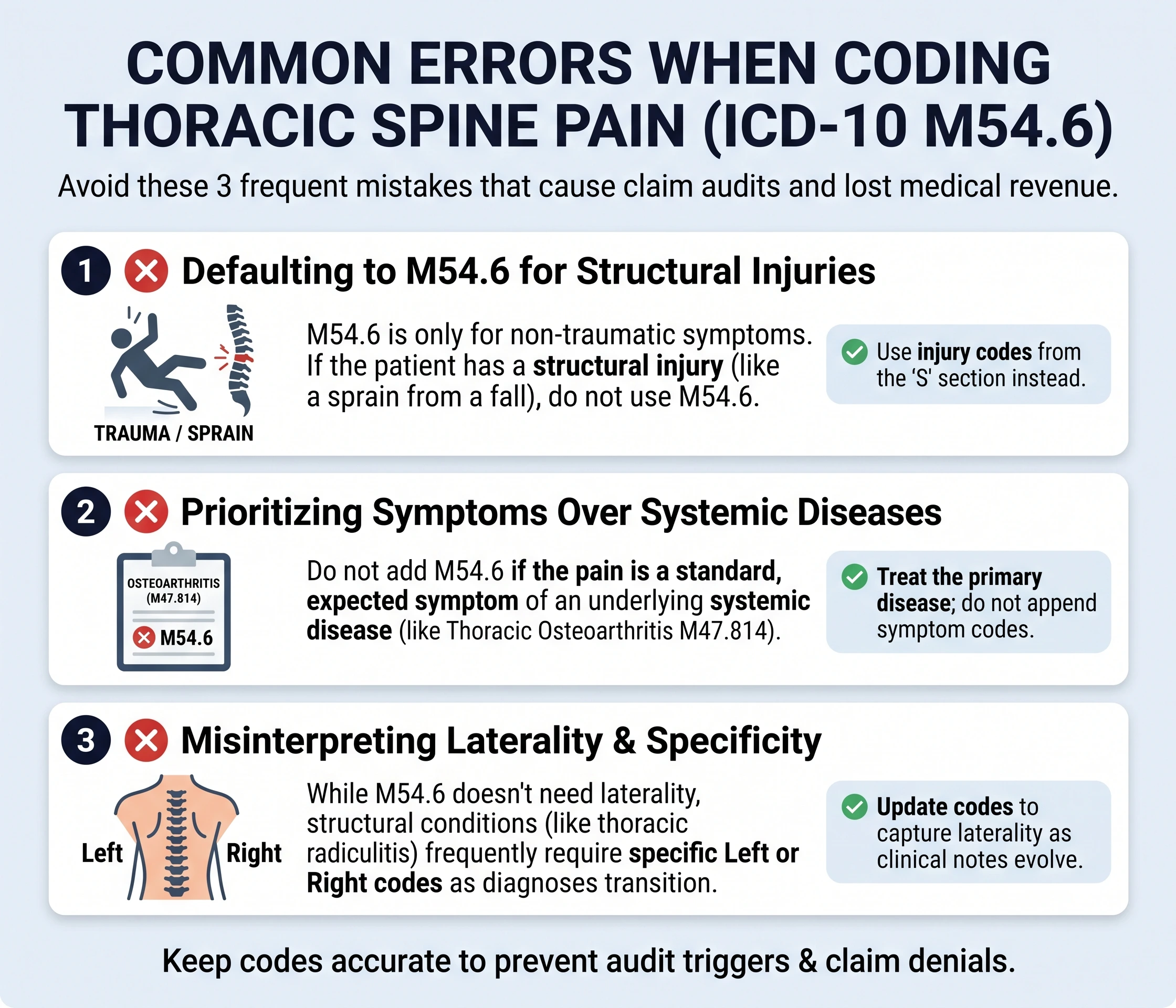
Medical practices lose revenue due to the improper application of the thoracic pain ICD 10 code. Coders frequently make specific categorization errors that trigger immediate audits.
The most frequent mistake is defaulting to the ICD 10 code thoracic pain when the physician documents a specific structural injury. The M54.6 DX code represents a non-traumatic symptom. If a patient experiences acute midline thoracic back pain ICD 10 following a physical fall and the provider diagnoses a sprain, M54.6 is incorrect. The coder must use an injury code from the S section of the manual.
Another frequent error involves prioritizing the symptom over a systemic disease. When a patient presents with osteoarthritis thoracic spine ICD 10 (M47.814) and complains of back pain, the coder should not append M54.6. The Official Guidelines state that a symptom code should not be assigned as an additional diagnosis when the symptom is routinely associated with the primary disease. Thoracic pain is a standard, expected symptom of thoracic osteoarthritis.
Coders also misinterpret laterality requirements. While M54.6 does not require a right or left designation, clinical notes often describe right thoracic pain ICD 10 or left thoracic pain ICD 10. If the specific diagnosis transitions from general pain to a structural issue like thoracic radiculitis ICD 10, the subsequent structural codes frequently require specific laterality characters.
Differentiating M54.6 from related injury codes
To avoid using the ICD 10 code for thoracic pain unspecified inappropriately, billers must recognize the correct alternatives for musculoskeletal injuries. Traumatic events require specific S-codes rather than M-codes.
Diagnosis Type | Correct ICD-10-CM Code | Clinical Requirement |
General Symptom | M54.6 (Pain in thoracic spine) | No known trauma or definitive underlying structural diagnosis. |
Muscle Injury | S29.012- (Strain of muscle and tendon of back) | Documented overstretching or tearing of paraspinal muscles. |
Ligament Injury | S23.3XX- (Sprain of ligaments of thoracic spine) | Documented stretching or tearing of spinal ligaments. |
Injuries to the muscles or tendons require a thoracic strain ICD 10 code. The coder must add a seventh character of A, D, or S to the base code S29.012 to indicate whether the visit is an initial encounter, a subsequent encounter, or a sequela. Using the ICD 10 code for thoracic muscle strain accurately reflects a traumatic event rather than general dorsalgia. Ligament injuries fall under a different category entirely. A thoracic spine sprain ICD 10 is reported with S23.3XXA for an initial encounter.
Documenting radiculopathy and nerve involvement
Thoracic radiculopathy ICD 10 reporting requires a distinct code structure. When pain radiates from the thoracic spine along a nerve root, the clinical presentation changes from simple dorsalgia to neurological impairment. The intercostal nerves run directly beneath the ribs, and compression of these nerves causes severe radiating pain.
The correct assignment for this condition is M54.14 (Radiculopathy, thoracic region). Submitting the ICD 10 code for thoracic radiculopathy justifies higher complexity evaluation and management (E/M) codes. It also supports medical necessity for specific treatments like intercostal nerve block injections or epidurals.
Using M54.6 in this scenario misrepresents the patient’s condition and frequently results in denials for neurodiagnostic testing like electromyography (EMG). If a physician documents thoracic pain with radiculopathy ICD 10, the radiculopathy code takes absolute precedence on the CMS-1500 form.
Handling complex presentations and thoracolumbar pain
Patients frequently present with pain that crosses exact anatomical boundaries. Pain occurring at the junction of the thoracic and lumbar spine (the T12-L1 region) requires careful review of the provider’s notes.
There is no single combination ICD 10 code for thoracolumbar pain caused by undetermined factors. Coders typically report M54.6 for the thoracic spine pain ICD 10 code and M54.50 for low back pain on the same claim. However, if the physician explicitly diagnoses a degenerative condition spanning both regions, such as M51.35 (Other intervertebral disc degeneration, thoracolumbar region), that single combination code replaces the separate symptom codes.
Degenerative disc disease presents another coding variable. A diagnosis of thoracic DDD ICD 10 is reported with M51.34 (Other intervertebral disc degeneration, thoracic region). The pain is inherent to the disc degeneration, rendering the separate use of thoracic pain ICD code M54.6 redundant and non-compliant.
Audit triggers and medical necessity denials
Health insurance companies utilize automated software algorithms to monitor claims containing the ICD-10-CM M54.6 diagnosis. Payer systems flag practices that overuse non-specific symptom codes across their patient panels.
Commercial insurers consider M54.6 a low-acuity diagnosis. It supports billing for initial patient evaluations, conservative pharmacological management, and basic physical therapy referrals. Medicare Administrative Contractors (MACs) routinely deny prior authorizations for advanced imaging (like MRI or CT scans) or surgical interventions if the only submitted diagnosis is pain in the thoracic spine ICD 10.
Advanced procedures require documentation of neurological deficits or structural abnormalities. Diagnoses such as thoracic stenosis ICD 10 (M48.04) establish a higher level of medical necessity. To secure approval for a thoracic MRI, the clinical documentation must support a specific structural or neurological code rather than a general pain symptom.
Specialty specific guidelines for chiropractors and physical therapists
Different medical specialties face specific billing rules regarding thoracic dorsalgia based on Local Coverage Determinations (LCDs) established by regional Medicare contractors.
Physical therapists treating thoracic stiffness ICD 10 or upper back pain ICD 10 frequently use M54.6 during the initial patient evaluation. The symptom code justifies the physical therapy assessment and the creation of a plan of care.
Chiropractors adjusting the thoracic spine use the ICD 10 code for pain in thoracic spine to describe the patient’s primary subjective complaint. However, Medicare rules strictly require chiropractors to document and code a spinal subluxation to justify reimbursement for Chiropractic Manipulative Treatment (CMT). The required billing sequence involves reporting the subluxation code, such as M99.02 (Segmental and somatic dysfunction of thoracic region), as the primary diagnosis. The M54.6 code is then listed as the secondary diagnosis to describe the specific symptom caused by that subluxation.
Accurate documentation strategies for medical billers
Medical billers can only assign codes based on explicit, written physician documentation. To support accurate upper back pain ICD 10 code assignment, clinical notes must provide specific details.
Providers must include the following elements in their clinical charts to avoid unspecified codes:
- Exact anatomical location: The documentation must explicitly state “thoracic”, “mid back”, or “upper back”. If a provider simply writes “back pain” without specifying the region, the coder must assign M54.9 (Dorsalgia, unspecified). Unspecified codes frequently trigger requests for medical records from insurance payers, delaying reimbursement by 30 to 60 days.
- Chronicity of the condition: ICD-10-CM does not provide a separate M54.6 code to distinguish chronic thoracic back pain ICD 10 from acute thoracic back pain ICD 10. The provider’s written notes regarding chronicity determine whether additional codes, such as G89.4 (Chronic pain syndrome), apply to the claim.
- Laterality details: Clear documentation of acute left-sided thoracic back pain ICD 10 or right-sided thoracic pain ICD 10 provides the medical necessity required for targeted pain management therapies, even if the primary M54.6 code does not require a laterality character.
Accurate assignment of the M54.6 ICD code requires reading past the initial patient intake complaint. Coders must review the entire medical record for underlying conditions, distinct traumatic injuries, and exact anatomical locations. Strict adherence to ICD-10-CM guidelines reduces audit risks, limits claim denials, and ensures healthcare facilities receive correct reimbursement for the care delivered.