


Healthcare facilities perform millions of electrocardiograms annually to evaluate cardiac function. When a physician interprets a tracing and identifies irregularities without confirming an underlying cardiac disease, medical billers rely on specific abnormal EKG ICD 10 codes to establish medical necessity. Properly applying these alphanumeric codes ensures accurate reimbursement and creates an exact clinical history for the patient.
The standard ICD-10-CM R94.31 abnormal electrocardiogram code
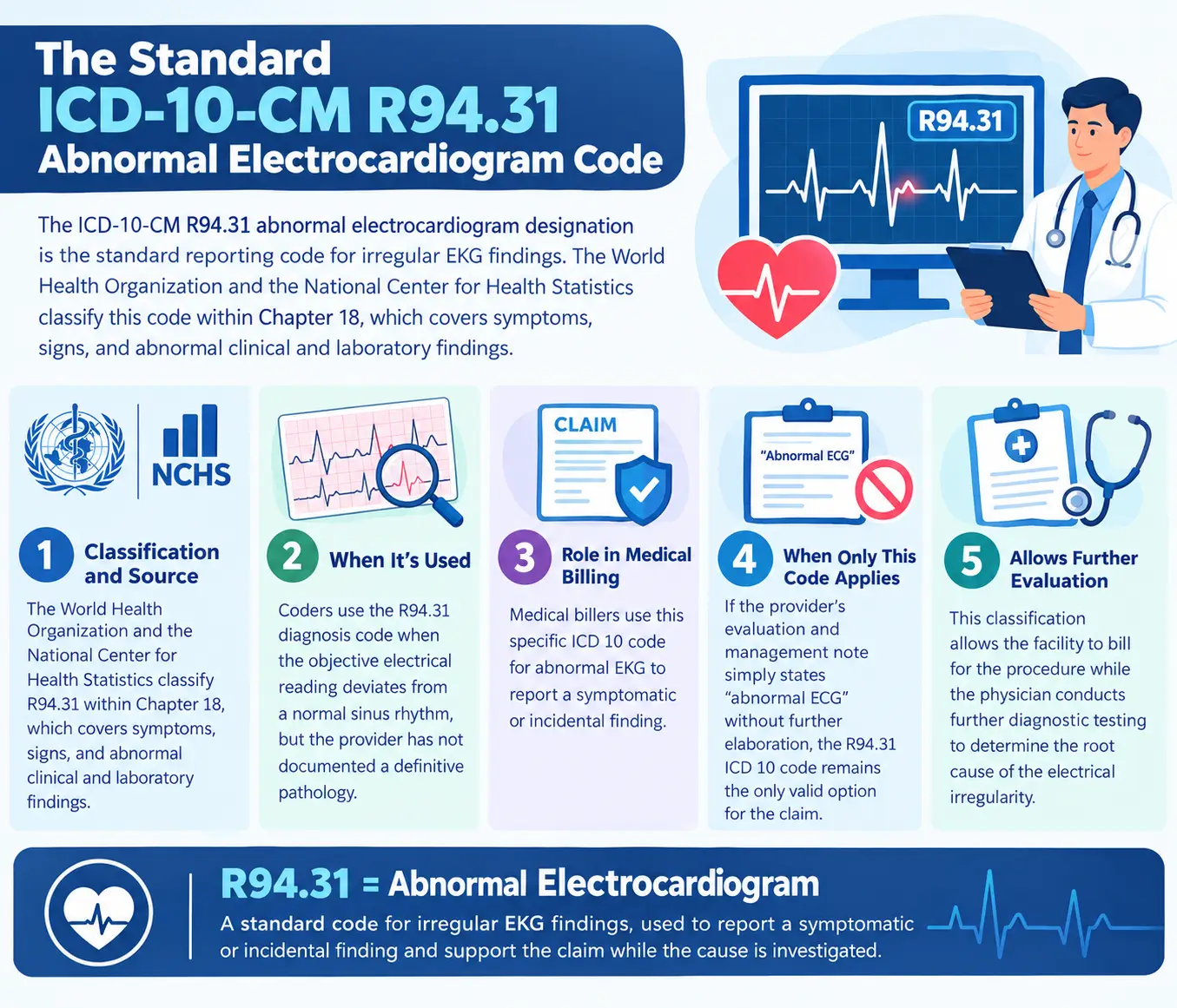
The ICD-10-CM R94.31 abnormal electrocardiogram designation is the standard reporting code for irregular EKG findings. The World Health Organization and the National Center for Health Statistics classify this code within Chapter 18, which covers symptoms, signs, and abnormal clinical and laboratory findings.
Coders use the R94.31 diagnosis code when the objective electrical reading deviates from a normal sinus rhythm, but the provider has not documented a definitive pathology. Medical billers use this specific ICD 10 code for abnormal EKG to report a symptomatic or incidental finding. If the provider’s evaluation and management note simply states “abnormal ECG” without further elaboration, the R94.31 ICD 10 code remains the only valid option for the claim. This classification allows the facility to bill for the procedure while the physician conducts further diagnostic testing to determine the root cause of the electrical irregularity.
Descriptive findings and the R94.31 diagnosis code
Physicians frequently document precise electrical variations on the tracing. The ICD-10 coding manual does not assign individual alphanumeric codes to every possible waveform fluctuation. Instead, it groups these descriptive machine outputs under a single classification. Billers must map these specific clinical terms back to the primary diagnosis code for abnormal EKG.
Repolarization variations and ST segment changes
The T wave on an electrocardiogram represents ventricular repolarization. When the medical record indicates a nonspecific T wave abnormality ICD 10, coders must assign R94.31. The coding guidelines do not provide a discrete ICD 10 code for nonspecific T wave abnormality. The same grouping applies to an ICD 10 code for nonspecific ST and T wave abnormality.
A T wave abnormality ICD 10 notation, including a T wave inversion ICD 10 or a T wave inversion in EKG ICD 10, strictly describes the shape of the electrical wave. Because this is a descriptive finding rather than a diagnosed disease, the ICD 10 code for T wave inversion defaults to R94.31.
Changes to the ST segment follow identical coding rules. If a physician records a nonspecific ST abnormality ICD 10, the coder searches for the ICD 10 code for nonspecific ST abnormality and finds it routed to R94.31. This applies to records indicating an ST and T wave abnormality ICD 10, ST depression ICD 10, ST segment depression ICD 10, or ST segment changes on electrocardiogram ICD 10. Unless the physician explicitly links these ST-T wave changes to active myocardial ischemia or an acute infarction, the findings remain classified as an abnormal finding on EKG ICD 10.
Axis deviations and voltage abnormalities
The QRS complex details ventricular depolarization. Like repolarization changes, variations in the QRS complex lack specific disease codes unless they result in a confirmed bundle branch block or ventricular hypertrophy.
A low voltage QRS ICD 10 finding frequently occurs due to patient anatomy, chronic obstructive pulmonary disease, or pericardial fluid. Because the machine outputs this as a numerical measurement, the low QRS voltage in precordial leads ICD 10 maps directly to R94.31. Similarly, poor R wave progression ICD 10 and left axis deviation ICD 10 describe directional electrical vectors. Without a confirmed clinical diagnosis attached to these vectors, they are classified as EKG abnormalities ICD 10.
Definitive diagnoses versus abnormal finding on EKG ICD 10
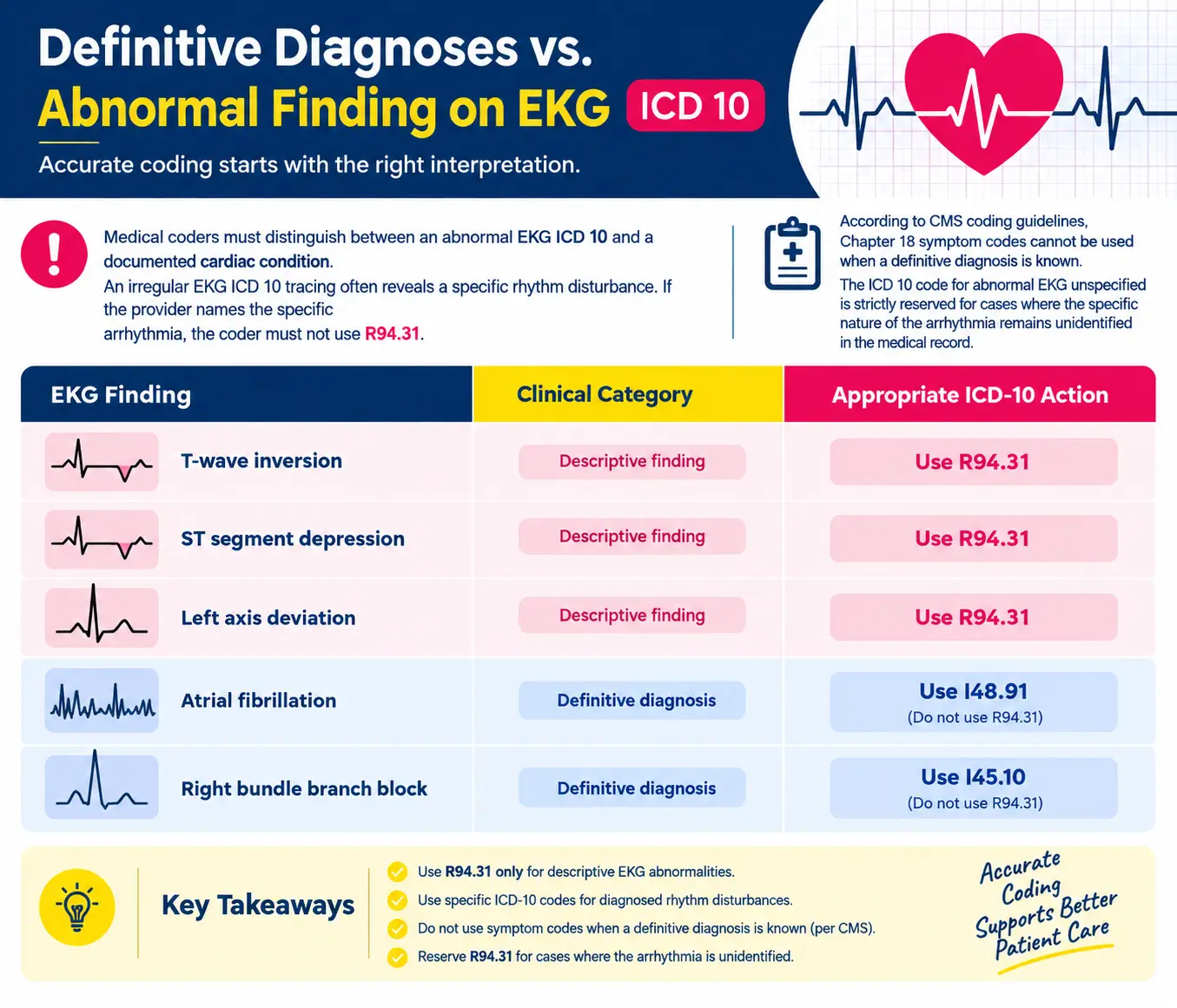
Medical coders must distinguish between an abnormal EKG unspecified ICD 10 and a documented cardiac condition. An irregular EKG ICD 10 tracing often reveals a specific rhythm disturbance. If the provider names the specific arrhythmia, the coder must not use R94.31.
According to the Centers for Medicare & Medicaid Services (CMS) coding guidelines, Chapter 18 symptom codes cannot be used when a definitive diagnosis is known. If an abnormal rhythm ECG ICD 10 shows atrial flutter, the biller reports I48.92. If the trace shows a first-degree atrioventricular block, the correct code is I44.0. The ICD 10 code for abnormal EKG unspecified is strictly reserved for cases where the specific nature of the arrhythmia remains unidentified in the medical record.
EKG Finding | Clinical Category | Appropriate ICD-10 Action |
T-wave inversion | Descriptive finding | Use R94.31 |
ST segment depression | Descriptive finding | Use R94.31 |
Left axis deviation | Descriptive finding | Use R94.31 |
Atrial fibrillation | Definitive diagnosis | Use I48.91 (Do not use R94.31) |
Right bundle branch block | Definitive diagnosis | Use I45.10 (Do not use R94.31) |
Preoperative and screening EKG coding guidelines
The rules for reporting an abnormal ECG ICD 10 change when the patient undergoes testing for surgical clearance or preventive care. In these scenarios, the primary diagnosis code must explain the reason for the encounter, not the result of the test.
Encounter codes for surgical clearance
Surgeons and anesthesiologists require electrocardiograms before administering general anesthesia. A preoperative EKG ICD 10 claim begins with a Z code. Coders use Z01.810 (Encounter for preprocedural cardiovascular examination) in the primary position.
If the tracing reveals irregularities, the coder appends the abnormal EKG diagnosis code (R94.31) in the secondary position. The preop EKG ICD 10 documentation must clearly link the Z code to the planned surgical procedure to justify the medical necessity of the test.
Preventive screening documentation
Preventive healthcare visits utilize a different set of encounter codes. A screening EKG ICD 10 uses Z13.6 (Encounter for screening for cardiovascular disorders). If this screening yields an EKG abnormality ICD 10, the biller places R94.31 after the screening code. Reporting an ICD 10 code for abnormal EKG findings as the primary diagnosis on a preventive visit often causes immediate claim rejections from commercial payers.
Coding for abnormal stress test results
Cardiology practices utilize exercise stress tests to evaluate coronary artery blood flow. The ICD 10 code for abnormal EKG results during a standard resting 12-lead test is R94.31. Exercise testing requires a different classification.
An abnormal stress ECG ICD 10 requires the use of R94.39 (Abnormal result of other cardiovascular function study). When a patient generates an abnormal stress test ICD 10, the provider is documenting the heart’s response to increased oxygen demand. A positive stress test ICD 10 indicates probable ischemia. If the physician documents ischemia but does not establish a diagnosis of coronary artery disease or angina pectoris, R94.39 accurately captures the finding.
Linking CPT and ICD-10 for EKG billing
Medical billers must correctly link the abnormal electrocardiogram ICD 10 code to the Current Procedural Terminology (CPT) codes to receive payment. The American Medical Association maintains the CPT and ICD-10 systems, and correct pairing prevents automated payer denials.
Component billing requirements
Standard resting 12-lead EKGs utilize three primary procedure codes.
- CPT 93000 reports the global service. This includes the equipment, the technician’s time, and the physician’s interpretation.
- CPT 93005 reports the technical component. This covers only the physical performance of the test and the generation of the tracing.
- CPT 93010 reports the professional component. This represents the physician’s written interpretation.
When billing CPT 93010 with the ICD 10 for abnormal EKG, the facility must ensure the physician provided a separate, formal interpretation.
Medical documentation standards
According to the Medicare Claims Processing Manual, a single sentence stating “EKG normal” or “abnormal ECG findings” in an evaluation and management progress note does not meet the requirements for billing the professional component.
The EKG procedure code requires specific medical documentation. A complete EKG diagnosis report must include at least three of the following elements:
- Heart rate and rhythm
- Electrical axis
- Measurement of the PR, QRS, and QT intervals
- Description of ST segments and T waves
- Comparison to a previous tracing
Without this detailed diagnosis documentation, payers classify the service as an overpayment during post-payment audits. The billing documentation must explicitly outline the abnormal ECG findings ICD 10 that justify the use of R94.31.
Navigating medical necessity and audit risks
Insurance companies actively monitor the use of the abnormal electrocardiogram code. Medicare Administrative Contractors publish Local Coverage Determinations outlining exactly which diagnosis codes support specific procedure codes.
While the ICD 10 code for abnormal electrocardiogram generally justifies an initial test, using it as the sole justification for multiple tracings on the same date of service triggers automated reviews. If a patient presents to the emergency department and requires serial testing to rule out a myocardial infarction, billers must apply appropriate modifiers, such as modifier 76 (Repeat procedure or service by same physician). The clinical notes must clearly state why the EKG changes required ongoing monitoring.
Additionally, the ICD-10-CM manual attaches Excludes1 notes to Chapter 18 codes. An Excludes1 note dictates that two specific codes cannot be billed together on the same claim. If a patient has a documented acute myocardial infarction (I21.-), billers cannot report R94.31. The definitive diagnosis code already accounts for the electrical abnormalities.
EKG coding compliance and record accuracy
Applying the correct abnormal EKG ICD 10 codes requires coders to interpret clinical data directly from the physician’s formal report. Finding a nonspecific T-wave abnormality, low voltage QRS, or poor R-wave progression directs the coder to R94.31, provided no definitive cardiac disease is present. Billers ensure timely payment by verifying that the written interpretation contains the required intervals and axis measurements before submitting the claim. Matching the exact EKG billing codes to the specific clinical findings protects the healthcare facility during payer audits and maintains accurate patient histories.