


Unintentional weight reduction frequently points to underlying systemic illness. Medical coders rely on specific diagnostic codes to capture this symptom when the root cause remains undetermined. The primary abnormal weight loss ICD-10 code bridges the gap between clinical observation and definitive diagnosis. Accurate application of this code ensures proper medical billing and establishes medical necessity for diagnostic testing. Medical billers, coders, and clinicians must align their documentation to meet the precise standards required by the Centers for Medicare and Medicaid Services (CMS) and private payers.
What is the ICD-10 code for abnormal weight loss?
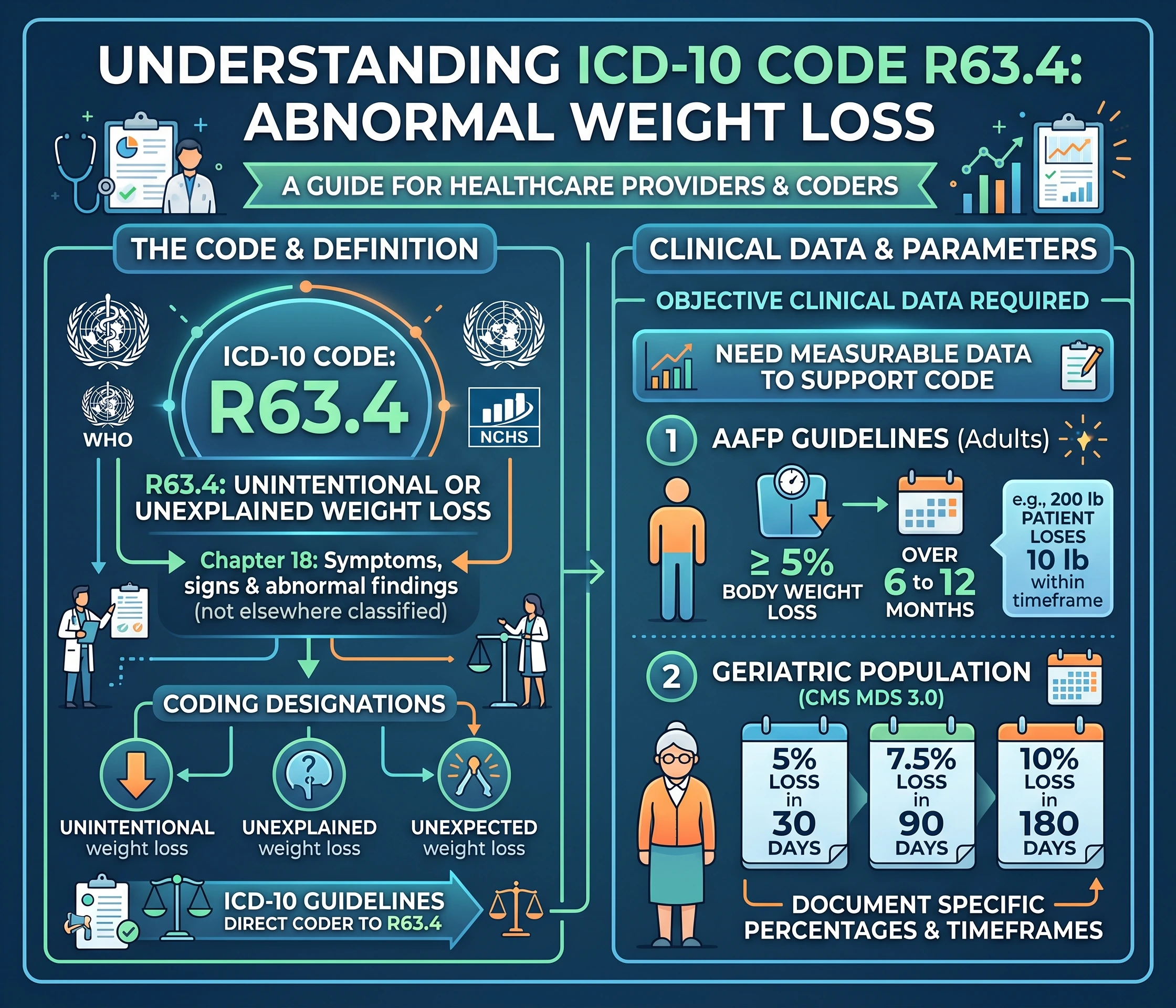
The correct ICD-10 code for abnormal weight loss is R63.4. The World Health Organization (WHO) and the National Center for Health Statistics (NCHS) classify this code under Chapter 18 of the manual (Symptoms, signs and abnormal clinical and laboratory findings, not elsewhere classified).
Specifically, R63.4 ICD-10 represents unintentional or unexplained weight loss. Coders use this designation when a patient loses a significant amount of weight without trying, usually before the physician diagnoses a specific underlying condition.
The R63.4 diagnosis code covers several overlapping clinical terms documented by providers. When a physician documents unintentional weight loss ICD-10 guidelines direct the coder to R63.4. The same applies for unexplained weight loss ICD-10 assignments, as well as unexpected weight loss ICD-10 mapping.
Clinical definitions of significant weight loss
Medical coding requires objective clinical data. Patients often report feeling lighter or state that their clothes fit loosely. However, clinical documentation needs measurable data to support the ICD-10-CM R63.4 abnormal weight loss code.
The American Academy of Family Physicians (AAFP) defines clinically significant weight loss ICD-10 parameters as a drop of 5 percent or more in body weight over a period of six to 12 months. For a 200-pound patient, a 10-pound loss within this timeframe warrants medical evaluation and justifies the use of the code.
In geriatric populations, the diagnostic criteria become stricter. Nursing home guidelines outlined by CMS in the Minimum Data Set (MDS 3.0) define significant weight loss as a 5 percent loss in 30 days, a 7.5 percent loss in 90 days, or a 10 percent loss in 180 days. Documenting these specific percentages and timeframes protects the facility during chart audits.
Medical necessity and diagnostic testing under R63.4
When R63.4 appears on a CMS-1500 claim form, it communicates to payers that the physician is actively investigating a symptom. Because rapid weight loss ICD-10 mapping points to potential malignancies, endocrine disorders, or gastrointestinal diseases, this symptom code justifies a wide array of diagnostic procedures.
Payers generally accept R63.4 as medical necessity for baseline laboratory tests. These include Complete Blood Counts (CBC), Comprehensive Metabolic Panels (CMP), and Thyroid Stimulating Hormone (TSH) screenings. If the physician suspects an occult malignancy, the weight loss diagnosis code can also support the medical necessity for imaging studies, such as computed tomography (CT) scans of the abdomen and pelvis. Medicare Administrative Contractors (MACs) publish Local Coverage Determinations (LCDs) that outline the exact Current Procedural Terminology (CPT) codes supported by R63.4.
What documentation supports abnormal weight loss?
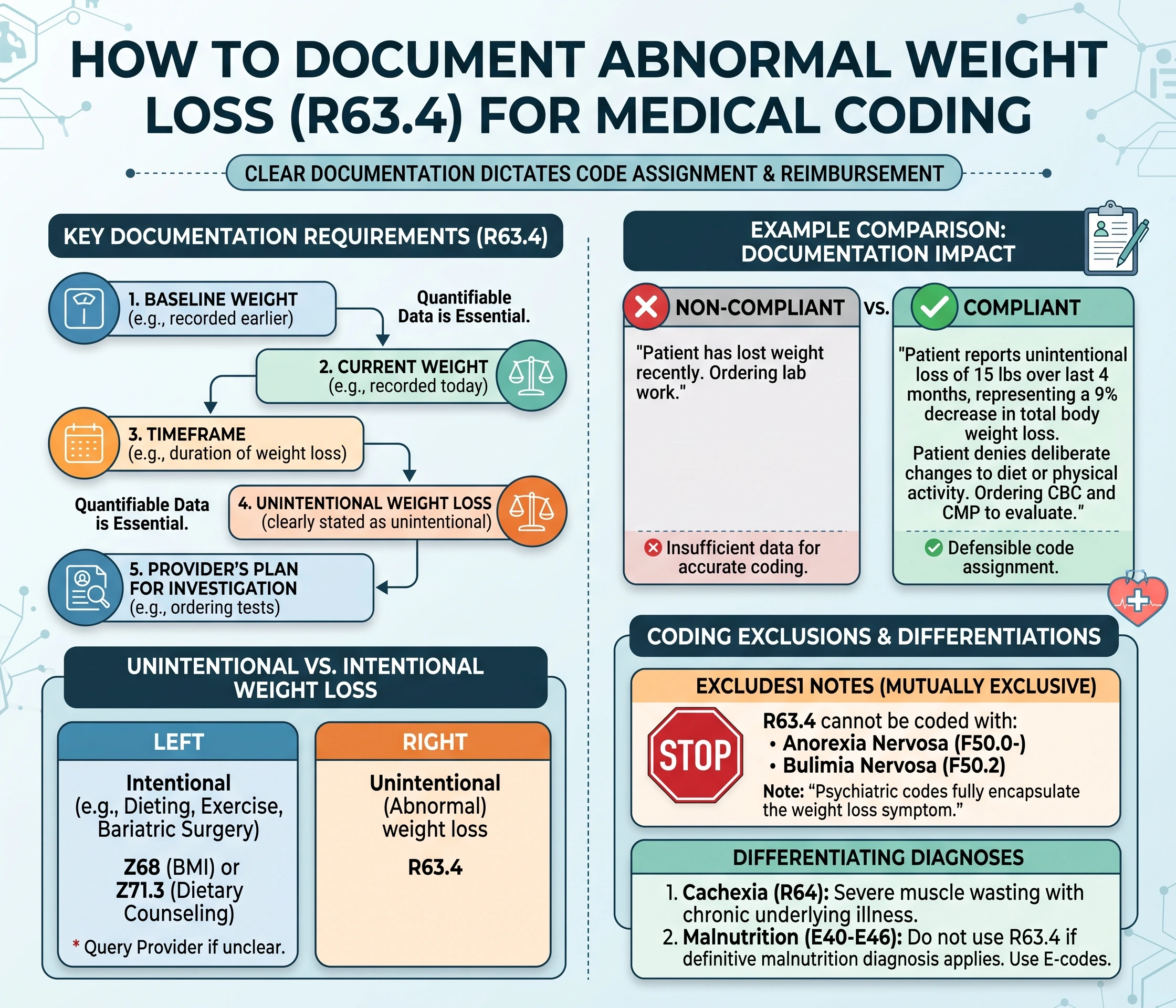
Clear documentation directly dictates code assignment and claim reimbursement. Medical billers cannot extract a diagnosis based solely on vitals flowsheet data. The provider must explicitly state the condition in the clinical note.
How should abnormal weight loss be documented for coding? To assign the code defensibly, the medical record must contain specific quantitative elements.
The initial assessment must record the patient’s baseline weight and the current weight. The provider needs to specify the timeframe over which the weight loss occurred. The documentation must clearly state the weight loss was unintentional. Finally, the note should detail the provider’s plan for investigating the symptom.
Consider the difference between non-compliant and compliant documentation:
- Non-compliant: “Patient has lost weight recently. Ordering lab work.”
- Compliant: “Patient reports unintentional loss of 15 lbs over the last 4 months, representing a 9% decrease in total body weight loss. Patient denies deliberate changes to diet or physical activity. Ordering CBC and CMP to evaluate.”
If a physician simply writes “weight loss” without qualifying it as abnormal or unintentional, a coder should query the provider for clarification. Intentional weight loss achieved through diet, exercise, or bariatric surgery falls under a different coding category entirely, typically Z68 (Body mass index) or Z71.3 (Dietary counseling and surveillance).
Excludes1 and Excludes2 notes for R63.4
ICD-10-CM guidelines specify particular exclusions for R63.4. An Excludes1 note means two conditions cannot be coded together under any circumstances because they represent mutually exclusive conditions.
For R63.4, abnormal weight loss related to anorexia nervosa (F50.0-) or bulimia nervosa (F50.2) triggers an Excludes1 edit. A patient actively restricting calories due to a psychiatric condition does not qualify for the R63.4 symptom code. The psychiatric codes fully encapsulate the weight loss symptom.
What is R63.4 compared to similar diagnoses? Other related but distinct codes require careful differentiation. Cachexia (R64) is a metabolic syndrome associated with underlying chronic illness, characterized by severe muscle wasting. If the provider documents malnutrition, coders must look to the E40-E46 block. R63.4 should not replace a definitive malnutrition diagnosis when clinical indicators support the E-codes.
Abnormal weight loss ICD-10 coding guidelines and sequencing rules
How do you code abnormal weight loss when a definitive diagnosis exists? The Official Guidelines for Coding and Reporting dictate specific sequencing rules for symptom codes. Chapter 18 codes are acceptable for reporting purposes when a related definitive diagnosis has not been established by the provider.
If the physician diagnoses a definitive condition causing the weight loss, such as hyperthyroidism (E05.90) or a malignant neoplasm (C00-C96), the underlying condition becomes the principal diagnosis.
If the symptom is an integral part of the disease process, you do not assign R63.4. For example, severe weight loss is a standard expectation in late-stage untreated cancer. However, if the weight loss is not routinely associated with the definitive diagnosis, the coder may report R63.4 as an additional secondary diagnosis.
Inpatient versus outpatient coding applications
Coding applications differ based on the healthcare setting. In the outpatient clinic setting, coders assign R63.4 when the patient presents with the symptom and leaves the office without a confirmed diagnosis. Section IV.H of the ICD-10-CM guidelines prohibits outpatient coders from reporting probable, suspected, or rule-out conditions. In these cases, the coder must report the symptom code rather than the suspected disease.
The rules shift for facility billing. In the inpatient hospital setting, if a patient is admitted for abnormal weight loss and the discharge summary lists a suspected diagnosis, inpatient coders assign the code for the suspected condition as if it were established. R63.4 acts as the principal diagnosis only if no underlying cause was suspected by the attending physician at the time of discharge.
Hierarchical condition categories (HCC) and risk adjustment
Medicare Advantage plans and Accountable Care Organizations (ACOs) rely on the HCC risk adjustment model to predict future healthcare costs. Diagnoses are mapped to specific HCCs, which carry risk adjustment factor (RAF) scores.
R63.4 does not map to an HCC category. As a symptom code, it carries no risk-adjusted payment weight. This operational fact requires providers to aggressively investigate the root cause of the unintentional weight loss. Once the underlying cancer, severe malnutrition, or advanced diabetes is identified and coded, the patient’s RAF score will accurately reflect their true clinical disease burden. Relying on R63.4 for extended periods without a definitive workup leads to under-representation of patient acuity.
Common errors in coding body weight loss
Auditors frequently identify recurring errors surrounding the ICD-10 code for unintentional weight loss.
One persistent error involves defaulting to malnutrition codes (E40-E46) based solely on a low body mass index (BMI). Malnutrition requires specific clinical indicators, such as subcutaneous fat loss and specific lab values, along with a direct provider statement. Coders cannot diagnose malnutrition independently.
Similarly, low body weight (R68.89) or underweight (R62.51 for children, Z68.1 for adults with a BMI less than 19.9) codes often get mixed up with R63.4. A patient can have a low body weight without experiencing recent, abnormal weight loss. Can R63.4 be used for unexplained weight loss? Yes, but it requires a documented recent drop in mass, not just a baseline low mass.
Failing to link related symptoms can artificially inflate the code count without adding clinical clarity. Symptoms like poor appetite, loss of appetite, and decreased oral intake (R63.0) frequently accompany weight loss. If the provider links anorexia and weight loss to a single underlying condition, the definitive condition dictates the coding strategy. If they remain unexplained, both symptom codes may be reported, provided they are explicitly documented.
Clinical scenarios and practical application
Consider a 72-year-old male presenting to his primary care physician. His chart shows a weight of 185 pounds six months ago. Today, he weighs 165 pounds. The physician documents: “Patient presents with a 20-pound weight loss over 6 months. Patient states his appetite is normal and he has not started any exercise routines. Workup initiated for potential gastrointestinal pathology. Ordering colonoscopy and abdominal CT.”
In this scenario, the primary diagnosis code for the encounter is R63.4. The physician provided the baseline weight, current weight, timeframe, and intent. Because the gastrointestinal pathology is only suspected at this stage, the outpatient coder cannot assign a specific GI disease code. R63.4 accurately reflects the patient’s presentation and justifies the imaging and procedures ordered by the physician.
Assigning the correct abnormal weight loss ICD-10 code directly affects the tracking of patient health deterioration and secures authorization for subsequent diagnostic panels. Providers must supply exact baseline weights, current weights, and specific timeframes to substantiate the designation. When billers strictly follow the Excludes notes and sequence underlying conditions according to official ICD-10-CM guidelines, healthcare organizations face fewer claim denials and clinical data remains precise for patient care.